Constituent Assembly of India: Background, Composition & Committees

Gajendra Singh Godara
15
mins read
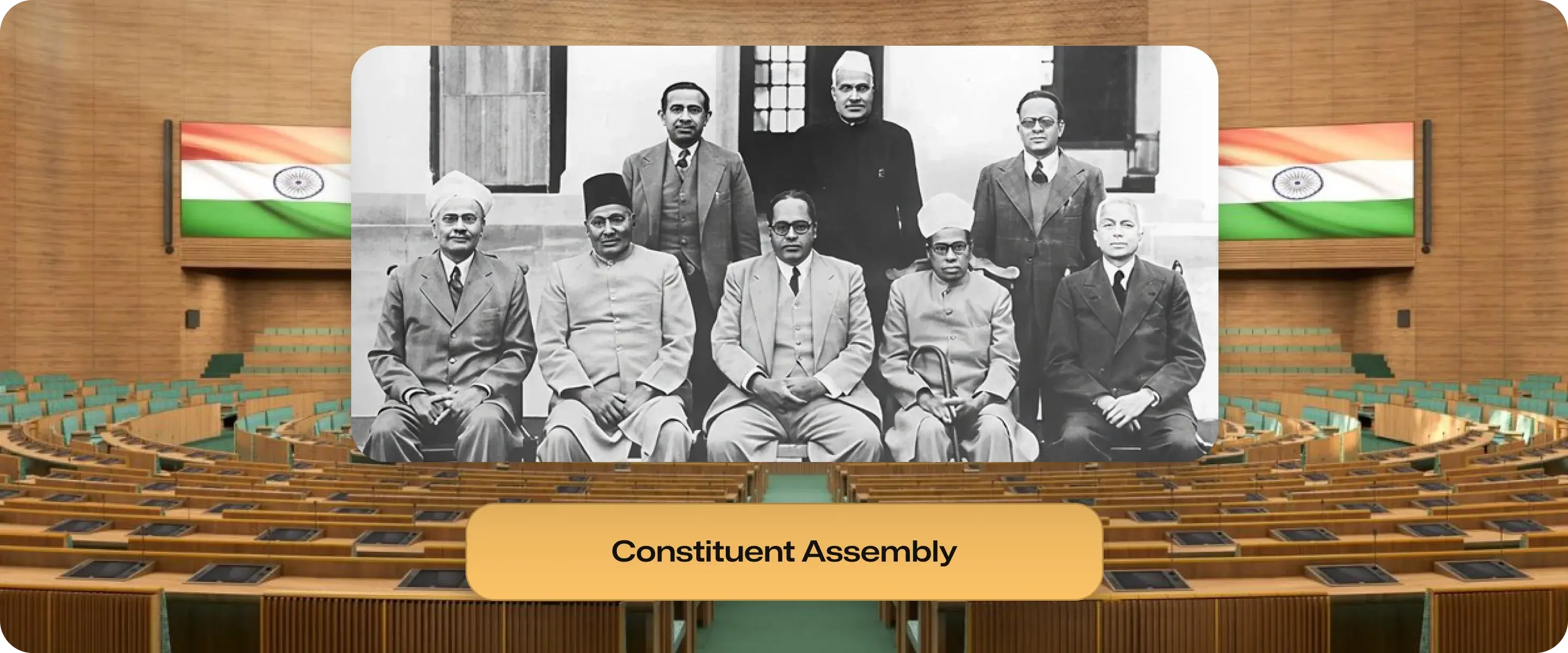
The Constituent Assembly was the specially elected body that drafted India’s Constitution. Established in 1946 after World War II, it was a 389-member assembly responsible for framing India’s future government. Its very purpose was to replace colonial rule with a home-grown “people’s constitution.” After the war, the British Cabinet Mission Plan (1946) put this into practice. In the end, the Assembly’s work (1946–1950) laid the cornerstone of independent India’s democracy and republic.The document's fundamental principles were shaped by the Assembly's extensive discussions on federalism, fundamental rights, and governance, which were led by notable individuals such as Jawaharlal Nehru, Dr. B.R. Ambedkar, and Sardar Vallabhbhai Patel.
Historical Background of Constituent Assembly of India
M.N. Roy’s Proposal (1934)
The very concept of a Constituent Assembly dates to the 1930s. In 1934, Manabendra Nath Roy (M.N. Roy) became the first to formally demand a constituent assembly for India. He argued that India needed a “people’s constitution” drafted by its own people, not handed down by Britain.
Congress Endorsement and Nehru’s Leadership (1935–1939)
By 1935 the Indian National Congress had adopted the goal of a Constituent Assembly.
In November 1938, Jawaharlal Nehru famously declared that “the Constitution of free India must be framed, without outside interference, by a Constituent Assembly elected on the basis of the adult franchise”.
Mahatma Gandhi also emphasized self-reliance, famously stating that “Swaraj will not be a free gift of the British Parliament”, underscoring that Indian independence would have to be won by Indians themselves.
August Offer (1940) and the Muslim League’s Position
During WWII, the British government issued the August Offer (1940), which for the first time accepted the principle that Indians would draft their own constitution after the war. It proposed a future Constituent Assembly and promised safeguards for Muslim and other minority interests.
The Muslim League, however, was cautious. It noted the promise of minority safeguards but insisted on even stronger guarantees, ultimately using the offer’s shortcomings to push for a separate nation.
Join our WhatsApp Community
The Cabinet Mission Plan, 1946
In early 1946 a British Cabinet Mission set out the framework for India’s transition. The Mission recommended forming a Constituent Assembly of 389 members. Seats were apportioned roughly one per million people. This meant 296 seats for British India (292 in provinces plus 4 in chief-commissioner provinces) and 93 seats for the Princely States.
The plan reserved seats in each province by community (Muslims, Sikhs, and General/non-Muslims) according to population. Importantly, members were not directly elected by all adults. Instead, provincial legislative assemblies (which were themselves elected by a limited electorate) chose the Constituent Assembly members by proportional representation (single transferable vote).
The Princely States did not vote; their rulers nominated delegates.
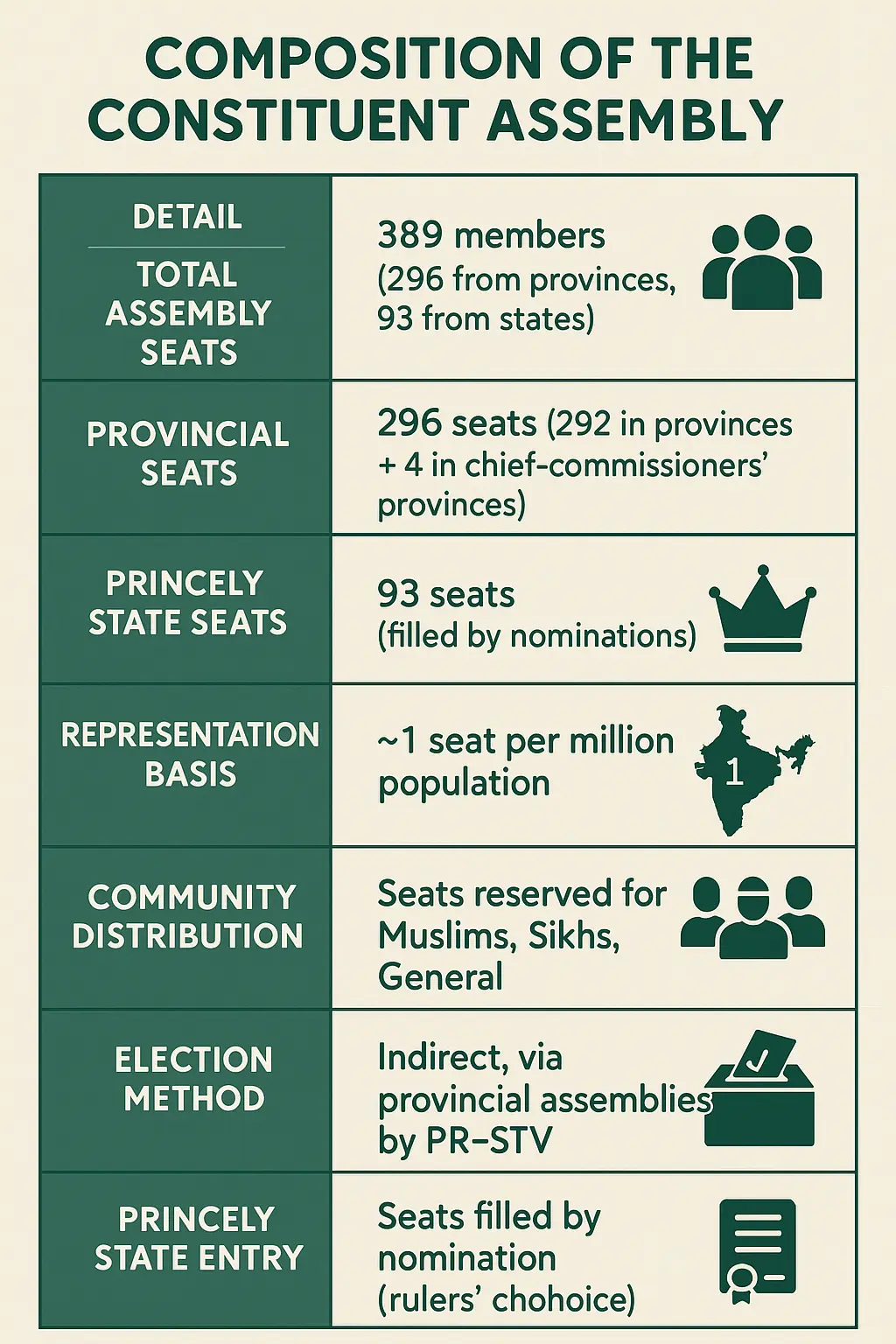
Composition of the Constituent Assembly | |
Key Provision | Detail |
Total Assembly Seats | 389 members (296 from provinces, 93 from states) |
Provincial Seats | 296 seats (292 in provinces + 4 in chief-commissioners’ provinces) |
Princely State Seats | 93 seats (filled by nominations) |
Representation Basis | ~1 seat per million population |
Community Distribution | Seats reserved for Muslims, Sikhs, General |
Election Method | Indirect, via provincial assemblies by PR–STV |
Princely State Entry | Seats filled by nomination (rulers’ choice) |
Thus, under the 1946 plan, a 389-member Constituent Assembly was formed. Only provincial legislators (a limited electorate) voted, and Communal representation was built in. No national adult franchise election took place.
Representatives from the regions that became Pakistan left the Assembly following its partition in August 1947. The number of members dropped from 389 to 299, with 70 coming from princely states and 229 from British Indian provinces.
Membership of the Constituent Assembly
Membership was partly elected (from provincial assemblies) and partly nominated (by the rulers of states). Delegates came from all major communities: Hindus formed the large majority, but Muslims, Sikhs, Christians, Parsees, Scheduled Castes, Scheduled Tribes and others also had seats. Women had 15 seats (about 4%).
Congress held roughly two-thirds of the seats (about 69% of 296 seats in 1946, rising to 82% after partition). But despite Congress’s large share, members spanned many ideologies: conservatives and traditionalists alongside socialists, liberals, Marxists and others. This is why historian Granville Austin called it “India in microcosm”.
Add as a preferred Source on Google
Elections of 1946 : Results and Representation
Provincial elections in early 1946 set the stage for the Assembly. Congress candidates won 208 of the 296 provincial seats; the Muslim League won 73; and other parties (Communists, Akali Dal, etc.) won the remaining 15. The Princely States’ 93 seats were initially left vacant and later filled by nomination.
These indirectly chosen delegates included freedom fighters, lawyers, educators, social workers and rural leaders, giving the Assembly a wide social base. Notably, Mahatma Gandhi did not join the Assembly. He intentionally stayed out of the elections and constitutional process, feeling his role was elsewhere (to quell communal violence and uphold moral authority)
Despite indirect elections, the Assembly included members from every significant community. Congress itself was not monolithic – it contained members ranging from moderate conservatives to radicals.
The First Meeting and Key Milestones
The Constituent Assembly of India was first convened on 9 December 1946 at New Delhi’s Legislature House.
The Muslim League had boycotted this opening session, so delegates present were mainly Congress-led. J.B. Kripalani, the Assembly’s Secretary, elected Dr. Sachchidananda Sinha (the eldest member) to become the Provisional President of the Constituent Assembly.
Two days later, on 11 December 1946, Dr. Rajendra Prasad was formally elected as the permanent President of the Assembly.
One of the Assembly’s first acts was to introduce the “Objective Resolution” on 13 December 1946. Presented by Nehru, it laid out the guiding principles of the future constitution (including sovereignty of the people, justice, liberty and equality). The aim was establishing Constitutionalism.
The Objective Resolution was debated and finally adopted on 22 January 1947. Other milestones followed: the Assembly adopted the new national flag on 22 July 1947 (just before independence) and remained busy through Independence Day (15 August 1947).
On 29 August 1947, the Assembly appointed the Drafting Committee under Ambedkar. After nearly three years of discussion, the full Assembly adopted the Indian Constitution on 26 November 1949.
The Constitution of India was signed by members of the constituent assembly on 24 January 1950. The Constituent Assembly elected Dr. Rajendra Prasad as the first President of India and adopted the National anthem and National song.
Impact of the Indian Independence Act, 1947
The Indian Independence Act of 1947 radically changed the Assembly’s status. On 15 August 1947 India became a sovereign Dominion, and the Constituent Assembly of India became fully sovereign for India. It could frame any constitution it wished and even repeal British laws.
The Assembly also assumed a dual role as the provisional Parliament of India, passing laws until elections. After partition, 299 members of the new (Indian) Assembly remained and continued to meet.
Dr. Rajendra Prasad served as the Assembly’s President throughout this period. In its legislative role, the Assembly elected G. V. Mavalankar as Speaker to preside over its debates.
Women in the Constituent Assembly
Women’s representation in the Assembly was very limited: 15 women were members of the constituent assembly in 1946. These women were diverse in background and region, as shown below:
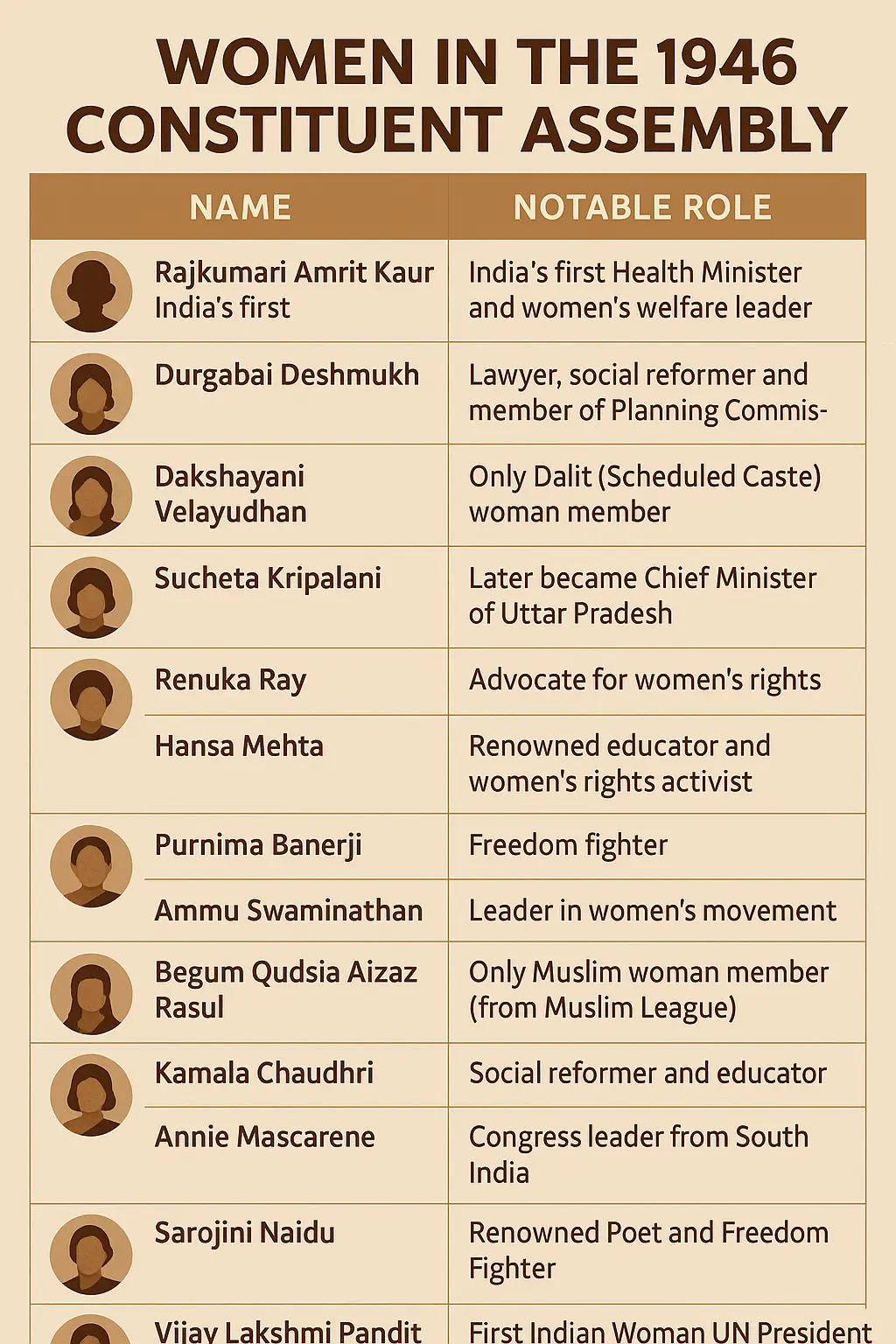
Name | Notable Role |
Rajkumari Amrit Kaur | India’s first Health Minister and women’s welfare leader |
Durgabai Deshmukh | Lawyer, social reformer and member of Planning Commission |
Dakshayani Velayudhan | Only Dalit (Scheduled Caste) woman member |
Sucheta Kripalani | Later became Chief Minister of Uttar Pradesh |
Renuka Ray | Advocate for women’s rights |
Hansa Mehta | Renowned educator and women’s rights activist |
Purnima Banerji | Freedom fighter |
Ammu Swaminathan | Leader in women’s movement |
Begum Qudsia Aizaz Rasul | Only Muslim woman member (from Muslim League) |
Kamala Chaudhri | Social reformer and educator |
Annie Mascarene | Congress leader from South India |
Sarojini Naidu | Renowned Poet and Freedom Fighter |
Vijay Lakshmi Pandit | First Indian Woman UN President |
Leela Roy | Bengal’s only Female Member |
They formed only about 5% of the Assembly, a fact noted by contemporaries. Despite their small number, they were active in debates on fundamental rights, minority rights, and social reform.
Committees of the Constituent Assembly
The Assembly did most of its work through specialized committees. In total 22 committees were appointed (8 major ones and several sub-committees). Key committees and their leaders included:
Union Powers Committee – chaired by Jawaharlal Nehru (on division of powers between center and states)
Union Constitution Committee – Jawaharlal Nehru (on structure of central government)
States Committee – Jawaharlal Nehru (relations between center and states)
Provincial Constitution Committee – Vallabhbhai Patel (structure of provinces)
Drafting Committee – B. R. Ambedkar (prepared and revised the text of the Constitution)
Fundamental Rights Committee – Vallabhbhai Patel (with sub-committee on minorities and tribal areas)
Rules of Procedure Committee – Rajendra Prasad (set assembly rules)
Steering Committee – Rajendra Prasad (managed Assembly business)
Ad Hoc Committee on National Flag – Rajendra Prasad (finalized flag design)
Committee on Functions of the CA – G. V. Mavalankar (later Speaker, oversaw separation of legislative functions)
House Committee – B. Pattabhi Sitaramayya (assembly amenities)
Language Committee – Moturi Satyanarayana (on official languages)
Order of Business Committee – K. M. Munshi (agenda and debate schedule)
Patel’s committees drafted fundamental rights and division of powers; Nehru’s committees handled central government structure, etc. Each major part of the constitution was vetted by at least one committee, whose work was then discussed in the full Assembly. The Assembly frequently received reports and began clause-by-clause debates based on these committee drafts.
Drafting and Adoption of the Constitution of India
The Drafting Committee, headed by B. R. Ambedkar took the lead after August 1947. It prepared the first comprehensive draft constitution, containing 315 Articles and 8 Schedules.
This draft was submitted in February 1948 and widely circulated for feedback. After considering amendments and public input, the Assembly undertook detailed discussions.
From November 1948 through October 1949, the Constitution was reviewed clause by clause. Members of the constituent assembly debated and refined every provision. Finally, on 26 November 1949, the completed Constitution was adopted.
The draft was signed by members on 24 January 1950. (Articles on citizenship and transitional provisions had already come into effect on 26 Nov 1949.) The Constitution of India formally came into force on 26 January 1950, making India a Republic.
Criticism and Limitations of the Constituent Assembly
The Constituent Assembly has faced critique for its limitations.
It was not directly elected by all adults; franchise in 1946 was highly restricted (e.g. only ~28% of adults could vote).
Congress controlled roughly 70% of seats (82% post-Partition), so many wondered if opposition views were fully heard.
Members of the constituent assembly were disproportionately drawn from the educated elite; many were lawyers, former legislators, or upper-caste leaders. So the Assembly could seem elitist.
Winston Churchill had dismissed it as a “body of caste Hindus”, or “only one community”, a claim others later called a “travesty of facts”. In reality, all major communities were represented.
The process was also time-consuming. The Assembly sat for 165 days over almost three years (2 years, 11 months, 17 days), far longer than the four-month conventions in other countries (for example, the US Constitutional Convention of 1787).
On balance, however, the Assembly’s debates were unusually inclusive for the time. Minority voices – Muslims, Sikhs, Scheduled Castes, and others – did participate (e.g. 9 Muslim delegates joined after Partition).
The Assembly’s frictions and consensus-building reflected India’s diversity. As historian Austin noted, it produced a broadly acceptable constitution that “expresses the will of the many rather than the needs of the few”.
Legacy and Significance
Despite its flaws, the Constituent Assembly’s legacy is immense. It created a democratic, secular, and sovereign Constitution that has governed India ever since.
When the new Constitution took effect, the Assembly reconstituted itself as India’s Provisional Parliament (1950–52), guiding the young republic through its first elections.
Its debates and resolutions have lasting value: the Supreme Court and scholars routinely cite Constituent Assembly debates to interpret constitutional meaning.
Above all, the Assembly symbolizes India’s peaceful transfer to self-rule. It embodied the spirit of deliberation and compromise at the end of the freedom struggle.
UPSC Previous Year Questions
Q. Who was the Provisional President of the Constituent Assembly before Dr. Rajendra Prasad took over?(2024)
C. Rajagopalachari
Dr. B.R. Ambedkar
T.T. Krishnamachari
Dr. Sachchidananda Sinha
Answer: (d)
Q. Consider the following statements in respect of the Constitution Day: (2023)
Statement-I:
Constitution Day is celebrated on 26th November every year to promote constitutional values among citizens.
Statement-II:
On 26th November, 1949, the Constituent Assembly of India set up a Drafting Committee under the Chairmanship of Dr. B.R. Ambedkar to prepare a Draft Constitution of India.
Which one of the following is correct in respect of the above statements?
Both Statement-I and Statement-II are correct and Statement-II is the correct explanation for Statement-I
Both Statement-I and Statement-II are correct and Statement-II is not the correct explanation for Statement-I
Statement-I is correct but Statement-II is incorrect
Statement-I is incorrect but Statement-II is correct
Answer: (c)
What was the Constituent Assembly of India?
When was the first meeting of the Constituent Assembly held?
How many members were in the Constituent Assembly?
Who were the provisional and permanent Presidents?
When did the Constitution come into force?
The Constituent Assembly represented the final phase of India’s freedom struggle. In its proceedings (1946–1950), India’s leaders negotiated a new sovereign republic “of the people, by the peop, for the people.” The Constitution they produced remains the supreme law of the land. While not perfectly representative (limited franchise, Congress majority), the Assembly exemplified the new nation’s unity and pluralism. Its legacy endures as a testament to India’s ability to frame its own destiny through consensus and constitutional debate.





Research methodology
PadhAI's research methodology ensures every article is accurate, UPSC-ready, and beginner-friendly. We curate current affairs analysis based on UPSC exam relevance by cross-referencing The Hindu, Indian Express, and PIB. General Studies (GS) topics are drafted from NCERTs and standard books such as M. Laxmikanth, Spectrum, and GC Leong, then reviewed by subject matter experts to eliminate factual errors. Additionally, we update aspirants with verified government exam notifications alongside expert blogs suggesting the best resources, syllabus, and comprehensive Prelims and Mains strategies.


Gajendra Singh Godara is an IIT Bombay graduate and a UPSC aspirant with 4 attempts, including multiple Prelims and Mains appearances. He specializes in Polity, Modern History, International Relations, and Economy. At PadhAI, Gajendra leverages his firsthand exam experience to simplify complex concepts, creating high-efficiency study materials that help aspirants save time and stay focused.
No comments yet. Be the first to join the discussion!