Indus River Map Analysis: 10 Strategic Points

Gajendra Singh Godara
Last updated
1. Geographic Origin and Initial Trajectory
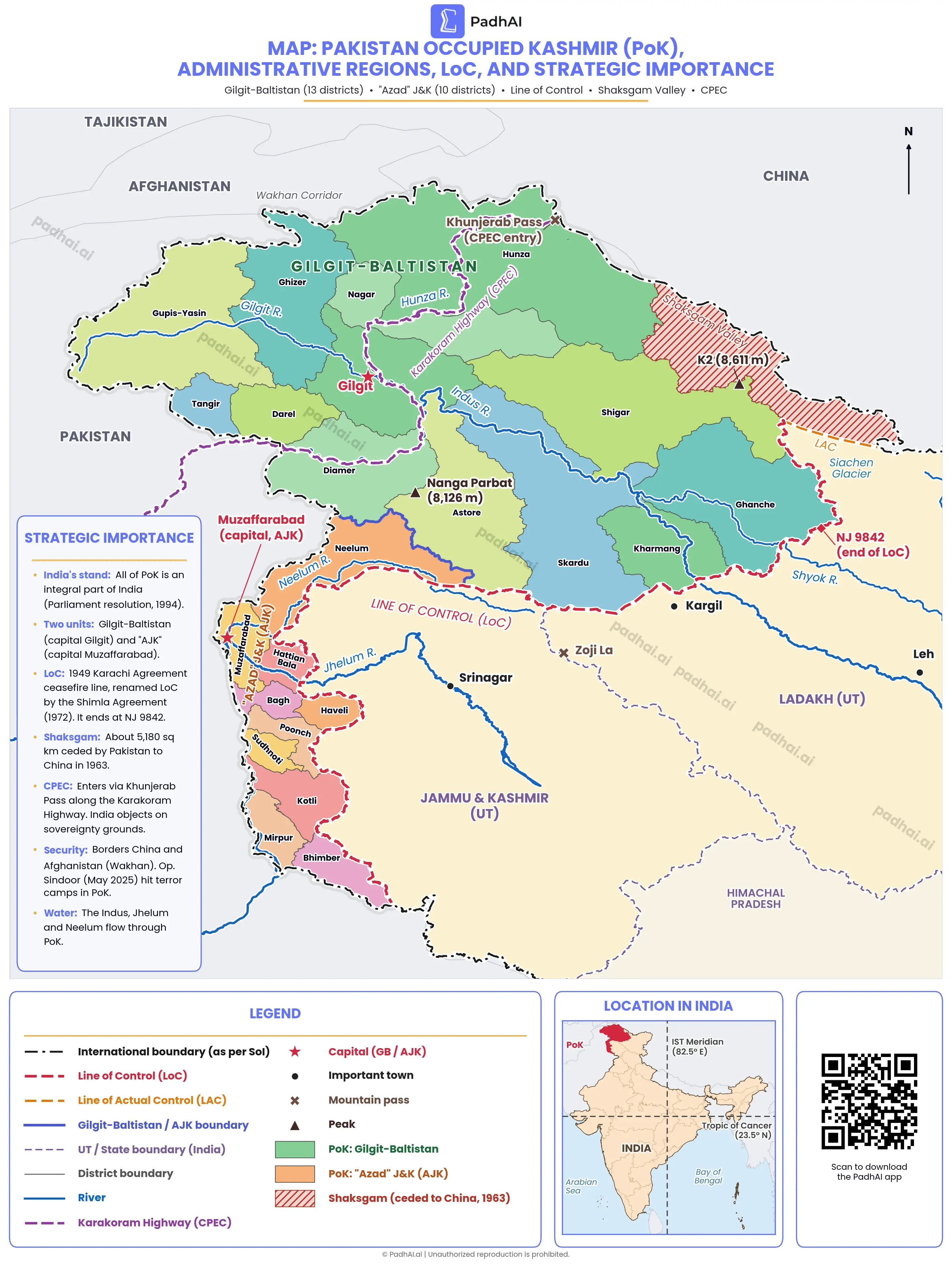
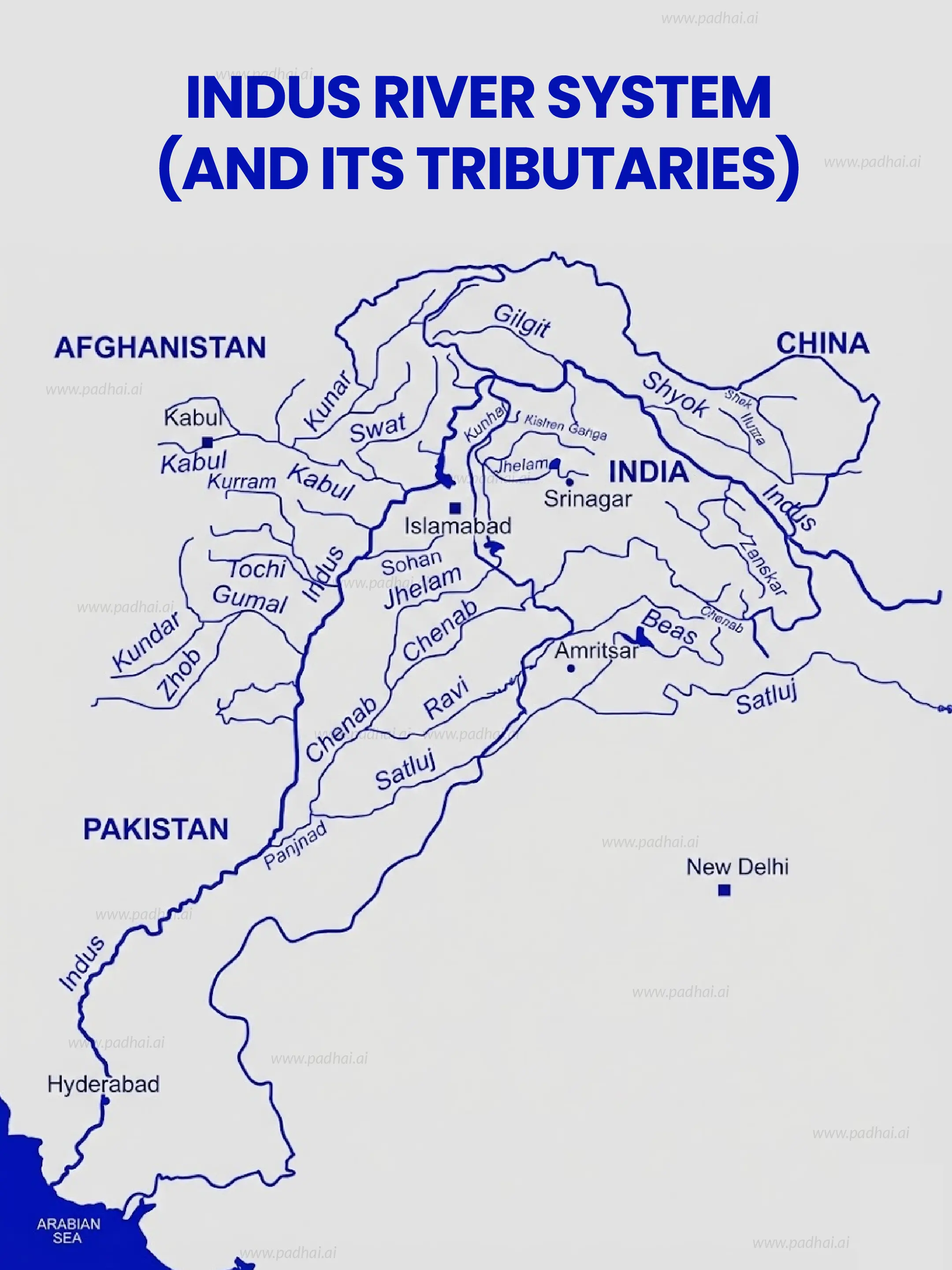
The Indus River begins its course near Lake Mansarovar on the northern slopes of the Kailash Mountain Range in the Tibetan Plateau. Upon entering Indian territory, the river flows northwest between the Ladakh and Karakoram ranges; it maintains a path largely adjacent to the Ladakh range before entering the Pakistan-occupied Kashmir (PoK) region.
2. The Syntaxial Bend at Nanga Parbat
A critical map feature is the sharp southward turn the river executes near the Nanga Parbat formation. In this vicinity, the river carves massive canyons with depths ranging from 4,500 to 5,200 meters (15,000 to 17,000 feet). This geological shift marks the transition of the river from the mountainous Northern Areas into the plains of Pakistan.
3. The Panjnad (Left-Bank Tributaries)
The name "Punjab" derives from the "Five Waters" or tributaries that drain the eastern basin. These five left-bank rivers—Jhelum, Chenab, Ravi, Beas, and Sutlej—converge to form the Panjnad River, which ultimately joins the Indus at Mithankot. Aspirants should note that the Beas runs entirely within Indian territory before joining the Sutlej at the Harike wetland.
4. Right-Bank Tributary Dynamics
The Shyok River constitutes the primary right-bank tributary and originates from the Rimo Glacier within the Siachen system in Ladakh. Other significant right-bank contributions include the Gilgit, Kabul, Gomal, and Kurram rivers, which supply icy waters from the Hindu Kush and Karakoram ranges into the main stream.
5. Treaty-Based Water Division
The Indus Water Treaty (1960) formalized the division of the river system between India and Pakistan. The treaty allocates control of the three "eastern rivers" (Ravi, Beas, Sutlej) to India, while control of the three "western rivers" (Indus, Jhelum, Chenab) belongs to Pakistan.
6. Ecological Uniqueness
The Tidal Bore The Indus is one of the few river systems globally that exhibits a tidal bore. This phenomenon occurs when the incoming tide from the Arabian Sea forms a wave that travels upstream against the natural current of the river. This feature distinguishes the Indus delta from other major Indian river deltas.
7. Historical Course Shifts
Cartographic history reveals that the river has altered its path significantly over time. Following an earthquake in 1816, the Indus shifted westward, moving away from its previous course that ran into the Rann of Kutch and bordered the Banni grasslands.
8. Specific Biodiversity Markers
The river hosts the Platanista gangetica minor, commonly known as the blind Indus River Dolphin. This endangered species is endemic to the Indus waters. Historically, the basin supported diverse megafauna, including rhinoceroses, as recorded by Emperor Babur in the Baburnama.
9. Basin and Discharge Metrics
The Indus features a massive catchment basin exceeding 1,165,000 square kilometers. With an approximate yearly discharge of 207 cubic kilometers, it ranks as the 21st largest river in the world by discharge volume. The total length of the river extends to 3,180 kilometers, making it the longest river in Pakistan.
10. Absence of Latitudinal Intersections
A specific geographical anomaly relevant to map questions is that neither the Indus main stream nor its tributaries cross the Tropic of Cancer or the Indian Standard Time (IST) line. This fact aids in eliminating incorrect options during multiple-choice questions regarding the river's coordinate positioning.


Gajendra Singh Godara
Ex-UPSC Aspirant | Exam Preparation Expert
Gajendra Singh Godara is an IIT Bombay graduate and a UPSC aspirant with 4 attempts, including multiple Prelims and Mains appearances. He specializes in Polity, Modern History, International Relations, and Economy. At PadhAI, Gajendra leverages his firsthand exam experience to simplify complex concepts, creating high-efficiency study materials that help aspirants save time and stay focused.
Suggested Maps