Tropic of Cancer Map: Analysis and 17 Countries
The Tropic of Cancer maps the exact northern boundary of the Earth's Tropical Zone. This imaginary line represents the northernmost latitude where the sun reaches the zenith directly overhead.
For UPSC aspirants, understanding this geographic vector is key for climatology questions. It helps with understanding the June Solstice and global pressure belts. The following analysis deconstructs the geographical, astronomical, and climatic attributes of this latitude.

Gajendra Singh Godara
Last updated
What Is the Tropic of Cancer?
The Tropic of Cancer is a major circle of latitude currently positioned at approximately 23°26′11.7″ North of the Equator. It functions as the demarcation line separating the Torrid Zone (Tropics) from the North Temperate Zone.
During the June solstice, the Northern Hemisphere tilts toward the Sun the most. This makes the solar rays hit directly at this latitude.
Geographical Distribution: The 17 Countries
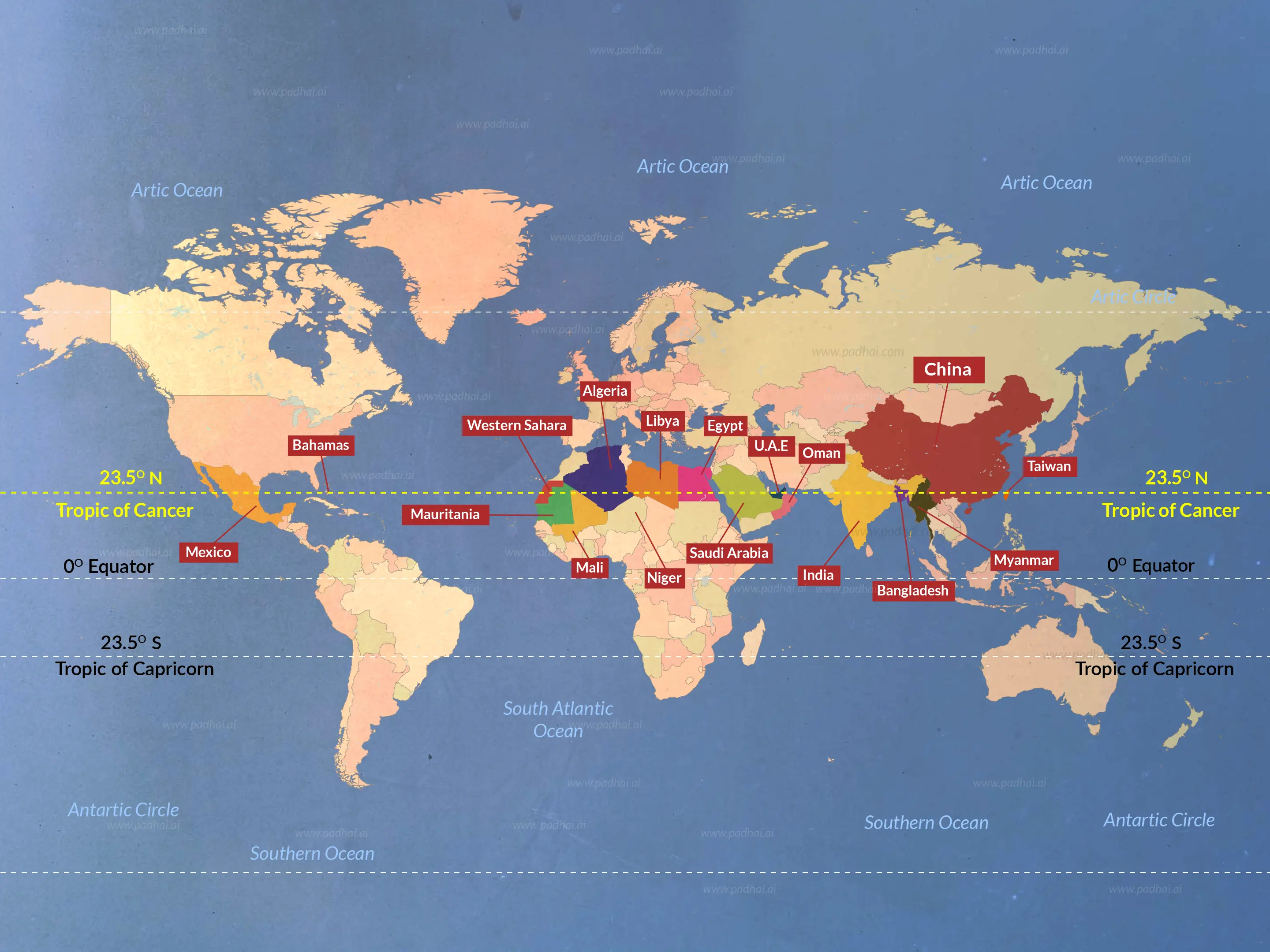
The Tropic of Cancer passes through 17 countries spread across three continents. The precise path moves eastward from the Prime Meridian. The countries located on this line are listed below:
Continent | Countries (West to East) |
Africa | Western Sahara, Mauritania, Mali, Algeria, Niger, Libya, Egypt |
Asia | Saudi Arabia, UAE, Oman, India, Bangladesh, Myanmar, China, Taiwan |
North America | Mexico, Bahamas (Archipelago) |
The line crosses six important bodies of water. These are:
Indian Ocean
Atlantic Ocean
Pacific Ocean
Taiwan Strait
Red Sea
Gulf of Mexico
Does the Tropic of Cancer Have a Fixed Location?
No, the location of the Tropic of Cancer drifts southward annually. The position changes because of axial precession. This is a slow wobble of the Earth's axis. The gravitational forces from the Sun and Moon cause it.
Current data indicates the line drifts south at a rate of 0.468 arcseconds, or approximately 15 meters, per year. In 1917, the line sat at exactly 23° 27′ N; projections place it at 23° 26′ N by the year 2045.
Climatic Variations Along the Latitude
The map of the Tropic of Cancer reveals distinct climatic contradictions. The climate zones intersect the latitude in the following ways:
Arid Zones: In North Africa and the Middle East, high-pressure systems cause hot desert climates. Examples include the Sahara Desert and the Arabian Desert.
Monsoon Zones: In South and Southeast Asia, there are areas with a tropical monsoon climate. This includes countries like India, Bangladesh, and Myanmar. These areas receive heavy seasonal rainfall vital for agriculture.
Temperate Zones: Some areas in China and the highlands of Mexico have temperate weather. They have clear wet and dry seasons.
Astronomical Origins and Nomenclature
The name "Tropic of Cancer" originates from the constellation Cancer. Over 2,000 years ago, ancient astronomers named the line. At that time, the Sun was in the direction of the constellation Cancer during the June solstice. However, due to the precession of the equinoxes, the Sun currently resides in the constellation Taurus during this solstice.
The word "tropic" comes from the Greek word "trope," which means "turn." It symbolizes where the Sun changes direction and starts moving south.
Relevance to Circumnavigation
The Fédération Aéronautique Internationale (FAI) uses the Tropic of Cancer as a benchmark for speed records. To qualify for a round-the-world speed record, a flight must travel a distance equal to the Tropic of Cancer. This distance is about 36,788 kilometers or 22,859 miles. This standard guarantees that circumnavigation attempts traverse a significant portion of the Earth's surface.
Conclusion
The Tropic of Cancer is a dynamic geographical marker that defines the northern limit of the tropics. It crosses 17 countries and dictates critical climate patterns ranging from the arid Sahara to the Indian monsoon belt. For UPSC preparation, recognizing the interplay between this latitude, the Earth's axial wobble, and global weather systems is fundamental


Gajendra Singh Godara
Ex-UPSC Aspirant | Exam Preparation Expert
Gajendra Singh Godara is an IIT Bombay graduate and a UPSC aspirant with 4 attempts, including multiple Prelims and Mains appearances. He specializes in Polity, Modern History, International Relations, and Economy. At PadhAI, Gajendra leverages his firsthand exam experience to simplify complex concepts, creating high-efficiency study materials that help aspirants save time and stay focused.
Suggested Maps