96 Ramsar Sites in India Map | Download PDF and Image
India hosts 96 Ramsar Sites, includes fresh entries like Kopra, Jalashay and Silisereh Lake, marking Chhattisgarh's debut on the list. Download the updated map.

Gajendra Singh Godara
Last updated
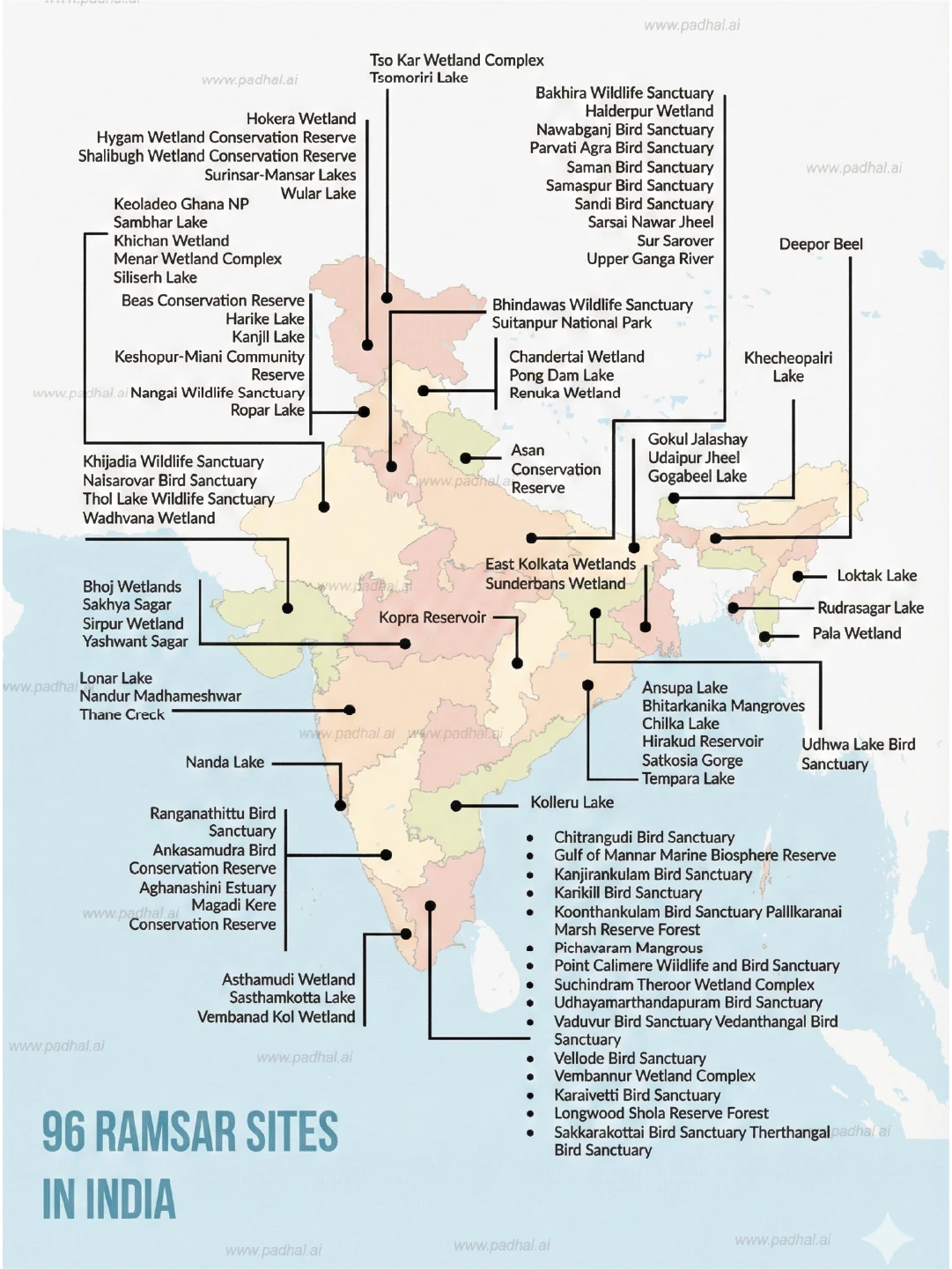
Ramsar Sites Map Geographic Distribution and Density
The 2026 map reveals a significant concentration of wetlands in the southern peninsula and the northern plains.
Dominance of Tamil Nadu: Tamil Nadu holds the highest number of Ramsar sites in India, with a total of 20 designations. This cluster highlights the rich coastal and riverine wetland ecosystems prevalent in the state.
Northern Plains Corridor: Uttar Pradesh follows with 10 sites, creating a dense conservation corridor along the Gangetic plains.
Eastern Cluster: Odisha and Bihar each contribute 6 sites, emphasizing the ecological value of the eastern river basins and deltaic regions.
New Additions and Territorial Expansion
The Ministry of Environment, Forest and Climate Change expanded the Ramsar network significantly between 2024 and 2025. This expansion introduced 96 Ramsar Sites in India by adding three new states to the Ramsar map for the first time.
List of First-Time State Inclusions:
Chhattisgarh: Designated Kopra Jalashay as its first Ramsar site in December 2025,.
Jharkhand: Added Udhwa Lake Bird Sanctuary in February 2025,.
Sikkim: Included Khecheopalri Wetland in February 2025.
These additions bridge the geographical gaps in central and eastern India, creating a more continuous conservation map.
Do all Indian states host Ramsar Sites?
No, several states still lack Ramsar representation. As of 2026, the states of Telangana, Arunachal Pradesh, Meghalaya, and Nagaland do not possess any designated Ramsar Sites.
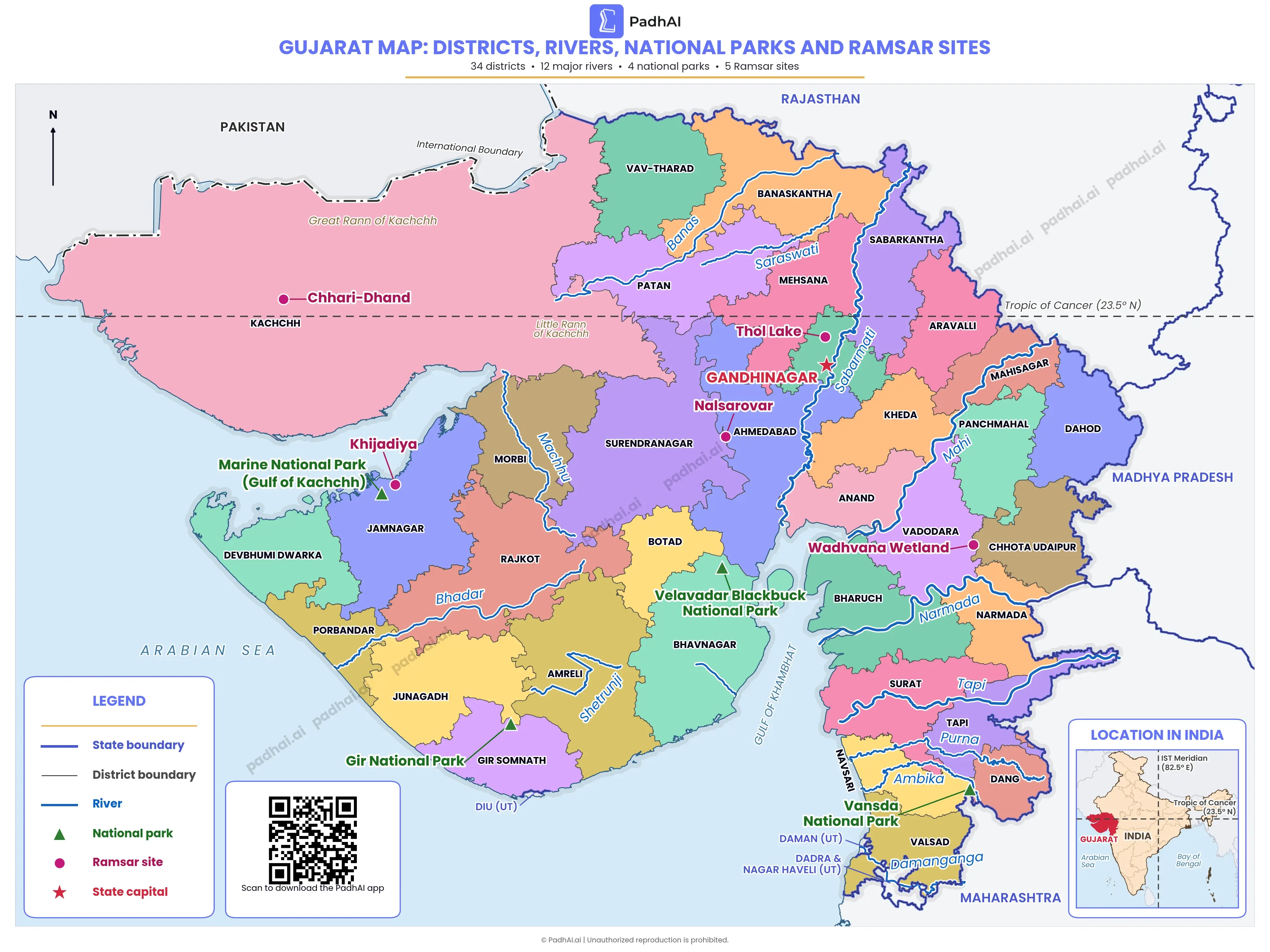
The distribution of Ramsar sites varies significantly across latitudes. By referencing a Tropic Of Cancer Map, students can see that sites like Keoladeo (Rajasthan) and Deepor Beel (Assam) lie to the north, while the brackish Chilika Lake lies to the south. Additionally, high-altitude wetlands like Tso Kar and Tsomoriri are nestled within the major mountain ranges in India, specifically the Trans-Himalayan region.
Comparative Metrics: Extremes of the Map
Candidates should memorize the specific extremes of the Ramsar network for matching-list questions.
Category | Site Name | State | Area / Year |
Largest | Sundarban Wetland | West Bengal | 4,230 km² |
Smallest | Renuka Lake | Himachal Pradesh | 0.2 km² |
Oldest | Chilika Lake | Odisha | 1981 |
Newest | Silisereh Lake | Rajasthan | Dec 2025 |
Ecological Significance of the Newest Sites
The sites added in late 2025 provide specific ecological services that appear on the map.
Silisereh Lake (Rajasthan): This man-made lake in the Aravalli Hills functions as a critical water source for Alwar city and supports the buffer zone of the Sariska Tiger Reserve,.
Kopra Jalashay (Chhattisgarh): A reservoir-type wetland that serves as a winter stopover for migratory birds and supports hydrological stability in the upper Mahanadi basin,.
Tawa Reservoir (Madhya Pradesh): Located inside the Satpura Tiger Reserve, this site protects the endangered Indian Giant Squirrel and the state fish, Tor mahseer.
Conservation Status and The Montreux Record
The map also signals sites under severe ecological stress. The Montreux Record tracks Ramsar sites facing changes due to pollution or human interference.
Listed Sites: Only Keoladeo National Park (Rajasthan) and Loktak Lake (Manipur) currently appear on this record,.
Restoration Success: Chilika Lake was removed from this record in 2002 following successful restoration interventions.
Summary
The 2025 update to the Ramsar map increases India’s total count to 96 sites. This expansion integrates previously unrepresented regions like Chhattisgarh and Sikkim into the international conservation framework. The data confirms Tamil Nadu’s leading position and highlights the government’s focus on preserving diverse ecosystems ranging from high-altitude lakes in Ladakh to coastal mangroves in West Bengal.
Many wetlands designated under the Ramsar Convention are also featured on the National Parks India Map. Notable examples include Keoladeo National Park and the Sundarbans; both are also designated UNESCO World Heritage Sites In India. In some cases, these wetlands overlap with Tiger Reserves In India, providing essential water sources for apex predators in regions like the Sundarbans and Bhitarkanika.


Gajendra Singh Godara
Ex-UPSC Aspirant | Exam Preparation Expert
Gajendra Singh Godara is an IIT Bombay graduate and a UPSC aspirant with 4 attempts, including multiple Prelims and Mains appearances. He specializes in Polity, Modern History, International Relations, and Economy. At PadhAI, Gajendra leverages his firsthand exam experience to simplify complex concepts, creating high-efficiency study materials that help aspirants save time and stay focused.
Suggested Maps