Secularism in India: Constitutional Provisions, Challenges

UPSC Prelims & Mains

GS I

Social Justice

Latest Update

Gajendra Singh Godara
Nov 24, 2025
15
mins read
Secularism in India
Secularism in India
Secularism in India
Secularism in India

What is Secularism?

What is Secularism?

What is Secularism?

What is Secularism?

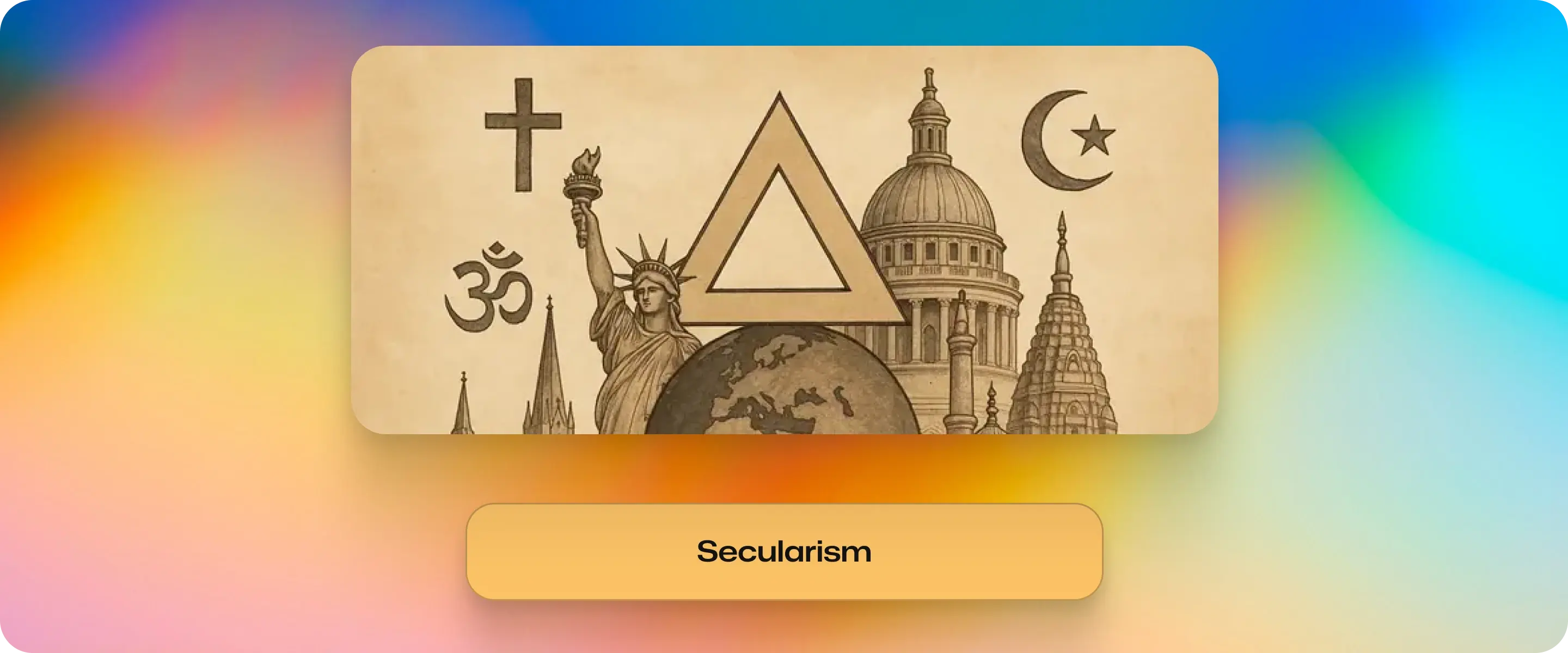
Secularism means that the government remains neutral and does not favor or oppose any religion. A secular person is not bound by religious doctrines in personal decisions. In this system, politics and law are separate from religion. This ensures everyone can follow any faith or no faith freely.

Secularism in India: Conceptual Foundations

Secularism in India: Conceptual Foundations

Secularism in India: Conceptual Foundations

Secularism in India: Conceptual Foundations

It broadly conveys two meanings:
a. Separation of state and religion i.e. Dharm Nirpekshta.
b. Equal treatment of all religions by the state i.e. Sarva Dharma Samabhava.

Historical Roots

  1. India has always accommodated diverse beliefs. Ancient rulers studied multiple faiths, and respected and taught that reverence should extend to all religions.  

  2. History in fact provides grounds for “Sarva Dharma Samabhava” (equal regard for all religions)                                                                                                                                                               

  3. During the freedom struggle, Mahatma Gandhi and Jawaharlal Nehru encouraged integration of all religions. They formed the belief that as an independent nation, India would not have a state religion.

What does “India is a secular country” mean?

India’s Constitution defines it as a secular republic. 

  • The country has no religion of its own. The government does not distinguish between religions. 

  • The Indian Citizens can follow the religion of their choice or no religion. The government does not favor or discriminate against any religion.

  • Public institutions serve all faiths equally. No community can claim special status from the state.

Indian Model vs Western Model 

The Indian model is often called “positive secularism.” 

  • The state gives equal respect to all religions and may even support religious activities that serve the public. 

  • For example, the government funds the maintenance of some temples and other religious sites of historical importance. 

  • In the Western model, like in the United States or France, there is strict separation. The government does not fund religious institutions and keeps religious symbols out of public offices. Western states usually do not allow religion to influence laws or policies.

Comparison of Indian vs Western Secularism:

  1. State and Religion: In India, the government respects all religions and protects minority faiths. Western governments remain strictly neutral and do not fund or favor any religion.

  2. Uniform Laws: India has different personal laws for different religious communities (though there is a goal of a Uniform Civil Code for everyone). In Western countries, one set of civil laws applies to all citizens regardless of religion.

  3. Role of State: India allows the state to regulate religious practices for public welfare (for example, by banning untouchability or other harmful customs). Western governments usually avoid interfering in religious matters altogether.

Join our WhatsApp Community

Join our WhatsApp Community

Join our WhatsApp Community

Join our WhatsApp Community

Secularism in Indian Constitution

Secularism in Indian Constitution

Secularism in Indian Constitution

Secularism in Indian Constitution

In India’s Constitution, the term “secular” has been included through 42nd Amendment Act in 1976.  

Initially, the Preamble referred to India as a “Sovereign democratic republic”.

Subsequent to the 42nd Amendment in 1976, it was referred to as the “Sovereign socialist secular democratic republic.” This modification made it clear that it is an essential characteristic of India.  

There are several aspects of the Constitution which reflects the secular character of India.  

  1. Fundamental Rights: Legal equality is guaranteed to every individual under Article 14 and Article 15 provides for non-discriminatory practices on the grounds of religion (as well as on the grounds of race, caste, gender, etc.). From Article 25 to Article 28, the freedom of religion is guaranteed which encompasses the right to practice any religion, to propagate any religion and to administer and manage religious institutions of one’s choice without state interference.  

  2. Directive Principles: Article 44 implores India to have a Uniform Civil Code which is the objective of having one set of personal laws for all the members of the state. This aims to remove discriminatory, religion-based differences to promote equality.

  3. Fundamental Duties: To foster a spirit of tolerance and harmonious coexistence among the people of different religious faiths and communities. Article 51A(e) promotes harmony and brotherhood among all people, transcending religious, linguistic, and regional diversities, as a fundamental duty (though these duties are non-justiciable).

Judicial Interpretation

India’s Supreme Court has reinforced secularism in landmark cases. 

  • In the Kesavananda Bharati case (1973), the Court said secularism is part of the “basic structure” of the Constitution, meaning it cannot be removed by amendment. 

  • In the famous S. R. Bommai case (1994), the Court explicitly declared that secularism is essential. It ruled that no government can discriminate on the basis of religion. These decisions established that it is a core constitutional value that cannot be undermined by any law or government.

Uniform Civil Code and Secularism:  

The Uniform Civil Code (UCC) also called Secular Civil Code is also approached from the lens of secularism.  

  • Uniform Civil Code entails having the same personal laws irrespective of the religion of the individuals involved. 

  • Advocates argue that a UCC strengthens the tenets of secularism by guaranteeing that all individuals, citizens of the state or otherwise, are treated the same as the laws of the land, and by obliterating religion-based legal inequalities.  

While some are concerned that the UCC may infringe on religious autonomy, others emphasize that it remains a Directive Principle under Article 44. 

Why Secularism Is Important in India

Managing Religious Diversity

India’s population includes Hindus, Muslims, Christians, Sikhs, Buddhists, Jains, and others. 

  • It allows all communities to practice their faiths without fear. 

  • It ensures that the state does not align with a single religion. 

  • By keeping the government neutral, it prevents conflicts based on faith. 

  • This helps maintain unity in a diverse society.

Protecting Minority Rights

  • Minority communities need protection to feel secure and equal. 

  • Secularism means the government cannot make laws favoring the majority religion. 

  • Constitutional rights like freedom of religion and equal citizenship safeguard minorities. 

For example, anyone can open a place of worship or start a school for their faith. Secular rules encourage respect for the cultural and educational institutions of all groups.

Ensuring Democratic and Social Harmony

  • It champions the notion that every citizen, irrespective of their faith, is treated equally in the eyes of the law.  

  • Equity, in this sense, constitutes the bedrock of democracy. A situation where the authority of the state remains indifferent guarantees that no community perceives preferential treatment.  Such an outcome yields social harmony.  

  • In a secular democracy, attention centers on universal concerns like employment and schooling, as opposed to the detrimental fragmentation of society on religious demographics.

UPSC Current Affairs Magazines

Add as a preferred Source on Google

UPSC Current Affairs Magazines

Add as a preferred Source on Google

Challenges to Secularism in India

Challenges to Secularism in India

Challenges to Secularism in India

Challenges to Secularism in India

Communal Politics and Vote-Banking

  • One challenge is when religion is used in politics to win votes. Politicians sometimes appeal to voters based on faith or caste. This is known as “communal politics.” 

  • It can weaken secularism by dividing people along religious lines. 

  • Although election laws ban campaigning on pure religious grounds, enforcement is weak and communal appeals still occur.

State-Religion Entanglement and Majoritarianism:

  • India has some complex ties between state and religion. For example, the government often manages or funds certain religious sites. 

  • Critics say this can favor the majority community and undermine neutrality. In recent years, there have been concerns that the majority religion has influenced government policy more. 

  • Such trends can threaten secular balance. However, supporters argue that such regulation ensures fairness and curbs corruption in religious institutions.

Implementation Gaps and Criticism:

  • Sometimes secular ideals are not fully realized in practice. The term “pseudo-secularism” is used by some to claim that leaders pretend to be neutral but actually favor certain groups. 

  • Others argue that India’s secular model is unique and not flawed by nature, but it needs better implementation. 

  • For example, having different laws for different religions can lead to unequal treatment, especially for women. 

  • Social biases and prejudice also persist in some areas. These issues show that upholding secular principles remains a complex challenge.

Add as a preferred Source on Google

UPSC Current Affairs Magazines

Add as a preferred Source on Google

UPSC Current Affairs Magazines

Way Forward: Strengthening Secular State in India

Way Forward: Strengthening Secular State in India

Way Forward: Strengthening Secular State in India

Way Forward: Strengthening Secular State in India

Promoting Value-Education and Inter-Religious Harmony:

  • Education creates and sustains understanding and tolerance, so schools must also educate on respect for all religions, and respect all traditions within India's diversity as well. 

  • Community programs and interfaith dialogues can strengthen community and understanding of different religions and cultures, fostering openness and world citizenship. 

  • Religious leaders, psychologists, and public figures can act as promoters of Constructive Dialogue, helping people view secularity as social values and not only as law.

Institutional Reforms

  • The government can introduce reforms to reinforce secularism. 

  • Working toward a Uniform Civil Code would apply one common set of laws for marriage, divorce, and inheritance to everyone. 

  • Ensuring that bodies managing religious endowments are fair and transparent can help. 

  • Reviewing any laws that give special privileges to one religion could also move India toward true equality. These changes would strengthen the secular framework of the state.

Deepening Secular Culture through Active Citizenship

  • Individuals can treat everyone as equal members of one nation. 

  • Social media and civil society groups can run campaigns against hate and discrimination. 

  • Celebrating shared values like freedom and justice, rather than focusing on religion, strengthens society. 

  • By being informed and engaged, people can ensure their leaders uphold secular principles. 

In a democracy, each citizen’s actions and voice help keep the state neutral and inclusive.

UPSC Previous Year Questions

UPSC Previous Year Questions

UPSC Previous Year Questions

UPSC Previous Year Questions

Q. Are tolerance, assimilation and pluralism the key elements in the making of an Indian form of secularism? Justify your answer. (2022)
Q. Customs and traditions suppress reason leading to obscurantism. Do you agree? (2020)
Q. What are the challenges to our cultural practices in the name of secularism? (2019)

Frequently asked question (FAQs)

What is secularism?
What is secularism?
What is secularism?
What is secularism?
How does the Indian model of secularism differ from the Western model?
Which constitutional amendment added “secular” to the Indian Preamble?
What is the significance of the S. R. Bommai case for secularism?
How is the Uniform Civil Code linked to secularism in India?

Conclusion

Conclusion

Conclusion

Conclusion

The essence of secularism in India is the equal treatment of all religions by the state. It is the consequence of the nation’s historical, constitutional, and demographic equity and diversity, and it has been actively endorsed since the Constitution. It is actively endorsed in the Constitution. 

India’s type of secularism is different from the western model of ‘pure’ separation of state and religion as it involves active state regard to religions. This has been of assistance in managing the tensions and conflicts arising from the multiplicity of diverse religions and cultures in the country.  

Latest UPSC Exam 2025 Updates

Latest UPSC Exam 2025 Updates

Latest UPSC Exam 2025 Updates

Latest UPSC Exam 2025 Updates

UPSC Calendar 2026 is released on 15th May, 2025.

UPSC Mains Result 2025 is now released.

Check out the updated and latest UPSC Syllabus 2026 here.

UPSC Notification 2025 was released on 22nd January 2025.

UPSC Prelims 2026 will be conducted on 24th May, 2026 & UPSC Mains 2026 will be conducted on 21st August 2026.

The UPSC Prelims 2026 is scheduled for May 24, 2026, while the UPSC Mains 2026 will be conducted from August 21, 2026.

The UPSC Selection Process is of 3 stages-Prelims, Mains and Interview.

UPSC Result 2024 is released with latest UPSC Marksheet 2024. Check Now!

Suggested posts

Amendment of Indian Constitution: Procedure and List of Amendments

A constitutional amendment or amendment of Indian Constitution is a process of making changes to the law of the land i.e. Constitution of India. Article 368 provides Parliament with the authority to amend the Constitution by way of addition, variation or repeal of any provision. This variability allows the law to respond to shifts in society and fill in gaps — a point Nehru made when he argued that a Constitution should not be so inflexible that it cannot reflect changes in time.

Amendments have introduced new rights, settled ambiguities, and kept India’s democracy current. For example, the Right to Education and the creation of local governments were made possible by amendments, showing how the Constitution acts as a “living document.”

Ammendments in Indian Constitution

A constitutional amendment or amendment of Indian Constitution is a process of making changes to the law of the land i.e. Constitution of India. Article 368 provides Parliament with the authority to amend the Constitution by way of addition, variation or repeal of any provision. This variability allows the law to respond to shifts in society and fill in gaps — a point Nehru made when he argued that a Constitution should not be so inflexible that it cannot reflect changes in time.

Amendments have introduced new rights, settled ambiguities, and kept India’s democracy current. For example, the Right to Education and the creation of local governments were made possible by amendments, showing how the Constitution acts as a “living document.”

Read now

Amendment of Indian Constitution: Procedure and List of Amendments

A constitutional amendment or amendment of Indian Constitution is a process of making changes to the law of the land i.e. Constitution of India. Article 368 provides Parliament with the authority to amend the Constitution by way of addition, variation or repeal of any provision. This variability allows the law to respond to shifts in society and fill in gaps — a point Nehru made when he argued that a Constitution should not be so inflexible that it cannot reflect changes in time.

Amendments have introduced new rights, settled ambiguities, and kept India’s democracy current. For example, the Right to Education and the creation of local governments were made possible by amendments, showing how the Constitution acts as a “living document.”

Ammendments in Indian Constitution

A constitutional amendment or amendment of Indian Constitution is a process of making changes to the law of the land i.e. Constitution of India. Article 368 provides Parliament with the authority to amend the Constitution by way of addition, variation or repeal of any provision. This variability allows the law to respond to shifts in society and fill in gaps — a point Nehru made when he argued that a Constitution should not be so inflexible that it cannot reflect changes in time.

Amendments have introduced new rights, settled ambiguities, and kept India’s democracy current. For example, the Right to Education and the creation of local governments were made possible by amendments, showing how the Constitution acts as a “living document.”

Read now

a close up of a cell phone with a blurry background

About Author

Gajendra Singh Godara

Growth | FTE| Resident at SigIQ

Gajendra Singh Godara brings authentic UPSC preparation insights from his four-attempt journey, having successfully cleared Prelims and written Mains multiple times. His deep expertise spans Polity, Modern History, International Relations, and Economy. At PadhAI, Gajendra transforms his extensive exam experience into accessible content that simplifies complex concepts for aspirants at every preparation stage. His firsthand understanding of UPSC's demands enables him to create targeted materials that save time while maximizing learning efficiency for current affairs, general studies, and optional subjects.

a close up of a cell phone with a blurry background

About Author

Gajendra Singh Godara

Growth | FTE| Resident at SigIQ

Gajendra Singh Godara brings authentic UPSC preparation insights from his four-attempt journey, having successfully cleared Prelims and written Mains multiple times. His deep expertise spans Polity, Modern History, International Relations, and Economy. At PadhAI, Gajendra transforms his extensive exam experience into accessible content that simplifies complex concepts for aspirants at every preparation stage. His firsthand understanding of UPSC's demands enables him to create targeted materials that save time while maximizing learning efficiency for current affairs, general studies, and optional subjects.

a close up of a cell phone with a blurry background

About Author

Gajendra Singh Godara

Growth | FTE| Resident at SigIQ

Gajendra Singh Godara brings authentic UPSC preparation insights from his four-attempt journey, having successfully cleared Prelims and written Mains multiple times. His deep expertise spans Polity, Modern History, International Relations, and Economy. At PadhAI, Gajendra transforms his extensive exam experience into accessible content that simplifies complex concepts for aspirants at every preparation stage. His firsthand understanding of UPSC's demands enables him to create targeted materials that save time while maximizing learning efficiency for current affairs, general studies, and optional subjects.

a close up of a cell phone with a blurry background

About Author

Gajendra Singh Godara

Growth | FTE| Resident at SigIQ

Gajendra Singh Godara brings authentic UPSC preparation insights from his four-attempt journey, having successfully cleared Prelims and written Mains multiple times. His deep expertise spans Polity, Modern History, International Relations, and Economy. At PadhAI, Gajendra transforms his extensive exam experience into accessible content that simplifies complex concepts for aspirants at every preparation stage. His firsthand understanding of UPSC's demands enables him to create targeted materials that save time while maximizing learning efficiency for current affairs, general studies, and optional subjects.

PadhAI UPSC App

PadhAI UPSC App

PadhAI UPSC App

We're PadhAI - a free UPSC prep app built by IITians, AI PhDs & top UPSC experts.

Why choose PadhAI?

Why choose PadhAI?

Why choose PadhAI?

Read daily top news (TH & IE) & Solve Current Affairs MCQs
Topic-wise search of 30+ yrs PYQs
24×7 AI tutor for doubt resolution
Practice 30k+ MCQs & full GS + CSAT mocks
Play Duel UPSC quizzes with fellow aspirants
Practice 30k+ MCQs & full GS + CSAT mocks

Why choose PadhAI?

Read daily top news (TH & IE) & Solve Current Affairs MCQs

Topic-wise search of 30+ yrs PYQs

24×7 AI tutor for doubt resolution

Practice 30k+ MCQs & full GS + CSAT mocks

Play Duel UPSC quizzes with fellow aspirants

PadhAI UPSC App

We're PadhAI - a free UPSC prep app built by IITians, AI PhDs & top UPSC experts.

Why choose PadhAI?

Read daily top news (TH & IE) & Solve Current Affairs MCQs

Topic-wise search of 30+ yrs PYQs

24×7 AI tutor for doubt resolution

Practice 30k+ MCQs & full GS + CSAT mocks

Play Duel UPSC quizzes with fellow aspirants

PadhAI UPSC App

We're PadhAI - a free UPSC prep app built by IITians, AI PhDs & top UPSC experts.

Suggested posts

Suggested posts

Suggested posts

Secularism in India
Secularism in India

Secularism in India: Constitutional Provisions, Challenges

Secularism means that the government remains neutral and does not favor or oppose any religion. A secular person is not bound by religious doctrines in personal decisions. In this system, politics and law are separate from religion. This ensures everyone can follow any faith or no faith freely.

Ammendments in Indian Constitution

Amendment of Indian Constitution: Procedure and List of Amendments

A constitutional amendment or amendment of Indian Constitution is a process of making changes to the law of the land i.e. Constitution of India. Article 368 provides Parliament with the authority to amend the Constitution by way of addition, variation or repeal of any provision. This variability allows the law to respond to shifts in society and fill in gaps — a point Nehru made when he argued that a Constitution should not be so inflexible that it cannot reflect changes in time.

Amendments have introduced new rights, settled ambiguities, and kept India’s democracy current. For example, the Right to Education and the creation of local governments were made possible by amendments, showing how the Constitution acts as a “living document.”

Secularism in India

Secularism in India: Constitutional Provisions, Challenges

Secularism means that the government remains neutral and does not favor or oppose any religion. A secular person is not bound by religious doctrines in personal decisions. In this system, politics and law are separate from religion. This ensures everyone can follow any faith or no faith freely.

Ammendments in Indian Constitution

Amendment of Indian Constitution: Procedure and List of Amendments

A constitutional amendment or amendment of Indian Constitution is a process of making changes to the law of the land i.e. Constitution of India. Article 368 provides Parliament with the authority to amend the Constitution by way of addition, variation or repeal of any provision. This variability allows the law to respond to shifts in society and fill in gaps — a point Nehru made when he argued that a Constitution should not be so inflexible that it cannot reflect changes in time.

Amendments have introduced new rights, settled ambiguities, and kept India’s democracy current. For example, the Right to Education and the creation of local governments were made possible by amendments, showing how the Constitution acts as a “living document.”

Download PadhAI App

Don't get left behind in your preparation

Download PadhAI App

Don't get left behind in your preparation

Download PadhAI App

Don't get left behind in your preparation

Download PadhAI App

Don't get left behind in your preparation

Embark on your journey!

Address

3rd floor, Electrical and Electronic, ALG Towers, Plot no. 48, main road, Industrial Estate, Perungudi, Chennai, Tamil Nadu 600096

PadhAI is a product of SigIQ AI, and Metayb is a recognized reseller authorized to sell PadhAI subscriptions.

Embark on your journey!

Address

3rd floor, Electrical and Electronic, ALG Towers, Plot no. 48, main road, Industrial Estate, Perungudi, Chennai, Tamil Nadu 600096

PadhAI is a product of SigIQ AI, and Metayb is a recognized reseller authorized to sell PadhAI subscriptions.

Embark on your journey!

Address

3rd floor, Electrical and Electronic, ALG Towers, Plot no. 48, main road, Industrial Estate, Perungudi, Chennai, Tamil Nadu 600096

PadhAI is a product of SigIQ AI, and Metayb is a recognized reseller authorized to sell PadhAI subscriptions.

Embark on your journey!

Address

3rd floor, Electrical and Electronic, ALG Towers, Plot no. 48, main road, Industrial Estate, Perungudi, Chennai, Tamil Nadu 600096

PadhAI is a product of SigIQ AI, and Metayb is a recognized reseller authorized to sell PadhAI subscriptions.