Best Economics Book for UPSC: Prelims, Mains and Optional
Best economics books for UPSC Prelims, Mains & Optional. Here’s the expert guide covering topper’s recommended booklist, note making and preparation strategy.

Gajendra Singh Godara
Last updated
10
mins read

Many aspirants are confused about economics books. Questions like "which economics book is best for upsc Prelims?" or "Is one book enough?" are common. Economics plays a vital role in all three stages of the UPSC examination namely Prelims, Mains, and Interview.
During service, economics is integral to decision-making, policy implementation, and understanding socio-economic challenges. That is why picking the right economics book for upsc exam preparation is important.

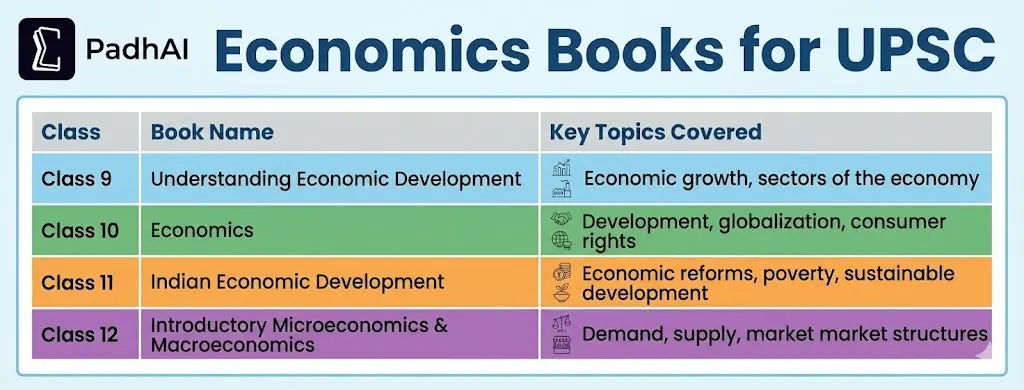
Building a strong foundation is the first step to mastering economics, and NCERT textbooks are essential for this purpose.
Class | Book Name | Key Topics Covered |
Class 9 | Understanding Economic Development | Economic growth, sectors of the economy |
Class 10 | Economics | Development, globalization, consumer rights |
Class 11 | Indian Economic Development | Economic reforms, poverty, sustainable development |
Class 12 | Introductory Microeconomics | Demand, supply, market structures |
Class 12 | Introductory Macroeconomics | National income, money, banking, fiscal policies |
Prelims needs a mix of basic understanding and current issues. Once NCERTs are clear, move to one detailed book.
When looking for the best book for economics upsc Prelims, popular choices include Indian Economy by Ramesh Singh, Indian Economy by Nitin Singhania, and Indian Economy by Sanjiv Verma. They explain concepts simply, cover major topics and include updated schemes.
Indian Economy by Jayant Parikshit is another cornerstone in UPSC economics preparation. It is a comprehensive guide that covers a wide range of topics, from basic economic concepts to contemporary economic issues in India.
Books like Indian Economy Key Concepts by Shankar Ganesh help with definitions and quick revision.
Some aspirants also refer to Uma Kapila’s Indian Economy: Performance and Policies for structure and depth.
Join our WhatsApp Community
Mains needs deeper analysis and recent data.
Books that help include Indian Economy by Ramesh Singh, Indian Economy by Mishra and Puri, and Indian Economy by Dutt and Sundaram.
These books explain structural issues, reforms, five-year strategies, poverty, agriculture, banking and industry.
Indian Economy Since Independence by Uma Kapila is useful for historical understanding.
Economic concepts become clearer when linked with the latest facts from the Economic Survey and the Budget.
Books for UPSC Economics Optional Paper 1
Microeconomics:
Modern Microeconomics by A. Koutsoyiannis
Advanced Economic Theory: Microeconomic Analysis by H. L. Ahuja
Intermediate Microeconomics by Hal Varian
Microeconomic Theory by Nicholson
Macroeconomics, Money, Banking & Public Finance:
Macroeconomic Theories & Policies – R.T. Froyen
Macroeconomics by H. L. Ahuja
Macroeconomics by Blanchard
Macroeconomic Analysis by Edward Shapiro
Monetary Economics by S. B. Gupta
Public Finance by Musgrave & Musgrave (Essential for Public Finance)
Public Finance by H.L. Bhatia
RBI Website for Banking Concepts & latest Monetary Policy
International Economics:
International Economics by D. Salvatore (Highly Recommended)
International Economics by H.G. Mannur
Open Economy Macroeconomics from Froyen
Websites of WTO, Euro Zone, Trade Blocs
Growth & Development:
Growth & Development with special reference to Developing Countries by A.P. Thirlwall
Economic Development by Todaro & Smith
Growth and Development by M.L. Jhingan
Human Development Report, Reports on Environment & Development (by COP, World Bank etc.)
Books for UPSC Economics Optional Paper 2
Economic History of India:
Economic History of India: 1857-1947 by Tirthankar Roy (Essential)
The New Oxford Companion to Economics in India: Edited by Kaushik Basu
Indian Economy Since Independence:
Indian Economy Since Independence by Uma Kapila
Indian Economy by Mishra and Puri
Indian Economy by Dutt and Sundaram
Indian Economy: Performance and Policies – Uma Kapila
Current Economic Affairs:
Economic Survey (Current & Last Year)
Union Budget Documents
Websites of RBI, NITI Aayog, PIB & PRS
Selected Articles from Regular & Business Newspapers (The Hindu, Indian Express, Business Line)
Journals like EPW (Economic and Political Weekly)
Note: Economics as an Optional is a dynamic subject that evolves over time. Staying updated with current economic trends and developments is crucial. It often requires a comprehensive approach, incorporating concepts from mathematics, statistics, and political science.
Add as a preferred Source on Google
For authentic and updated information, regularly visit these official government websites:
Ministry of Finance (finmin.gov.in): Authentic data, reports, budget documents
RBI Website (rbi.org.in): Monetary policy updates, banking concepts, key rates
NITI Aayog (niti.gov.in): Policy papers, strategy documents, development reports
WTO Website (wto.org): International trade updates, dispute settlements
PIB (pib.gov.in): Official government press releases and scheme updates
PRS Legislative Research (prsindia.org): Policy analysis, bill summaries
Ministry of Commerce (commerce.gov.in): Trade statistics, FDI data, export-import policies
These websites provide current data essential for writing analytically rich answers in Mains and staying updated for Prelims.
Economics is present in every stage of the exam.
Prelims has Economics and Social Development.
Mains GS Paper III covers growth, budgeting, agriculture, industry, environment, and social welfare.
Optional papers go into theory, policy, and development.
To score well, you need clarity, accurate facts, and good examples. That is why picking the right books, like an economics book, an environment book & essay book, is essential.
If you are new to economics, start with NCERTs to build a base. Then, pick a good book for economics for upsc like Sanjiv Verma or Shankar Ganesh for clarity. After that, move to comprehensive texts like Ramesh Singh or Nitin Singhania.
If you already know economics, begin directly with Singh or Kapila and then read Survey and Budget. Optional students must add advanced books gradually.
A simple four-phase plan works:
Phase 1 NCERT basics.
Phase 2 core books.
Phase 3 current affairs.
Phase 4 optional texts.
The following table lists frequently asked economics topics in UPSC Prelims and Mains:
Category | Important Topics |
Monetary Policy | Repo Rate, Reverse Repo Rate, CRR, SLR, MSF Rate, Bank Rate, Monetary Policy Committee |
Banking & Finance | Types of Banks, Payment Banks, Small Finance Banks, SARFAESI Act, NPA, Credit Rating Agencies |
Economic Reforms | New Economic Policy 1991 (LPG), Disinvestment, PSU Reforms, Ease of Doing Business |
Fiscal Policy | GST, Direct & Indirect Taxes, Fiscal Deficit, Revenue Deficit, FRBM Act |
Agriculture | MSP, e-NAM, PM-KISAN, APMC Reforms, Agricultural Marketing |
Industry | Make in India, PLI Schemes, SIDBI, Investment Models, FDI Policy |
External Sector | FEMA, Foreign Exchange Reserves, Current Account Deficit, Trade Agreements |
Development | Demographic Dividend, Human Development Index, Poverty Measurement, Inclusive Growth |
Planning | NITI Aayog, Five Year Plans History, SDGs, Economic Planning in India |
Financial Inclusion | Jan Dhan Yojana, Microfinance, SHGs, Financial Literacy |
Understanding these topics thoroughly using the recommended books for upsc will help you score well in both Prelims and Mains.
Economics is vast, and notes are essential for end-time revision. Here are proven tips for preparing effective economics notes:
Topic-wise Organization: Divide notes into Prelims-focused (facts, schemes, data) and Mains-focused (analysis, reform suggestions, interlinkages).
Use Tables and Flowcharts: For topics like monetary policy tools, types of banks, or five-year plan evolution, visual formats aid quick revision.
Include Current Data: Always note the latest GDP growth rate, inflation figures, fiscal deficit percentage, and key budget allocations. Update these annually.
Link Static with Current: When studying a concept (e.g., MSP), immediately note recent news or policy changes related to it.
Source Notation: Note which information came from NCERTs, standard books, or Economic Survey. This helps during revision and answer writing.
Practice Integration: After completing each chapter, write 2-3 practice answers integrating concepts with current examples.
Frequently asked question (FAQs)
Which book is best for economics UPSC Prelims?
Is one book enough for UPSC economics?
Which websites should I follow for economics current affairs?
Are government reports (Budget/Economic Survey) really necessary?
Should I start with advanced books if I have an economics background?
There is no single best book for economics upsc that covers everything perfectly. The most effective approach is to build basics with NCERTs, read one or two core Indian economy books, and then update your understanding with the Survey, Budget and reliable reports.
Optional students must add advanced texts, but only after their foundation is strong. With consistent study, clear notes and regular revision, this subject becomes easy and scoring. Economics also helps you understand government policies, so it benefits you beyond the exam too.





Gajendra Singh Godara
Ex-UPSC Aspirant | Exam Preparation Expert
Gajendra Singh Godara is an IIT Bombay graduate and a UPSC aspirant with 4 attempts, including multiple Prelims and Mains appearances. He specializes in Polity, Modern History, International Relations, and Economy. At PadhAI, Gajendra leverages his firsthand exam experience to simplify complex concepts, creating high-efficiency study materials that help aspirants save time and stay focused.
No comments yet. Be the first to join the discussion!