Best Essay Books for UPSC: Topper’s Recommended Booklist
Best UPSC essay writing books recommended by toppers. Read expert guidance, model essays, and practice material to boost your UPSC Mains score.

Gajendra Singh Godara
Last updated
12
mins read

Essay writing is a crucial component of UPSC Mains, carrying 250 marks in total. Experts note that focused preparation with the right essay book for UPSC can significantly boost your score. The best UPSC essay writing books offer clear guidance on structure, relevant examples and ideas, helping to sharpen your thinking and expression.
Choosing the right material is the first step toward success. Below is a curated list of core UPSC essay writing books that are highly recommended by toppers.
Best UPSC Essay Books
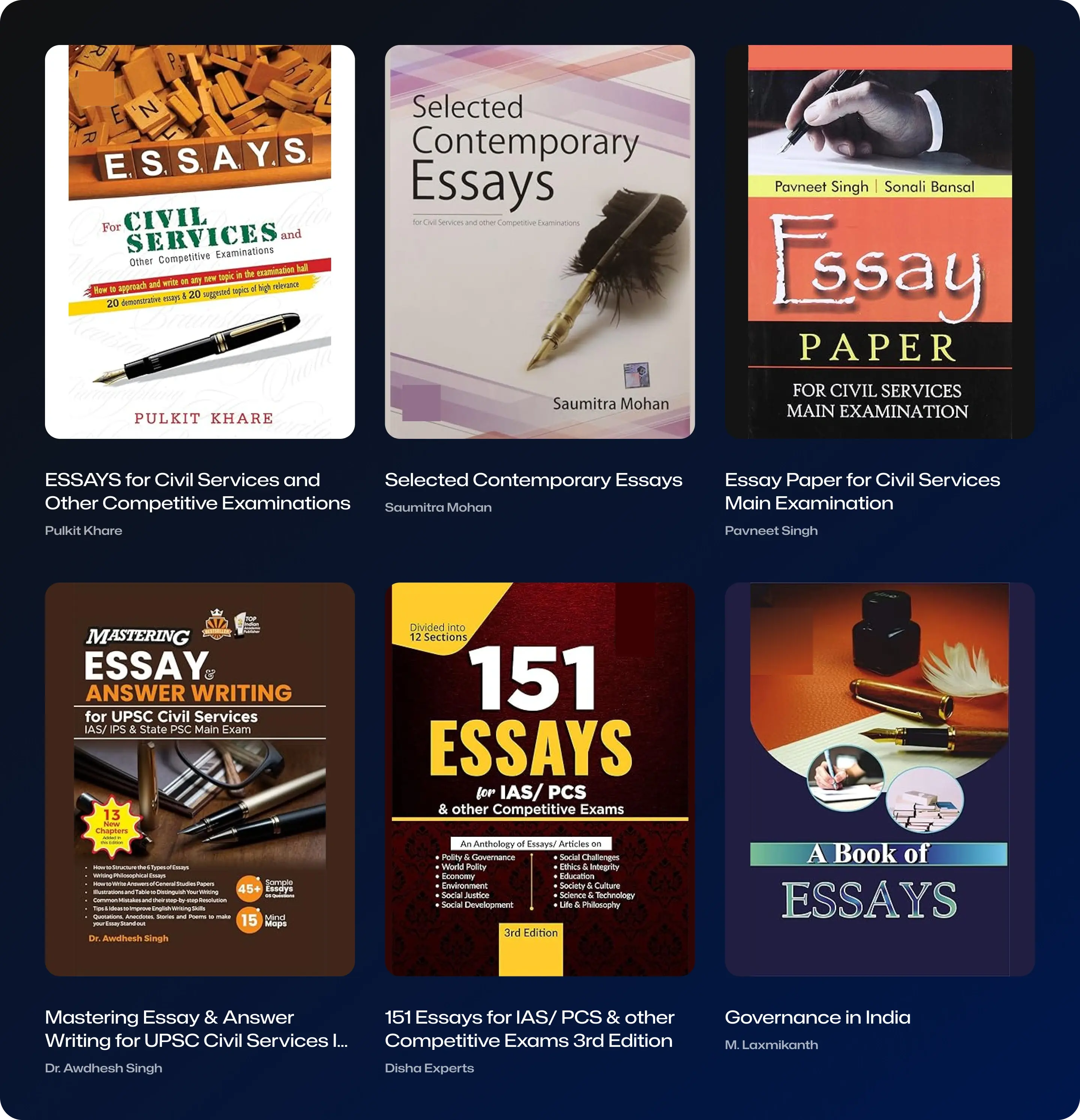
Essays for Civil Services & Other Competitive Examinations (Pulkit Khare): Provides a step-by-step structure for essays. It covers many relevant topics and teaches you how to craft strong introductions, arguments and conclusions.
Selected Contemporary Essays (Saumitra Mohan): A collection of essays on trending issues. Reading these essays helps you integrate current affairs and balanced arguments into your writing.
Essay Paper for Civil Services Main Examination (Pavneet Singh & Sonali Bansal): Contains actual UPSC essay questions with solved answers. Studying these shows how toppers structure essays and use evidence effectively.
Mastering Essay & Answer Writing for UPSC Civil Services (Dr. Awadesh Singh): Offers targeted guidance on essay writing. It includes model essays, mindmaps and quotations to illustrate high-scoring answers.
151 Essays for IAS/PCS & Other Competitive Exams (Disha Experts): A large bank of practice essays on diverse static and current topics. Writing from this book helps you experiment with different themes and identify areas to improve.
A Book of Essays (Kalpana Rajaram): Contains essays beyond the standard syllabus, rich with facts and quotes. This widens your perspective and helps develop a unique voice in your essays.
Beyond these core books, aspirants should read general reference texts for depth. For example, India Since Independence by Bipan Chandra offers historical context, while Discovery of India by Nehru provides broad insights. Ram Ahuja’s Social Problems in India and Neera Desai’s Women in Indian Society cover social issues. Nitin Singhania’s Indian Art and Culture and Greta Thunberg’s The Climate Book are useful for cultural and environmental perspectives. These books supply examples and background that make your essays richer.
Supplementary Books for Depth & Perspective
Beyond core essay guides, books in history, sociology, ethics and the economy enrich your essays. The table below lists some reference books and their strengths:
Book Name | Author(s) | Strength |
India Since Independence | Bipan Chandra | In-depth historical context (freedom struggle) |
The Discovery of India | Jawaharlal Nehru | Broad historical and philosophical view |
Social Problems in India | Ram Ahuja | Data and analysis on social issues |
Women in Indian Society | Neera Desai & Usha Thakkar | Analysis of gender and social issues |
Indian Art and Culture | Nitin Singhania | Comprehensive culture reference |
The Climate Book | Greta Thunberg | Contemporary environmental insights |
The Story of My Experiments with Truth | Mahatma Gandhi | Autobiographical insights, ethical perspectives |
India's Struggle for Independence | Bipin Chandra | Historical context for freedom movement essays |
Getting India Back on Track | Ratan N. Tata, Bibek Debroy | Economic reforms and policy perspectives |
(Many of these books are recommended in UPSC study lists.)
Join our WhatsApp Community
Coverage of diverse topics
A quality essay book covers a wide array of themes: static and current, social and political, economic and philosophical issues.
For example, one guide lists topics across polity, governance, economy, environment, culture and philosophy. Such breadth ensures you can write on almost any essay topic.
Practice material
Look for books with ample practice content: model essays, previous-year questions and solved answers.
For instance, one essay guide provides actual UPSC essay questions with expert solutions. Another popular book contains dozens of sample essays on different themes. Studying these models shows you what examiners expect and lets you practice varied topics.
Guidance on structure and language
Good books teach the ideal essay format. They explain how to write an engaging introduction, logically linked paragraphs and a concise conclusion. Pulkit Khare’s Essays for Civil Services, for example, breaks down the essay into clear steps so you learn to organize ideas under time pressure. These guides also stress clear, precise language over overly complex words.
Updated and relevant content
The best essay books are updated regularly with recent data and issues. They include chapters on trending topics and current events.
For example, Selected Contemporary Essays focuses on the latest themes and shows how to weave in current affairs. Using such books ensures your essays cite recent policies or global events, making them more relevant.
Inspiration and ideas
Top essay books also provide inspiration. They include famous quotes, anecdotes and case studies to enrich your writing. A Book of Essays by Kalpana Rajaram, for example, offers many quotations and facts from eminent personalities. Dr. Awadesh Singh’s book adds mindmaps and philosophical insights to illustrate points. These resources help you add originality and evidence to your arguments.
Build a reading habit: Regularly read newspapers and journals (like The Hindu, Yojana, EPW). This expands your knowledge base and provides examples and quotes for essays, while helping you apply concepts studied in an ethics book for upsc and an economics book for upsc to real-world issues.
Practice writing regularly: Essay writing improves with practice. Start by writing one essay per week, focusing on time management and clear expression. Gradually increase frequency as the exam nears.
Study model essays: Read sample essays and previous-year answers from these books. Note how they frame arguments and conclusions. For example, reading toppers’ essays teaches you effective use of facts and balance.
Connect with current affairs: Update your essays with recent events. Good essay books encourage linking topics to new developments. For instance, citing a recent policy or global event makes your answer more relevant.
Seek feedback: Get your practice essays reviewed by mentors or peers. Feedback helps identify weaknesses in structure, clarity or content so you can improve before the exam.
Add as a preferred Source on Google
Relying only on facts: Writing essays by just listing facts (without analysis) makes them shallow. Good upsc books show how to weave facts into arguments and maintain a logical flow.
Poor structure: Writing long, unorganized paragraphs can confuse the reader. Top essay guides stress the ideal structure (intro-body-conclusion) and often provide outlines, helping you stay organized.
One-sided arguments: Focusing on only one viewpoint leads to imbalance. Quality essay books model balanced writing by presenting and refuting counterarguments, teaching you to write more nuanced essays.
Overly complex language: Using too many big words or making grammatical errors can hurt clarity. Many books advise using clear, concise language. Reading their model essays exposes you to crisp writing styles.
Lack of practice: Under-practising is a common trap. Even the best book won’t help if you don’t write regularly. Books with essay prompts or exercises encourage consistent writing practice and better time management.
By choosing essay books that address structure, balance, clarity and by writing frequently, you can avoid these pitfalls.
Paper structure: The essay paper has 2 sections of 4 topics each; you attempt one from each. Each essay is 125 marks (1000–1200 words), for a total of 250 marks. This is roughly 14% of the Mains score.
High weightage: A strong essay score can greatly boost your overall rank. The essay tests critical thinking and clarity of thought, allowing you to demonstrate your knowledge of current affairs, history and other subjects. These skills benefit not only the essay but all written answers and even the interview.
Examiners look for: Essays must stay focused on the topic, have a clear structure (introduction, body, conclusion), and be written concisely. Examiners reward balanced arguments and precise language, since these reflect the candidate’s analytical ability and writing skills.
Previous Year UPSC Essay Topics (2023-2025)
Analyzing past essay topics helps you understand UPSC's preference for philosophical and contemporary themes. Below are the actual essay questions from the last three years:
Year | Section A Topics | Section B Topics |
2025 | 1. Truth knows no color. 2. The supreme art of war is to subdue the enemy without fighting. 3. Thought finds a world and creates one also. 4. Best lessons are learnt through bitter experiences. | 1. Muddy water is best cleared by leaving it alone. 2. The years teach much which the days never know. 3. It is best to see life as a journey, not as a destination. 4. Contentment is natural wealth; luxury is artificial poverty. |
2024 | 1. Forests precede civilizations and deserts follow them. 2. The empires of the future will be the empires of the mind. 3. There is no path to happiness; Happiness is the path. 4. The doubter is a true man of science. | 1. Social media is triggering ‘Fear of Missing Out’ amongst the youth, precipitating depression and loneliness. 2. Nearly all men can stand adversity, but to test the character, give him power. 3. All ideas having large consequences are always simple. 4. The cost of wrong is less than the cost of doing nothing. |
2023 | 1. Thinking is like a game, it does not begin unless there is an opposite team. 2. Visionary decision-making happens at the intersection of intuition and logic. 3. Not all who wander are lost. 4. Inspiration for creativity springs from the effort to look for the magical in the mundane. | 1. Girls are weighed down by restrictions, boys with demands – two equally harmful disciplines. 2. Mathematics is the music of reason. 3. A society that has more justice is a society that needs less charity. 4. Education is what remains after one has forgotten what one has learned in school. |
Integrate essay prep into your GS study plan. For example:
Daily: Read editorials and make notes of important issues, quotes or statistics. Spend 30–45 minutes reviewing current events and thinking about related essay topics.
Weekly: Set aside one or two days for writing full essays under timed conditions. Start with one essay per week and increase to 2–3 as the exam approaches.
Monthly: Review past essay topics to spot trends. Rotate through different essay books to cover varied themes. Use feedback to refine your content.
For instance, if you study economics one week, spend another day brainstorming and writing an essay on a related theme (like inflation or development). As the exam nears, shift focus fully to writing and revising essays.
Frequently asked question (FAQs)
Which is the best essay book for UPSC for beginners?
Is one book enough, or should I refer to multiple books?
How much practice writing essays is enough before mains?
Should I only read essay books or also general books (history, economy, philosophy)?
How to keep essay content updated with current affairs while using static books?
Choosing the right essay books and practicing with them consistently are key to excelling in the UPSC essay paper. Quality books provide the content, structure and examples you need, but only disciplined reading and writing turn that knowledge into high-scoring essays. Build a habit of daily reading, critical thinking and writing. Remember, books are tools: regular practice, feedback and a clear, analytical mindset will make the biggest difference in your scores. With dedication and the right guidance, you can sharpen your writing skills and succeed in the UPSC exam.





Gajendra Singh Godara
Ex-UPSC Aspirant | Exam Preparation Expert
Gajendra Singh Godara is an IIT Bombay graduate and a UPSC aspirant with 4 attempts, including multiple Prelims and Mains appearances. He specializes in Polity, Modern History, International Relations, and Economy. At PadhAI, Gajendra leverages his firsthand exam experience to simplify complex concepts, creating high-efficiency study materials that help aspirants save time and stay focused.
No comments yet. Be the first to join the discussion!