Best Environment Book for UPSC Prelims and Mains
The best environment book for UPSC is R. Rajagopalan. Know topper-recommended resources for Prelims & Mains with study tips & strategy.

Gajendra Singh Godara
Last updated
5
mins read

Environment and Ecology has become one of the most scoring and high-impact areas in UPSC preparation. Over the past few years, a significant portion of Prelims questions have come directly or indirectly from this subject. It also forms a crucial part of GS Paper 3, Essay topics, Ethics case studies and even interview discussions. If you understand basic concepts, stay updated with environmental news and rely on the right books, this subject becomes one of the easiest to handle.
This guide gathers key insights from the best UPSC preparation sources. It explains everything in simple language. It lists the best books you need to score well in both Prelims and Mains.
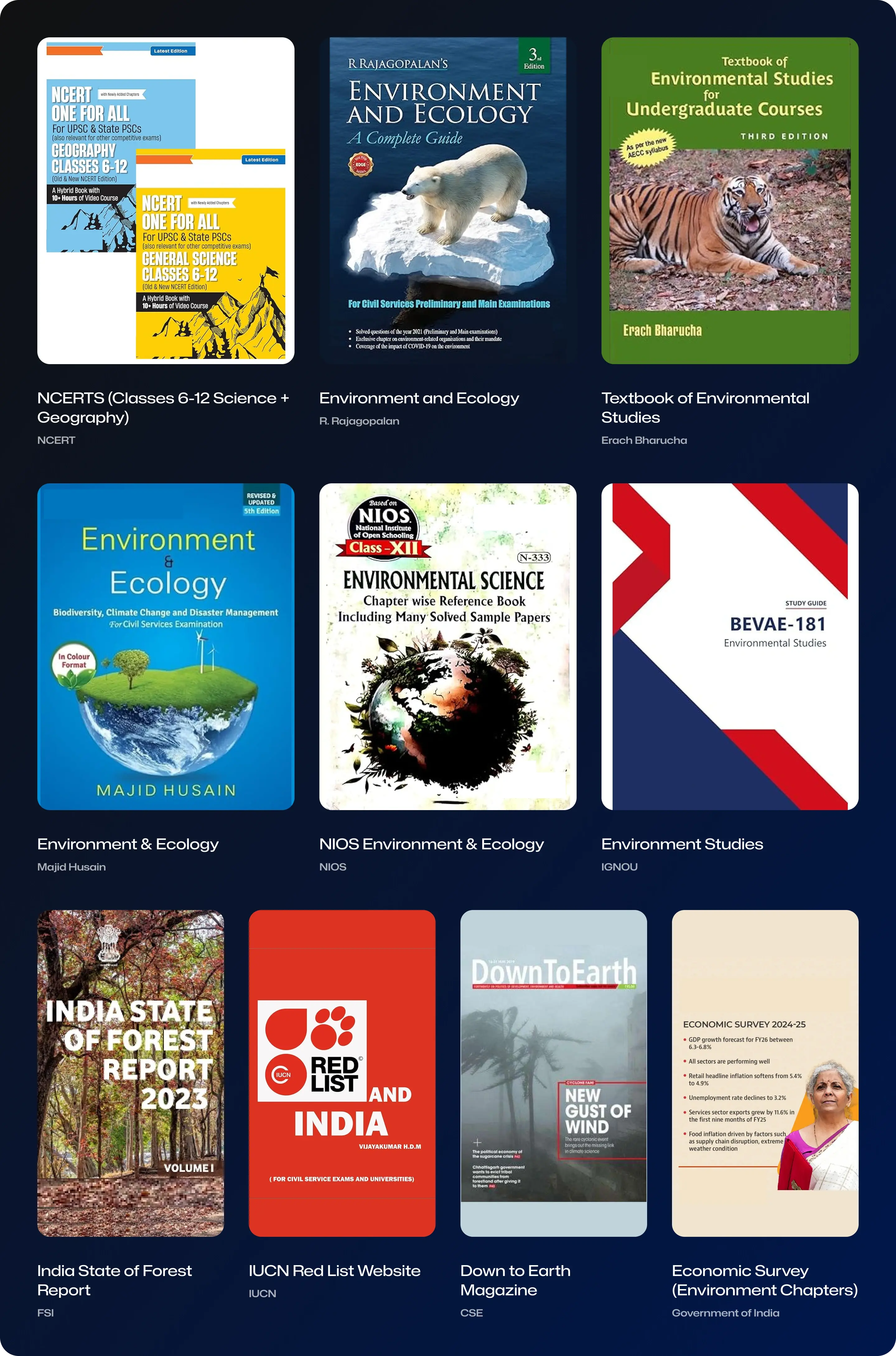
Book | Author / Source | Purpose |
NCERTs (Classes 6–12 Science + Geography) | NCERT | Fundamentals & conceptual clarity |
Environment and Ecology | R. Rajagopalan | Primary reference for Prelims + Mains |
Textbook of Environmental Studies | Erach Bharucha | Prelims-focused, crisp revision |
Environment & Ecology | Majid Husain | Geographical perspective with Environmental issues |
NIOS Environment & Ecology | NIOS | Strengthening basics |
Environment Studies | IGNOU | Advanced concepts for Mains |
India State of Forest Report | FSI | Data-based answers for GS III |
IUCN Red List Website | IUCN | Updated species status |
Down to Earth Magazine | CSE | Current environmental issues |
Economic Survey (Environment Chapters) | Government of India | Policy analysis + data |
The following list includes the explanation of most recommended and high-quality environment books for UPSC including both Prelims and Mains.
NCERT Science and Geography (Classes 6 to 12)
NCERT books build a solid foundation. Specifically focus on:NCERT Biology Class XII (Chapters 13–16): Organisms and Populations, Ecosystem, Biodiversity and Conservation, Environmental Issues (Most important for UPSC)
NCERT Chemistry Class XII: Environmental Chemistry
NCERT Geography Classes VI–XI: Natural resources, climate, biomes
NCERT Science Classes VII–X: Food chains, environmental issues, natural cycles
Environment and Ecology by R. Rajagopalan (Lexis Nexis)
Written with analytical depth and simple language, it facilitates a structured understanding of environmental topics. Many toppers prefer this book for its clarity.
Textbook of Environmental Studies by Erach Bharucha (Universities Press)
A standard UGC textbook used in undergraduate courses. It uses a multidisciplinary approach and is excellent for understanding sustainability and human-environment interaction.
Environment & Ecology by Majid Husain
Combines geographical perspective with environmental issues. Useful if you're already using Majid Husain for Geography.
NIOS Environment and Ecology
A good supplementary source for strengthening basic ideas and improving conceptual understanding without technical complexity.
IGNOU Environment Studies Material
Useful for aspirants who want deeper clarity for Mains answers. It explains sustainability, ecological balance, human-environment interactions and environmental management.
Government Reports and Data Sources
These include:India State of Forest Report (FSI)
IUCN Red List updates
WWF India publications
MoEF&CC annual reports
They help enrich GS-III answers with accurate data, examples and schemes.
8. Additional Helpful Sources
Down To Earth magazine for monthly analysis of environment issues
Science Reporter monthly magazine by CSIR, covers scientific perspectives on environmental issues.
Yojana and Kurukshetra for sustainable development themes
PIB for environment-based government schemes and updates
Economic Survey chapters related to environment, resources and climate policy
Join our WhatsApp Community
Beginners
Start with NCERTs and PadhAI notes, then move to IGNOU books. This combination helps you understand concepts smoothly, similar to the approach followed while starting an economics book for upsc.Intermediate Level
Use IGNOU as your main book. Add current affairs, government reports and species updates regularly.Advanced Level
In addition to the above, read Down to Earth, Economic Survey chapters and select IGNOU notes for depth in GS-III answers and essays.6-Week Simple Study Plan for Environment
Week 1 and 2: NCERTs (Basics and clarity)
Week 3 and 4: IGNOU (Complete understanding)
Week 5: Current Affairs, ISFR, IUCN and Government Schemes
Week 6: Practice 400–500 MCQs and full revision
This method ensures that you cover 100% of the UPSC-relevant content.
Environment is no longer just a science topic. It overlaps with geography, governance, current affairs, agriculture, economy, disaster management and international relations. UPSC asks questions that combine concept, application and awareness.
Growing Weightage in Prelims
Every year, around 15 to 20 questions are asked from Environment alone. These questions help boost your Prelims score because they are usually conceptual and predictable.Strong Link with Current Affairs
Most ecology questions today are inspired by news headlines. Topics such as climate meetings, pollution norms, species recovery, forest conservation and environmental laws are frequently discussed in newspapers and government reports.Major Portion of GS Paper 3
Conservation, biodiversity, environmental pollution, climate agreements, sustainable development, ecological governance and disaster management are central areas in GS 3. It comprises approximately 20% of GS Paper 3 marking scheme, making it a significant focus area alongside economy and security topics.Helps in Essays and Interview
Themes such as climate resilience, sustainability, environmental ethics and water crisis regularly appear in UPSC Essays and personality test discussions.
A Scoring and Conceptual Subject With the right books, weekly revision and adequate practice questions, Environment becomes one of the easiest subjects in the entire UPSC syllabus.
Add as a preferred Source on Google
A simple and practical plan works best for this subject.
Step 1: Build Basic Concepts
Study NCERT textbooks to understand ecology, ecosystems, biomes, food chains, natural cycles, biodiversity, human impact on environment and basic conservation.
Step 2: Move to Standard Reference Books
Books like R. Rajagopalan and IGNOU Environment Studies cover UPSC requirements thoroughly.
Step 3: Integrate Current Affairs
Use newspapers, government portals, environmental magazines and monthly compilations to stay updated on species, policies, agreements and environmental performance indicators.
Step 4: Revise FrequentlyThe environment subject requires periodic revision because many topics overlap. A quick weekly revision helps strengthen memory.
Common Mistakes Aspirants Should Avoid
Depending only on PDFs and ignoring standard books
Not staying updated with species lists and climate reports
Focusing only on theory without linking it to current affairs
Ignoring environmental acts, policies and global conventions
Not revising frequently
Reading too many books instead of building clarity
Final Tips for Scoring High in Environment
Environment becomes extremely easy and high scoring when you combine:
Clear Conceptual Understanding
Updated Current Affairs
Well-Organised Notes
Enough Practice Questions
If you follow a focused approach and rely on trusted sources, In the Environment subject you can score significantly higher in both Prelims and Mains.
Frequently asked question (FAQs)
Which is the best environment book for UPSC?
Should I read NCERTs for Environment?
Is PMF IAS Environment enough for Prelims?
How many months are required to complete the Environment?
How important is current affairs in Environment preparation?
Choose the right resources wisely. Pair a clear reference book (like IGNOU or R. Rajagopalan's Environment and Ecology) with NCERTs for basics, especially NCERT Biology Class XII (Chapters 13–16). Balance strong fundamentals with up-to-date current affairs and regular revision. Creating concise notes and practicing questions will help integrate environment topics into your overall GS preparation and boost your UPSC score.






Gajendra Singh Godara
Ex-UPSC Aspirant | Exam Preparation Expert
Gajendra Singh Godara is an IIT Bombay graduate and a UPSC aspirant with 4 attempts, including multiple Prelims and Mains appearances. He specializes in Polity, Modern History, International Relations, and Economy. At PadhAI, Gajendra leverages his firsthand exam experience to simplify complex concepts, creating high-efficiency study materials that help aspirants save time and stay focused.
No comments yet. Be the first to join the discussion!