Tropic of Capricorn Map | Download PDF and Image
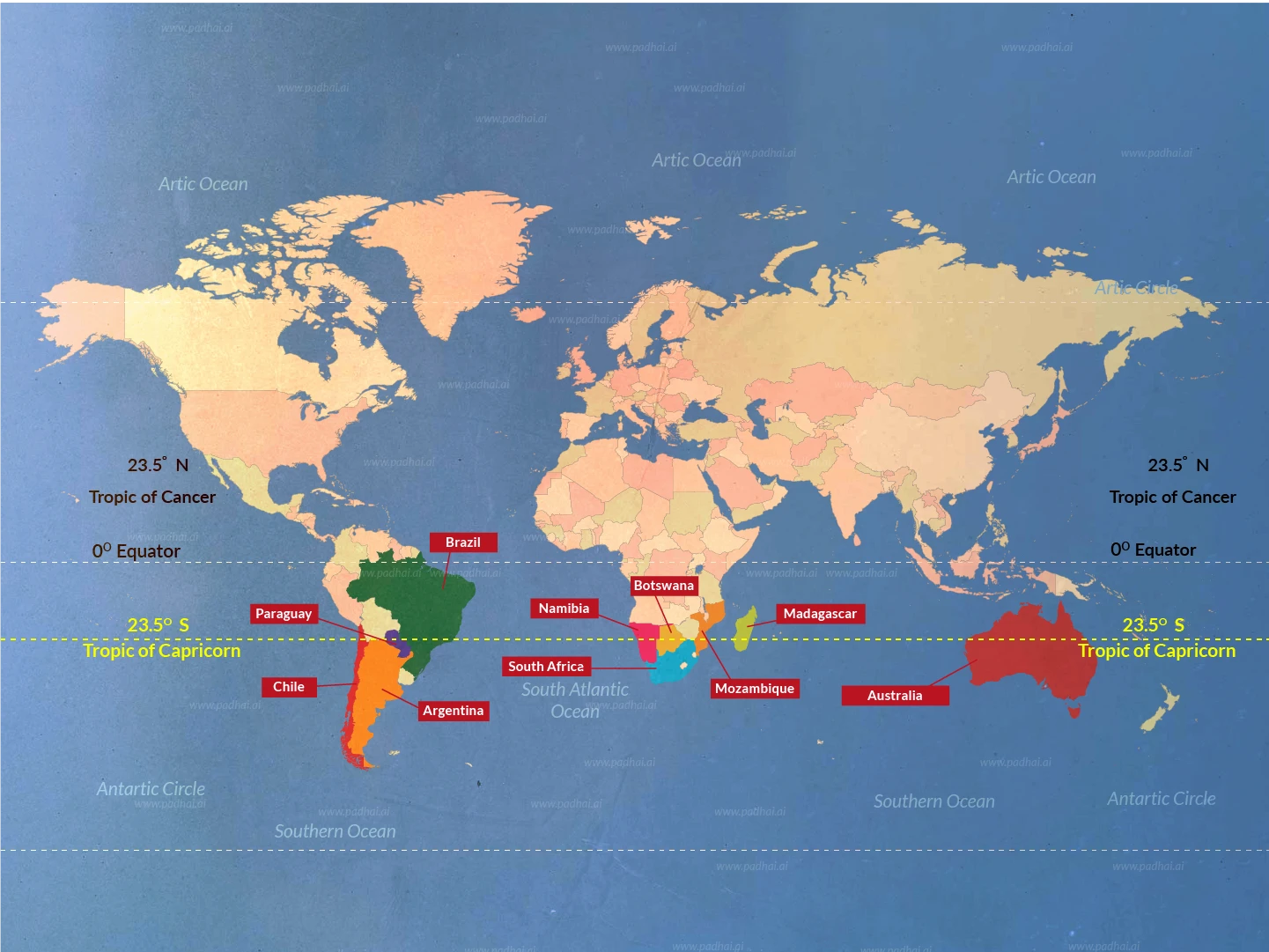
The Tropic of Capricorn is a latitude line at 23.5° South passing through ten countries across South America, Africa, and Australia. It marks the southernmost point on Earth where the sun stands directly overhead during the December solstice.

Gajendra Singh Godara
Last updated
Geographic Trajectory: Countries and Oceans
Understanding the map requires identifying the specific nations and water bodies this latitude transects. The line crosses three continents and three major oceans, establishing a distinct southern belt.
South America
Four nations in South America host this latitude. The line enters the continent on the Pacific coast and exits into the Atlantic.
Chile: Crosses the Antofagasta Region.
Argentina: Passes through Jujuy, Salta, and Formosa provinces.
Paraguay: Intersects the departments of Boquerón, Presidente Hayes, Concepción, San Pedro, and Amambay.
Brazil: Cuts across Mato Grosso do Sul, Paraná, and São Paulo.
Africa
The African continent contains five countries along this parallel.
Namibia: The line crosses the Erongo, Khomas, Hardap, and Omaheke regions.
Botswana: Passes through the Kgalagadi, Kweneng, and Central districts.
South Africa: Restricts its path to the Limpopo Province.
Mozambique: Transects Gaza and Inhambane provinces.
Madagascar: The line crosses the southern provinces of Toliara and Fianarantsoa.
Australia
The latitude bisects the Australian continent, touching Western Australia, the Northern Territory, and Queensland.
Water Bodies
Three oceans lie in the path of the Tropic of Capricorn:
Pacific Ocean: To the west of South America and east of Australia.
Atlantic Ocean: Between South America and Africa.
Indian Ocean: separating Africa and Australia.
Key Highlights of the Southern Tropic
The physical properties of this latitude extend beyond simple cartography.
Solar Geometry and Day Length
The Tropic of Capricorn divides the Southern Temperate Zone from the tropics to the north. This boundary dictates solar exposure.
December Solstice: The sun reaches the zenith here, providing approximately 13 hours and 35 minutes of daylight.
June Solstice: The sun sits 90 degrees below the horizon at solar midnight, reducing daylight to roughly 10 hours and 41 minutes.
Physical Dimensions
The total length of this circle of latitude stands at 36,788 kilometers (22,859 miles). This measurement remains constant relative to the Arctic Circle as they move in tandem.
Is the Latitude Fixed?
No. The coordinates of the Tropic of Capricorn shift continuously. Earth's axial tilt wobbles over a 41,000-year cycle, causing the line to drift northward at a rate of 15 meters (0.47 arcseconds) per year. This drift means the latitude was at exactly 23°27′S in 1917 and will reach 23°26'S by 2045.
Climatic and Topographical Zones
The line intersects diverse biomes and topographical features.
Arid Zones: The latitude cuts through major deserts, including the Atacama in Chile, the Kalahari in Botswana, and the Gibson Desert in Australia.
Agricultural Regions: Rainfall patterns in southern Africa allow for pasture farming and grain cultivation near the Zambezi River.
Mountain Ranges: The Andes in South America and the Great Dividing Range in Australia create significant relief precipitation and rain shadows along this parallel.
Determining Climatic Boundaries
The study of this latitude provides the framework for distinguishing between tropical and temperate climates.
Conclusion
The Tropic of Capricorn is a dynamic geographic marker at 23°26′11.7″ South that transects ten nations and three oceans. Its position defines the southern limit of the direct solar zenith and shifts northward annually due to planetary mechanics. Mastery of this map allows students to correlate solar positioning with the diverse climatic realities of the Southern Hemisphere.


Gajendra Singh Godara
Ex-UPSC Aspirant | Exam Preparation Expert
Gajendra Singh Godara is an IIT Bombay graduate and a UPSC aspirant with 4 attempts, including multiple Prelims and Mains appearances. He specializes in Polity, Modern History, International Relations, and Economy. At PadhAI, Gajendra leverages his firsthand exam experience to simplify complex concepts, creating high-efficiency study materials that help aspirants save time and stay focused.
Suggested Maps