Major Types of Soil in India Map | PDF & Image Download
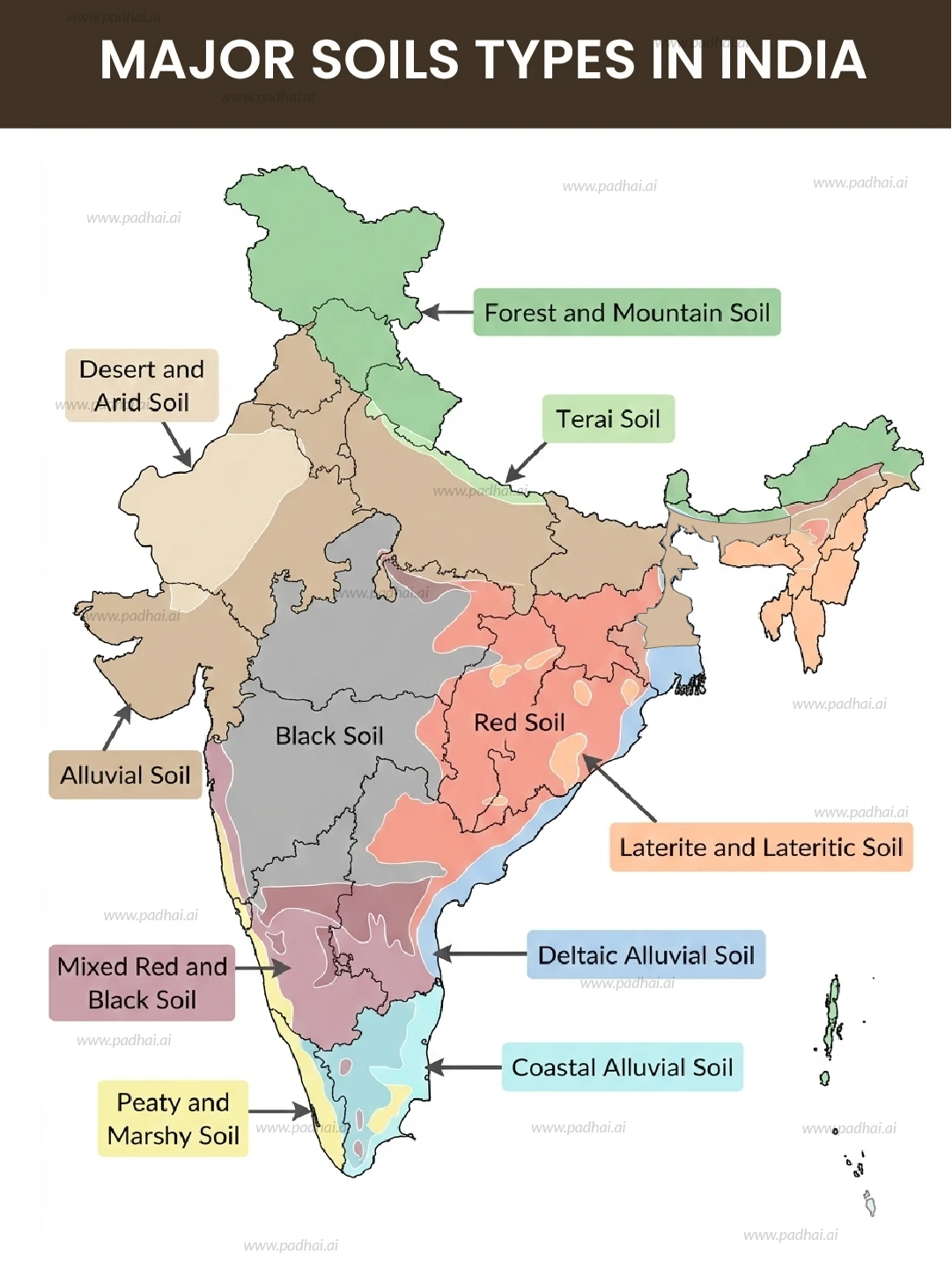
The soil map of India illustrates a complex geographical arrangement governed by lithology and climate. The Indian Council of Agricultural Research (ICAR) identifies eight distinct categories that cover specific zones ranging from the Himalayas to the Peninsular tip. This analysis decodes the map through ten specific distribution points, detailing the location and extent of each primary soil order.

Gajendra Singh Godara
Last updated
Soils in India Geographical Distribution Analysis
ICAR Categorization: The official map divides the Indian subcontinent into eight distinct soil groups based on genesis, color, and composition. These categories align with the USDA Soil Taxonomy and range from the fertile alluvial plains to the saline coastal marshes.
Alluvial Dominance (The Plains): The most extensive zone on the map covers 45-46% of the total land area. This region encompasses the entire Indo-Gangetic plains from Punjab to West Bengal and Assam, as well as the river valleys of the Narmada, Tapti, and the Eastern coastal deltas.
Black Soil Belt (The Deccan): A concentrated dark zone occupies the Deccan Plateau, covering 16.6% of the land. This region spans the states of Maharashtra, Madhya Pradesh, Gujarat, and parts of Karnataka, directly corresponding to the underlying volcanic trap rocks.
Red and Yellow Arc (The Periphery): A vast area of 3.5 lakh square kilometers surrounds the Black soil region. The map displays this soil type in Tamil Nadu, Karnataka, Odisha, Chhattisgarh, and the northeastern states, where ancient crystalline rocks prevail.
Laterite Highlands (The Summits): Discontinuous patches appear on the map in areas of high temperature and heavy rainfall. These specific zones include the summits of the Western and Eastern Ghats, the Vindhyas, the Satpuras, and the Rajmahal Hills.
Arid Zone (The Northwest): The northwestern section of the map, specifically Rajasthan and Northern Gujarat, features Desert (Arid) soil. This area accounts for 4.3% of the landmass and corresponds to regions with aeolian sand deposits.
Mountain Soil (The Northern Border): The northernmost strip of the map represents Mountain or Forest soil, covering 8.6% of India. This distribution follows the Himalayan ranges and extends to the forested slopes of the Western and Eastern Ghats.
Saline and Alkaline Pockets: Small, specific patches appear in canal-irrigated regions like Punjab, Haryana, and parts of Bihar. The map also identifies these saline zones in coastal areas of Maharashtra and Gujarat where tidal influence is high.
Peaty and Marshy Wetlands: Blue-coded areas on the map indicate heavy, organic-rich soils in humid regions. These locations are specific to the Sunderbans in West Bengal, the coastal districts of Odisha, and the backwaters of Kerala.
USDA Soil Orders: When viewed through the lens of modern taxonomy, the map is predominantly colored by Inceptisols (39.7%) and Entisols (28.1%). This distribution indicates that a majority of Indian soils are geologically young or recently formed.
Conclusion
The soil map of India reveals a terrain dominated by Alluvial soil (45-46%) in the plains and Black soil (16.6%) on the plateau. While the Himalayan and Desert regions exhibit distinct climatic soils, the USDA taxonomy classifies the majority of the land as Inceptisols and Entisols.


Gajendra Singh Godara
Ex-UPSC Aspirant | Exam Preparation Expert
Gajendra Singh Godara is an IIT Bombay graduate and a UPSC aspirant with 4 attempts, including multiple Prelims and Mains appearances. He specializes in Polity, Modern History, International Relations, and Economy. At PadhAI, Gajendra leverages his firsthand exam experience to simplify complex concepts, creating high-efficiency study materials that help aspirants save time and stay focused.
Suggested Maps