Food Security in India: Key Issues and Government Initiatives
Food security in India: Over 172 million Indians face undernourishment. Understand the NFSA 2013 framework, PDS reforms, nutrition schemes, and government initiatives.

Gajendra Singh Godara
Last updated
12
mins read
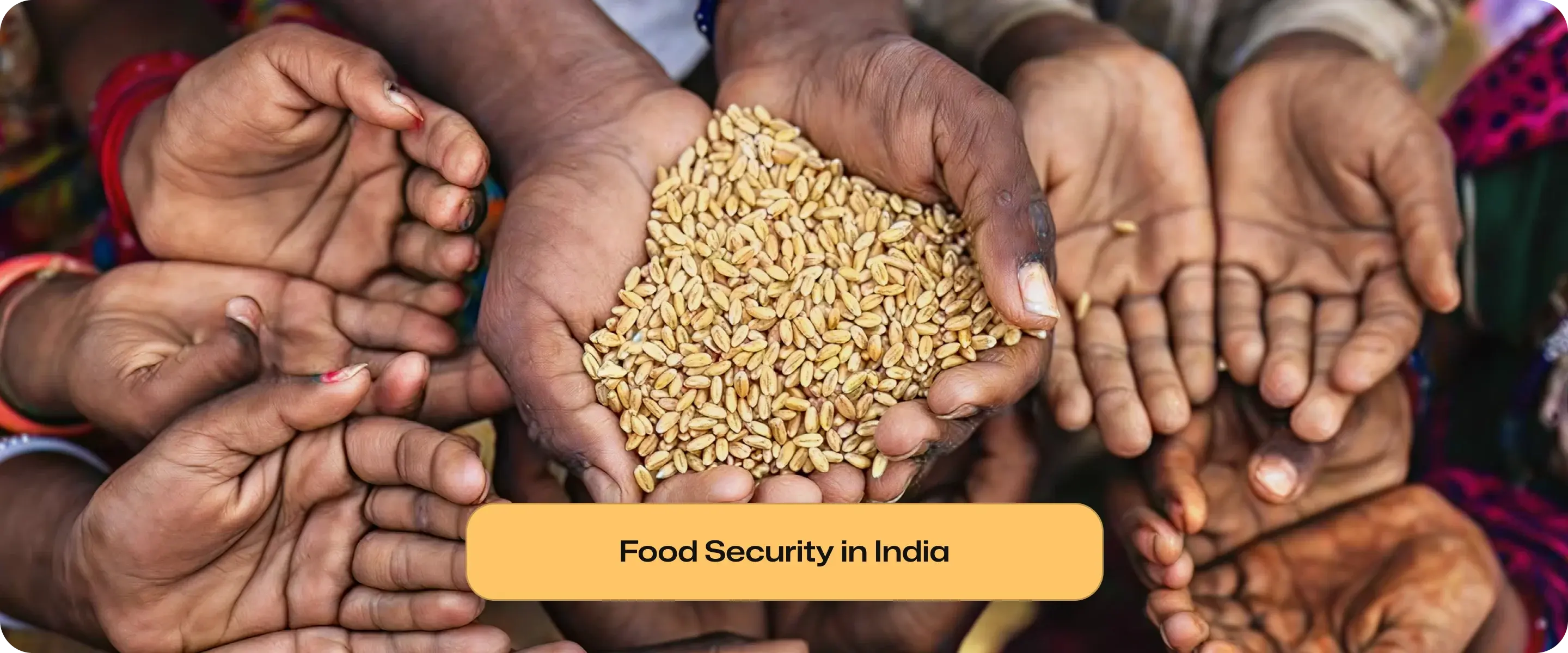
In India, food security means that everyone should always have access to enough food that is safe and healthy, but this is still a very difficult task. Approximately 43% of children experience chronic malnutrition, which has an impact on their health and future, and nearly 195 million Indians remain undernourished despite recent economic growth, though the most recent FAO data (2024) shows 172 million undernourished people in India.
According to the 2022 Global Food Security Index, India came in at number 68 out of 113 countries. Among the main obstacles are poverty, supply chain problems, rising food prices, and unequal distribution. Effective reforms and immediate action are required to ensure that everyone has access to affordable and wholesome food.What is Food Security?
Food security means enough safe, nutritious food for everyone at all times. It has three dimensions:
Availability: Adequate food production and supply.
Access: People’s ability to obtain food (through markets, income or welfare programs).
Utilisation: Proper nutritional use of food in the diet.
Join our WhatsApp Community
As the fifth largest economy in the world and a leading producer of agricultural food, India generates a substantial surplus of food grains. However, paradoxically, India is also home to one of the largest hungry and malnourished populations in the world. For this reason, food security is and remains a national priority.
Massive Undernourished Population: Around 13-14% of India’s population which approximately equates to 180-200 million people comes in the category of being undernourished even after India’s self-sufficiency in grain production.
Absence of Basic Nutrition: The rates of children being malnutritioned in India are highly staggering. As the data says, approx one in every three children (under the age of 5) are stunted and one in every five children are wasted.
Poor Global Ranking: India ranks 105th out of 127 countries in the Global Hunger Index 2024 with a score of 27.3, putting herself in the “serious hunger” category, clearly making food security as one of the largest issues in the country.
Social Isolation: The problem of malnutrition and access to nutritious food is most profound in the children, women, the old population and Scheduled Castes/Tribes people, and the people in rural and backward areas.
Health System Under Strain: The problem of Hidden Hunger which amounts to the deficiency of micro nutrients in the body, leads to high rates of Anaemia, weak immunity and preventable diseases. This puts an extra strain on the healthcare system of the country.
Price Unpredictability: Global shocks such as COVID-19 Pandemic, armed conflicts around the world, natural disasters; they all make food unaffordable and inaccessible for 15-30% of the population.
Sustainable Development Goals: SDG 2 under the United Nations focuses on Zero Hunger which makes the issue of food security a priority for the country.
Agricultural and Production Issues:
Soil health is declining, groundwater is depleting and monsoon rains are erratic. These factors hurt crop yields.
Heavy reliance on a few staples (rice and wheat) and slow adoption of modern farming techniques add risk to production.
Distribution and Access Issues:
The PDS and supply chain suffer leaks and waste. Poor storage and transport cause high post-harvest losses. PDS leakage amounts to approximately 28% of subsidized grains (₹69,108 crore annually).
Food price inflation and global shocks (like pandemics or conflicts) can quickly make food unaffordable for the poor.
Migrant and urban populations often struggle to access subsidised rations.
Nutritional and Equity Issues:
Many diets lack variety and nutrients, leading to “hidden hunger”.
Deficiencies in protein, vitamins and minerals cause high rates of anemia and stunting.
Malnutrition is worse among children, women, the elderly and marginalized communities, and also varies sharply by state.
Institutional and Policy Gaps:
Multiple schemes and agencies can overlap without coordination.
Targeting errors (fake or missing ration cards) remain a problem.
Bureaucratic delays in procurement and distribution can cause shortages.
Often the focus has been on supplying calories (cereals) rather than improving overall dietary quality and nutrition outcomes.
Add as a preferred Source on Google
Constitutional and Legal Basis
India’s Constitution does not explicitly guarantee food, but the Supreme Court has interpreted the Right to Life (Article 21) to include a right to food. Court orders and public activism (for example, the Right to Food movement) urged the government to act. This led to the food security act in India—the National Food Security Act (NFSA) 2013 legally entitling eligible citizens to subsidised food grains.
Major Legislative Milestones
National Food Security Act (2013)
Guarantees subsidised food grains to about two-thirds of India’s population (75% rural, 50% urban, about 81 crore total).
Under this Act, entitled households receive 5 kg of grains per person every month and Antyodaya (the poorest) households receive 35 kg per month.
To ensure food accessibility, the Act includes provisions to sell grains at very low prices (₹3/kg rice, ₹2/kg wheat, ₹1/kg coarse grains at 2013 prices). By default, the eldest woman of the household is the primary ration-card holder.
State Nutrition Acts:
Some other states, in provisions to the national programs, have their own food security or nutrition laws.
However differences in coverage and enforcement at the state level have been noted.
Key Delivery Mechanisms
Public Distribution System (PDS): The government procures foodgrains (through the Food Corporation of India) and keeps buffer stocks. Subsidised food is sold through PDS fair-price shops to ration-card holders. The “Targeted PDS” directs these benefits to eligible poor families.
Nutrition Schemes: The Mid-Day Meal Scheme (free school lunches) and ICDS (supplementary feeding via anganwaadis) provide food for children and mothers. The POSHAN Abhiyaan (Nutrition Mission) coordinates efforts to reduce malnutrition. In crises like COVID-19, programs such as the Pradhan Mantri Garib Kalyan Anna Yojana distributed extra free food to the needy.
Prevalence of Undernourishment: 14% of Indians (2021–23 FAO data), roughly 180–200 million people.
Child Nutrition (NFHS-5): 35.5% of children under five are stunted; 19.3% are wasted; 32.1% are underweight. These rates remain among the highest in the world.
Global Rankings: India’s Global Hunger Index score (2024) is in the “serious” category, placing it around 102nd out of 123 countries. India has one of the world’s highest child wasting rates.
Grain Production vs Hunger: India produces enough food grains and maintains large stocks, yet millions still lack reliable access to adequate food.
Rights-Based Measures:
The food security act in India NFSA 2013 is the main law (a rights-based program) providing subsidised food for ~81 crore Indians.
One Nation One Ration Card (2020) ensures beneficiaries can claim rations anywhere in India, helping migrants.
The government is also piloting direct cash transfers of food subsidy (DBT) in some states to reduce leakages.
Production & Supply Initiatives:
The National Food Security Mission (launched 2007) boosts production of rice, wheat and pulses via better seeds and technology.
Other schemes promote climate-resilient farming (crop insurance, efficient irrigation, improved inputs) and crop diversification (promoting millets, legumes and oilseeds).
Government procurement (minimum support prices) supports farmers’ incomes and stabilizes food supply.
The PM Dhan Dhaanya Krishi Yojana (PMDDKY) was launched to bridge the productivity gap in 100 underperforming districts. By converging 36 existing schemes, it focuses on improving soil health, providing credit, and building storage infrastructure, which directly enhances the ‘Availability’ pillar of food security.
Nutrition-Centric Initiatives:
The Mid-Day Meal program (free school lunches) and ICDS (anganwaadi feeding) directly address child and maternal nutrition.
POSHAN Abhiyaan (2018) integrates ministries and stakeholders to reduce child stunting and anemia.
Food fortification programs (e.g. fortified rice and iodised salt) aim to improve the nutrient content of staples.
Storage, Logistics & Tech Reforms:
The government is expanding modern warehousing and cold chains to reduce losses.
Digital reforms include e-PoS machines at ration shops, Aadhaar-linked ration cards and mobile alerts for beneficiaries.
The e-NAM digital market links farmers to wider markets. Public-private partnerships are being encouraged in food storage and logistics.
Shift to Nutrition Security: Government policies and initiatives should start focusing on other valuable foods like millets, fortified staples, fruits and vegetables. Along with these initiatives like educational food and nutritional programs (Kitchen Garden), should be implemented to fight with the problem of hidden hunger.
Expand Coverage and Access: Making sure that all the vulnerable sections including women, migrants, old people, urban poor and disabled get access to nutritious food. This can be done by enhancing portability and transparency of schemes.
Build Climate Resilience: Investing in climate-smart agriculture, drought resistant seeds, water efficient irrigation (micro-irrigation, rainwater harvesting) and expanding crop insurance, making sure that farmers can withstand the extreme weather.
Enhance Supply Chains: Improve rural roads, storage and cold chains to reduce spoilage. Fully digitize the PDS (online ration cards, real-time tracking) to minimize fraud. Engage communities in monitoring and grievance redressal.
Policy and Institutional Reforms: Use data (Aadhaar, surveys) to update beneficiary lists and eliminate fake cards. Improve coordination between agriculture, health and social welfare departments. Incentivize private investment in food processing and logistics to create a more efficient food system.
Prelims
Q. With reference to the provisions made under the National Food Security Act, 2013, consider the following statements: (2018)
The families coming under the category of ‘below poverty line (BPL)’ only are eligible to receive subsidised food grains.
The eldest woman in a household, of age 18 years or above, shall be the head of the household for the purpose of issuance of a ration card.
Pregnant women and lactating mothers are entitled to a ‘take-home ration’ of 1600 calories per day during pregnancy and for six months thereafter.
Which of the statements given above is/are correct?
1 and 2 only
2 only
1 and 3 only
3 only
Answer: (b)
Mains
Q. In what way could replacement of price subsidy with Direct Benefit Transfer (DBT) change the scenario of subsidies in India? Discuss. (2015)
Frequently asked question (FAQs)
What is meant by food security?
What are the four pillars of food security?
Which are the three dimensions of food security in India?
What is the coverage under NFSA 2013?
What are major problems of food security in India?
Despite India experiencing a surplus in food production, hunger and malnourishment continue to prevail. Considering food security holistically entails addressing the quality of diets, equitable access, and resilience to climate shocks. These facets of food security will require the implementation of integrated action policy reforms in the areas of agriculture, nutrition, and welfare.
UPSC aspirants will find this integrated argument relevant to both GS3 and GS2; constructing a robust response will require strong definitional clarity, contemporary evidence in the form of data, identification of key legislations and landmark schemes, and the articulation of challenges and possible answers in the context of poverty, welfare, and agriculture policies.




Gajendra Singh Godara
Ex-UPSC Aspirant | Exam Preparation Expert
Gajendra Singh Godara is an IIT Bombay graduate and a UPSC aspirant with 4 attempts, including multiple Prelims and Mains appearances. He specializes in Polity, Modern History, International Relations, and Economy. At PadhAI, Gajendra leverages his firsthand exam experience to simplify complex concepts, creating high-efficiency study materials that help aspirants save time and stay focused.

No comments yet. Be the first to join the discussion!