Green Revolution in India: History, Objectives & Impact

Gajendra Singh Godara
Last updated
9.5
mins read
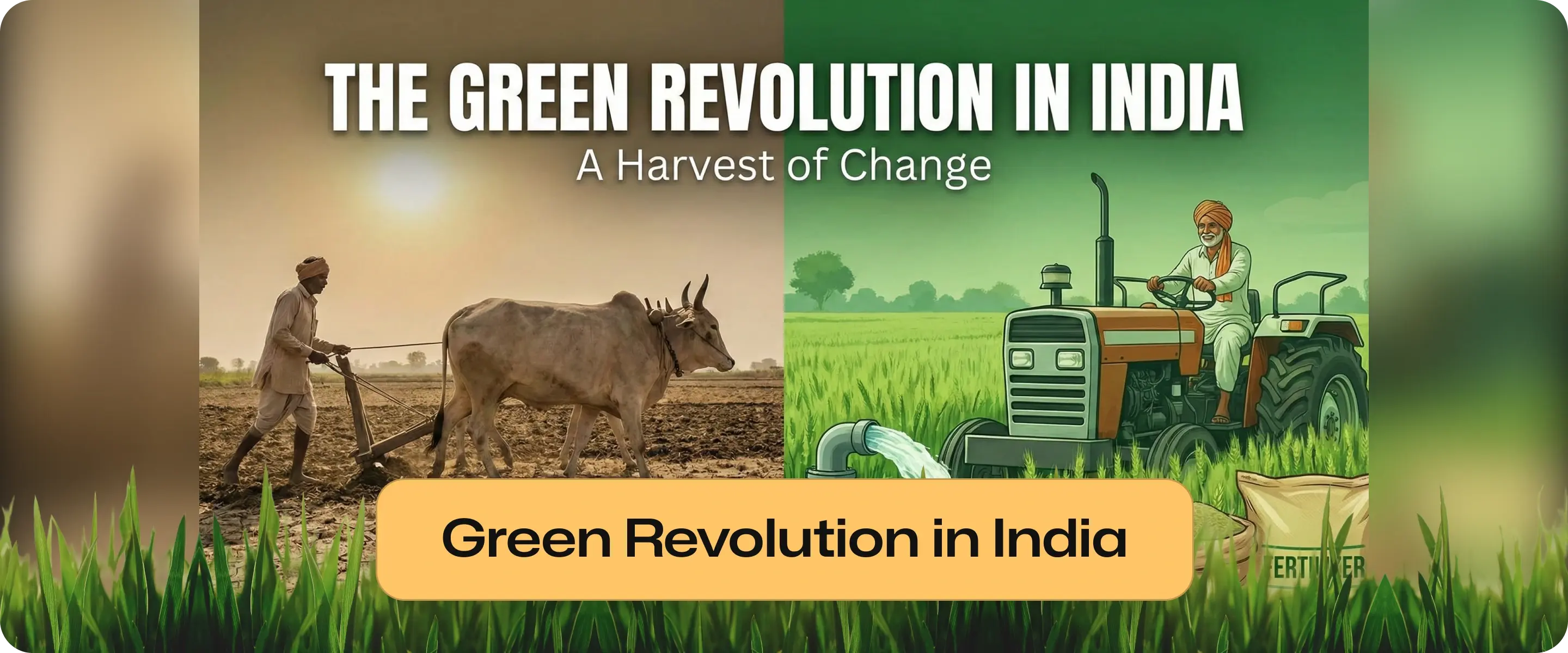
The Green Revolution in India was a period (from the mid-1960s) when new farming methods greatly increased crop yields. Traditional farming gave way to modern, technology-driven practices. Punjab and Haryana saw major yield increases. The Green Revolution increased India's grain self-sufficiency and prevented famines, but it also degraded soil and water, exacerbated rural inequality, and created long-term environmental and health problems.
Background and Need
When India gained independence in 1947, the agriculture practiced was traditional, and the productivity was low. Most farmers relied on the monsoon and on old farming methods.
In the 1950s and 1960s, with the rapidly growing population, there was a critical food shortage, and India had to start importing grains.
The 1943 Bengal Famine was a devastating food shortage that showed the dangers of food insecurity, therefore, reinforcing the need to modernise agriculture.
By the 1960s, the need for modern agriculture was a national priority for the Government.
Join our WhatsApp Community
In the 1960s, the Green Revolution in India became the basis for a new agricultural policy. The change was due to the agricultural scientists in India.
Dr. M. S. Swaminathan was the first to collaborate with Dr. Norman Borlaug, the American agronomist who was developing high-yield dwarf varieties of wheat in Mexico.
Dr. M. S. Swaminathan is called the “Father of the Green Revolution in India” because he introduced those techniques here and adapted them to India's needs.
In India, the Green Revolution began in 1965-66, a time when the country experienced two back-to-back droughts, resulting in severe food scarcity and a dependence on food imports.
To ensure food security, the Indian Government shifted focus to developing high-yielding variety (HYV) seeds, chemical fertilizers, and expanded irrigation systems for effective land use.
Add as a preferred Source on Google
Lal Bahadur Shastri also used the slogan, “Jai Jawan, Jai Kisan” to advocate for increased agricultural output, and “produce or perish” across the entire country, and agricultural and land reforms were “the new frontier” of the country.
Programs like IADP (Intensive Agriculture Development Program), launched in 1960-61, and IAAP (Intensive Agriculture Area Programme) were launched in 1964-65.
In 1974, the Command Area Development Programme (CADP) was introduced with two components: On-farm development (land levelling, water channels, soil prep) and Off-farm development (roads, markets, rural transport).
After wheat production jumped from 12 million tonnes in 1965 to 17 million tonnes in 1968, India significantly reduced grain imports, though it resumed limited imports by the mid-1970s.
Short-term objectives:
The goal was to avoid hunger by boosting staple grain output. Policymakers wanted to raise yields quickly so India could feed its growing population and reduce imports.
Higher harvests would allow better food stocks and help stabilize prices year to year.
Building reserve stocks of grain was part of the plan as a safety buffer against future droughts.
Long-term objectives:
The plan was to modernize agriculture into an efficient industry. This would raise farmer incomes and create more rural jobs.
Abundant harvests would supply agro-industries (mills, food processing, textiles from cotton, etc.), linking farming to broader economic growth.
A strong agricultural sector was seen as essential for rural development and the overall economy.
These changes increased spending power in villages and helped grow rural businesses.
High-Yielding Varieties (HYVs) of Seeds
Core Innovation
The introduction of high-yielding varieties (HYVs) of wheat and rice is what most scholars and the public alike consider the start of the Green Revolution in India. These were scientifically designed to take much traditional seed to produce a greater amount of grains per acre.
Examples of New Seeds
Sonalika and Kalyan Sona were one of the first dwarfed wheat variants being introduced to India. The rice variant IR8, produced in the Philippines, was designed to produce high yields and was dubbed miracle rice.
Conditions for Success
For these wheat and rice variants to yield high returns, they would need adequate irrigation and the use of chemical fertilizers and pesticides. High returns benefited regions with strong irrigation systems, these being Punjab, Haryana, and western Uttar Pradesh.
2. Improved Irrigation and Mechanization
Expansion of Irrigation
As a result of the water-intensive HYV crops, the construction of irrigation systems shifted into overdrive. During the Green Revolution, the construction of canals and water systems shifted into overdrive to guarantee water provision the whole year round.
Rise of Mechanized Farming
The Green Revolution in India brought unprecedented levels of farming mechanization. The traditional bullock-drawn equipment was replaced with tractors, and electric pumps were also introduced in larger numbers.
The increase in the number of tractors from 37,000 in 1960 to over a million by 1990 enabled farmers to grow bigger and faster.
3. Treating Crop and Rural Credit
Use of Modern Inputs
The incorporation of chemical pesticides and fertilizers is a large contributor to the increase in the rate of productivity for crops.
The fertilizers consumed in the 1990s increased from below 1 million tonnes in the 1960s to over 12 million tonnes.
Financial Support for Farmers
The Government of India and rural banks designed certain agricultural credit schemes since modern inputs were costly.
Loans for seeds, fertilizers, and equipment were provided by cooperative and nationalized banks; hence, farmers could participate in the Green Revolution.
4. Growing in the Cultivated Area
Double Cropping
Double cropping is growing for two seasons a year. It is a major feature of the Green Revolution in India and has helped increase productivity.
Wheat and rice become a common rotation, and the output in the land is greatly increased.
Widening the area in farming
The use of improved fertilizers and irrigation has enabled farming in previously uncultivated and low-yielding land.
This has not only boosted agricultural output but also increased employment in the fields and provided food security to the rural areas.
5. Commercialization of Agriculture
Introduction of Minimum Support Prices
For the first time, farming became market-driven rather than subsistence-based. The Government introduced Minimum Support Prices (MSP), guaranteeing returns to farmers. This transformed the farmer’s mindset from ‘survival production’ to ‘profit production’.
Phase I (Mid-1960s to ~1980)
Foundation Phase – Wheat Revolution in the Northwest
Region of Focus: Primarily Punjab, Haryana, and western Uttar Pradesh.
Main Crop: Wheat — the first major success of the Green Revolution.
Key Developments:
High-yield varieties of wheat, Sonalika and Kalyan Sona, were introduced.
Irrigation infrastructures through canals and tube wells expanded rapidly.
Farm mechanization — tractors, threshers, and pumps became common.
Impact of the First Phase:
Punjab was the “Breadbasket of India” for its record harvest of grains.
India started to reduce its dependency on imports.
Phase II (1980s to ~1990)
Expansion Phase – Rice Revolution and Regional Spread
Region of Focus: Expansion to southern and eastern states, including Andhra Pradesh, Tamil Nadu, and eastern Uttar Pradesh.
Main Crops: Rice and wheat — with a new focus on high-yield rice varieties like IR8 and Jaya.
Key Developments:
High-yielding rice seeds have been widely adopted, particularly in irrigated zones.
Continued use of fertilizers, pesticides, and machinery improved productivity.
Impact of the Second Phase:
Yields increased significantly in the new regions.
Benefits see a shift from regional to national, with a discernible impact in both northern and southern India.
Economic impact is positive for India and a site for rural prosperity in several states.
Phase III (1990s Onward)
Diversification – Moving Past the Focus on Rice and Wheat
Aim: To broaden the regional and crop focus of the Green Revolution to include the eastern and semi-arid territories of India.
Principal Shifts: The focus moved to new crops like maize, sorghum, millets, and pulses.
Key Developments:
Seed research yielded several new classes engineered for dryland agriculture.
The eastern states of Bihar, Odisha, and West Bengal were targeted by government yield improvement initiatives.
The shift from research primarily directed at sustaining crops to agro-based research focused on crop moderation sparked innovations in sustainable agriculture.
Impact of the Third Phase:
Intensified Double Cropping, especially in Punjab, where traditional crops like maize and pulse were replaced with wheat and rice.
Although it led to integrated food production and stabilized national food security, it also led to groundwater depletion, reduced crop diversity, and unsustainable farming practices.
This laid the foundation for the discourse on a “Second Green Revolution in India,” stressing the need for equity, diversification, and sustainability.
Positive Impacts of the Green Revolution
Food Security and Self-Sufficiency: India transitioned from being a food-deficient country in the 1960s to being self-sufficient and, by the 1970s, a surplus producer of food grains. With this, the country’s dependence on foreign aid and imports was lifted.
Increased Productivity: The combination of high-yielding varieties (HYVs) of wheat and rice, irrigation, fertilisers, and mechanisation resulted in a significant rise in crop yields, especially in the Punjab, Haryana, and western Uttar Pradesh regions.
Economic Growth and Farmer Prosperity: The increase in farm yields translated into better incomes, strengthened rural economies, and poverty reduction in agriculturally advanced states.
Institutional Development: The Green Revolution stimulated the growth of agricultural research, extension, and rural infrastructure (canals) and electrification.
Employment Opportunities: The rise in farm activities and rural infrastructure created jobs in agriculture and its allied sectors, including the agro-machinery and fertiliser industries.
Negative Impacts of the Green Revolution
Environmental Degradation: Soil and water pollution, and escalating problems of unfertilized and overeploited soil, were the products of excessive and unreasonable amounts of chemical fertilisers, pesticides, and groundwater exploitation.
Regional Imbalances: The punishing of unexploited rain-fed regions and the eastern parts of the country created and exaggerated an unjust focus on a handful of irrigated regional states.
Social Inequality: The gap between large-scale subsistence farmers and smaller subsistence farmers created inequitable competition in subsidy and technological access, leading to unbalanced and inequitable gains.
Reduction of Biodiversity: By practicing monocropping of wheat and rice, we substantially reduced diversification and made the ecosystem fragile.
Chemical residues in the food chain become potent and affect the health of future generations and the environment, posing a health risk.
Regional Disparities and Missed Areas
Many areas of eastern and rain-fed India missed the Green Revolution.
In Bihar, Odisha, and similar regions, rice yields stayed around 2–2.5 tonnes per hectare, far below the 5–6 tonnes per hectare in Punjab.
These regions lacked the canals, groundwater, and roads needed for HYV farming. Most farmers there were smallholders who could not afford costly seeds, fertilizers, or pumps. Credit and market support were limited.
Consequently, the gap between the irrigated northwest and other regions widened, and income inequality deepened.
For instance, average farm incomes in eastern India often remained around half the national average because yields stayed low.
Way Forward: Towards an Evergreen Revolution
Promote Sustainable Productivity
There should be an emphasis on attaining sustainability and attaining a high standard in the quality of food produced, rather than attaining high yields in food production by following sustainable development goals.
Motivate organic farming and natural farming techniques that maintain and defend the fertility and ecological balance of soils, and the flourishing of biodiversity.
Efficient Resource Management
Enhance the efficiency of the use of water through micro-irrigation, rainwater harvesting, and watershed development.
Adopt farming technologies that are energy-efficient, low-emission, and environmentally friendly.
Crop Diversification And Nutrition Security
Go beyond the production of surplus wheat and rice. Actively promote the cultivation of pulses, millets, and oilseeds.
Support local food systems and promote the cultivation of nutritionally valuable crops to help diversify diets.
Empowering Farmers
Enhance the provision of credit, market, and access to modern technology, specifically to small and marginal farmers.
Increase the scale of farmer-producer organizations (FPOs) to strengthen the system, allow collaborative leverage, and assure earnings.
Climate-Resilient Agriculture
Construct and disseminate climate-adaptive seeds and cropping methods.
Use a synthesis of climate-adaptive farming practices with weather forecasting and other digital technologies to help farmers deal with climate change impacts.
Policy and Institutional Support
Integrate policies concerning agriculture with alignment to ecological balance, ensuring long-term policies.
Expand and strategically allocate resources to rural-embedded research, rural infrastructure, and rural-embedded innovative practices to promote integrated growth that is inclusive and resilient, and to achieve ecological balance.
UPSC Previous Year Questions
Q. How did India benefit from the contributions of Sir M. Visvesvaraya and Dr. M.S. Swaminathan in the fields of water engineering and agricultural science, respectively? (2019)
Q. Explain various types of revolutions that took place in Agriculture after India's independence. How have these revolutions helped in poverty alleviation and food security in India? (2017)
Q. Why did the Green Revolution in India virtually bypass the eastern region despite fertile soil and good availability of water? (2014)
Frequently asked question (FAQs)
Who is called the father of the Green Revolution in India?
When did India’s Green Revolution begin?
What were the main crops of the Green Revolution in India?
What is the main importance of the Green Revolution in India’s economic development?
What major environmental challenges arose from the Green Revolution in India?
The Green Revolution in India was a turning point. It changed farming from chronically low-output to highly productive.
New seeds and methods helped India go from imports and hunger to food surplus and steady growth. Many lives were saved, and rural incomes grew, especially in the main farming regions. Yet the revolution also came with costs: damage to soil and water, and unequal benefits for farmers.
Today, India applies these lessons by using modern science and better practices to raise yields and allow more sustainable agriculture practices, which are aligned with SDGs. Its experience guides India toward a future agriculture that is productive, inclusive, and eco-friendly.





Gajendra Singh Godara
Ex-UPSC Aspirant | Exam Preparation Expert
Gajendra Singh Godara is an IIT Bombay graduate and a UPSC aspirant with 4 attempts, including multiple Prelims and Mains appearances. He specializes in Polity, Modern History, International Relations, and Economy. At PadhAI, Gajendra leverages his firsthand exam experience to simplify complex concepts, creating high-efficiency study materials that help aspirants save time and stay focused.

No comments yet. Be the first to join the discussion!