Best Ethics Book for UPSC Mains: 2026 Topper’s Booklist
Best Ethics book for UPSC Mains: A curated list of topper-recommended books, syllabus breakdown, and GS Paper-4 strategy to score 130+ score in Ethics Paper.

Gajendra Singh Godara
Last updated
10
mins read
Ethics, Integrity and Aptitude (GS Paper-4) is a unique and high-value section of the UPSC Mains exam. It tests a candidate’s moral reasoning and decision-making in real-world scenarios. With 250 marks and a mix of theory and case-study questions, this paper can significantly boost your score if prepared properly.
Choosing the right Ethics, Integrity, and Aptitude book for UPSC is crucial because a good resource lays a clear foundation of concepts and provides plenty of practice examples. In this post, we explain why ethics matters in UPSC, which books are most valued, and how to build an effective GS Paper IV strategy.
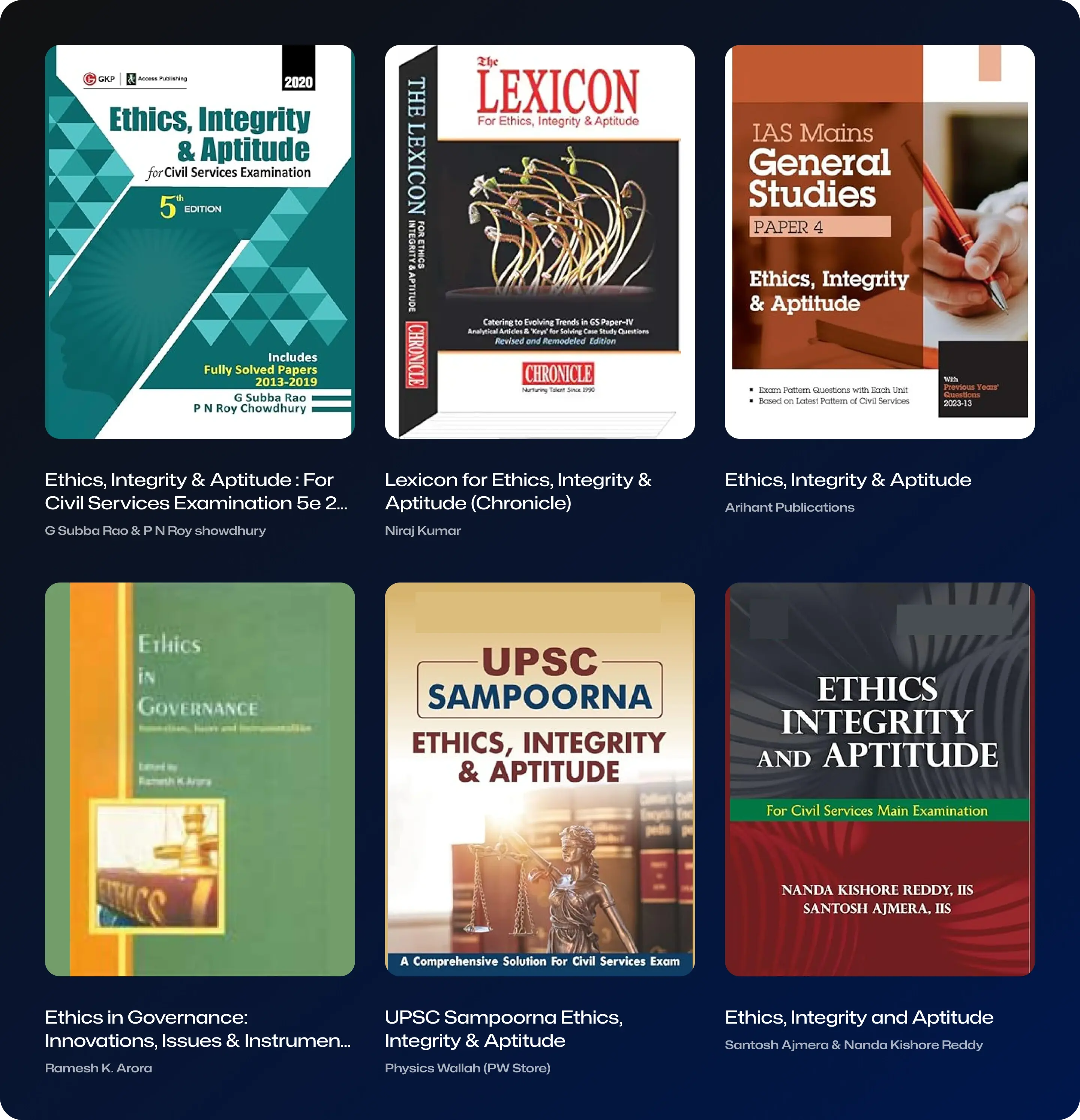
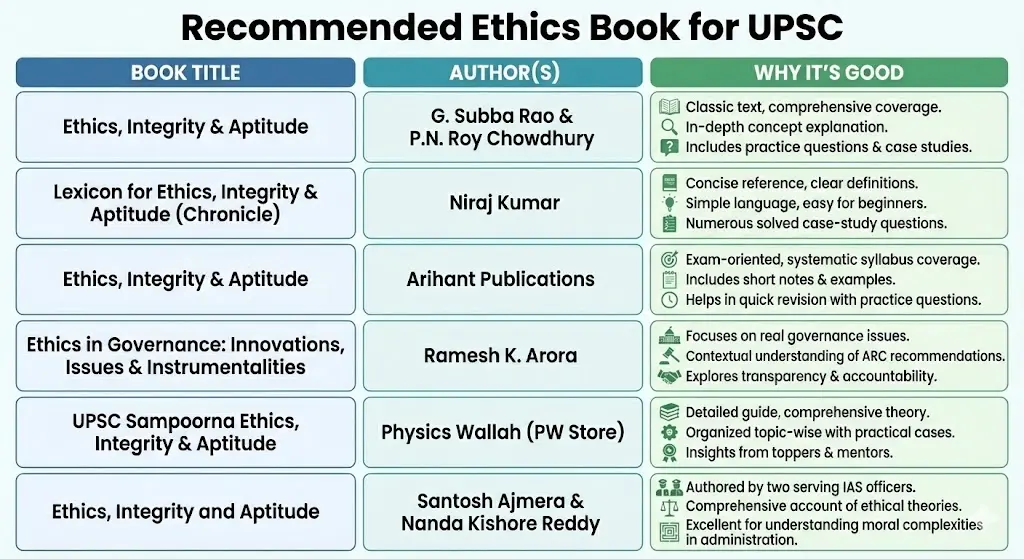
UPSC Aspirants should focus on books that match the GS paper-4 Ethics syllabus and have plenty of examples. The table below lists some top books for upsc:
Book Title | Author(s) | Why it’s good |
Ethics, Integrity & Aptitude | G. Subba Rao & P.N. Roy Chowdhury | A classic text offering comprehensive coverage of ethics topics and many case studies. It explains concepts in depth and includes questions for practice. |
Lexicon for Ethics, Integrity & Aptitude (Chronicle) | Niraj Kumar | A concise reference with clear definitions and numerous examples. Its simple language helps beginners grasp ideas easily, and it has plenty of solved case-study questions. |
Ethics, Integrity & Aptitude | Arihant Publications | An exam-oriented guide covering all syllabus points systematically. It includes short notes, illustrative examples and practice questions, which help in quick revision. |
Ethics in Governance: Innovations, Issues & Instrumentalities | Ramesh K. Arora | Focuses on real governance issues and ARC recommendations. It provides contextual understanding of transparency, accountability and public ethics through governance case studies. |
UPSC Sampoorna Ethics, Integrity & Aptitude | Physics Wallah (PW Store) | A detailed guide with comprehensive theory and many practical case studies. It’s organized topic-wise and includes insights from toppers and mentors. |
Ethics, Integrity and Aptitude | Santosh Ajmera & Nanda Kishore Reddy | Authored by two serving IAS officers. Provides a comprehensive account of ethical theories and real-world dilemmas. Excellent for understanding moral complexities in administration. |
These books are widely used by UPSC candidates and teachers. Some aspirants also use “A Short Introduction to Ethics” by Simon Blackburn for philosophical background, though it is less directly exam-focused. You may also consult annual magazines (like Yojana) or government reports such as Administrative Reforms Commission (ARC). The key is to stick to a few resources and study them thoroughly.
Join our WhatsApp Community
Many aspirants often ask, “Which is the best ethics book for UPSC Mains?”
There isn’t a single answer. Instead, the best book depends on clarity, coverage, and how well it matches your study style, much like choosing the right essay books for effective answer writing.
Experts stress starting with basics and picking one or two standard texts, rather than many references.
For fundamentals, study the NCERT Psychology Class 11 and 12 books. These introduce concepts like human behavior and values in simple terms. After that, move to a standard ethics text.
Always cross-check each topic with the UPSC syllabus and past questions. This ensures you don’t miss key values (like honesty, empathy, impartiality) and theories (such as utilitarianism, deontology) that recur in the exam.
Total Marks: 250 marks
Duration: 3 hours
Question number: The paper usually consists of 12–14 questions in total.
Section A (Theory): This section focuses on the core concepts of ethics, integrity, and aptitude. It carries 125 marks.
Section B (Case Studies): This section tests how you apply ethical principles to real-world problems. It is also worth 125 marks.
Question Format: Questions carry either 10 marks or 20 marks. For 10-mark questions, the word limit is 150 words. For 20-mark questions, the word limit is 250 words.
Add as a preferred Source on Google
Yojana Magazine: Monthly publication covering ethics-related governance initiatives and policy decisions
Press Information Bureau (PIB): Official government announcements relevant to public administration ethics
Ministry of Personnel and Public Grievance (DOPT): Publications on civil service conduct rules
National Commission Reports: Various commission reports on ethical governance and social issues
The Second ARC Report on `Ethics in Governance’ is more than just another book to read. Using its summary you will be able to understand the key ideas and how to quote them in UPSC mains answers.
Newspaper Editorials: Read ethics-related opinion pieces in The Hindu and Indian Express
Supplementary Resources: Biographies and Historical References
While not textbooks, the following biographies provide practical ethics examples that strengthen answers:
Mahatma Gandhi: Experiments with Truth – Demonstrates integrity, non-violence, and sacrifice
Varghese Kurien (Autobiography): Shows dedication to public service and social responsibility (White Revolution)
Swami Vivekananda – Karmayoga and Biography: Explores duty, service, and moral philosophy
Contemporary Leaders: Study cases of ethical administrators and their decision-making (e.g., Ratan Tata's philanthropy, N.R. Narayana Murthy on corporate ethics)
Those examples personalize ethics concepts and make your answers more compelling.
1. Master the syllabus and values:
Start by reviewing the official UPSC syllabus for GS Paper IV.
Key areas include Ethics and Human Interface, Attitude, Aptitude and Core Values, Emotional Intelligence, Public Service Ethics, and Case Studies.
Identify values like integrity, empathy, impartiality, objectivity, etc., which UPSC highlights.
Make a list of core concepts (e.g., honesty, probity, CSR, corporate ethics) and thinkers (e.g., Gandhi, Tagore on ethics) that often appear.
2. Build your foundation:
As you study upsc books, highlight or note down important definitions, principles and examples.
Writing notes in your own words reinforces learning and creates quick revision material.
Also, create mind-maps or charts for the hierarchy of values and ethical theories so you can recall them during the exam.
3. Regular answer writing practice:
Ethics is an application paper, so practice is vital. Use Previous Year Questions (PYQs) to guide you.
Start each answer with a brief introduction defining the key term. In the body, highlight application by using real examples, case laws, or current events.
When writing, include keywords from the question.
Draw flowcharts or tables if they simplify an answer. For instance, you can list values like honesty, compassion, etc., in a table under respective categories.
Make diagrams for frameworks (e.g., stages of ethical reasoning, leadership styles). These visuals earn marks and show clarity.
4. Learn from examples:
Ethics is all about context. Whenever you read a new concept or principle, immediately link it to a real-life example.
Use examples from historical events, recent news, or famous personalities.
For instance, relate integrity to a government scheme’s success story, or accountability to a corruption case.
Reading editorials and case studies can give you fresh ideas.
5. Revise concepts frequently:
Cyclic revision is key in ethics. Revise your notes and highlights at regular intervals.
Before the exam, skim through important thinkers’ one-liners (Gandhi on ethics, Kant on duty, etc.), values list, and typical governance examples.
You should be able to quickly recollect definitions and match them to examples. Revision ensures that your answers remain crisp and not vague.
6. Read ARC and Government reports selectively:
While not mandatory as a book, scanning the 2nd ARC report on Ethics in Governance is beneficial.
It lists core values of civil service (integrity, impartiality, etc.) and policy recommendations.
Similarly, read summaries of reports or policies related to ethical issues (like Whistleblowers Protection Act, or National Commission for Protection of Child Rights). Mentioning such specifics in answers demonstrates substance.
7. Stay current:
Ethics answers can include contemporary incidents or government actions.
Follow any UPSC relevant news on ethical dilemmas (for example, data privacy issues, corruption cases, or commendable acts).
Frequently asked question (FAQs)
Which is the best book for Ethics (GS IV)?
Are one or two books enough for Ethics?
Should I read ARC or reports along with Ethics books?
Is Ethics a scoring paper with proper preparation?
How important is case-study practice for Ethics?
Preparing GS Paper IV requires a balanced strategy: choose concise, exam-aligned books, understand core values and theories, and apply them through extensive practice. Begin with basic NCERTs to build intuition, then master one standard book by making notes and doing case-study drills. Use the table above to guide your book choice, but focus on consistent study of the selected text(s).
Practice writing answers regularly, and incorporate current examples and ARC insights wherever relevant. With disciplined revision and real-life illustrations, Ethics can become a scoring paper. Remember, clarity and practice beat verbosity; aim to write clear, example-rich answers in simple language. By using the right resources and strategy, you can confidently tackle the Ethics paper and boost your UPSC mains performance.







Gajendra Singh Godara
Ex-UPSC Aspirant | Exam Preparation Expert
Gajendra Singh Godara is an IIT Bombay graduate and a UPSC aspirant with 4 attempts, including multiple Prelims and Mains appearances. He specializes in Polity, Modern History, International Relations, and Economy. At PadhAI, Gajendra leverages his firsthand exam experience to simplify complex concepts, creating high-efficiency study materials that help aspirants save time and stay focused.
No comments yet. Be the first to join the discussion!