Best UPSC Mains Answer Writing Book for 2026 Prep
Download the best UPSC Mains answer writing book. Practice in UPSC Exam Style.
₹500
₹0 Free
If you have cleared UPSC Prelims or are working toward it, you already know that Mains is a different beast altogether. It is not just about knowing facts — it is about how clearly and smartly you can present them on paper, within a tight word limit, in three hours.
That is exactly where a good UPSC Mains answer writing book changes the game.
Most aspirants spend months reading books but barely a week practicing how to write answers. The result? They sit in the exam hall and either run out of space, overshoot the word limit, or write everything they know without actually answering the question. A dedicated UPSC Mains practice book trains you to avoid all of that.
This guide will help you find the right book, understand how the official answer sheet works, and build a daily practice habit that toppers swear by.
What Is the UPSC Mains Answer Sheet?
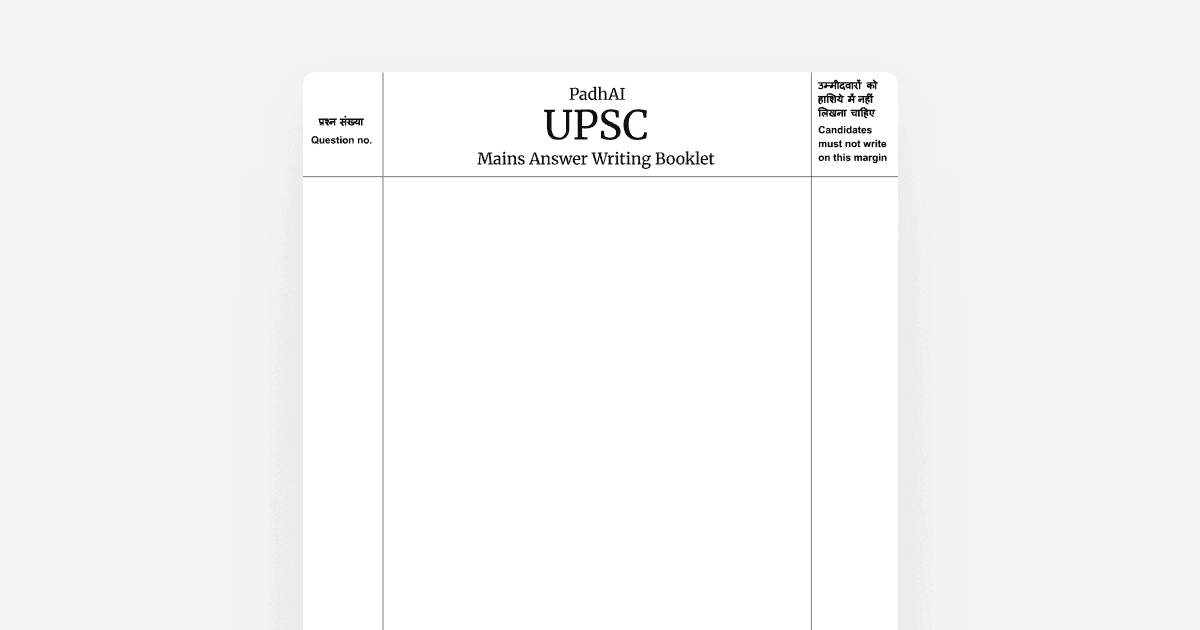
The UPSC Mains Answer Sheet — officially called the Question Cum Answer Booklet (QCAB) — is the A4-size booklet where you write all your responses during the Mains examination. It is not a separate sheet handed to you alongside a question paper. The questions are printed inside the same booklet, and you write your answers in the space provided right below each question.
This matters more than most aspirants realise. The booklet has pre-defined margins, specific spacing, and a fixed number of pages allocated per question type. Writing outside those allocations or ignoring the margins can hurt your presentation score.
The structure of the QCAB varies slightly depending on the paper:
GS Papers (I to IV): Questions are printed with answer spaces below. Two pages are allocated for 10-mark questions; three pages for 15-mark questions.
Essay Paper (Paper I): Two essays of 1,000–1,100 words each, written in three hours. No sub-question spacing — it is open-ended.
Compulsory Language Papers (English and Regional Language): Fixed spaces per question as per the paper pattern.
Optional Papers: Similar to GS format, structured as per optional subject requirements.
Understanding this physical structure before you sit for the exam — and practicing on similar paper — is one of the most underrated preparation strategies.
Word Limits and Marks Distribution
One of the most practical things a UPSC Mains answer writing book teaches you is how to gauge your word count within the given space. The official word limits are:
Question Type
Short Answer
Long Answer
Essay (each)
Marks
10 marks
15 marks
125 marks
Word Limit
150 words
250 words
1,000–1,100 words
Pages Allocated
2 pages
3 pages
Open
Each GS paper has 20 questions — typically 10 questions of 10 marks and 10 questions of 15 marks — totalling 250 marks per paper. You have three hours to write all 20 answers, which comes to roughly 9 minutes per question. There is zero room for rambling.
Writing a 15-mark answer in 250 words sounds simple until you have never practiced doing it on paper, under time pressure, with margins eating into your page. That is why practicing with a format-accurate UPSC Mains practice book or answer sheet is non-negotiable.
Why Toppers Use a UPSC Mains Practice Book
Ask any IAS topper how they prepared for Mains, and almost every one of them will mention daily answer writing practice. It is not a suggestion — it is a pattern. Here is why:
1. Format Familiarity Saves Real Time
There is a specific structure to the QCAB — how the cover page is filled, what goes in the rough work section, how to cancel an attempted answer properly. When you practice on identical format sheets, you are not reading instructions for the first time in the exam hall. That familiarity saves you five to seven minutes minimum, which is almost an entire answer.
2. You Learn How Much 150 Words Actually Looks Like
Until you have written 150 words on a QCAB-format page, you genuinely do not know if that fills one page, one-and-a-half, or barely half. Knowing this physically — not theoretically — is what helps you pace your writing.
3. Time Management Becomes Muscle Memory
Nine minutes per question is the math, but it only becomes intuitive after you have timed yourself repeatedly. Daily practice with a UPSC Mains practice book builds this into your reflex. After a few weeks, you instinctively know when you are running behind.
4. Handwriting Improves with Repetition
UPSC examiners read thousands of answer sheets. Legible handwriting is not just courteous — it directly affects how your answers are received. Messy or cramped handwriting under pressure is a real problem, and the only solution is repetition on paper that feels like the actual exam.
5. Self-Evaluation Gets Sharper
Once you have written an answer on paper, you can compare it against a model answer from your UPSC Mains answer writing book. This comparison — done regularly — is the fastest way to improve. You start noticing patterns: "I always miss the constitutional angle" or "My conclusions never suggest a way forward."
How to Use a UPSC Mains Answer Writing Book Effectively
Buying the right UPSC Mains answer writing book is step one. Using it right is everything else. Here is how to get the most out of it:
Step 1: Read the Technique Chapters First (Not Later)
Most aspirants buy a book, flip to the practice questions, and start writing. Then they wonder why their answers still do not improve. Read the technique chapters first — introduction structure, how to use keywords, when to draw a diagram, how to end an answer — before you write a single practice answer.
Step 2: Attempt One Answer Per Day Minimum
Consistency beats intensity. Writing one well-thought-out answer per day — timed, on QCAB-format paper — produces better results than writing ten answers over the weekend. The Insights IAS SECURE Initiative, which has been running since 2014, posts seven questions every weekday across all GS papers for exactly this reason.
Step 3: Always Compare Against a Model Answer
Writing is only half the work. After you write, compare your answer to the model answer in your UPSC Mains answer writing book. Do not just read — annotate. Mark what you got right, what you missed, and what structural difference led to a better answer.
Step 4: Use Diagrams and Flowcharts — Even Rough Ones
Research from Analytics IAS suggests that using 5–7 relevant keywords per answer can improve marks by 10–15 per paper. Even a rough diagram can replace 30–40 words of text and add to the visual presentation of your answer. Practice drawing them within the allocated space.
Step 5: Take Full Mock Tests — Not Just Individual Questions
Once a week, attempt a full paper — 20 questions in three hours — on QCAB-format sheets. This is the only way to build stamina and real-time pacing. Individual question practice does not prepare you for the physical and mental demand of writing for three hours straight.
Step 6: Get Feedback From Someone Else
Self-evaluation improves over time, but an external reviewer — a mentor, a teacher, or a test series evaluator — catches blind spots you cannot see in your own writing. Most serious answer writing programs, including Drishti IAS's daily practice and Insights IAS SECURE, offer expert evaluation.
FAQs on UPSC Mains Answer Writing Book
Q1: Is the PadhAI Mains Answer Writing Booklet the best option, and is it available for free?
Yes, the PadhAI Best UPSC Mains Answer Writing Book for 2026 Prep is available to download as a free PDF, having been discounted from ₹500 to ₹0 .It is considered a game-changer because it allows you to practice in the exact UPSC exam style, which trains you to present facts clearly within tight word limits instead of overshooting space or rambling.
Q2: What is the official format used for writing answers in the UPSC Mains exam?
The official answer sheet is called the Question Cum Answer Booklet (QCAB), which is an A4-size booklet . Unlike standard exams where you get a separate question paper, the questions in the QCAB are pre-printed with specific spaces, margins, and page allocations right below them . Practicing on this specific format is crucial because writing outside the predefined margins can negatively impact your presentation score.
Q3: What are the required word limits and page allocations for GS paper questions?
For a 10-mark short answer, the official word limit is 150 words, and you are allocated exactly two pages to write your response . For a 15-mark long answer, the limit is 250 words, which must fit within an allocation of three pages . These limits correspond exactly to the physical space UPSC provides, and writing significantly more does not fetch extra marks.
Q4: How many answer-writing practice questions should I attempt daily?
Aspirants should start by writing a minimum of one well-thought-out, timed answer daily on QCAB-format paper . Daily consistency builds the necessary muscle memory and is far more effective than cramming multiple hastily written answers over the weekend . After four to six weeks of this routine, you can scale up to two answers a day alongside one full 20-question mock test a week to build stamina.
Q5: Can I use diagrams and flowcharts in my UPSC Mains answers?
Absolutely. UPSC examiners highly appreciate the use of diagrams, flowcharts, tables, and maps as they add visual clarity to your answers . Even a rough but properly labelled diagram can effectively replace 30–40 words of text, making your answer cleaner while saving precious time . However, it is important to practice drawing them so they fit neatly within the allocated page space without spilling over.
Final Thoughts
The difference between aspirants who score 400+ in UPSC Mains GS and those who do not is rarely about who read more books. It is almost always about who practiced writing more answers, under timed conditions, on format-accurate paper.
A UPSC Mains answer writing book — whether it is Manuj Jindal's Courseware, Dr. Awdhesh Singh's essay guide, or a 200-page QCAB-format notebook — is not an optional purchase. It is the training tool that turns your knowledge into marks.
Start with one answer today. Time it. Compare it. Write another tomorrow. That is the entire method.