UPSC CAPF Exam Answer Key 2026: Paper 1 PDF & Score
The UPSC CAPF Exam Answer Key 2026 helps you check Paper 1 responses from the 19 July exam, calculate your marks using the +2 and minus one-third rule, and compare against past cut offs. This guide covers official and unofficial keys, the QPRep objection window, response sheets, and what to do next.

Last updated
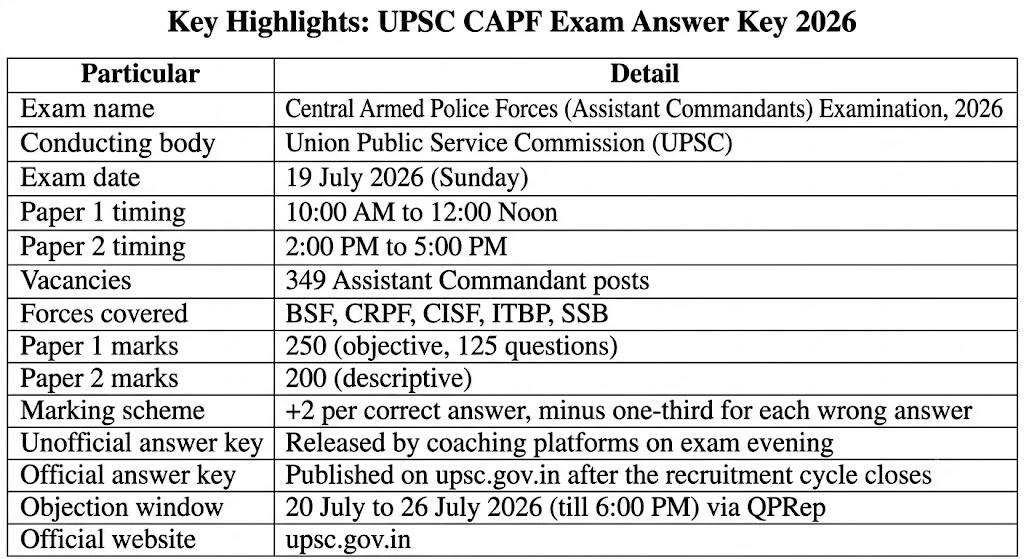
Particular | Detail |
Exam name | Central Armed Police Forces (Assistant Commandants) Examination, 2026 |
Conducting body | Union Public Service Commission (UPSC) |
Exam date | 19 July 2026 (Sunday) |
Paper 1 timing | 10:00 AM to 12:00 Noon |
Paper 2 timing | 2:00 PM to 5:00 PM |
Vacancies | 349 Assistant Commandant posts |
Forces covered | BSF, CRPF, CISF, ITBP, SSB |
Paper 1 marks | 250 (objective, 125 questions) |
Paper 2 marks | 200 (descriptive) |
Marking scheme | +2 per correct answer, minus one-third for each wrong answer |
Unofficial answer key | Released by coaching platforms on exam evening |
Official answer key | Published on upsc.gov.in after the recruitment cycle closes |
Objection window | 20 July to 26 July 2026 (till 6:00 PM) via QPRep |
Official website | upsc.gov.in |
If you walked out of the hall on 19 July with a rough count in your head, you already know the feeling.
You remember eight questions you got right, three you fought with, and one you changed at the last second and now regret.
The UPSC CAPF Exam Answer Key 2026 is what turns that fog into an actual number.
Here is the part most aspirants get wrong. There is no single answer key. There are two, and they serve completely different purposes.
The unofficial key is prepared by subject faculty at coaching institutes within hours of the exam. It is fast, it is useful, and it is occasionally wrong. Treat it as a working estimate.
The official key comes from the Commission itself and is legally final. UPSC does not release it the same evening.
It appears on upsc.gov.in only after the entire recruitment cycle for that year is complete, which in practice means months later, usually after the final merit list.
So when you search for the CAPF exam answer key 2026 today, what you can realistically access is the provisional version. That is enough to plan your next three months, and planning is the whole point.
Join our WhatsApp Community
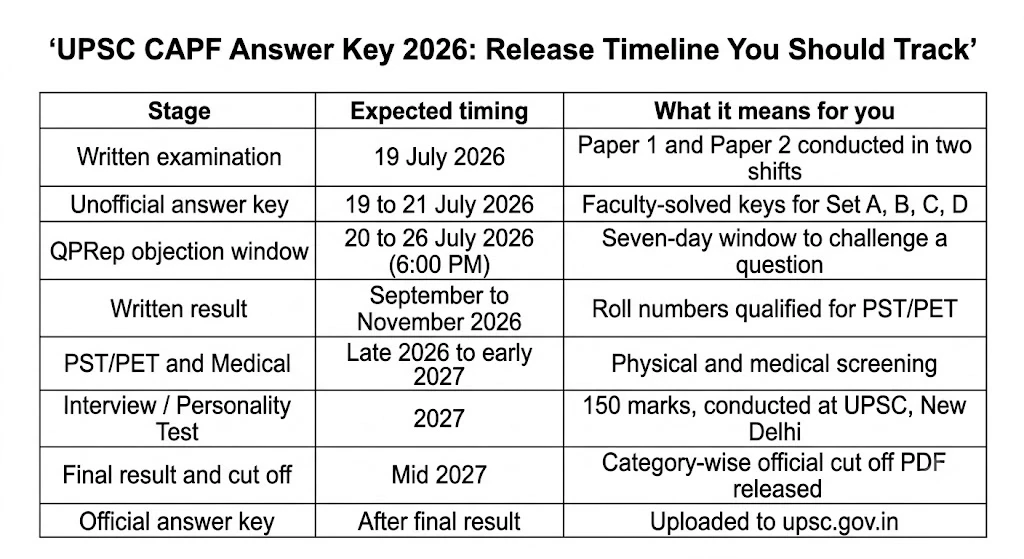
UPSC follows a predictable pattern year after year. Knowing the sequence stops you from refreshing the website for something that was never going to appear this week.
Stage | Expected timing | What it means for you |
Written examination | 19 July 2026 | Paper 1 and Paper 2 conducted in two shifts |
Unofficial answer key | 19 to 21 July 2026 | Faculty-solved keys for Set A, B, C, D |
QPRep objection window | 20 to 26 July 2026 (6:00 PM) | Seven-day window to challenge a question |
Written result | September to November 2026 | Roll numbers qualified for PST/PET |
PST/PET and Medical | Late 2026 to early 2027 | Physical and medical screening |
Interview / Personality Test | 2027 | 150 marks, conducted at UPSC, New Delhi |
Final result and cut off | Mid 2027 | Category-wise official cut off PDF released |
Official answer key | After final result | Uploaded to upsc.gov.in |
A small but important nuance: the written result only lists roll numbers. Your actual marks are not disclosed at that stage.
UPSC publishes individual marksheets only after the final recommendation, along with the cut off document.
UPSC CAPF Exam Analysis 2026
Basis | Unofficial key | Official UPSC key |
Source | Coaching faculty and subject experts | Union Public Service Commission |
Availability | Within hours of the exam | After the recruitment cycle ends |
Accuracy | High but not guaranteed | Final and binding |
Can it be challenged? | No formal process | Yes, through QPRep within 7 days |
Best use | Estimating your score early | Verifying the final position |
Set-wise format | Set A, B, C, D | Set-wise PDFs on upsc.gov.in |
One detail catches candidates off guard every year. Paper 1 booklets in Set A, B, C and D contain the same 125 questions arranged in a different order.
If you are matching a Set D key against a Set B booklet question by question, your score will look catastrophic and it will be entirely an artefact of shuffled numbering.
Always match the set printed on your booklet cover.
UPSC CAPF Notification
Add as a preferred Source on Google
When the Commission finally uploads the file, the path is straightforward:
Open upsc.gov.in in your browser.
Click on the Examination tab in the top navigation bar.
Select Answer Keys from the dropdown menu.
Locate the entry titled Central Armed Police Forces (ACs) Examination, 2026.
Open the Paper 1 PDF for your booklet set.
Download and save the file, then cross-check against your response sheet rather than your memory.
That last line matters more than it sounds. Memory-based checking inflates scores by six to ten marks on average, because candidates unconsciously recall the answer they meant to mark rather than the one they actually darkened.
Paper 1: General Ability and Intelligence
Total questions: 125
Maximum marks: 250
Correct answer: +2 marks
Wrong answer: minus one-third of 2 marks, that is minus 0.66
Unattempted: 0, no penalty
Formula: Estimated Paper 1 Score = (Correct answers × 2) − (Wrong answers × 0.66)
Worked example: Suppose you attempted 105 questions. Of these, 78 are correct and 27 are wrong, and 20 are left blank.
Marks gained: 78 × 2 = 156
Marks lost: 27 × 0.66 = 17.82
Net Paper 1 score: 138.18 out of 250
Against past General category Paper 1 thresholds, that is a comfortable position. Against 2021 levels, it is borderline. Which is exactly why the next section exists.
Paper 2: General Studies, Essay and Comprehension
Paper 2 is descriptive and carries 200 marks. There is no negative marking and no objective answer key, so it cannot be challenged on QPRep.
Model answers published by coaching platforms are indicative guidance, nothing more.
There is a rule here that quietly ends many campaigns. Paper 2 is evaluated only if you clear the minimum qualifying standard in Paper 1.
Candidates must secure at least 25 percent in Paper 1 (62.5 out of 250) and at least 15 percent in Paper 2 (30 out of 200).
Write a brilliant essay and miss the Paper 1 threshold, and the essay is never read.
Section | Approximate questions | Approximate marks | Nature |
General Science | 20 to 25 | 40 to 50 | Static plus applied |
Current Events (national and international) | 25 to 30 | 50 to 60 | Last 12 months |
Indian Polity and Economy | 20 to 25 | 40 to 50 | Conceptual |
History of India | 15 to 20 | 30 to 40 | Modern-heavy |
Indian and World Geography | 15 to 20 | 30 to 40 | Physical and Indian |
General Mental Ability | 20 to 25 | 40 to 50 | Reasoning and numeracy |
Note: weightage varies year to year. Use this to diagnose your weak section after checking the UPSC CAPF Exam Answer Key 2026, not as a syllabus substitute.
Mapping your wrong answers by section is far more valuable than the total score. Twenty-seven errors spread evenly across six sections is a revision problem.
Twenty-seven errors clustered in Mental Ability is a speed problem, and those two need completely different fixes.
The cut off is not a fixed number. It moves with paper difficulty, vacancy count and the applicant pool. Here is the official category-wise data across recent cycles.
Year | Category | Paper 1 (out of 250) | Written Stage (out of 450) | Final (out of 600) |
2024 | General | 97.44 | 182 | 311 |
2024 | OBC | 97.44 | 182 | 308 |
2024 | SC | 84.68 | 164 | 283 |
2024 | ST | 86.03 | 168 | 286 |
2023 | General | 118.85 | 196 | 325 |
2023 | OBC | 118.85 | 196 | 321 |
2023 | SC | 109.28 | 186 | 307 |
2023 | ST | 103.83 | 176 | 301 |
2022 | General | 135.08 | 221 | 345 |
2022 | SC | 120.30 | 203 | 313 |
2022 | ST | 112.90 | 196 | 314 |
2021 | General | 138.00 | 226 | 345 |
2020 | General | 117.34 | 205 | 325 |
Look at the General category Paper 1 line across five years: 117.34, then 138.00, then 135.08, then 118.85, then 97.44.
That is a swing of over 40 marks. Anyone telling you a precise expected cut off within 48 hours of the exam is guessing with confidence, not analysing.
What Your Estimated Score Realistically Means
Paper 1 estimate (General) | Realistic reading |
Above 130 | Strong position across almost every past cycle |
110 to 130 | Safe in a difficult year, borderline in an easy one |
95 to 110 | Depends entirely on paper difficulty; keep preparing |
62.5 to 95 | Below most recent thresholds; plan the next attempt |
Below 62.5 | Minimum qualifying standard not met |
Reserved category aspirants should read these bands against their own category rows in the table above, not the General column.
UPSC accepts challenges only through the Online Question Paper Representation Portal (QPRep), hosted at upsconline.nic.in. No email, no post, no hand delivery.
Window: From the day after the exam until 6:00 PM on the seventh day. For the 19 July 2026 exam, that runs from 20 July to 26 July 2026.
How to file:
Visit upsconline.nic.in and open the QPRep section.
Log in using your Roll Number and Date of Birth.
Select the CAPF (ACs) Examination, 2026 entry.
Enter the booklet set, question number and the answer you believe is correct.
Upload supporting evidence.
Submit before the deadline and save the acknowledgement.
Evidence standard. This is where most representations collapse. UPSC accepts NCERT textbooks, standard reference works and official government publications such as PIB releases, ministry reports and Census or NSO data.
It rejects coaching institute keys, test series solutions, Wikipedia entries and unverified websites. If your only proof is another coaching centre's answer, do not bother filing.
No fee is currently charged for a QPRep representation. The Commission does not respond individually to any candidate about acceptance or rejection.
Outcome. If a question is found defective, UPSC drops it. Marks are then computed proportionately over the remaining valid questions, so no candidate is penalised for the Commission's error.
Life After the Answer Key: What Serious Aspirants Do Next
Checking the capf exam answer key is a two-hour activity. What you do in the following fortnight decides your result.
If your score looks comfortable, start physical preparation immediately. The PST and PET are elimination stages, not formalities, and every year candidates who clear the written comfortably are sent home at the ground.
Event | Male candidates | Female candidates |
Height | 165 cm | 157 cm |
Chest | 81 cm, minimum 5 cm expansion | Not applicable |
100 metre race | 16 seconds | 18 seconds |
800 metre race | 3 minutes 45 seconds | 4 minutes 45 seconds |
Long jump | 3.5 metres (3 chances) | 3.0 metres (3 chances) |
Shot put (7.26 kg) | 4.5 metres | Not applicable |
Alongside the ground work, begin interview preparation. The Personality Test carries 150 marks out of a total 600, which is a full 25 percent of the final merit.
Panels probe your home state, your graduation subject, your reason for choosing a uniformed service, and current affairs with a security and border management flavour.
If your score is borderline, prepare for both outcomes. Keep training physically while continuing your reading.
The gap between the written exam and the result is the cheapest preparation time you will ever get.
If your score falls short, diagnose before you re-plan. Was it accuracy, speed, or coverage? Aspirants who repeat the same preparation with more hours usually repeat the same score.
Five Mistakes Aspirants Make While Checking the Answer Key
Matching the wrong set. Set A, B, C and D carry identical questions in shuffled order. Confirm your booklet code first.
Forgetting negative marking. Counting correct answers alone overstates your score by ten to twenty marks for most candidates.
Trusting the first key that appears. Early keys get corrected within 24 hours. Re-download after a day.
Treating an unofficial key as final. Only the Commission's key has standing.
Filing objections without valid evidence. A representation backed by a coaching key is rejected without consideration.
Why the CAPF Answer Key Matters Beyond Your Score
The Union Public Service Commission draws its authority from Article 315 of the Constitution, which provides for a Public Service Commission for the Union and for each State.
Article 320 assigns it the duty of conducting examinations for appointments to the services of the Union.
Article 322 protects its independence by charging its expenses to the Consolidated Fund of India, and Article 323 requires it to submit an annual report to the President.
This constitutional footing explains the Commission's cautious approach to answer keys. It publishes only after the recruitment cycle closes, and it accepts challenges only through one narrow, evidence-bound channel.
Understanding that logic tells you something useful as an aspirant: the process is slow by design, not by neglect, and no amount of refreshing the site will speed it up.
The CAPF Assistant Commandant is a Group A Gazetted Officer appointed at Level 10 of the 7th CPC Pay Matrix, with a starting basic pay of ₹56,100 per month.
That is the same entry level as many Civil Services allied posts, which is worth remembering when you weigh this exam against the CSE route.
Frequently asked question (FAQs)
When will the official UPSC CAPF Exam Answer Key 2026 be released?
How do I calculate my marks using the capf exam answer key 2026?
Is there an answer key for CAPF Paper 2?
Can I challenge a question in the UPSC CAPF Exam Answer Key 2026?
What is a safe score in CAPF Paper 1 for the General category?
The UPSC CAPF Exam Answer Key 2026 answers one question well: roughly where do you stand. It cannot tell you whether you have cleared, because the cut off will not exist for months.
Use the key to calculate honestly, map your errors by section, and then move your energy to the ground and to interview preparation.
Every year, a set of candidates clears the written test comfortably and loses the post on the 800 metre track. The paper is done. The recruitment is not.




Gajendra Singh Godara
Ex-UPSC Aspirant | Exam Preparation Expert
Gajendra Singh Godara is an IIT Bombay graduate and a UPSC aspirant with 4 attempts, including multiple Prelims and Mains appearances. He specializes in Polity, Modern History, International Relations, and Economy. At PadhAI, Gajendra leverages his firsthand exam experience to simplify complex concepts, creating high-efficiency study materials that help aspirants save time and stay focused.
No comments yet. Be the first to join the discussion!