Brahmaputra River Map | PDF & Image Download
The Brahmaputra River originates at the Chemayungdung Glacier and flows 2,900 kilometers across Tibet, India, and Bangladesh. This transboundary system drains 580,000 square kilometers and supports the Assam Valley’s agriculture before forming a massive delta in the Bay of Bengal.
As it cuts through the Himalayas, understanding its path is essential for mastering the major mountain ranges in India.
It is a trans-boundary river, making it a critical topic when studying the neighbouring countries in India. It originates in Tibet (China), flows through India, and empties into the Bay of Bengal via Bangladesh.

Gajendra Singh Godara
Last updated
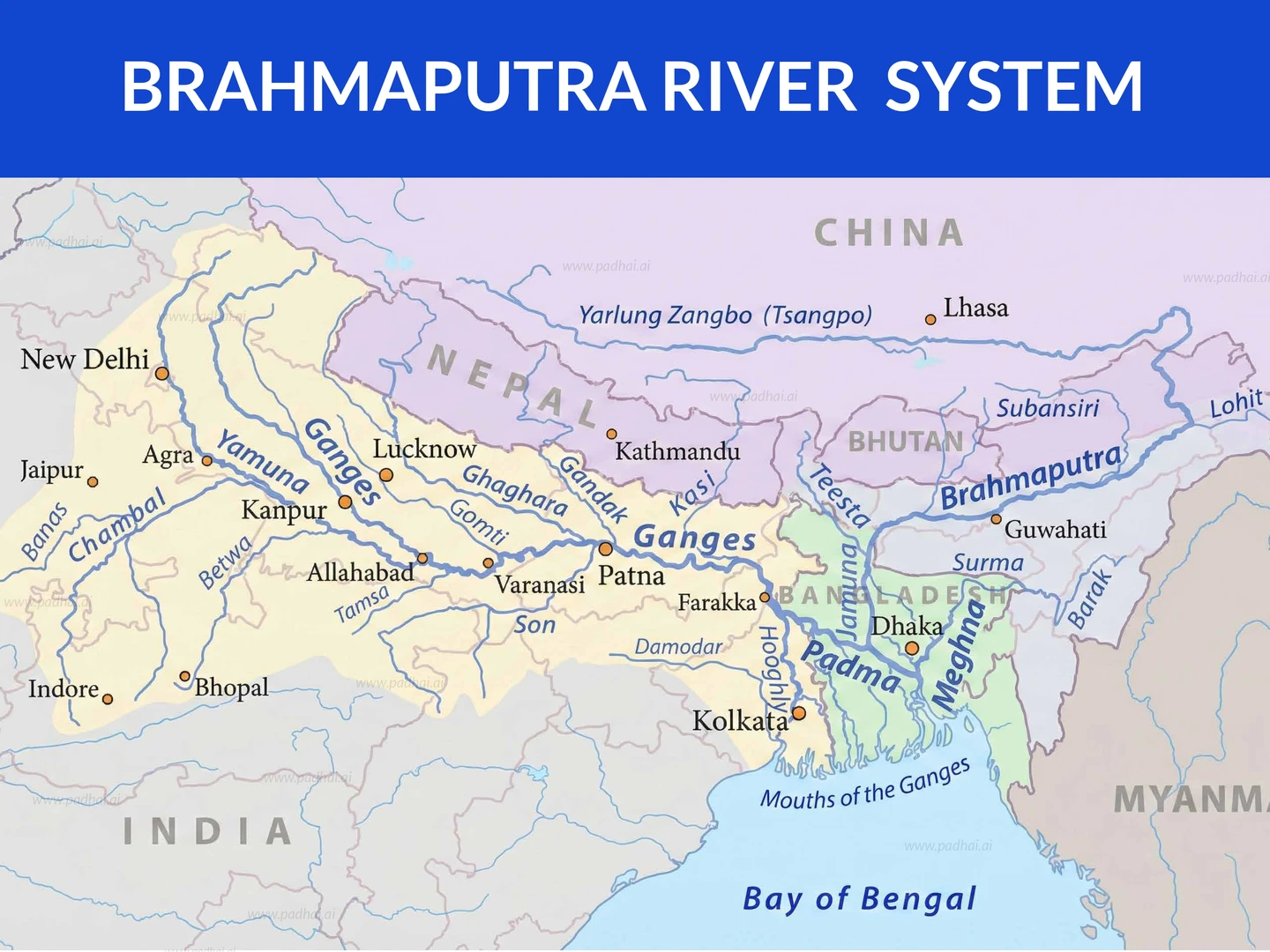
Brahmaputra River Course Trajectory and Regional Nomenclature
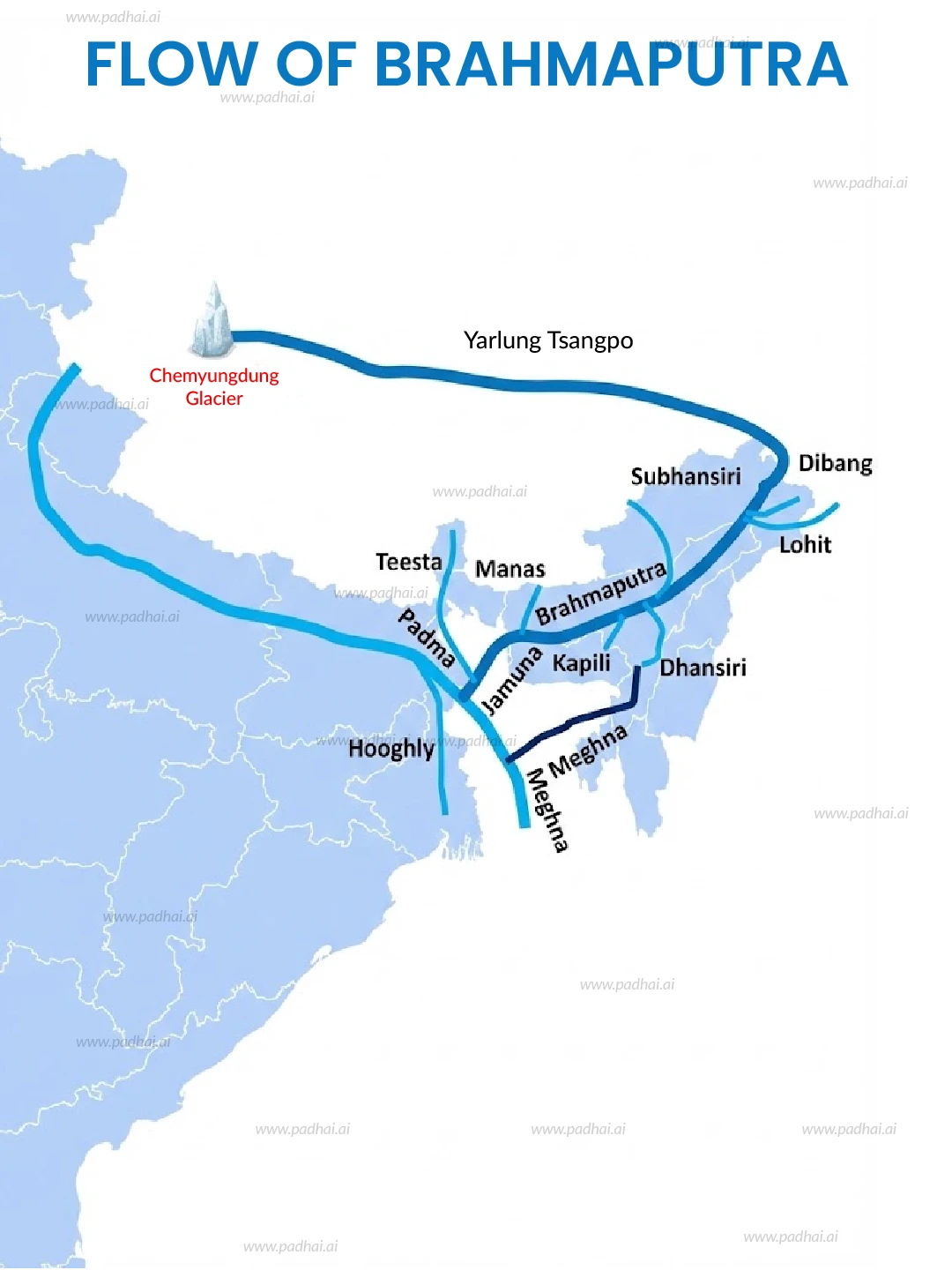
The river exhibits distinct physical characteristics and adopts different names as it traverses diverse topographic zones.
Tibet (Source): The river rises from the Chemayungdung Glacier near the prominent mountain peak of Mount Kailash at an altitude of 5,300 meters. Local populations refer to this section as the Yarlung Tsangpo, which flows eastward for 1,600 kilometers across the Tibetan Plateau.
India (Entry): The river enters India through Arunachal Pradesh after negotiating the Great Bend at the Namcha Barwa Gorge. Here, the river takes the name Siang or Dihang and flows for 230 kilometers to Pasighat.
Assam (Expansion): Two major tributaries, the Dibang and the Lohit, join the Siang near Pasighat to form the Brahmaputra proper. The channel expands significantly in the Assam plains, measuring up to 10 kilometers wide in places.
Bangladesh (Exit): The river turns south into Bangladesh, merging with the Ganga (Padma) to become the Jamuna, finally emptying into the Bay of Bengal.
The river deposits massive amounts of silt, creating the fertile plains of Assam. When studying the types of soil in India, the Brahmaputra valley is a prime example of rich, newer alluvial soil (Khadar).
Conclusion
The Brahmaputra River Map defines a high-volume, sediment-rich hydrological system that drains the Tibetan Plateau and the Eastern Himalayas. It flows 2,900 kilometers, supports a catchment of 580,000 square kilometers, and provides the foundation for the economy and ecology of Northeast India. The river sustains critical biodiversity in Kaziranga and Manas while simultaneously posing risks through annual flooding and erosion.
As one of the major rivers In India, the Brahmaputra forms the eastern pillar of the Himalayan Drainage System. Aspirants should study this map in conjunction with the Indus River system in the west and the Ganga River Map in the center, particularly focusing on where the Brahmaputra and Ganga merge to form the world’s largest delta.


Gajendra Singh Godara
Ex-UPSC Aspirant | Exam Preparation Expert
Gajendra Singh Godara is an IIT Bombay graduate and a UPSC aspirant with 4 attempts, including multiple Prelims and Mains appearances. He specializes in Polity, Modern History, International Relations, and Economy. At PadhAI, Gajendra leverages his firsthand exam experience to simplify complex concepts, creating high-efficiency study materials that help aspirants save time and stay focused.
Suggested Maps