Delimitation in India: Significance, Challenges & 2026 Bill
Delimitation is important for fair representation. It involves redrawing constituency boundaries under the law. The proposed 2026 Delimitation Bill will impact its structure in a significant way.

Gajendra Singh Godara
Last updated
12
mins read
Key highlights:
Delimitation meaning: The process of redrawing boundaries of territorial constituencies to reflect population changes.
Delimitation Commission: An independent, high-powered body appointed by the President to redraw electoral maps.
Constitutional articles: Article 82 & 170, Article 329(a)
Amendments: 42nd Amendment (1976), 84th Amendment (2001), 87th Amendment (2003)
131st Amendment Bill (2026): Proposed law to "unlock" the freeze. Includes Women's reservation , 850-Seat Proposal, Census Decoupling
Significance: rebalances representation according to current demographics
Challenges: North-south conflict
Way forward: balance population count with performance based weightage
2026 Delimitation Bill
The Delimitation process is in the news due to proposed changes that will impact the procedure:
The Union Government has convened a three-day special session of parliament to table three transformative bills:
The Constitution (131st Amendment) Bill, 2026- Aims to delink the Women’s reservation from future census cycles. It will allow Parliament to use the 2011 census data for the same.
The Delimitation Bill, 2026: Proposes repealing the 2002 Act. It would set up a new Delimitation Commission. A retired Supreme Court judge would chair it. Lok Sabha given the power to increase number of seats to 850
Union Territories Laws (Amendment) Bill, 2026: It extends these changes to Union Territories. This includes the 33% women’s quota and expanded seats.
Under the original 2023 Women’s Reservation Act (Nari Shakti Vandan Adhiniyam), the government directly linked implementation to the post-2026 delimitation exercise. It would have led to a delay in implementation until 2034. The proposed changes allow the reservation to be in place for the 2029 General Election.
The introduction of these bills has led to protests by Southern states. The argument is that the 131st Amendment will give North Indian states more representation. It may reduce South India’s voice.
What is Delimitation?
Delimitation means the process of redrawing the boundaries of electoral constituencies to ensure fair representation based on population changes. It is handled by the independent Delimitation Commission of India which is a high-power body set up under the Delimitation Commission Act.
Its main goal is to uphold “one person, one vote, one value”. It ensures each constituency has a similar population.
While the number of Lok Sabha and state assembly seats is currently frozen as per the 42nd and 84th Constitutional Amendments, the Constitution (131st Amendment) Bill proposes to lift this freeze immediately.
By making changes to Article 82 and Article 170, the government aims to give Parliament more authority over which census data to use.
To implement the Nari Shakti Vandan Adhiniyam (Women’s Reservation Act) for the 2029 General Elections, the government aims to use the 2011 Census as the baseline for the immediate redrawing of boundaries.
Historically, delimitation took place in 1952, 1963, and 1976. Lok sabha seats increased from 494 to 543.
The new Delimitation Bill 2026 proposes a major change: It would increase seats from 543 to 850. Of these, 815 would be for States and 35 for UTs. This change aims to ensure 33% reservation for women without reducing existing general category seats.
Join our WhatsApp Community
Constitutional Framework of Delimitation Process in India
Delimitation in India is grounded in the Constitution and Delimitation Acts. After every census, Parliament must enact a Delimitation Act and readjust state seats.
Important Articles for delimitation are:
Article 82: Parliament to enact a Delimitation Act after every census.
Article 170: Readjusting state legislative assembly seats after every census. The 2026 bill aims to amend this article. It would allow use of the 2011 Census. It also allows any census Parliament chooses. This would let officials redraw Assembly seats right away.
Article 330 and 332: Reservation of seats for SC/STs based on their population.
Article 327: Parliament is empowered to make laws regarding election.
Article 329(a): Orders of Delimitation cannot be challenged in any court. Also known as “force of law”
Article 334A: Inserted into the Constitution by the 106th Constitutional Amendment Act, 2023 for reservation of seats for women. The new Bill aims to change the conditions regarding census data in the original Article to ensure the 33% reservation applies in the 2029 General Elections.
Role of the Central Government in the Delimitation Process
Constitutional Basis: The central government implements a Delimitation Act after every census under Articles 82 and 170.
Establishment of Commission: The Delimitation Commission of India is an independent body appointed by the President of India.
Scope of Delimitation: The Commission redraws constituency boundaries for Lok Sabha and state assembly seats. It uses changes in the average population.
Coverage: The process includes all states and union territories with elected legislatures.
Non-Interference Principle: The Centre may start the process, but it cannot change the Commission’s final orders. These orders have the force of law.
Add as a preferred Source on Google
Role & Composition of the Delimitation Commission of India
The Delimitation Commission of India is a high-powered, independent authority whose orders have the force of law. The President of India appoints it, and it works in collaboration with the Election Commission of India. Its composition typically includes:
A retired Supreme Court judge (Delimitation commission Chairman). 2026 bill specifies that the Chairperson can be a sitting/former Supreme Court judge.
The Chief Election Commissioner and respective State Election Commissioners.
Associate members (sitting MPs/MLAs nominated by Speakers) from each state/UT undergoing delimitation. They can advise but cannot vote.
The Commission’s functions and powers include:
Redrawing constituency boundaries so each has roughly equal population;
Allocating seats to states as per law;
Identifying SC/ST and women-reserved seats proportionally.
Once the official Gazette publishes its final orders, no court can challenge them. Thus, once the Commission notifies its report, its delineations bind the next elections (Article 329(a)).
Delimitation Process and Criteria
Key steps and principles in the delimitation exercise are:
Census Data: Typically, the Commission uses the latest census as the primary basis.To apply Women’s Reservation in the 2029 elections, the government has proposed that it would use 2011 Census data to redraw boundaries now and not wait for the 2027 census results.
Geography and Administration: The Commission takes into account geographic contiguity (constituencies should be geographically compact) and existing administrative units (districts/blocks). It also takes into account "socio-economic realities" and community interests to avoid splitting communities up for no good reason. The 2026 Commission has a much bigger job to do: add 307 seats to the Lok Sabha.
Reservation of Seats: Each state has a set number of SC/ST seats based on how many people live there. These seats are set up so that reserved constituencies are in areas with more SC/ST people. For the first time, the Commission must also find the 33% of seats that are set aside for women under Article 334A.
Draft Recommendations and Feedback: The Commission publishes a draft delimitation plan for each state. It invites objections and suggestions from the public and feedback from political parties and state governments. They may hold public hearings for disputed changes. After taking feedback into account, the Commission finalizes its report.
Final Order: The Gazette publishes the final delimitation order. After that, the new boundaries take effect in the next general elections.
These procedures ensure transparency and allow stakeholders (political groups, civil society, affected communities) to participate. For example, the Delimitation Commission of India typically consults the Election Commission of India and state authorities to reconcile technical and political concerns.
Historical Timeline of Delimitation Commissions of India
How many delimitation commissions formed in India?
The Delimitation Acts of 1952, 1962, 1972, and 2002 established Delimitation Commissions.
A new Delimitation Commission is being formed under the Delimitation Bill, 2026. The Bill aims to repeal and replace the Delimitation Act, 2002. Their goal is to identify the 33% reserved seats for women and redraw boundaries.
Notably, India did not constitute a Delimitation Commission after the 1981 and 1991 Censuses because of political and demographic considerations (42nd Amendment 1976).
Reason for freezing delimitation in India in 1976: It aimed to support population control. It also helped preserve the federal balance. It maintained political stability by avoiding tensions over seat changes.
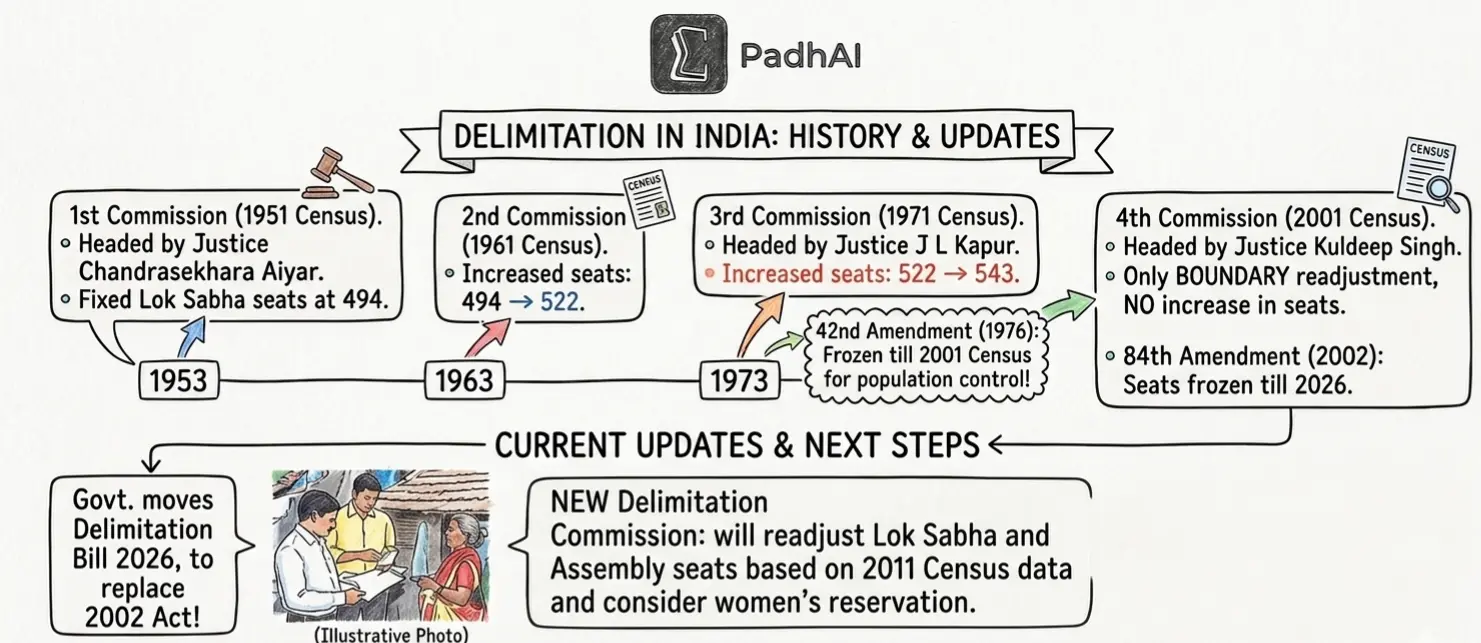
Delimitation Exercise (Census basis) | Year Commission Constituted | Lok Sabha Seats (post-delimitation) |
Based on 1951 Census | Delimitation Commission of 1952-53 | 494 |
Based on 1961 Census | Delimitation Commission of 1963-64 | 522 |
Based on 1971 Census | Delimitation Commission of 1973-76 | 543 |
Based on 2001 Census | Delimitation Commission of 2002-08 | 543 (unchanged) |
Based on 2011 Census (Proposed) | Delimitation Commission of 2026 | 850 (Proposed Expansion) |
History of Delimitation Freeze in India
Historically, many amendments were passed to put the delimitation process on hold for different reasons:
42nd Amendment (1976): Froze Lok Sabha and Assembly seats at 1971 levels until the 2000 census.
84th Amendment (2001): Extended the freeze from 2001 to the first census after 2026.
87th Amendment (2003): Allowed delimitation based on the 2001 census. It reshuffled boundaries but kept the total seats of each state the same.
The government introduced the Constitution Bill, 2026, in the Special Session in April 2026. It effectively “breaks the freeze” by:
Removing the 2026 Deadline: It removes the requirement to wait for the 2027 census.
Expanding seats: It proposes increasing the Lok Sabha capacity from the frozen 543 to 850 seats.
Prioritizing the Quota: It lets the 2011 Census serve as the baseline to help implement the Women’s Reservation by 2029.
Significance of Delimitation Exercise in India
Equal Representation: Fixes imbalances in areas that have too many or too few voters to make sure that everyone has the same voting power.
Electoral Integrity: Adjusts constituency boundaries according to demographic shifts, ensuring fair and accurate representation.
Preventing Malapportionment: Eliminates too much variation in constituency sizes, preserving the fairness of democratic representation.
Changing Electoral Boundaries and Representation
The main goal of delimitation is fairness. This means that each MP or MLA should represent about the same number of people. In practice, this means that constituencies should be drawn so that the number of people per seat is about the same across a state. Now, after five decades of debate, the delimitation commission must carefully consider these factors.
Population disparities: Northern states, like Uttar Pradesh, Bihar, Madhya Pradesh, and Rajasthan, have grown faster. Most southern states, like Tamil Nadu, Kerala, and Andhra Pradesh, have grown more slowly. If officials reallocated seats only by population, the north would gain many seats. The south would lose many seats. The 1976 freeze aimed to reward successful population control. It did this by not moving seats from slower-growth states. But the new 2026 amendment may penalise it. Southern leaders argue this would undermine the federal spirit, given the South’s contributions to GDP and social development.
Number of seats: The Constitution capped the total number of Lok Sabha seats at 543. This preserved the size of Parliament while adjusting state-wise shares. Transitioning from a 543-seat House to a projected 850-seat Lok Sabha will be a big challenge.
Reserved seats: Any change in a state's total seats will also change its SC/ST seats. Ensuring fair SC/ST representation across India is a key objective, even as boundaries move. The Commission also needs to find the seats set aside for women.
In short, delimitation will change the way people are represented based on current demographics, but the process is politically sensitive. The government has to fulfil its pledge that “not even one seat will be reduced” for the South.The 2026 Delimitation Commission of India must balance fairness with federal equity. It must ensure that it does not unfairly punish states that are successful in social development, It must also uphold “one vote, one value” across the nation.
Challenges with the Delimitation process in India
Population vs development: Drawing lines based only on population growth can be unfair. For example, Tamil Nadu and Kerala, which have low fertility rates, may lose representation compared to states with high populations, like Uttar Pradesh and Bihar.
Economic Contribution: Southern states contribute significantly to tax revenues and GDP but receive disproportionately lower representation and federal resources. Karnataka, Tamil Nadu, and Maharashtra get back only ~30% of their contributions, while Bihar and UP receive 250–350%.
Outdated Data: The 2026 Amendment Bill proposes using 15-year-old data (2011 Census) to faster implement women's reservation. Critics argue this ignores the major demographic shifts of the last 15 years.
Political Gerrymandering Risks: Partial actors may manipulate the delimitation process for political gain. Incidents of biased boundary adjustments, such as those alleged in Jammu & Kashmir, highlight the risk of gerrymandering.
Reservation issues: using old census data may also distort reservation under SC/ST and women’s reservation laws. There are also demands for “quota-within-quota” (OBC reservation for women and sub-categorization of SCs).
Administrative and Security Challenges in Sensitive Regions: Conducting surveys in conflict-prone or geographically challenging areas, especially in the Northeast, poses logistical difficulty, fosters public distrust, and could fuel unrest.
Lack of safeguards and oversight: Institutions like Inter-State or Zonal Councils have weak roles. This makes checks on political delimitation less common. This could make people less likely to trust the process.
Concerns of Southern states over Delimitation Process
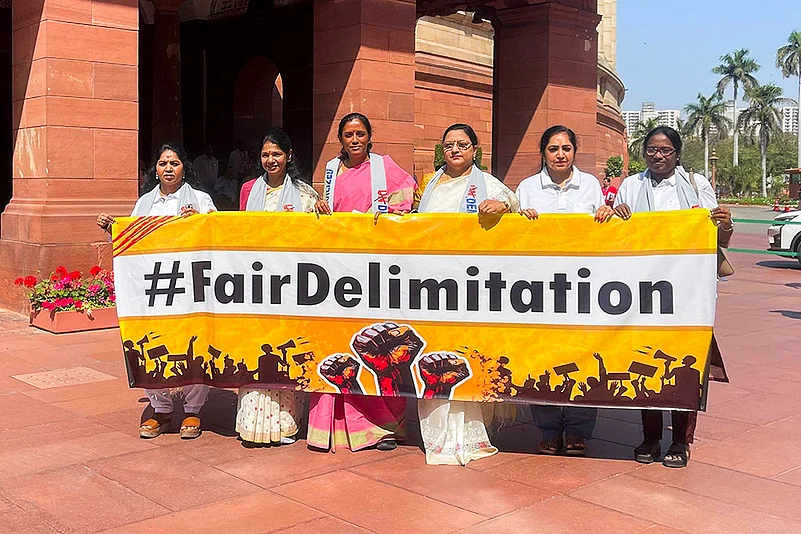
Fear of reduced representation in Parliament
Southern states, including Tamil Nadu, Karnataka, Kerala, Telangana, and Andhra Pradesh, argue that if delimitation uses population count as sole measure, their political influence may decrease.
Tamil Nadu CM calls all-party meeting (March 5, 2024)
On February 25, 2024, CM M.K. Stalin announced an all-party meeting for March 5, 2024.The meeting discussed delimitation. He warned it is a “sword hanging over five southern states.”
Success in family planning becomes a liability
Tamil Nadu’s effective population control measures helped development. Now, people fear these measures may backfire. They could reduce Tamil Nadu’s representation and penalize the state.
Push for 1971-based freeze and JAC formation
Southern states want delimitation to stay frozen using the 1971 Census. They also seek constitutional safeguards through a Joint Action Committee.
The Joint Action Committee (JAC), proposed in 2024, has now become a formal “Federal Protection Front.” It includes the Chief Ministers of Tamil Nadu, Kerala, Karnataka, and Telangana.
The JAC is now asking for a "Weightage Formula" for the 2026 Delimitation Commission. They want to base seat allocation 50% on population. Development indices, including HDI, education, and GST contribution, would determine the other 50%
International Practices For Delimiting of Constituencies
Many democracies delimit constituencies by population. For comparison:
Jurisdiction | Legislature | Seats (total) | Allocation Method |
India (Lok Sabha) | Lower House (Parliament) | 543 (fixed) as of now. 2026 bill proposes expansion to 850 | Delimitation Commission redraws constituencies based on census; SC/ST and women' s seats reserved. Constitutional amendments (1976, 2001) froze total seats. 2026 bill to break the freeze and use the 2011 census. |
United States | House of Representatives | 435 (fixed since 1913) | Apportionment by “Equal Proportions” method after each decennial census. No state gains/loses seats unless population warrants; e.g., 37 of 50 states saw no seat change in 2020 reapportionment. |
European Union | European Parliament | 720 total (current) | Degressive proportionality: smaller member countries have more MEPs per capita than larger ones Seats are reallocated infrequently, balancing population with federal identity. |
Way forward
The way forward for upcoming delimitation requires balancing the concept of “one person, one vote” with “protecting performing states”. As the 131st Amendment is being debated, policy makers have suggested a few solutions to tackle this:
Seat expansion: Move ahead with expanding the seats to 850 so that no state loses the absolute number of seats.
Weighted Representation formula: Instead of relying only on population count, experts suggest a multi-index formula. It rewards low fertility states. It also gives weight to the Human Development Index (HDI) and education levels. It considers economic contribution too.
Strengthening the Rajya Sabha: To make up for the Lok Sabha's large population, each state should have the same number of seats, no matter how many people live there.This follows the US Senate model. Also, the constitution should give the Rajya Sabha more power over bills that deal with federalism or state lines.
Fiscal Compensation: Through the 16th Finance Commission, the government could offer grants to states. These grants would reward states that achieved the SDGs. They would also help offset any loss of seats. Using a formula that stops Southern states from losing money because they have higher income per person would also help.
Inter-state council: Use Article 263 to start a formal dialogue. Hold talks between the Centre and the “Federal Protection Front” states before the final vote on the 131st Amendment.
Judicial oversight: Ensuring associate members of the delimitation commission have a meaningful role in redrawing boundaries.
What is delimitation of constituencies in India?
Is delimitation commission a constitutional body?
How often does delimitation occur in India?
What are the key objectives of delimitation?
Why is delimitation relevant for UPSC aspirants?







Gajendra Singh Godara is an IIT Bombay graduate and a UPSC aspirant with 4 attempts, including multiple Prelims and Mains appearances. He specializes in Polity, Modern History, International Relations, and Economy. At PadhAI, Gajendra leverages his firsthand exam experience to simplify complex concepts, creating high-efficiency study materials that help aspirants save time and stay focused.
No comments yet. Be the first to join the discussion!