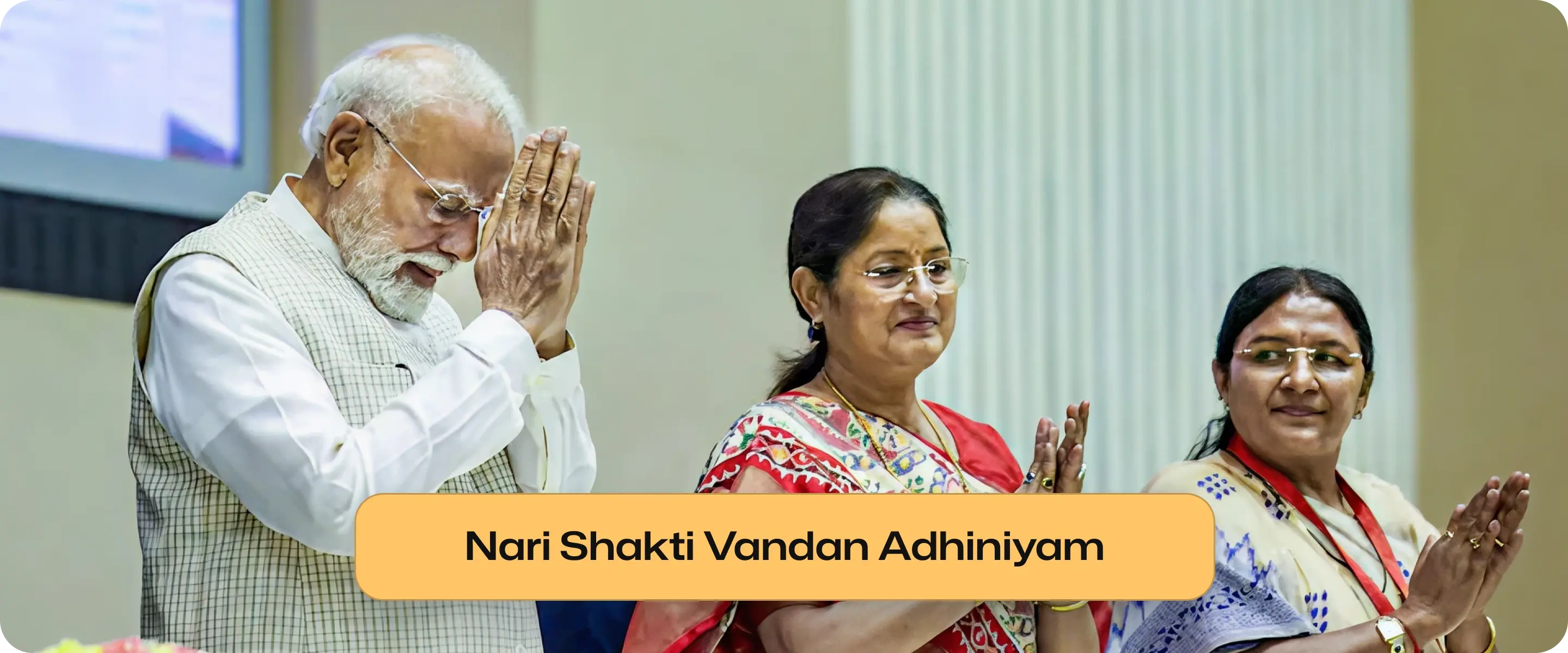
Nari Shakti Vandan Adhiniyam: Women’s Reservation Act 2023

Nari Shakti Vandan Adhiniyam (106th Amendment Act) is an important legislation passed in 2023 that reserves 33% of seats in Lok sabha, State Legislative Assemblies and Delhi assembly for women.

UPSC Prelims

Current affairs

Latest Update

Nari Shakti Vandan Adhiniyam: Women’s Reservation Act 2023

Key highlights: 

  • Definition: Legislation reserving 33% (⅓) seats for women in Lok Sabha, State Legislative Assemblies and Delhi Assembly.

  • Enacted: September 2023

  • Key Provisions: Article 330A, Article 332A, Article 239AA

  • Proposed changes: Delink 2026 Census, Increase Lok Sabha seats, SC/ST quota

  • Significance: Women Empowerment, Political Inclusivity, Structural Representation, Global Significance

  • Challenges: Outdated Census, North-South Divide, Proxy Representation, Lack of OBC sub-quota, Rotation Mechanism, Less Deliberation

  • Way forward: Update Data, Fair Delimitation, OBC Representation, Training Female MPs, Rajya Sabha Reservation

Recent Updates about the Women Reservation Act

Recent Updates about the Women Reservation Act

  • Key amendments to the Women’s reservation law (Nari Shakti Vandhan Adhiniyam) will be discussed in a three day long special session of Parliament from 16 April -18 April, 2026.

  • The government is planning to fast-track the implementation of Nari Shakti Vandhan Adhiniyam by delinking the quota from future Census and delimitation.

  • This will allow the women reservation quota to be in effect for 2029 Lok sabha and assembly elections.

  • Another significant proposal is to increase the strength of the Lok Sabha from 543 to 816 seats

Join our WhatsApp Community
What is Nari Shakti Vandan Adhiniyam?

What is Nari Shakti Vandan Adhiniyam?

Nari Shakti Vandhan Adhiniyam Key Facts

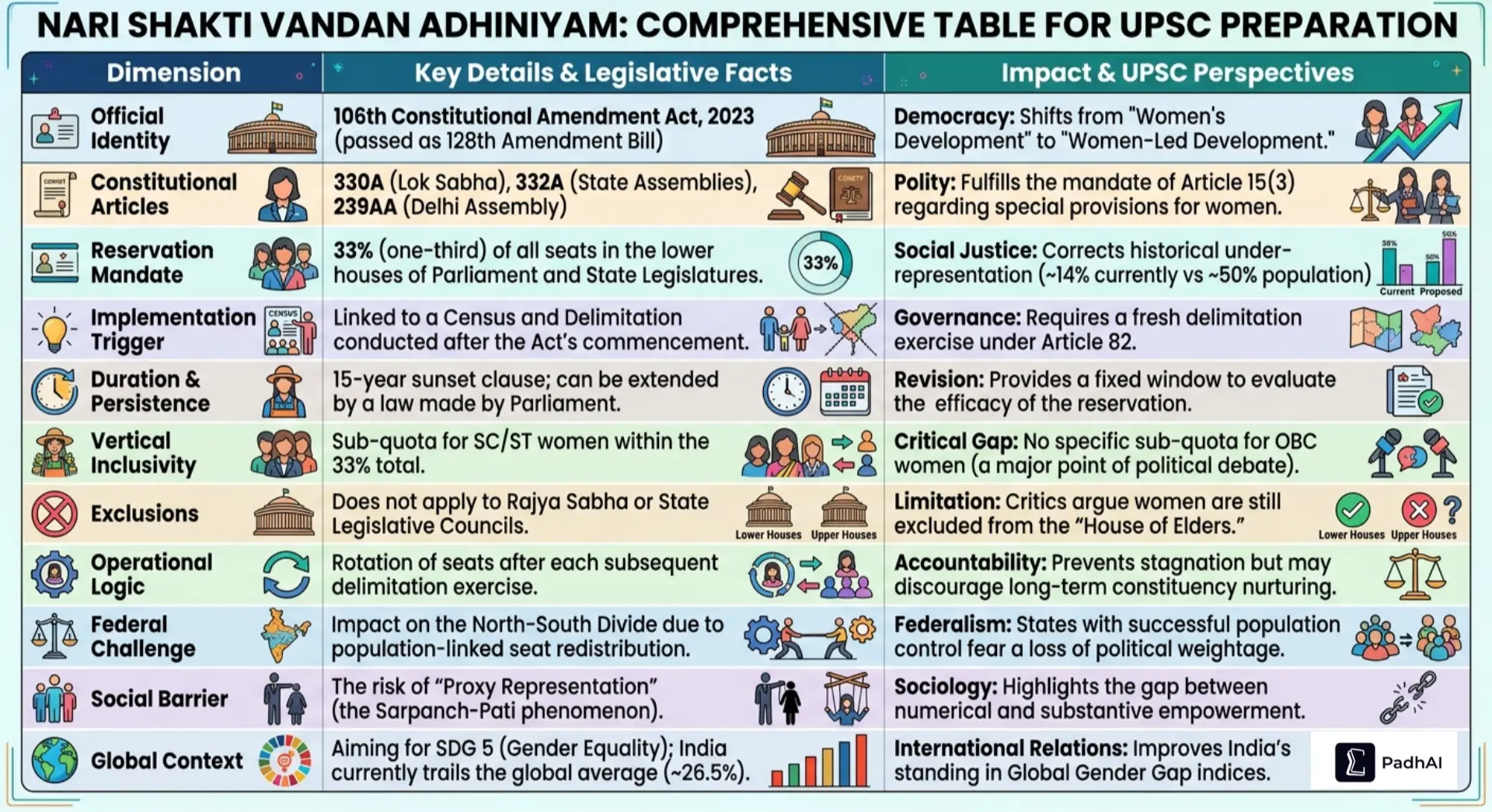
The Nari Shakti Vandan Adhiniyam is officially called the Constitution (106th Amendment) Act, 2023. It is a landmark legislation that aims to bridge the gender gap in political representation and provide women a voice in the legal processes.

Key provisions of the Women’s Reservation Act

The Act provides 33% of reservation for women in the Lok sabha, state legislative assemblies and Delhi Assembly. It was enacted in 2023 through the 106th Constitutional Amendment.

  1. Article 330A: Provides reservation for women in the Lok Sabha.

  2. Article 332A: reservation for women in every State Legislative Assembly.

  3. Article 239AA: reservation for women in the Legislative Assembly of the National Capital Territory of Delhi. (specifically added clauses 239AA(2)(b) and others)

  4. Sub-reservation: Within the 33% quota, seats are further reserved for women belonging to Scheduled Castes (SC) and Scheduled Tribes (ST).

  5. Sunset Clause: The reservation is initially provided for a period of 15 years, which can be extended by Parliament.

  6. Rotation: Reserved seats will be rotated after every subsequent delimitation exercise.

UPSC Current Affairs Magazines

UPSC Current Affairs Magazines

Read Monthly Yojana Magazines

Read Monthly Yojana Magazines

Read Latest UPSC Current Affairs

Read Latest UPSC Current Affairs

What are the changes being proposed to Nari Shakti Vandan Adhiniyam?

What are the changes being proposed to Nari Shakti Vandan Adhiniyam?

  • The Indian government is now planning to amend the 2023 Act to enable faster implementation. This requires delinking the implementation for the ongoing 2026 Census.

  • A draft amendment bill has been cleared in the Union Cabinet which proposes increasing the seats in Lok Sabha from 543 to 816, with 273 seats being reserved for women

  • The reservation will follow a vertical model- meaning seats reserved for SC/ST women within the quota.

  • The redrawing of constituencies will happen according to 2011 census data, so that the reservation can be rolled out in time for the 2029 elections.

Under the original framework, implementation of the reservation was dependent on delimitation after the 2026 Census. The 2026 Census was delayed, so the rollout of quotas would have taken till 2034 to be implemented. The new amendments will allow the women’s reservation to be in place for the 2029 Lok Sabha elections.

Add as a preferred Source on Google

Significance of Women’s Reservation Act

Significance of Women’s Reservation Act

There are many arguments in favour of this act, focusing on gender equality in the political sphere: 

  1. Women Empowerment: Moving forward from the “Beti Bachao, Beti Padhao” initiative, this new act will focus on a higher phase of female empowerment that allows women to partake in major legal and political decisions.

  2. Inclusive decision-making: Research suggests that women bring a unique perspective to the table by focusing on issues like health, sanitation, education and policies that uplift women. This would ensure a holistic approach to decision making.

  3. Electoral consolidation: Women’s representation in politics will encourage women to come forth and vote in elections, transitioning from a “silent” voting bloc to a more decisive and participatory role

  4. Historic Underrepresentation: Despite high voter turnout , women have been drastically underrepresented in national and state legislatures. Roughly 13% of seats in Lok Sabha and 13-17% in Rajya Sabha were held by women in 2024. Nari Shakti Vandan Adhiniyam Act will help correct this by enabling women to have more representation in legal bodies. 

  5. Global Alignment: The Act aligns India with the UN Sustainable Development Goal (SDG) 5.5, which calls for women’s full and effective participation in politics.

Challenges and criticisms of Women’s Reservation Act

Challenges and criticisms of Women’s Reservation Act

As the changes have been proposed to the 2023 Act, there are many new challenges and issues that have come up:

  1. Census debate: Critics argue that using 2011 census data , which is 15 years old, ignores demographic shifts, urbanization, and migration patterns. It might lead to issues in representation

  2. Seats expansion: Increasing the number of Lok Sabha seats will lead to individual MPs getting very little time to speak and put forward their points. 

  3. North-south divide: A population based approach to increase in seats will favour Northern states more than Southern states. It might diminish the political influence of South Indian representatives in overall decision-making.

  4. OBC quota: While SC/ST women have reserved seats within the 33% quota, Other Backward Classes (OBC) women do not. Without an OBC sub-quota, this act will not bring an intersectional change. 

  5. Proxy Representation: There is a phenomenon of “Sarpanch-pati” (Husband of the head) where the women hold the official position but the male relatives (like husband) exercise real power. Critics fear that since it exists on a local level, it might spread to the national level.

  6. Rotation mechanism: There is no clarity on the mechanism of rotating seats. Frequent rotation might cause MPs to not focus on development, while lack of rotation may lead to stronghold on certain seats. 

  7. Lack of deliberation: Critics have argued that such a monumental change in electoral structure requires public  as well as parliamentary debate.

Way Forward

Way Forward

The proper implementation of Nari Shakti Vandan Adhiniyam and the proposed changes requires balancing the speed of rollout with structural changes and intersectional outlook.

  • New Census data: Use of the 2026 Census data instead of 2011 data will prevent misrepresentation and create a more accurate picture of the society. 

  • Fair Delimitation: The government should ensure that the representation of Southern states is not impacted by reconsidering allocating seats based purely on population count.

  • Representation of OBC: The government should use the 2026 Census to evaluate the demands for OBC sub-quota objectively.

  • Training: Government should also invest in training first-time female MPs on parliamentary and political procedures to combat proxy representation. 

  • Upper House Representation: In the long term, the reservation should also be extended to Rajya Sabha and State legislative councils to ensure women have a say in Lok Sabha and Rajya Sabha decisions both.

Frequently asked question (FAQs)

What is Nari Shakti Vandan Adhiniyam bill?
Has the women's reservation bill been passed?
Why is the women's reservation bill needed?
What are the proposed changes in the Women's reservation act?
Why is Lok Sabha seat expansion proposed ?

Conclusion

Conclusion

The Nari Shakti Vandan Adhiniyam should not be viewed as the final step in women empowerment, but a stepping stone. Reservation of women’s seats marks a significant milestone in the Indian electoral system, but affirmative action should also be backed by a change in mindset and culture towards the role of women in the political sphere. The implementation of the Act should also be in a balanced and well-thought out way that benefits women from all walks of life equally.


Suggested posts

Custodial Deaths in India: Key Concerns, Laws & Way Forward

Key highlights: 

  • Constitutional Violation : Custodial deaths violate Article 21 (Right to Life)

  • Landmark Case : The Jayaraj and Bennix custodial death case brought national attention to police brutality

  • Root Cause : Linked to colonial era laws and weak accountability

  • Legal Framework : Governed by Bharatiya Nyaya Sanhita and Bharatiya Nagarik Suraksha Sanhita

  • International Status : India has signed but not ratified United Nations Convention Against Torture

Custodial Deaths in India: Key Concerns, Laws & Way Forward
Nari Shakti Vandan Adhiniyam (106th Amendment Act) is an important legislation passed in 2023 that reserves 33% of seats in Lok sabha, State Legislative Assemblies and Delhi assembly for women.

Custodial Deaths in India: Key Concerns, Laws & Way Forward

Key highlights: 

  • Constitutional Violation : Custodial deaths violate Article 21 (Right to Life)

  • Landmark Case : The Jayaraj and Bennix custodial death case brought national attention to police brutality

  • Root Cause : Linked to colonial era laws and weak accountability

  • Legal Framework : Governed by Bharatiya Nyaya Sanhita and Bharatiya Nagarik Suraksha Sanhita

  • International Status : India has signed but not ratified United Nations Convention Against Torture

Custodial Deaths in India: Key Concerns, Laws & Way Forward
Nari Shakti Vandan Adhiniyam (106th Amendment Act) is an important legislation passed in 2023 that reserves 33% of seats in Lok sabha, State Legislative Assemblies and Delhi assembly for women.

Nuclear Milestone of India : Fast Breeder Reactor at Kalpakkam

Key highlights

  • Definition: 500 MWe fast breeder reactor 

  • Location: Kalpakkam, Tamil Nadu

  • First Criticality milestone: April 6, 2026

  • Stage 2: Entry into India’s three-stage nuclear program

  • Fuel Type: MOX (Plutonium + Uranium)

  • Coolant: Liquid Sodium (fast neutron support)

  • Core Function: Breeds more fuel than it consumes

  • Institution: BHAVINI and IGCAR 

  • Strategic Goal: Transition to Stage 3 (Thorium-based reactors)

  • Global Status: India became second country after Russia with commercial-scale FBR

India’s Prototype Fast Breeder Reactor (PFBR)
Nari Shakti Vandan Adhiniyam (106th Amendment Act) is an important legislation passed in 2023 that reserves 33% of seats in Lok sabha, State Legislative Assemblies and Delhi assembly for women.

Nuclear Milestone of India : Fast Breeder Reactor at Kalpakkam

Key highlights

  • Definition: 500 MWe fast breeder reactor 

  • Location: Kalpakkam, Tamil Nadu

  • First Criticality milestone: April 6, 2026

  • Stage 2: Entry into India’s three-stage nuclear program

  • Fuel Type: MOX (Plutonium + Uranium)

  • Coolant: Liquid Sodium (fast neutron support)

  • Core Function: Breeds more fuel than it consumes

  • Institution: BHAVINI and IGCAR 

  • Strategic Goal: Transition to Stage 3 (Thorium-based reactors)

  • Global Status: India became second country after Russia with commercial-scale FBR

India’s Prototype Fast Breeder Reactor (PFBR)
Nari Shakti Vandan Adhiniyam (106th Amendment Act) is an important legislation passed in 2023 that reserves 33% of seats in Lok sabha, State Legislative Assemblies and Delhi assembly for women.

Artemis II: 4 Astronauts, 10 Days, One Historic Journey

Key highlights:

  • Mission led by: Reid Wiseman

  • Crew Milestones: Christina Koch (first woman) , Victor Glover (first person of colour), Jeremy Hansen (first non-American) to travel beyond Earth orbit

  • Trajectory: Free-return path → Moon’s gravity ensures safe return 

  • Distance Record: ~4,700 miles beyond lunar far side (farthest human travel)

  • Mission Purpose: 10-day deep-space test of Orion spacecraft life support

  • Strategic Aim: Lunar south pole exploration (water ice as a crucial resource)

  • Re-entry Test: High-speed return testing heat shield (~5,000°F)

  • India Link: ISRO part of Artemis Accords

 Artemis II: 4 Astronauts, 10 Days, One Historic Journey
Nari Shakti Vandan Adhiniyam (106th Amendment Act) is an important legislation passed in 2023 that reserves 33% of seats in Lok sabha, State Legislative Assemblies and Delhi assembly for women.

Artemis II: 4 Astronauts, 10 Days, One Historic Journey

Key highlights:

  • Mission led by: Reid Wiseman

  • Crew Milestones: Christina Koch (first woman) , Victor Glover (first person of colour), Jeremy Hansen (first non-American) to travel beyond Earth orbit

  • Trajectory: Free-return path → Moon’s gravity ensures safe return 

  • Distance Record: ~4,700 miles beyond lunar far side (farthest human travel)

  • Mission Purpose: 10-day deep-space test of Orion spacecraft life support

  • Strategic Aim: Lunar south pole exploration (water ice as a crucial resource)

  • Re-entry Test: High-speed return testing heat shield (~5,000°F)

  • India Link: ISRO part of Artemis Accords

 Artemis II: 4 Astronauts, 10 Days, One Historic Journey
Nari Shakti Vandan Adhiniyam (106th Amendment Act) is an important legislation passed in 2023 that reserves 33% of seats in Lok sabha, State Legislative Assemblies and Delhi assembly for women.

PadhAI UPSC App

We're PadhAI - a free UPSC prep app built by IITians, AI PhDs & top UPSC experts.

Why choose PadhAI?

Read daily top news (TH & IE) & Solve Current Affairs MCQs
Topic-wise search of 30+ yrs PYQs
24×7 AI tutor for doubt resolution
Practice 30k+ MCQs & full GS + CSAT mocks
Play Duel UPSC quizzes with fellow aspirants

Research methodology

PadhAI's research methodology ensures every article is accurate, UPSC-ready, and beginner-friendly. We curate current affairs analysis based on UPSC exam relevance by cross-referencing The Hindu, Indian Express, and PIB. General Studies (GS) topics are drafted from NCERTs and standard books such as M. Laxmikanth, Spectrum, and GC Leong, then reviewed by subject matter experts to eliminate factual errors. Additionally, we update aspirants with verified government exam notifications alongside expert blogs suggesting the best resources, syllabus, and comprehensive Prelims and Mains strategies.

a close up of a cell phone with a blurry background

About Author

Gajendra Singh Godara

Growth | FTE| Resident at SigIQ

Gajendra Singh Godara is an IIT Bombay graduate and a UPSC aspirant with 4 attempts, including multiple Prelims and Mains appearances. He specializes in Polity, Modern History, International Relations, and Economy. At PadhAI, Gajendra leverages his firsthand exam experience to simplify complex concepts, creating high-efficiency study materials that help aspirants save time and stay focused.

Latest UPSC Exam 2026 Updates

The final list of selected candidates for UPSC CSE 2025 is now available.
Check the category-wise cut-off marks for the UPSC Civil Services Examination 2025.
The official schedule for UPSC examinations in 2026 has been released on 15 May 2025.
The results of the UPSC Civil Services Mains Examination 2025 have been officially released.
Check the updated and latest syllabus for the UPSC Civil Services Examination 2026.
The official notification for the UPSC Civil Services Examination 2025 was released on 22 January 2025.
Access the UPSC Prelims 2025 question paper along with the unofficial answer key.

UPSC Exam Dates 2026

UPSC Prelims 2026 will be held on 24 May 2026, and UPSC Mains 2026 will begin on 21 August 2026.

UPSC Selection Process

The UPSC Civil Services selection process consists of three stages: Prelims, Mains, and the Interview.

UPSC Result 2024 & Marksheet

The UPSC Civil Services Result 2024 has been released along with the official marksheet.

Latest UPSC Exam 2026 Updates

The final list of selected candidates for UPSC CSE 2025 is now available.
Check the category-wise cut-off marks for the UPSC Civil Services Examination 2025.
The official schedule for UPSC examinations in 2026 has been released on 15 May 2025.
The results of the UPSC Civil Services Mains Examination 2025 have been officially released.
Check the updated and latest syllabus for the UPSC Civil Services Examination 2026.
The official notification for the UPSC Civil Services Examination 2025 was released on 22 January 2025.
Access the UPSC Prelims 2025 question paper along with the unofficial answer key.

UPSC Exam Dates 2026

UPSC Prelims 2026 will be held on 24 May 2026, and UPSC Mains 2026 will begin on 21 August 2026.

UPSC Selection Process

The UPSC Civil Services selection process consists of three stages: Prelims, Mains, and the Interview.

UPSC Result 2024 & Marksheet

The UPSC Civil Services Result 2024 has been released along with the official marksheet.

Join the discussion

No comments yet. Be the first to join the discussion!

Why choose PadhAI?

Read daily top news (TH & IE) & Solve Current Affairs MCQs

Topic-wise search of 30+ yrs PYQs

24×7 AI tutor for doubt resolution

Practice 30k+ MCQs & full GS + CSAT mocks

Play Duel UPSC quizzes with fellow aspirants

PadhAI UPSC App

We're PadhAI - a free UPSC prep app built by IITians, AI PhDs & top UPSC experts.

Why choose PadhAI?

Read daily top news (TH & IE) & Solve Current Affairs MCQs

Topic-wise search of 30+ yrs PYQs

24×7 AI tutor for doubt resolution

Practice 30k+ MCQs & full GS + CSAT mocks

Play Duel UPSC quizzes with fellow aspirants

PadhAI UPSC App

We're PadhAI - a free UPSC prep app built by IITians, AI PhDs & top UPSC experts.

Suggested posts

Custodial Deaths in India: Key Concerns, Laws & Way Forward

Custodial Deaths in India: Key Concerns, Laws & Way Forward

Custodial deaths in India, highlighted by the Jayaraj and Bennix custodial death case, expose serious concerns around accountability, human rights, and constitutional safeguards.
India’s Prototype Fast Breeder Reactor (PFBR)

Nuclear Milestone of India : Fast Breeder Reactor at Kalpakkam

India’s Prototype Fast Breeder Reactor (PFBR) at Kalpakkam marks a historic leap into Stage 2 of its nuclear program. It not only generates power but also produces more fuel, paving the way for long-term energy security.
 Artemis II: 4 Astronauts, 10 Days, One Historic Journey

Artemis II: 4 Astronauts, 10 Days, One Historic Journey

NASA’s Artemis II has officially launched, sending four astronauts on a historic 10-day journey around the Moon as a final bridge to permanent lunar settlements
Custodial Deaths in India: Key Concerns, Laws & Way Forward

Custodial Deaths in India: Key Concerns, Laws & Way Forward

Custodial deaths in India, highlighted by the Jayaraj and Bennix custodial death case, expose serious concerns around accountability, human rights, and constitutional safeguards.
India’s Prototype Fast Breeder Reactor (PFBR)

Nuclear Milestone of India : Fast Breeder Reactor at Kalpakkam

India’s Prototype Fast Breeder Reactor (PFBR) at Kalpakkam marks a historic leap into Stage 2 of its nuclear program. It not only generates power but also produces more fuel, paving the way for long-term energy security.
 Artemis II: 4 Astronauts, 10 Days, One Historic Journey

Artemis II: 4 Astronauts, 10 Days, One Historic Journey

NASA’s Artemis II has officially launched, sending four astronauts on a historic 10-day journey around the Moon as a final bridge to permanent lunar settlements

Global Terrorism Index 2026 | Highlights, Rankings, Analysis

Global Terrorism Index 2026 presents a clear picture of terrorism trends, rankings, and regional shifts. This article explains India’s rank, global patterns, and key insights for UPSC aspirants in a structured manner.
An abstract blue background with wavy lines

Don't get left behind in your preparation

Download PadhAI App

An abstract blue background with wavy lines

Don't get left behind in your preparation

Download PadhAI App

An abstract blue background with wavy lines

Don't get left behind in your preparation

Download PadhAI App

Current Affairs

UPSC Resources

UPSC updates

General studies

UPSC Preparation

Get FREE 1-Year PadhAI Premium Access (Worth ₹3,500)

Get FREE 1-Year PadhAI Premium Access (Worth ₹3,500)