UPSC Exam Fee: What You Pay, When, and Who Pays Nothing

Gajendra Singh Godara
Last updated
8
mins read
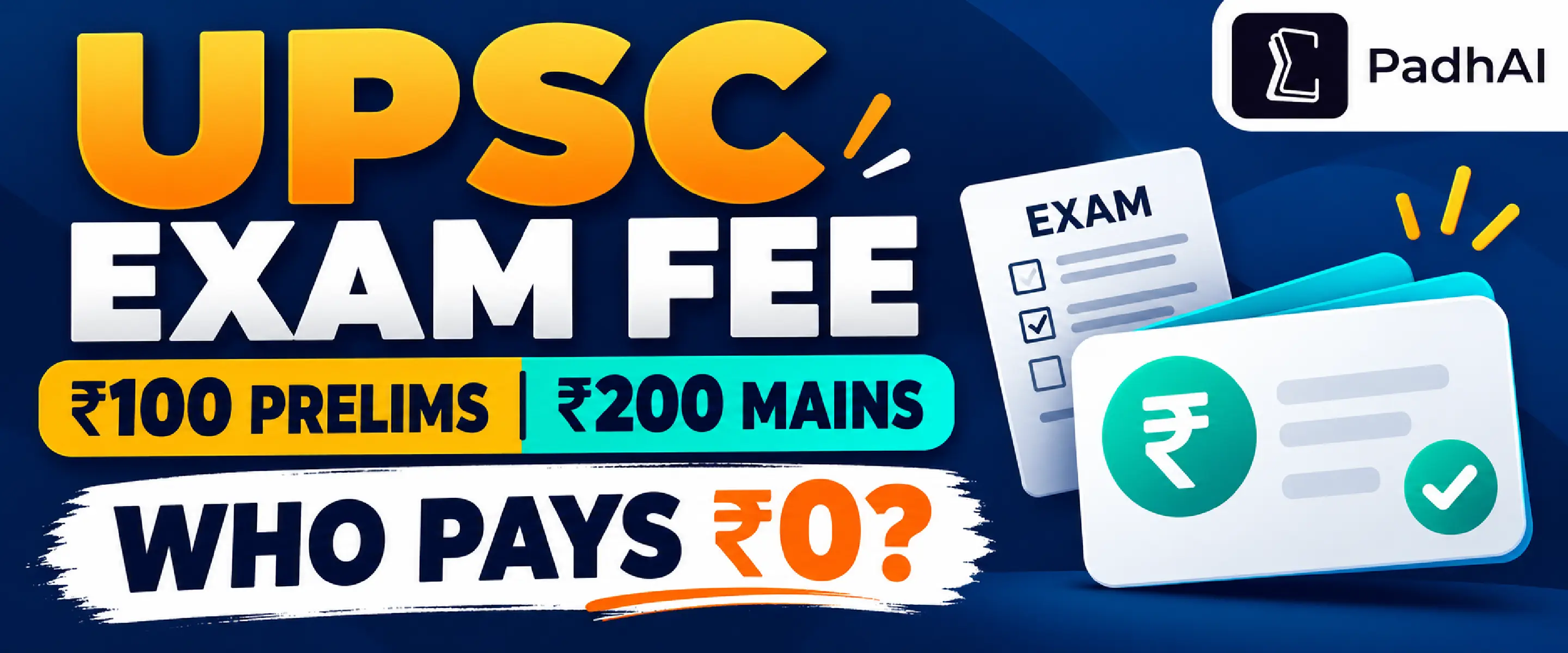
Prelims: ₹100. Mains: a further ₹200. Personality Test: no fee
Zero fee for SC, ST, PwBD and all women candidates, at both stages
EWS candidates pay in full. The 10% quota carries no fee waiver
The Mains fee is paid in a 10-day window opened after the Prelims result
Fees are never refunded, and an application without fee is summarily rejected
The CSE 2026 notice prescribes net banking, card and UPI as the payment modes
UPSC Exam Fee at a Glance
The fee for UPSC exam applications has not changed in years, and the amounts are small enough that money is rarely what stops anyone.
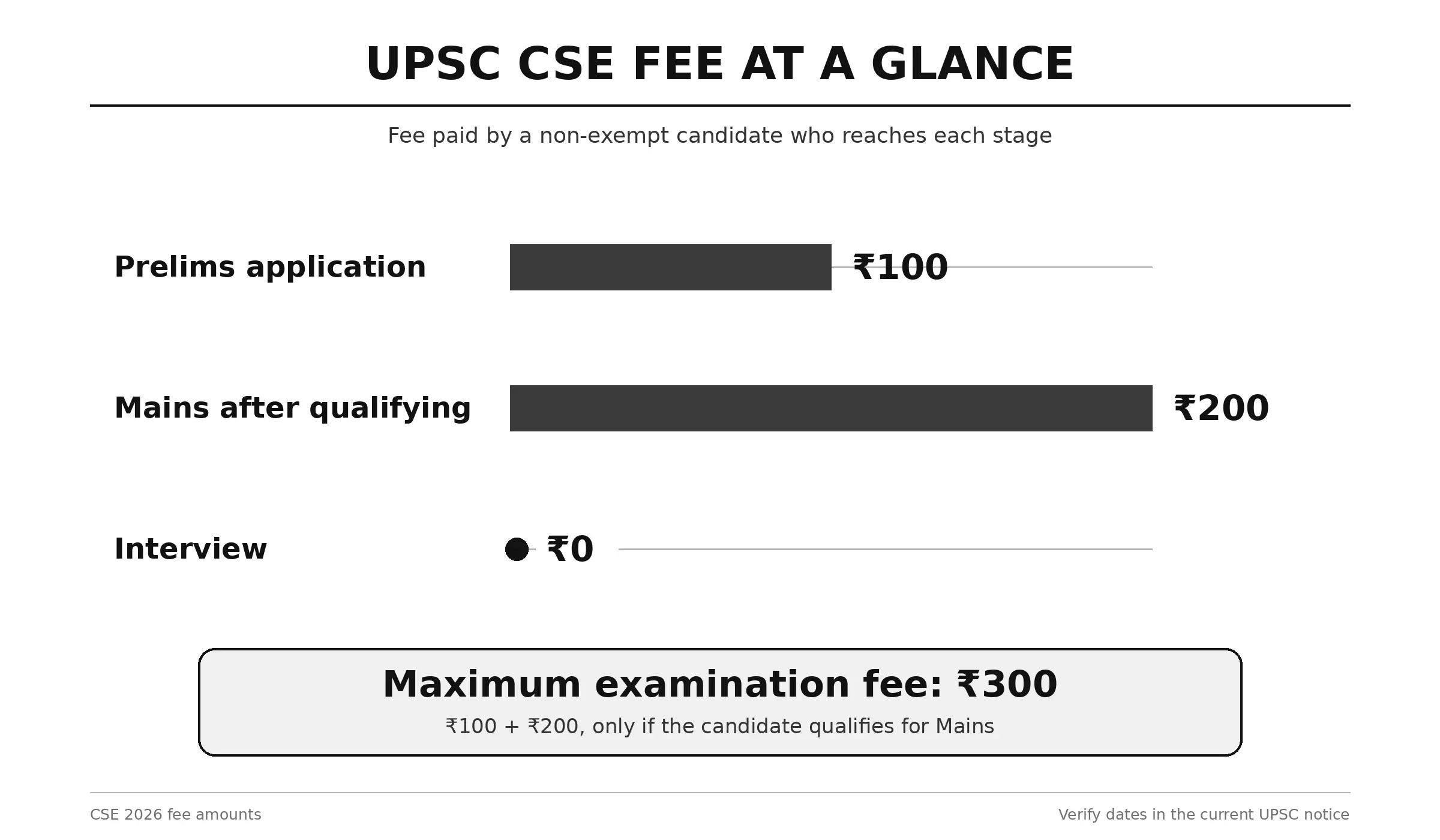
Stage | General | OBC | EWS | SC / ST | PwBD | Women (any category) |
Prelims | ₹100 | ₹100 | ₹100 | Nil | Nil | Nil |
Mains (DAF) | ₹200 | ₹200 | ₹200 | Nil | Nil | Nil |
Personality Test | Nil | Nil | Nil | Nil | Nil | Nil |
Total if you reach the interview | ₹300 | ₹300 | ₹300 | Nil | Nil | Nil |
So the maximum any candidate pays in UPSC examination fees across a full cycle, from application to interview, is ₹300.
Two points catch people out. EWS candidates get no fee concession. The 103rd Amendment created a 10% quota in vacancies, not a waiver on the reservation side benefits. And the ₹200 is a further fee, not a replacement for the ₹100 you already paid.
Join our WhatsApp Community
UPSC Exam Fee for Female Candidates and Other Exemptions
This is the single most searched sub-question on the topic, and the answer is simple.
Every woman candidate is exempt from the UPSC exam fee, at both Prelims and Mains, regardless of category.
A woman in the General category pays nothing. So does a woman in OBC, EWS, SC or ST.
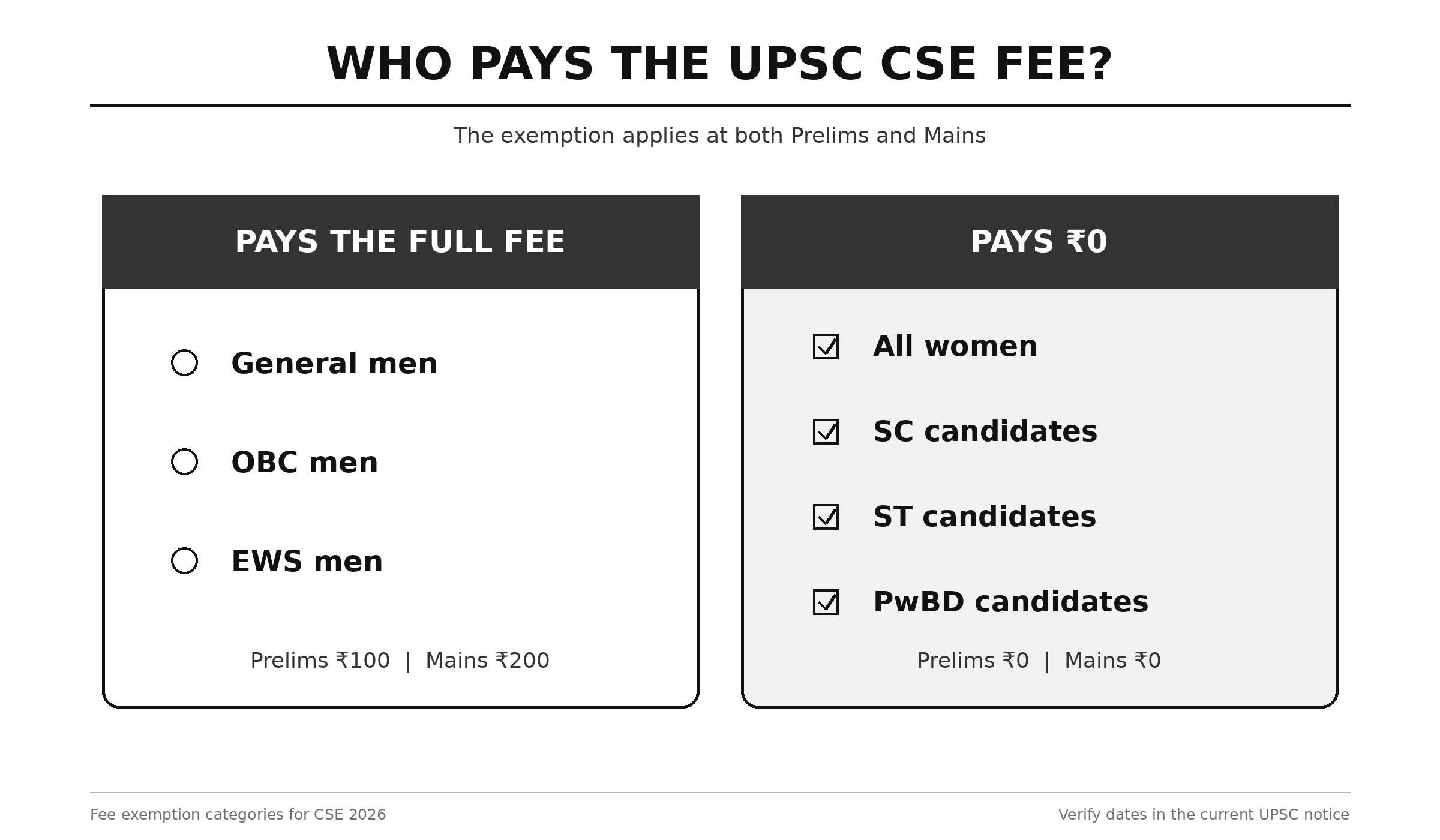
The full exempt list under the CSE notification:
Exempt | Not exempt |
All women candidates | General category men |
Scheduled Caste (SC) | OBC men |
Scheduled Tribe (ST) | EWS men |
Persons with Benchmark Disabilities (PwBD) | Nobody else |
Three things worth knowing:
The exemption is automatic once your category is entered correctly in the application. There is no separate form to claim it.
You still need the supporting certificate. Originals for SC, ST and PwBD claims are verified at the Personality Test stage, in the central government format.
Claiming an exemption you are not entitled to is treated as a false declaration, not a payment error, and can cost you your candidature.
How the UPSC Fees Are Split Across Stages
The fee is not one payment. It is two, months apart, and the second one has a deadline most first-timers do not see coming.
Stage 1, at application: ₹100. You pay this when you submit the online application, within the application window. In CSE 2026 that window ran from 4 February to 24 February 2026.
Stage 2, after the Prelims result: ₹200. Here is the detail that matters. Per the CSE 2026 notice, candidates admitted to the Main Examination pay the further ₹200 through a window of ten days provided after the declaration of the Prelims result.
Ten days. Not "sometime before Mains".
If you clear Prelims and then travel, fall ill, or simply stop checking the UPSC site because you are buried in Mains preparation, you can miss it.
The Detailed Application Form and its fee open together, and the DAF itself is the document your interview board will read line by line, so it is not something to fill at 2 am on the last day.
Add as a preferred Source on Google
How to Pay the Application Fee for UPSC
This section has changed, and most guides online have not caught up.
The CSE 2026 Examination Notice (No. 05/2026-CSE, dated 4 February 2026) prescribes these modes:
Net banking of any bank
Visa, MasterCard or RuPay credit or debit card
UPI payment
The notice then states plainly that payment of the examination fee can be made only through the prescribed modes, and that payment through any other mode is not valid.
Note what is absent: cash payment through an SBI challan. That option appears in almost every article on this keyword, including several published in 2026, and it was genuinely available in earlier cycles. It is not among the modes prescribed in the CSE 2026 notice.
If you have been planning to walk into an SBI branch with a printed pay-in-slip, check the notification for your cycle before you rely on it. Our advice: pay online, and pay early enough that a failed transaction leaves you time to retry.
If your payment fails or does not register. UPSC treats cases where the bank has not confirmed payment as fictitious payment cases and publishes a list of such applicants on its website after the application window closes.
If your money left your account but the application shows unpaid, do not assume it will resolve itself. Keep the transaction reference, check the Commission's website, and contact UPSC before the window shuts.
UPSC Registration Fees: Where the Fee Sits in the Flow
A common confusion: the One Time Registration is free. There are no UPSC registration fees as such, and no UPSC fees of any kind until you apply for a specific examination.
The current flow on upsconline.nic.in:
Step | What happens | Cost |
1. Account creation | Build a candidate profile | Free |
2. One Time Registration (OTR) | Create a lifetime registration, reused for every UPSC exam | Free |
3. Common Application Form | Enter general details, live photo capture, upload signature | Free |
4. Apply for the examination | Choose CSE or IFoS, pick centre, pay the fee | ₹100 |
Two practical notes. Uploads get rejected more often than payments do, so check your photograph and signature against the specified dimensions before you start; our photo and signature resizer does the sizing for you.
And exam centres are allotted on a first-apply, first-allot basis, so applying on day two rather than day twenty is worth more than it sounds.
Before any of this, confirm you are actually eligible. The UPSC age limit and eligibility criteria and how many attempts you have left are worth ten minutes, because the fee is not coming back.
The Rules That Cost People Their Application
Four clauses from the notification, stated plainly.
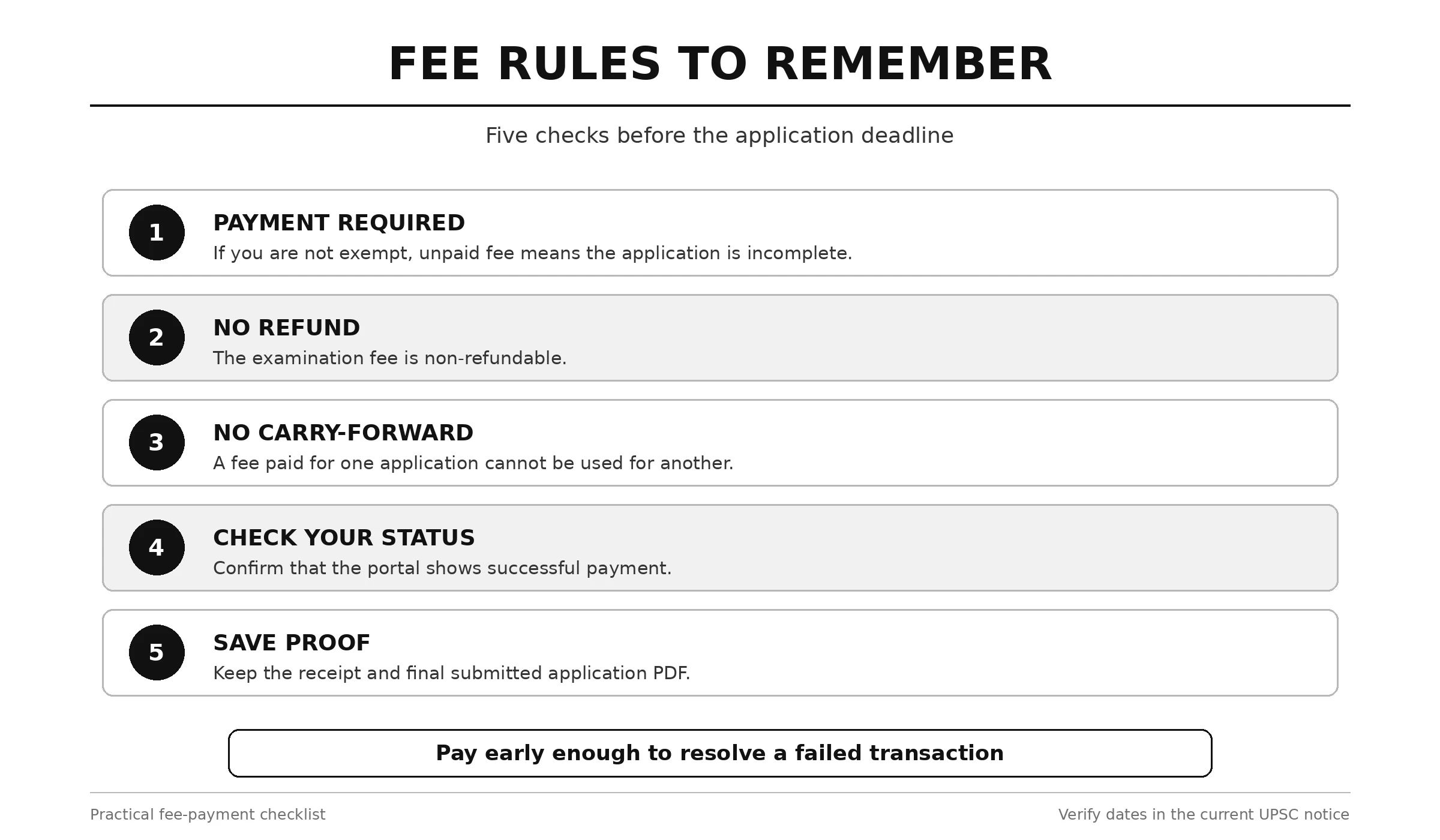
1. The fee is never refunded. Not if you change your mind, not if you become ineligible, not if you skip the exam. It also cannot be carried forward or held in reserve for another UPSC examination.
2. No fee means no application. An application submitted without the prescribed UPSC application fee, where no exemption is claimed, is summarily rejected. There is no grace period and no appeal.
3. You cannot withdraw your application. The CSE 2026 notice states that candidates will not be allowed to withdraw their applications after submission. UPSC did operate a withdrawal facility in earlier cycles, and several guides still describe the steps for it. Do not plan around it.
4. Corrections are possible, withdrawal is not. UPSC opens a short correction window after the application period closes, which for CSE 2026 ran from 28 February to 3 March 2026. That window is for fixing details, not for changing your mind.
The practical reading: pay the ₹100, but decide before you pay, not after.
UPSC Form Fee vs What the Attempt Actually Costs
Worth saying once, because arithmetic changes how people behave.
The ₹100 UPSC form fee is almost certainly the cheapest thing about this exam. A year of preparation costs books, test series, possibly coaching, possibly rent in another city, and a year of foregone earnings. Against that, ₹100 is a rounding error.
Yet the fee is what makes people walk into the hall unprepared. Having paid, they feel obliged to appear, and appearing is what consumes an attempt. Applying costs ₹100; sitting in one Prelims paper costs one of your six.
So treat them as separate decisions. Apply anyway to keep the option open, then decide on exam morning whether you are ready. If you walk in, it is an attempt. If you do not, it is not, and you are out ₹100.
That is the one place on this page where the fee genuinely matters, and it works the opposite way to how most people assume.
Key Dates and Fees for the Next Cycle
For CSE 2027, per the UPSC Calendar 2027:
Event | Date |
Notification and application opens | 13 January 2027 |
Prelims | 23 May 2027 |
Mains begins | 20 August 2027 |
Fees are set in the notification for each cycle, and the ₹100 and ₹200 figures have been stable for years.
Confirm both the amounts and the accepted payment modes against the CSE 2027 notice when it is published, rather than against any article, including this one.
What is the UPSC exam fee for Prelims and Mains?
Is there any UPSC exam fee for female candidates?
Do EWS candidates have to pay the UPSC application fee?
Can I get a refund of the UPSC form fee?
How can I pay the application fee for UPSC?
In summary, understanding the UPSC exam fee structure and payment process is vital for aspirants. For the general (unreserved) or OBC/EWS male candidates, the application fee is Rs. 100 for Prelims and Rs. 200 for Mains.
All women and candidates belonging to SC, ST, and PwBD categories are exempt from UPSC exam fees.
Fees can be paid online or via SBI challan, but once paid they are non-refundable. Make sure to pay fees well before the deadline and choose your exam center carefully (early applicants get priority for their preferred city).
By preparing with the right materials and staying aware of official updates (via the UPSC website or the press release), you can focus fully on studying for the exam itself.
For more guidance, explore detailed resources such as the PadhAI blogs on exam format and strategy or NCERT book recommendations. We wish you success in your UPSC preparation journey!





Research methodology
PadhAI's research methodology ensures every article is accurate, UPSC-ready, and beginner-friendly. We curate current affairs analysis based on UPSC exam relevance by cross-referencing The Hindu, Indian Express, and PIB. General Studies (GS) topics are drafted from NCERTs and standard books such as M. Laxmikanth, Spectrum, and GC Leong, then reviewed by subject matter experts to eliminate factual errors. Additionally, we update aspirants with verified government exam notifications alongside expert blogs suggesting the best resources, syllabus, and comprehensive Prelims and Mains strategies.


Gajendra Singh Godara
Ex-UPSC Aspirant | Exam Preparation Expert
Gajendra Singh Godara is an IIT Bombay graduate and a UPSC aspirant with 4 attempts, including multiple Prelims and Mains appearances. He specializes in Polity, Modern History, International Relations, and Economy. At PadhAI, Gajendra leverages his firsthand exam experience to simplify complex concepts, creating high-efficiency study materials that help aspirants save time and stay focused.
No comments yet. Be the first to join the discussion!