UPSC CMS Question Paper 2026 PDF: Download, Analysis
The UPSC CMS Question Paper for 2026 will be available only after the exam on 2 August 2026. This guide explains when the official PDF usually drops, where to get it, how it differs from coaching-reconstructed versions, and shares the last five years of papers with topic-wise weightage for practice.

Last updated
The UPSC CMS Question Paper 2026 is not out yet, and that is expected: the Combined Medical Services exam itself is scheduled for 2 August 2026, so there is nothing to download until candidates have actually sat for it.
Once both papers are conducted, the official PDF appears on upsc.gov.in, usually a few weeks later, while several coaching platforms publish a reconstructed version within hours based on candidate recall.
This guide walks through the exact timeline you can expect, how the two versions differ, and the previous year UPSC CMS question papers you should be solving right now to prepare for this attempt or the next one.
The key facts on the current status and past release pattern are listed below:
Particulars | Details |
Exam Date | 2 August 2026 (Sunday), two sessions |
Paper 1 Timing | 9:30 AM to 11:30 AM (General Medicine and Paediatrics) |
Paper 2 Timing | 2:00 PM to 4:00 PM (Surgery, Gynaecology and Obstetrics, PSM) |
Question Paper Status | |
Questions per Paper | 120 objective-type questions |
Marks per Paper | 250 |
Negative Marking | One-third of the marks allotted to each wrong answer |
Official Website | upsc.gov.in |
Join our WhatsApp Community
A question paper only exists once the exam has been held, and the Combined Medical Services Examination 2026 is set for 2 August 2026.
Anyone offering a downloadable "UPSC CMS Question Paper 2026 PDF" before that date is either selling a mock paper, a previous year set relabelled, or a guess. Save your download for once the real thing exists.
What you can rely on today is the previous year record: the exam pattern, the subject split, and the way past papers behaved.
All three are covered further down this page, and all three carry directly into this year's paper.
UPSC CMS Answer Key 2026
Two separate timelines run after every CMS exam, and mixing them up causes needless confusion.
The Unofficial Reconstructed Paper
Within a few hours of the last session ending, several coaching platforms publish a reconstructed question paper built from candidate memory and answer discussions.
It is useful for a same-day sense check, but treat it as approximate.
Question order, exact wording, and even a few options can differ from the original paper.
The Official UPSC PDF
UPSC uploads the authentic question paper to its website under the Previous Question Papers section.
Based on the last three cycles, here is the typical gap between the exam date and the official upload:
Year | Exam Date | Official Paper Uploaded | Approximate Gap |
2023 | 16 July 2023 | September 2023 | 6 to 8 weeks |
2024 | 14 July 2024 | Late August 2024 | 5 to 6 weeks |
2025 | 20 July 2025 | Early September 2025 | 6 to 7 weeks |
Source: UPSC Previous Question Papers section, upsc.gov.in
Going by this trend, the UPSC CMS 2026 question paper should land on the official site sometime in mid to late September 2026.
UPSC does not announce the exact upload date in advance, so bookmark this page and we will update it the moment the PDF is live.
Add as a preferred Source on Google
The steps stay the same every year, so save yourself the search later:
Visit the official UPSC website, upsc.gov.in.
Go to the Examinations tab, then click Previous Question Papers.
Select Combined Medical Services Examination from the exam list.
Choose the year, 2026, once it appears in the list.
Click the Paper I and Paper II links to open the PDFs.
Download and save both files; UPSC does not always keep old links live indefinitely.
UPSC releases the raw question paper only. It does not publish an official answer key for CMS, so cross-checking your responses depends on the analysis published by coaching platforms and previous year solution sets.
Since this year's paper is not available yet, the most reliable prep material is the actual record from recent years. Each of these was a real CMS paper, not a guess:
Year | Paper 1 Focus | Paper 2 Focus | Questions | Marks |
2025 | General Medicine, Paediatrics | Surgery, Gynaecology and Obstetrics, PSM | 120 each | 250 each |
2024 | General Medicine, Paediatrics | Surgery, Gynaecology and Obstetrics, PSM | 120 each | 250 each |
2023 | General Medicine, Paediatrics | Surgery, Gynaecology and Obstetrics, PSM | 120 each | 250 each |
2022 | General Medicine, Paediatrics | Surgery, Gynaecology and Obstetrics, PSM | 120 each | 250 each |
2021 | General Medicine, Paediatrics | Surgery, Gynaecology and Obstetrics, PSM | 120 each | 250 each |
Solve at least the last five years under exam-length timing: two hours per paper, no pausing halfway. That single habit does more for your speed than reading five extra chapters.
The exact questions never repeat, but the subjects that get heavier coverage tend to hold their pattern year on year. A look across recent CMS cycles shows a shift worth noting:
2024 and 2025 papers leaned more on cardiology, pulmonology, and infectious diseases within General Medicine.
2021 to 2023 papers gave relatively more weight to gastroenterology and endocrinology.
Surgery has consistently favoured general surgery and gastrointestinal or abdominal conditions across nearly every recent cycle.
Paediatrics keeps returning to neonatal care, paediatric emergencies, immunisation schedules, and growth milestones.
Treat this as a study emphasis, not a syllabus substitute. Integrated questions that blend two disciplines, say a Paediatrics question with a Preventive Medicine angle, are common enough that narrow topic-spotting can backfire.
Quick Read on Negative Marking
Every wrong answer costs one-third of that question's allotted marks. On a 250-mark, 120-question paper, each question is worth roughly 2.08 marks, so a wrong guess costs close to 0.69 marks.
Leaving a genuinely unfamiliar question blank almost always beats a random guess across four options; do the arithmetic once and it stops feeling like a leap of faith.
A quick refresher helps you read any question paper, old or new, the right way:
Paper | Subjects | Questions | Marks | Duration |
Paper I | General Medicine (96), Paediatrics (24) | 120 | 250 | 2 hours |
Paper II | Surgery (40), Gynaecology and Obstetrics (40), Preventive and Social Medicine (40) | 120 | 250 | 2 hours |
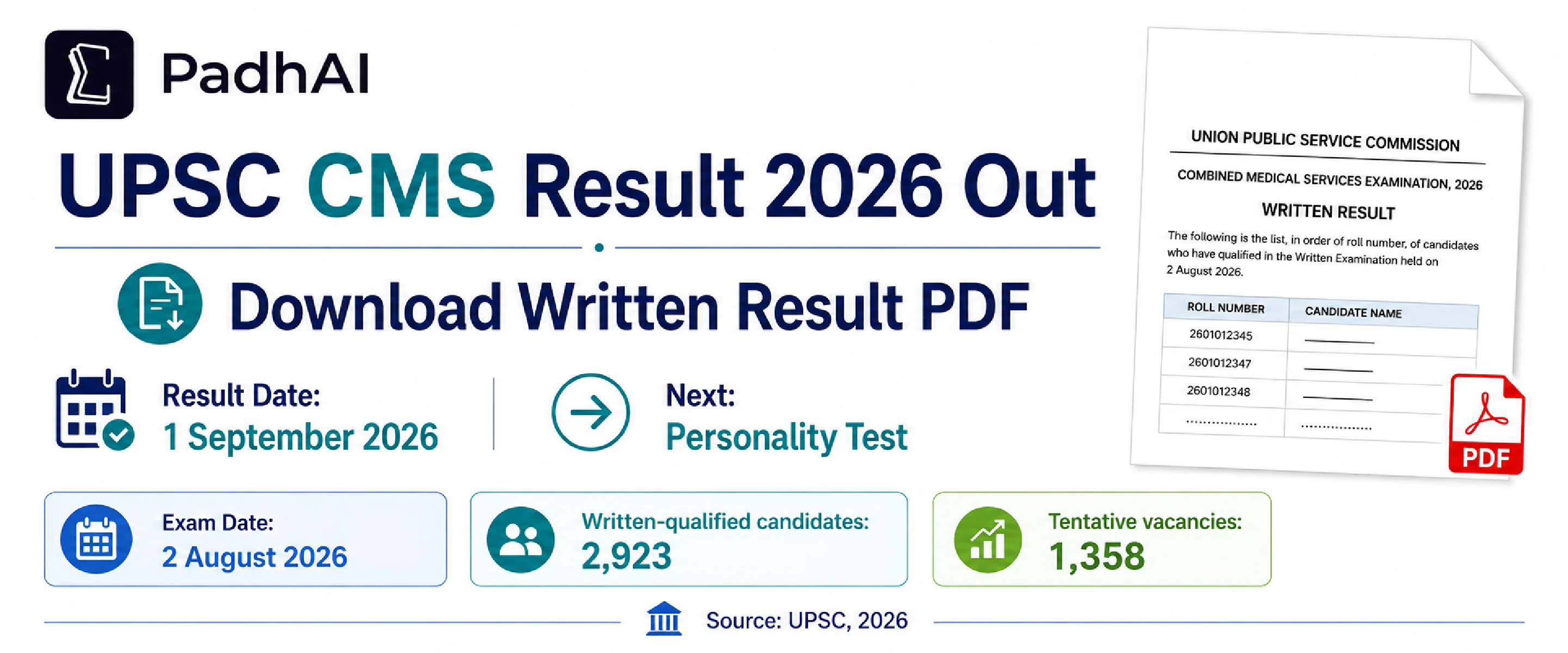
Both papers happen on the same day. Candidates who clear the written stage move to a 100-mark Personality Test, and the two scores combine into the final merit list.
For the full breakdown of dates, eligibility, and registration, see our UPSC CMS Exam 2026 guide.
Simply reading through a stack of PDFs teaches you very little. A more useful routine:
Attempt one full paper under a strict two-hour timer, phone away, no reference books open.
Mark every wrong or skipped answer and write one line on why you missed it: knowledge gap, silly error, or time pressure.
Revisit that topic within 48 hours while the mistake is still fresh.
Repeat with a different year's paper every alternate day through the final stretch before the exam.
This cycle, done consistently, builds both content recall and exam-day pacing at the same time, which is exactly what a single read-through cannot do.
Frequently asked question (FAQs)
Is the UPSC CMS Question Paper 2026 available for download?
When will the official UPSC CMS 2026 question paper be released?
Does UPSC release an official answer key along with the CMS question paper?
How many questions and marks does each UPSC CMS paper carry?
Where can I find genuine previous year UPSC CMS question papers?
The UPSC CMS Question Paper 2026 will exist only after the exam on 2 August 2026, and the official PDF should reach upsc.gov.in roughly six weeks later based on past cycles.
Until then, the smartest use of your time is solving the last five years of genuine papers under timed conditions and tracking your own error pattern.
Bookmark this page; we will update it with the direct download link the moment UPSC uploads the 2026 paper.
For everything else on this cycle, from eligibility to the admit card, check the UPSC notifications page on PadhAI.




No comments yet. Be the first to join the discussion!