Atomic Energy Bill 2025 (SHANTI Bill): Nuclear Power Sector

Atomic Energy Bill 2025 (SHANTI Bill) boosts India’s energy security with $214bn private nuclear investment, 49% FDI, ₹1,500Cr liability cap, and 100 GW target by 2047.

UPSC Prelims

Current affairs

Latest Update

Gajendra Singh Godara

Dec 16, 2025

4

mins read

Atomic Energy Bill ( Shanti Bill )

Atomic Energy Bill 2025

Atomic Energy Bill 2025

Atomic Energy Bill 2025

Atomic Energy Bill 2025

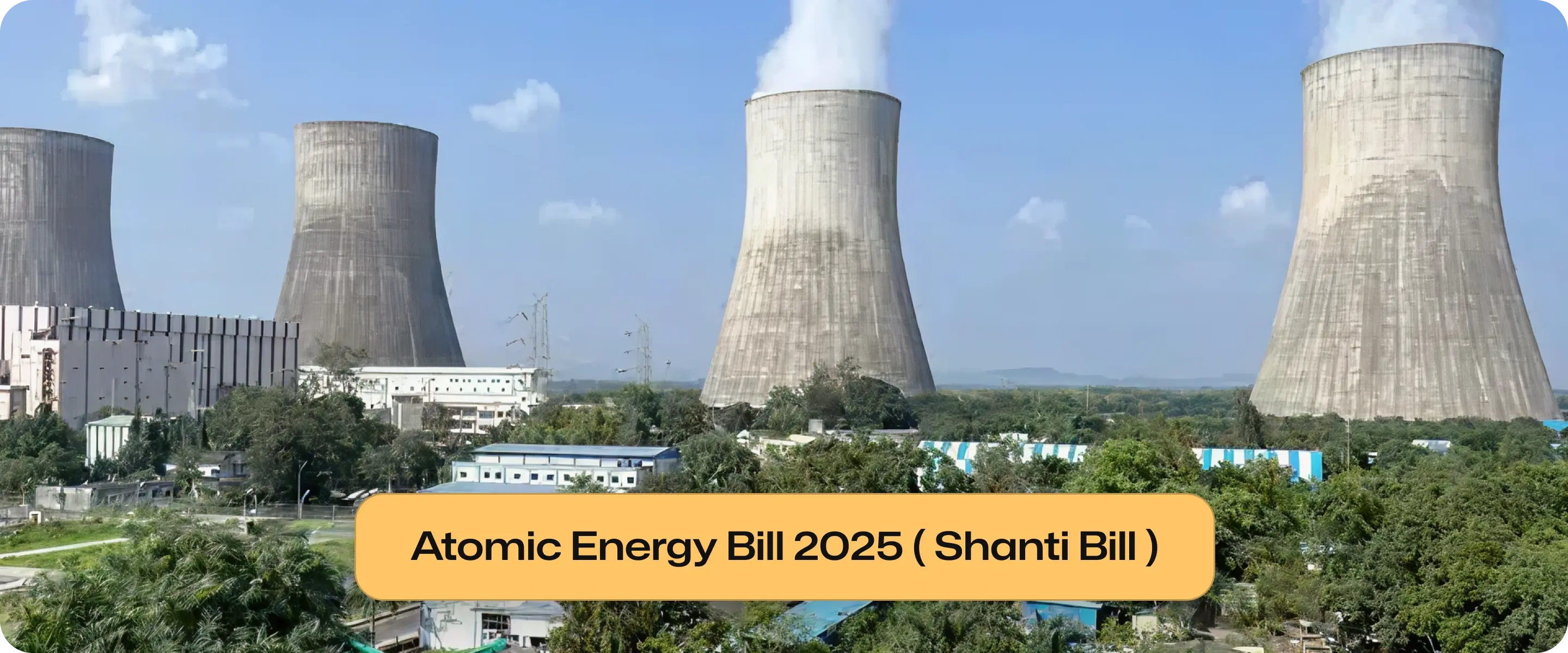
India is rewriting its nuclear energy rules. The Union Cabinet has approved the Atomic Energy Bill, 2025, officially branded as the SHANTI Bill. This legislation ends the government's decades-old monopoly on nuclear power generation. It opens the doors for private companies to build, own, and operate nuclear plants.

Here is a breakdown of what the SHANTI Bill means for India’s energy future.

What is the SHANTI Bill?

What is the SHANTI Bill?

What is the SHANTI Bill?

What is the SHANTI Bill?

SHANTI stands for Sustainable Harnessing and Advancement of Nuclear Energy for Transforming India.

This new umbrella law repeals two older acts:

  • The Atomic Energy Act, 1962.

  • The Civil Liability for Nuclear Damage Act, 2010 (CLND Act).

The government introduced this bill to modernize India's nuclear architecture. It aims to boost India's nuclear power capacity from the current 8.8 GW to 100 GW by 2047.

Join our WhatsApp Community

Join our WhatsApp Community

Join our WhatsApp Community

Join our WhatsApp Community

Key Features of the Atomic Energy Amendment Bill 2025

Key Features of the Atomic Energy Amendment Bill 2025

Key Features of the Atomic Energy Amendment Bill 2025

Key Features of the Atomic Energy Amendment Bill 2025

The SHANTI Bill introduces four major changes to the sector.

1. Private Sector Entry

For the first time, private companies can enter the entire nuclear value chain. The bill allows private players to participate in India's Nuclear Sector:

  • Plant Operations: Companies can now build, own, and operate nuclear power plants.

  • Fuel Cycle: Private firms can handle nuclear fuel fabrication and uranium exploration.

  • Equipment Manufacturing: The bill encourages the manufacturing of heavy reactor components.

Previously, only state-owned entities like the Nuclear Power Corporation of India Limited (NPCIL) could run these plants. The bill now permits up to 49% Foreign Direct Investment (FDI) in nuclear power projects.

2. Liability Reform

The bill fixes the "supplier liability" issue that stalled foreign investment for years.

  • Scrapping Section 46: The bill removes the contentious clause from the 2010 Act that allowed operators to sue suppliers.

  • Capped Liability: It introduces insurance-backed caps on liability. The operator caps their liability at ₹1,500 crore per incident.

  • Government Backstop: The government will cover damages beyond this cap, aligning India with international norms like the Convention on Supplementary Compensation (CSC).

3. Independent Regulator

The bill creates a statutorily Independent Nuclear Safety Authority. This group will manage safety and compliance. These tasks will be separate from the Department of Atomic Energy (DAE), which supports the sector.

4. Small Modular Reactors (SMRs)

The government has launched a ₹20,000 crore Nuclear Energy Mission to support the development of Small Modular Reactors (SMRs).

  • Target:  Operationalize five indigenously developed SMRs by 2033.

  • Use Cases: These smaller reactors will power energy-intensive industries like steel, cement, and data centers.

UPSC Current Affairs Magazines

UPSC Current Affairs Magazines

Add as a preferred Source on Google

Add as a preferred Source on Google

Why India Needs This Bill Now

Why India Needs This Bill Now

Why India Needs This Bill Now

Why India Needs This Bill Now

India faces a triple challenge: rising energy demand, climate goals, and grid stability.

  • Net Zero by 2070: Nuclear power provides the "baseload" clean energy needed to balance intermittent solar and wind power.

  • Data Center Demand: The boom in AI and data centers requires reliable, 24/7 electricity that coal cannot sustainably provide.

  • Capital Requirement: Expanding to 100 GW requires massive capital. The government cannot fund this alone. It needs private investment of about $26 billion.

This plan aims for 100 GW of nuclear capacity by 2047. The total cost is around $214 billion. The initial push requires about $26 billion from the private sector.

Add as a preferred Source on Google

Add as a preferred Source on Google

UPSC Current Affairs Magazines

UPSC Current Affairs Magazines

Strategic Significance of SHANTI Bill 2025

Strategic Significance of SHANTI Bill 2025

Strategic Significance of SHANTI Bill 2025

Strategic Significance of SHANTI Bill 2025

The SHANTI Bill does more than generate power. It strengthens India's strategic autonomy.

  • Energy Security: reducing dependence on imported coal and gas.

  • Global Hub: Positioning India as a manufacturing hub for SMRs and nuclear technology.

  • Jobs: Creating high-skilled jobs in engineering and R&D.

Key Challenges & Solutions for India's Nuclear Energy Expansion

  1. Safety & Regulation: Strengthen independent Nuclear Safety Regulatory Authority (NSRA) oversight for reactor safety and waste disposal. Promote Small Modular Reactors (SMRs) to help reduce carbon emissions and stabilize the grid. Invest ₹20,000 crore in research and development. The goal is to create 5 local SMRs by 2033.

  2. Private Sector & Partnerships: Expand commercial viability through liability reforms aligned with global norms. Deepen strategic partnerships with the US, France, and Russia. Russia's Kudankulam project demonstrates successful cooperation with 2 units operational and 4 more under construction.​

  3. Scalability & Technology Mix: Transition from PHWR-dominated (current 8.8 GW) to globally dominant Light Water Reactor (LWR) technology while preserving indigenous capability. India targets 100 GW by 2047 with a balanced portfolio: 46.5 GW PHWR, 38.8 GW PWR, 10 GW SMRs.​

Balanced Growth Path: Integrate nuclear energy within India's climate transition strategy while maintaining sovereignty. Ensure clear liability frameworks protecting victim compensation without deterring private investment-critical for achieving 4.15 GW annual capacity growth needed.​

Frequently asked question (FAQs)

What does SHANTI stand for in the new bill?
Does the SHANTI Bill allow foreign companies to own nuclear plants?
What is the nuclear energy target for 2047?
How does the bill change nuclear liability?
What are SMRs?
What are SMRs?
What are SMRs?
What are SMRs?

Latest UPSC Exam 2025 Updates

Latest UPSC Exam 2025 Updates

Latest UPSC Exam 2025 Updates

UPSC Calendar 2026 is released on 15th May, 2025.

UPSC Mains Result 2025 is now released.

Check out the updated and latest UPSC Syllabus 2026 here.

UPSC Notification 2025 was released on 22nd January 2025.

UPSC Prelims 2026 will be conducted on 24th May, 2026 & UPSC Mains 2026 will be conducted on 21st August 2026.

The UPSC Prelims 2026 is scheduled for May 24, 2026, while the UPSC Mains 2026 will be conducted from August 21, 2026.

The UPSC Selection Process is of 3 stages-Prelims, Mains and Interview.

UPSC Result 2024 is released with latest UPSC Marksheet 2024. Check Now!

Suggested posts

Australia Bans Social Media for Under-16s: A Global First

The Australian government has passed legislation that makes it illegal for social media platforms to allow children under 16 to hold accounts. This strict new law shifts the responsibility entirely onto tech giants. It demands that they redesign their systems to protect young users from online harms.

Here is a detailed breakdown of how Australia bans social media for minors and what this means for digital privacy and safety globally.

Australia Social Media Ban

The Australian government has passed legislation that makes it illegal for social media platforms to allow children under 16 to hold accounts. This strict new law shifts the responsibility entirely onto tech giants. It demands that they redesign their systems to protect young users from online harms.

Here is a detailed breakdown of how Australia bans social media for minors and what this means for digital privacy and safety globally.

Australia Bans Social Media for Under-16s: A Global First

The Australian government has passed legislation that makes it illegal for social media platforms to allow children under 16 to hold accounts. This strict new law shifts the responsibility entirely onto tech giants. It demands that they redesign their systems to protect young users from online harms.

Here is a detailed breakdown of how Australia bans social media for minors and what this means for digital privacy and safety globally.

Australia Social Media Ban

The Australian government has passed legislation that makes it illegal for social media platforms to allow children under 16 to hold accounts. This strict new law shifts the responsibility entirely onto tech giants. It demands that they redesign their systems to protect young users from online harms.

Here is a detailed breakdown of how Australia bans social media for minors and what this means for digital privacy and safety globally.

World Inequality Report 2026: India’s Rising Wealth Gap

  • The World Inequality Report 2026, released by the World Inequality Lab, reveals alarming disparities globally and in India. In India, the top 10% earn 58% of national income while the bottom 50% earn only 15%.

  • The report highlights widening income, wealth, gender, and climate inequalities, demanding urgent policy intervention for inclusive growth and social justice.

  • This is the 3rd edition of World Inequality Report after 2018 and 2022.

World Inequality Report 2026
  • The World Inequality Report 2026, released by the World Inequality Lab, reveals alarming disparities globally and in India. In India, the top 10% earn 58% of national income while the bottom 50% earn only 15%.

  • The report highlights widening income, wealth, gender, and climate inequalities, demanding urgent policy intervention for inclusive growth and social justice.

  • This is the 3rd edition of World Inequality Report after 2018 and 2022.

World Inequality Report 2026: India’s Rising Wealth Gap

  • The World Inequality Report 2026, released by the World Inequality Lab, reveals alarming disparities globally and in India. In India, the top 10% earn 58% of national income while the bottom 50% earn only 15%.

  • The report highlights widening income, wealth, gender, and climate inequalities, demanding urgent policy intervention for inclusive growth and social justice.

  • This is the 3rd edition of World Inequality Report after 2018 and 2022.

World Inequality Report 2026
  • The World Inequality Report 2026, released by the World Inequality Lab, reveals alarming disparities globally and in India. In India, the top 10% earn 58% of national income while the bottom 50% earn only 15%.

  • The report highlights widening income, wealth, gender, and climate inequalities, demanding urgent policy intervention for inclusive growth and social justice.

  • This is the 3rd edition of World Inequality Report after 2018 and 2022.

Human Rights Day 2025: History, Theme & Why It’s Celebrated

Every year, the global community unites to uphold the dignity of the individual on International Human Rights Day. For a Civil Services aspirant, this day is not merely an event but a syllabus touchpoint linking International Institutions (UN), the Constitution of India (Fundamental Rights), and Statutory Bodies (NHRC).

Here is a detailed analysis of Human Rights Day, its 2025 theme, and its relevance to the Indian politico-legal framework.

Human Rights Day 2025

Every year, the global community unites to uphold the dignity of the individual on International Human Rights Day. For a Civil Services aspirant, this day is not merely an event but a syllabus touchpoint linking International Institutions (UN), the Constitution of India (Fundamental Rights), and Statutory Bodies (NHRC).

Here is a detailed analysis of Human Rights Day, its 2025 theme, and its relevance to the Indian politico-legal framework.

Human Rights Day 2025: History, Theme & Why It’s Celebrated

Every year, the global community unites to uphold the dignity of the individual on International Human Rights Day. For a Civil Services aspirant, this day is not merely an event but a syllabus touchpoint linking International Institutions (UN), the Constitution of India (Fundamental Rights), and Statutory Bodies (NHRC).

Here is a detailed analysis of Human Rights Day, its 2025 theme, and its relevance to the Indian politico-legal framework.

Human Rights Day 2025

Every year, the global community unites to uphold the dignity of the individual on International Human Rights Day. For a Civil Services aspirant, this day is not merely an event but a syllabus touchpoint linking International Institutions (UN), the Constitution of India (Fundamental Rights), and Statutory Bodies (NHRC).

Here is a detailed analysis of Human Rights Day, its 2025 theme, and its relevance to the Indian politico-legal framework.

a close up of a cell phone with a blurry background

About Author

Gajendra Singh Godara

Growth | FTE| Resident at SigIQ

Gajendra Singh Godara brings authentic UPSC preparation insights from his four-attempt journey, having successfully cleared Prelims and written Mains multiple times. His deep expertise spans Polity, Modern History, International Relations, and Economy. At PadhAI, Gajendra transforms his extensive exam experience into accessible content that simplifies complex concepts for aspirants at every preparation stage. His firsthand understanding of UPSC's demands enables him to create targeted materials that save time while maximizing learning efficiency for current affairs, general studies, and optional subjects.

a close up of a cell phone with a blurry background

About Author

Gajendra Singh Godara

Growth | FTE| Resident at SigIQ

Gajendra Singh Godara brings authentic UPSC preparation insights from his four-attempt journey, having successfully cleared Prelims and written Mains multiple times. His deep expertise spans Polity, Modern History, International Relations, and Economy. At PadhAI, Gajendra transforms his extensive exam experience into accessible content that simplifies complex concepts for aspirants at every preparation stage. His firsthand understanding of UPSC's demands enables him to create targeted materials that save time while maximizing learning efficiency for current affairs, general studies, and optional subjects.

a close up of a cell phone with a blurry background

About Author

Gajendra Singh Godara

Growth | FTE| Resident at SigIQ

Gajendra Singh Godara brings authentic UPSC preparation insights from his four-attempt journey, having successfully cleared Prelims and written Mains multiple times. His deep expertise spans Polity, Modern History, International Relations, and Economy. At PadhAI, Gajendra transforms his extensive exam experience into accessible content that simplifies complex concepts for aspirants at every preparation stage. His firsthand understanding of UPSC's demands enables him to create targeted materials that save time while maximizing learning efficiency for current affairs, general studies, and optional subjects.

a close up of a cell phone with a blurry background

About Author

Gajendra Singh Godara

Growth | FTE| Resident at SigIQ

Gajendra Singh Godara brings authentic UPSC preparation insights from his four-attempt journey, having successfully cleared Prelims and written Mains multiple times. His deep expertise spans Polity, Modern History, International Relations, and Economy. At PadhAI, Gajendra transforms his extensive exam experience into accessible content that simplifies complex concepts for aspirants at every preparation stage. His firsthand understanding of UPSC's demands enables him to create targeted materials that save time while maximizing learning efficiency for current affairs, general studies, and optional subjects.

PadhAI UPSC App

We're PadhAI - a free UPSC prep app built by IITians, AI PhDs & top UPSC experts.

Why choose PadhAI?

Read daily top news (TH & IE) & Solve Current Affairs MCQs
Topic-wise search of 30+ yrs PYQs
24×7 AI tutor for doubt resolution
Practice 30k+ MCQs & full GS + CSAT mocks
Play Duel UPSC quizzes with fellow aspirants

Why choose PadhAI?

Read daily top news (TH & IE) & Solve Current Affairs MCQs

Topic-wise search of 30+ yrs PYQs

24×7 AI tutor for doubt resolution

Practice 30k+ MCQs & full GS + CSAT mocks

Play Duel UPSC quizzes with fellow aspirants

PadhAI UPSC App

We're PadhAI - a free UPSC prep app built by IITians, AI PhDs & top UPSC experts.

Why choose PadhAI?

Read daily top news (TH & IE) & Solve Current Affairs MCQs

Topic-wise search of 30+ yrs PYQs

24×7 AI tutor for doubt resolution

Practice 30k+ MCQs & full GS + CSAT mocks

Play Duel UPSC quizzes with fellow aspirants

PadhAI UPSC App

We're PadhAI - a free UPSC prep app built by IITians, AI PhDs & top UPSC experts.

Suggested posts

Australia Social Media Ban

Australia Bans Social Media for Under-16s: A Global First

The Australian government has passed legislation that makes it illegal for social media platforms to allow children under 16 to hold accounts. This strict new law shifts the responsibility entirely onto tech giants. It demands that they redesign their systems to protect young users from online harms.

Here is a detailed breakdown of how Australia bans social media for minors and what this means for digital privacy and safety globally.

World Inequality Report 2026

World Inequality Report 2026: India’s Rising Wealth Gap

  • The World Inequality Report 2026, released by the World Inequality Lab, reveals alarming disparities globally and in India. In India, the top 10% earn 58% of national income while the bottom 50% earn only 15%.

  • The report highlights widening income, wealth, gender, and climate inequalities, demanding urgent policy intervention for inclusive growth and social justice.

  • This is the 3rd edition of World Inequality Report after 2018 and 2022.

Human Rights Day 2025

Human Rights Day 2025: History, Theme & Why It’s Celebrated

Every year, the global community unites to uphold the dignity of the individual on International Human Rights Day. For a Civil Services aspirant, this day is not merely an event but a syllabus touchpoint linking International Institutions (UN), the Constitution of India (Fundamental Rights), and Statutory Bodies (NHRC).

Here is a detailed analysis of Human Rights Day, its 2025 theme, and its relevance to the Indian politico-legal framework.

Australia Social Media Ban

Australia Bans Social Media for Under-16s: A Global First

The Australian government has passed legislation that makes it illegal for social media platforms to allow children under 16 to hold accounts. This strict new law shifts the responsibility entirely onto tech giants. It demands that they redesign their systems to protect young users from online harms.

Here is a detailed breakdown of how Australia bans social media for minors and what this means for digital privacy and safety globally.

World Inequality Report 2026

World Inequality Report 2026: India’s Rising Wealth Gap

  • The World Inequality Report 2026, released by the World Inequality Lab, reveals alarming disparities globally and in India. In India, the top 10% earn 58% of national income while the bottom 50% earn only 15%.

  • The report highlights widening income, wealth, gender, and climate inequalities, demanding urgent policy intervention for inclusive growth and social justice.

  • This is the 3rd edition of World Inequality Report after 2018 and 2022.

Human Rights Day 2025

Human Rights Day 2025: History, Theme & Why It’s Celebrated

Every year, the global community unites to uphold the dignity of the individual on International Human Rights Day. For a Civil Services aspirant, this day is not merely an event but a syllabus touchpoint linking International Institutions (UN), the Constitution of India (Fundamental Rights), and Statutory Bodies (NHRC).

Here is a detailed analysis of Human Rights Day, its 2025 theme, and its relevance to the Indian politico-legal framework.

Armed Forces Flag Day 2025

Armed Forces Flag Day Celebration 2025: Date, History & Theme

National security relies on soldier morale as much as it relies on modern weapons. The defence budget covers operational needs, but the duty of society to care for the veteran and the war-widow finds its expression through a special system: the Armed Forces Flag Day.

For a civil services student, understanding this day requires more than a ceremonial look. You must study the administrative structure of the Kendriya Sainik Board (KSB), the management of the Armed Forces Flag Day Fund (AFFDF), and the idea of the 'Social Contract' between a nation and its defenders.

Download PadhAI App

Don't get left behind in your preparation

Download PadhAI App

Don't get left behind in your preparation

Download PadhAI App

Don't get left behind in your preparation

Download PadhAI App

Don't get left behind in your preparation

Embark on your journey!

Address

3rd floor, Electrical and Electronic, ALG Towers, Plot no. 48, main road, Industrial Estate, Perungudi, Chennai, Tamil Nadu 600096

PadhAI is a product of SigIQ AI, and Metayb is a recognized reseller authorized to sell PadhAI subscriptions.

Embark on your journey!

Address

3rd floor, Electrical and Electronic, ALG Towers, Plot no. 48, main road, Industrial Estate, Perungudi, Chennai, Tamil Nadu 600096

PadhAI is a product of SigIQ AI, and Metayb is a recognized reseller authorized to sell PadhAI subscriptions.

Embark on your journey!

Address

3rd floor, Electrical and Electronic, ALG Towers, Plot no. 48, main road, Industrial Estate, Perungudi, Chennai, Tamil Nadu 600096

PadhAI is a product of SigIQ AI, and Metayb is a recognized reseller authorized to sell PadhAI subscriptions.

Embark on your journey!

Address

3rd floor, Electrical and Electronic, ALG Towers, Plot no. 48, main road, Industrial Estate, Perungudi, Chennai, Tamil Nadu 600096

PadhAI is a product of SigIQ AI, and Metayb is a recognized reseller authorized to sell PadhAI subscriptions.

Current Affairs

UPSC Resources

UPSC updates

General studies

UPSC Preparation

Pricing