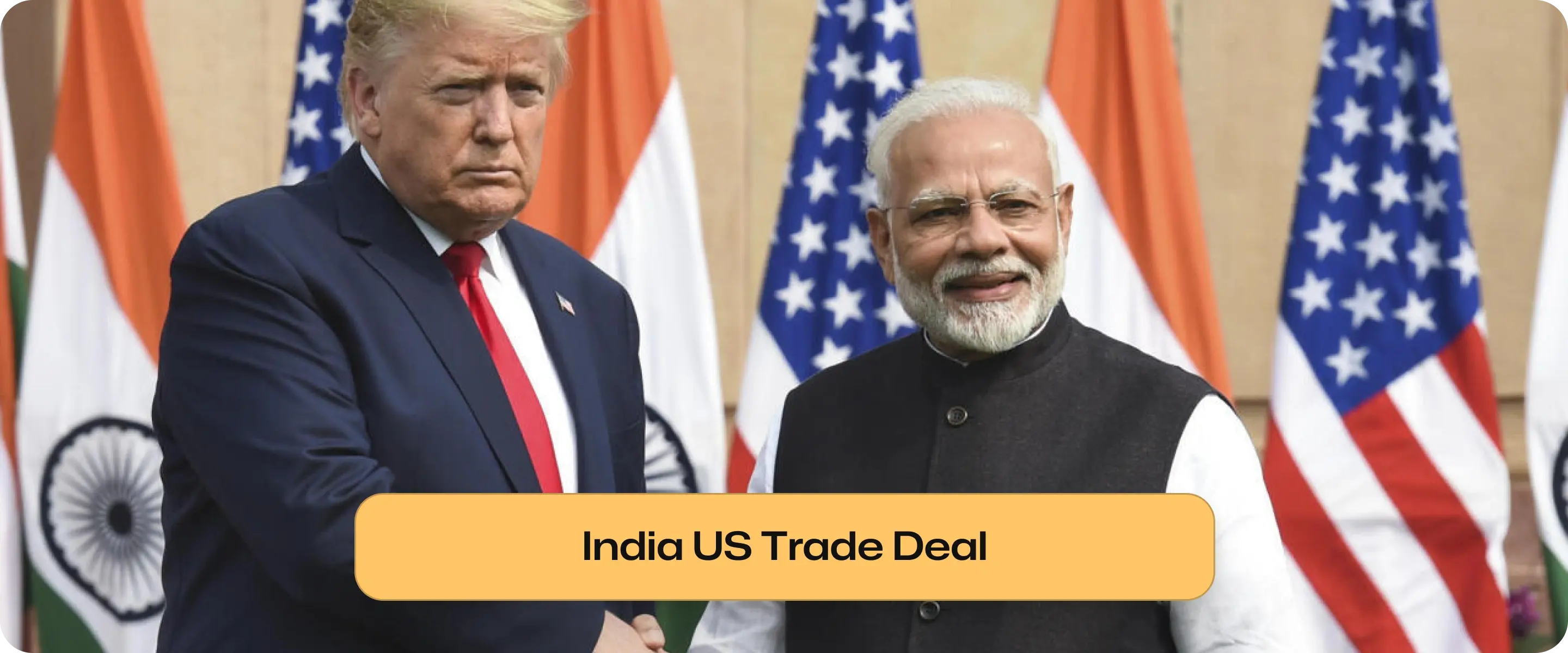
India-US Trade Deal Cuts Tariffs to 18%: Impact on India
India-US trade deal: A strategic reset in ties lowering tariffs from 50% to 18% amid Russian oil tensions. Boost for Make in India in textiles, gems, and marine products etc.

Gajendra Singh Godara
Last updated
10
mins read
Why in the News?
India-US Trade Deal: India and the US recently announced a landmark trade deal, slashing punitive tariffs on Indian goods from 50% to 18%.
This follows a period of tension in August 2025, when the US doubled tariffs to 50% citing India's Russian oil imports.
The journey toward the current agreement was marked by intense negotiations and a period of "tariff warfare".
Timeline | Key Events |
February 2025 | Modi-Trump roadmap signed; trade target set at $500 billion by 2030. |
March–July 2025 | Negotiations stall over agricultural protection, high tariffs, and India's Russian oil imports. |
August 1, 2025 | The US imposes a 25% reciprocal tariff on Indian products. |
August 27, 2025 | Tariffs doubled to a punitive 50% as a penalty for India's continued Russian oil imports. |
January 2026 | India rolls back several Quality Control Orders (QCOs) and duties to support domestic sectors hit by the trade shock. |
February 3, 2026 | A major breakthrough occurs; the US agrees to reduce tariffs from 50% to 18%. |
Join our WhatsApp Community
The US trade deal with India announced in February 2026 signals a significant "thaw" in economic tensions. The central feature of this reset is the reduction of the reciprocal tariff on "Made in India" products to 18%, down from the effective 50% imposed in 2025.
1. Tariff Reductions
The new agreement rollbacks the 25% "Liberation Day" tariffs and the additional 25% penalty linked to oil imports from Russia. This reduction is expected to provide a major boost to the 'Make in India' initiative by restoring market access for Indian exporters.
2. Market Access and Commitments
According to India US trade deal news, India has committed to a massive increase in imports from the US to address trade imbalances. Key commitments include:
Purchasing Volume: A target to buy over $500 billion worth of US products.
Targeted Sectors: The imports will focus on energy (natural gas and coal), technology, agricultural goods, and nuclear equipment.
Regulatory Reforms: India is expected to move toward reducing both tariff and non-tariff barriers on American goods.
To appreciate the importance of the new India-US Trade Deal, one must understand the severity of the 50% US tariff regime implemented in August 2025.
Sectoral Vulnerabilities
Nearly 66% of Indian exports to the US, valued at approximately $59 billion in FY25, were subjected to these high duties. The impact was most severe in labour-intensive sectors:
Textiles and Apparel: Hubs like Tirupur, Noida, and Surat reported production halts. The US accounts for nearly 60% of India's home textile exports.
Gems and Jewellery: Exports worth over $10 billion were at risk of erosion, leading to fears of mass unemployment.
Marine Products (Shrimps): The US contributes nearly 48% of the revenue for Indian shrimp exporters.
Handicrafts and Furniture: Both sectors saw sharp revenue contractions due to falling demand in the American market.
The Rebalancing of Trade
During the period of high tariffs, India's trade strategy underwent a forced evolution. To narrow the trade gap and appease US concerns over the trade deficit, India significantly increased its imports of American goods. For instance, India’s goods trade surplus with the US almost halved between April and November 2025.
Add as a preferred Source on Google
A pivotal nuance in the India-US Trade Deal is the shift in India’s energy sourcing. The 50% US tariff was partially a penalty for India's strategic decision to import oil from Russia.
The Shift to American Energy
Crude Oil: The US share in India's oil imports rose to 7.48% (April–October 2025), while Russia's share declined from 37.88% to 32.18%.
LPG and LNG: Indian public sector refiners signed a one-year agreement to import 2.2 million tonnes of American LPG annually. The US is now the second-largest supplier of LNG to India.
Nuclear Cooperation: India has opened its nuclear sector to foreign investment, aligning with American interests in expanding nuclear power capacity and small modular reactors.
Reports suggest that as part of the deal, India may have agreed to further reduce or stop buying Russian oil in favor of US and Venezuelan sources, though this has not been officially confirmed by India’s Ministry of External Affairs.
Countering China: The tariff reduction solidifies India's role as a key U.S. ally, offering a competitive edge in Western markets while China faces increasing trade restrictions.
Economic Stability: The agreement is expected to boost investor confidence, stabilize the rupee, and curb capital outflows during uncertain times.
Global Trade Leader: By securing deals with the U.S, free trade agreement with UK, and fta with EU, India strengthens its global position relative to neighbors heavily dependent on Chinese investment.
While the India-US Trade Deal offers a path to economic recovery, it is not without significant criticisms and concerns from experts and opposition leaders.
1. Erosion of Strategic Autonomy
The most significant criticism involves India's "strategic autonomy". Committing to halt oil imports from a long-term partner like Russia under US pressure is seen by some as a constraint on India’s independent foreign policy.
2. Extractive Negotiations
Critics argue that negotiations under the Trump administration tend to be "extractive," meaning the US may be securing lopsided benefits. The commitment to purchase $500 billion in US goods is an enormous sum, considering India’s total global goods imports were approximately $720 billion in FY25.
3. Impact on Domestic Producers
While reduced tariffs help exporters, the commitment to lower barriers for US agricultural products could threaten the livelihoods of Indian farmers. Farmers' groups have previously expressed readiness to oppose deals that threaten local agriculture.
4. Dependency Risks
The trade war highlighted the risk of India's heavy reliance on a single market. As of 2024, the US accounted for 18% of India's exports. Relying too heavily on US trade concessions may leave India vulnerable to future policy shifts in Washington.
Frequently asked question (FAQs)
Why is the India-US Trade Deal significant for India’s 'Make in India' initiative?
How did Russian oil imports influence the US trade policy toward India?
What are the key sectors benefited by the US tariff reduction?
What is the target for bilateral trade mentioned in the 2025 roadmap?
How has India’s energy sourcing changed as a result of trade tensions?
The India-US Trade Deal marks an important reset, shifting from conflict to cooperation by slashing tariffs from 50% to 18%. This move highlights India's rising global importance but requires careful attention to the "fine print" and protecting strategic autonomy.
Ultimately, India's success depends on turning this improved market access into long-term growth by boosting local manufacturing and diversifying its trade partners






Research methodology
PadhAI's research methodology ensures every article is accurate, UPSC-ready, and beginner-friendly. We curate current affairs analysis based on UPSC exam relevance by cross-referencing The Hindu, Indian Express, and PIB. General Studies (GS) topics are drafted from NCERTs and standard books such as M. Laxmikanth, Spectrum, and GC Leong, then reviewed by subject matter experts to eliminate factual errors. Additionally, we update aspirants with verified government exam notifications alongside expert blogs suggesting the best resources, syllabus, and comprehensive Prelims and Mains strategies.


No comments yet. Be the first to join the discussion!