G20 Summit 2025 Johannesburg: India’s Diplomacy & Global South

Gajendra Singh Godara
Last updated
7
mins read
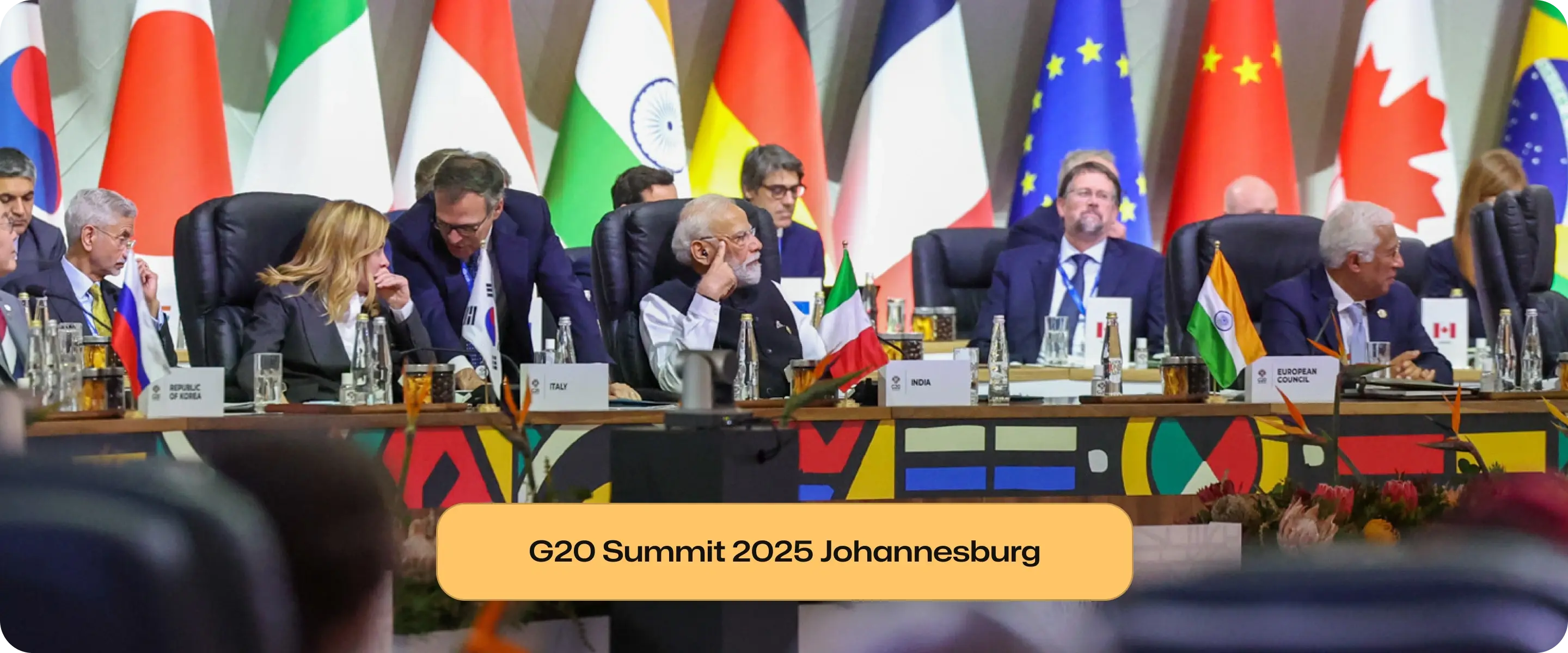
The G20 Summit 2025, convened in Johannesburg on November 22-23, represents a watershed moment in the history of multilateral diplomacy.
It was not merely an annual gathering but the closing chapter of a significant four-year geopolitical cycle where the G20 presidency was held consecutively by developing nations: Indonesia, India, Brazil, and finally, South Africa.
For the UPSC aspirant, this summit is a case study in "Asymmetric Multipolarity." While the Western bloc (G7) faced internal challenges, the Global South asserted its agenda with unprecedented clarity.
Join our WhatsApp Community
South African President Cyril Ramaphosa anchored the summit in the philosophy of "Ubuntu" (a Southern African philosophy emphasizing collective interdependence), choosing the theme "Solidarity, Equality, and Sustainability". This approach aimed to shift the G20's focus from crisis management to reforming the global financial architecture.
However, the summit occurred against a fractured backdrop:
The US Boycott: In a move reminiscent of Cold War-era brinkmanship, US President Donald Trump boycotted the summit. He cited ideological disagreements with South Africa's domestic policies and the summit's agenda, refusing to send even a high-level government representative.
The Vacuum and the Fill: The absence of the US President created a power vacuum. However, rather than rendering the summit irrelevant, it allowed emerging powers to consolidate. Leaders representing two-thirds of the global GDP still attended, including European heads of state (France, Germany, UK), effectively isolating the US position rather than the summit itself.
Significance for India: This environment validated India's strategy of "Strategic Autonomy." By engaging with both the Western powers present and the emerging Global South, India positioned itself as the indispensable bridge in a polarized world.
One of the most consequential outcomes for India's foreign policy was the formation of the Australia-Canada-India Technology and Innovation (ACITI) Partnership. This deserves special attention for GS Paper II (Groupings affecting India’s interests).
Why ACITI Matters:
Breaking the Ice with Canada: Since 2023, India-Canada relations have been strained. The ACITI agreement signals a pragmatic "Diplomatic Thaw," where economic security has taken precedence over political friction. The leaders even agreed to restart negotiations on the Comprehensive Economic Partnership Agreement (CEPA), aiming to double bilateral trade to $50 billion by 2030.
Critical Minerals Supply Chain: The partnership is explicitly designed to diversify supply chains for critical minerals like lithium, cobalt, and rare earth elements.
These minerals are essential for India's EV transition (FAME scheme) and renewable energy goals. Currently, China dominates the processing of these minerals. The ACITI partnership leverages Australia's reserves and India's processing potential to create a "China-Plus-One" alternative.
AI Governance: The partnership also focuses on "Collaborative AI," aiming to develop safety standards that counter authoritarian digital governance models, aligning with democratic values of transparency.
Add as a preferred Source on Google
To answer the question "What is India's role in G20?", one must look at the transition from "Agenda Taker" to "Agenda Setter." PM Narendra Modi presented six concrete proposals to institutionalize the Global South's priorities.
Initiative | Objective & UPSC Relevance |
1. Global Traditional Knowledge Repository | To create a digital library of indigenous wisdom. Significance: Combats "Biopiracy" and aligns with India's push for soft power in medicine (AYUSH). |
2. G20-Africa Skills Multiplier | Creating a pool of 1 million certified trainers in Africa. It’ll help Africa capitalize on its demographic dividend, preventing the "youth bulge" from becoming a security threat. |
3. Global Healthcare Response Team | A rapid deployment force of medical experts. This will address gaps exposed by COVID-19, operationalizing the "One Health" approach. |
4. Open Satellite Data Partnership | Sharing ISRO/G20 satellite data for development. "Space Diplomacy" to assist developing nations in agriculture and disaster management. |
5. Critical Minerals Circularity | Promoting recycling and "urban mining" of batteries. It is essential for the Circular Economy and reducing import dependence on raw lithium. |
6. Countering Drug-Terror Nexus | Breaking the financial spine of terror organizations. It directly addresses India's internal security concerns regarding narco-terrorism. |
The Johannesburg Declaration was heavy on economics, addressing the "Sovereign Debt Crisis" plaguing the developing world.
The Debt Trap: The summit highlighted startling data—African public debt has reached $1.8 trillion, with annual servicing costs of $163 billion. Currently, 57% of Africans live in countries that spend more on debt interest than on healthcare or education.
Mission 300: To counter this, the summit advanced "Mission 300," a World Bank and African Development Bank initiative.
Goal: Connect 300 million people in Sub-Saharan Africa to electricity by 2030.
Financing: It requires $30 billion in public funds to unlock $90 billion in private investment. The summit successfully served as a pledging conference for this initiative.
"Billions to Trillions": On climate finance, the declaration marked a semantic but significant shift. It acknowledged that the current flow of billions is inadequate, setting a target to mobilize $1.3 trillion by 2035 for developing nations to meet Paris Agreement goals.
IBSA vs. BRICS: The Return of the "Democratic" Grouping
An often-overlooked outcome was the meeting of the India-Brazil-South Africa (IBSA) forum on the sidelines.
Why IBSA? With BRICS expanding to include non-democratic regimes, IBSA is re-asserting itself as the "Democratic Voice of the Global South".
UNSC Reform: The leaders issued a strong statement that UN Security Council reform is "no longer an option, but a necessity." This indicates a coordinated push for permanent seats for Africa, Asia, and Latin America, challenging the monopoly of the P5.
Bilateral Diplomacy: Key Takeaways
Apart from the multilateral agenda, the PM’s bilateral engagements reflect India's multi-aligned foreign policy:
Italy: Focused on the "Joint Initiative to Counter Financing of Terrorism," specifically targeting cryptocurrency misuse. This aligns with FATF standards.
Japan: discussions centered on innovation and talent mobility, reinforcing the "Special Strategic and Global Partnership".
Jamaica & Netherlands: Showcased India's outreach to both Small Island Developing States (SIDS) and advanced European economies.
Critical Analysis & Way Forward
The G20 Summit 2025 demonstrated that global governance is becoming increasingly decentralized. The "Global South" is no longer a monolithic block of requestors but a coalition of proposers.
Challenges:
Implementation Gap: While the $1.3 trillion climate finance target is laudable, the "Cost of Capital Commission" launched at the summit must actively work to lower the "African risk premium" for this money to actually flow.
G20 vs. G7: The US boycott raises questions about the G20's future cohesion. If the G7 nations continue to prioritize their own bloc over the broader G20, the forum could face an existential crisis.
Q. Consider the following statements about G-20: (2023)
The G-20 group was originally established as a platform for the Finance Ministers and Central Bank Governors to discuss international economic and financial issues.
Digital public infrastructure is one of India’s G-20 priorities.
Which of the statements given above is/are correct?
1 only
2 only
Both 1 and 2
Neither 1 nor 2
Answer: (c)
Q. With reference to the “G20 Common Framework”, consider the following statements: (2022)
It is an initiative endorsed by the G20 together with the Paris Club.
It is an initiative to support Low Income Countries with unsustainable debt.
Which of the statements given above is/are correct?
1 only
2 only
Both 1 and 2
Neither 1 nor 2
Answer: (c)
Frequently asked question (FAQs)
When and where was the G20 Summit 2025 held, and why did it matter?
What were the major outcomes of the G20 Summit 2025 for developing nations?
What is India’s six-point proposal at the G20 Summit 2025?
What is the ACITI partnership launched during the summit?
How did the absence of the United States impact the G20 Summit 2025?
For India, the Johannesburg summit was a diplomatic triumph. It operationalized the African Union membership (a key achievement of India's 2023 presidency), secured critical supply chains through ACITI, and successfully navigated the US boycott without burning bridges. As the presidency moves to the next host, India has firmly established that it is not just part of the G20, but its intellectual and strategic anchor.



Research methodology
PadhAI's research methodology ensures every article is accurate, UPSC-ready, and beginner-friendly. We curate current affairs analysis based on UPSC exam relevance by cross-referencing The Hindu, Indian Express, and PIB. General Studies (GS) topics are drafted from NCERTs and standard books such as M. Laxmikanth, Spectrum, and GC Leong, then reviewed by subject matter experts to eliminate factual errors. Additionally, we update aspirants with verified government exam notifications alongside expert blogs suggesting the best resources, syllabus, and comprehensive Prelims and Mains strategies.


Gajendra Singh Godara is an IIT Bombay graduate and a UPSC aspirant with 4 attempts, including multiple Prelims and Mains appearances. He specializes in Polity, Modern History, International Relations, and Economy. At PadhAI, Gajendra leverages his firsthand exam experience to simplify complex concepts, creating high-efficiency study materials that help aspirants save time and stay focused.
No comments yet. Be the first to join the discussion!