Justice Surya Kant Takes Oath: 53rd Chief Justice of India
Justice Surya Kant takes oath as 53rd CJI of India on Nov 24, 2025. Understand how CJI is appointed under Article 124, Collegium system, removal & tenure.

Gajendra Singh Godara
8
mins read
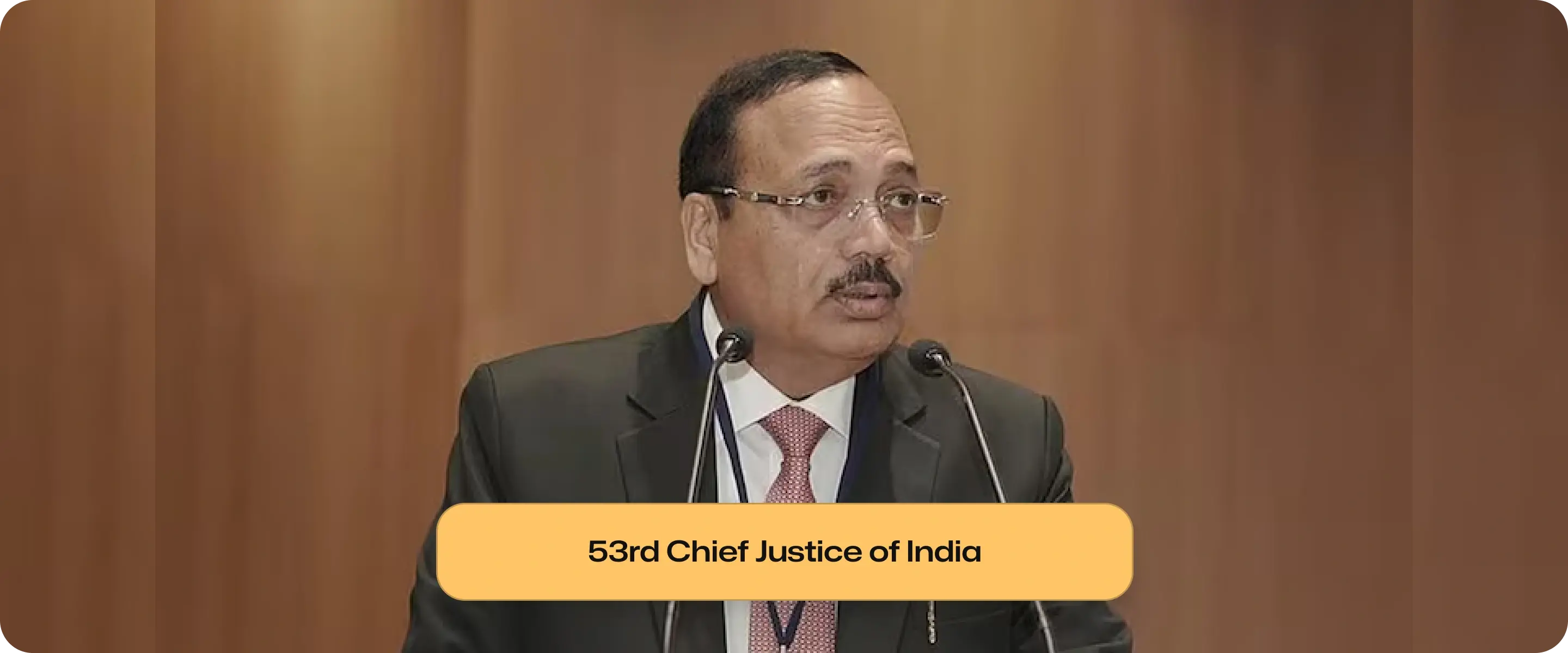
The Indian Judiciary witnessed a significant transition on November 24, 2025, as Justice Surya Kant was sworn in as the 53rd Chief Justice of India (CJI). This event marks the continuation of the constitutional lineage following the tenure of his predecessors.
For UPSC aspirants, the appointment of the present CJI of India is not merely a current affairs point; it is an opportunity to revisit the static constitutional provisions of Article 124, the evolution of the Collegium system, and the administrative powers of the "Master of the Roster."
Unlike the appointment of other judges, the appointment of the CJI is largely governed by the Memorandum of Procedure (MoP) and the convention of seniority, rather than a direct selection by the Collegium.
The Constitutional Basis
Under Article 124(2) of the Constitution, the President appoints the Chief Justice of India. However, the Constitution does not explicitly outline the procedure for selecting the CJI, leading to the evolution of conventions.
The Procedure (Step-by-Step):
Recommendation: The outgoing CJI recommends the name of their successor. By convention, this is almost always the senior-most judge of the Supreme Court.
Executive Processing: The Union Law Minister forwards this recommendation to the Prime Minister.
Advice to President: The Prime Minister advises the President, who then issues the warrant of appointment.
The Seniority Convention & The Second Judges Case (1993): The Supreme Court, in the Second Judges Case (1993), ruled that the senior-most judge of the Supreme Court must be appointed as the CJI.
Historical Context: This ruling was a response to the "supersession" controversies of the 1970s (e.g., the appointment of A.N. Ray in 1973 and M.H. Beg in 1977, bypassing senior judges). Since 1993, the seniority convention has been strictly followed to ensure judicial independence.
Join our WhatsApp Community
While the CJI is appointed based on seniority, the current CJI leads the Collegium to appoint other judges to the Supreme Court.
Composition: The Collegium consists of the CJI and the four senior-most judges of the Supreme Court.
Evolution:
First Judges Case (1981): Gave the Executive primacy in appointments and this was later overruled by the Second Judges Case in 1993
Second Judges Case (1993): Introduced the Collegium system; primacy given to the Judiciary.
Third Judges Case (1998): Expanded the Collegium to CJI + 4 senior-most judges.
Establishment (Article 124):
Article 124(1): Mandates the creation of a Supreme Court consisting of a Chief Justice of India (CJI) and other judges.
Note: The strength of the judges is determined by Parliament, not the Constitution itself.
Article 124(2): Provides for the appointment of every Supreme Court judge, including the CJI, by the President of India.
Tenure: Judges hold office until they attain the age of 65 years.
Article 124(4): Lays down the procedure for the removal (impeachment) of a judge on grounds of "proved misbehaviour or incapacity."
Administrative Powers of the CJI:
Article 146: Grants the CJI substantial administrative autonomy. It empowers the CJI to appoint officers and servants of the Supreme Court and determine their conditions of service, ensuring the court's independence from executive interference.
Article 145: Authorizes the Supreme Court to frame rules for regulating its own practice and procedure. These rules are made with the approval of the President but effectively under the leadership and guidance of the CJI.
Role in Vacancies (Article 126): This article deals with the appointment of an Acting Chief Justice.
When the office of the CJI is vacant or the CJI is unable to perform their duties (due to absence or otherwise), the President can appoint another judge of the Supreme Court to perform the duties of the office.
Seat of the Court (Article 130): Declares Delhi as the seat of the Supreme Court.
However, it empowers the CJI to appoint other place(s) as the seat of the Supreme Court, but only with the approval of the President. This provision is often cited in discussions about setting up regional benches of the SC.
Definition (Article 147):
Clarifies that references to the 'Supreme Court' in the Constitution include the Chief Justice and other judges, ensuring a unified understanding of the institution.
Add as a preferred Source on Google
To hold the office of the CJI of India, a person must fulfill the criteria laid out for a Supreme Court judge:
Qualifications:
Must be a citizen of India.
Experience:
Judge of a High Court for at least 5 years; OR
Advocate of a High Court for at least 10 years; OR
A Distinguished Jurist in the opinion of the President.
UPSC Trivia: No person has ever been appointed as a SC judge under the "Distinguished Jurist" category so far.
Tenure:
The CJI holds office until they attain the age of 65 years.
There is no fixed minimum tenure; it depends entirely on the date of birth and the retirement of the predecessor.
The independence of the Chief Justice of India is secured by a rigid removal process, often termed "impeachment" (though the Constitution uses the word 'removed').
Grounds: Proven misbehaviour or Incapacity.
The Process (Judges Inquiry Act, 1968):
Motion: Must be signed by 100 members (Lok Sabha) or 50 members (Rajya Sabha).
Investigation: A 3-member committee investigates the charges.
Parliamentary Vote: Both Houses must pass the motion by a Special Majority (Majority of total membership + 2/3rds of members present and voting) in the same session.
Presidential Order: The President passes the order for removal.
The role of the CJI goes beyond just hearing cases.
Administrative Head: The CJI is called the "Master of the Roster." They have the exclusive prerogative to constitute benches and allocate cases to other judges.
Constitutional Benches: The CJI decides the composition of larger benches (5, 7, or 9 judges) to interpret substantial questions of law.
Judicial Vision: The CJI sets the tone for the judiciary's approach toward pendency, digitization, and transparency.
The discussion on the present CJI of India is incomplete without acknowledging the legacy of the former CJI of India.
The CJI Chandrachud retirement in November 2024 marked the end of one of the longest tenures in recent history (2 years).
His tenure was characterized by the digitization of courts (e-Courts) and major constitution bench verdicts.
Following him, the office was held by Justice Sanjiv Khanna and Justice B.R. Gavai (brief tenure), leading to the current appointment of Justice Surya Kant.
This rapid succession highlights a structural issue in the Indian judiciary:
Short Tenures. Short tenures often limit a CJI’s ability to implement long-term institutional reforms.
Tenures at a Glance: Recent Chief Justices of India (2022-2027)
CJI No. | Chief Justice of India | Tenure Start | Tenure End | Approx. Tenure |
50th | D.Y. Chandrachud | November 9, 2022 | November 10, 2024 | ~2 years |
51st | Sanjiv Khanna | November 11, 2024 | May 13, 2025 | ~6 months |
52nd | B.R. Gavai | May 14, 2025 | November 23, 2025 | ~6 months |
53rd | Surya Kant | November 24, 2025 | February 9, 2027 | ~15 months |
Prelims
Q. With reference to Indian judiciary, consider the following statements : (2021)
Any retired judge of the Supreme Court of India can be called back to sit and act as a Supreme Court judge by the Chief Justice of India with prior permission of the President of India.
A High Court in India has the power to review its own judgement as the Supreme Court does.
Which of the statements given above is / are correct?
1 only
2 only
Both 1 and 2
Neither 1 nor 2
Answer: (a)
Q. Consider the following statements: (2019)
The motion to impeach a Judge of the Supreme Court of India cannot be rejected by the Speaker of the Lok Sabha as per the Judges (Inquiry) Act 1968.
The Constitution of India defines and gives details or what constitutes ‘incapacity and proved misbehavior’ of the Judges of the Supreme Court of India.
The details of the process of impeachment of the Judges of the Supreme Court of India are given in the Judges (Inquiry) Act, 1968.
If the motion for the impeachment of a Judge is taken up for voting, the law requires the motion to be backed by each House of the Parliament and supported by a majority of total membership of that House and by not less than two-thirds of total members of that House present and voting.
Which of the statements given above is/are correct?
1 and 2 only
3 only
3 and 4 only
1, 3 and 4 only
Answer: (c)
Mains
Q. Discuss the desirability of greater representation to women in the higher judiciary to ensure diversity, equity and inclusiveness. (2021)
Frequently asked question (FAQs)
When did Justice Surya Kant take oath as Chief Justice of India?
How long is his expected tenure as CJI?
What is his professional and judicial background?
What priorities or reforms has he signalled as CJI?
Why is his elevation noteworthy?
Justice Surya Kant's tenure as the 53rd Chief Justice of India arrives at a crucial juncture for the Indian judiciary. While his leadership is expected to uphold judicial independence and address pending reforms, the challenge of short tenures continues to underscore the need for systemic institutional stability. For UPSC aspirants, tracking his term will be essential not just for current affairs, but for understanding the evolving dynamics between the judiciary and the executive in upholding the rule of law.






Research methodology
PadhAI's research methodology ensures every article is accurate, UPSC-ready, and beginner-friendly. We curate current affairs analysis based on UPSC exam relevance by cross-referencing The Hindu, Indian Express, and PIB. General Studies (GS) topics are drafted from NCERTs and standard books such as M. Laxmikanth, Spectrum, and GC Leong, then reviewed by subject matter experts to eliminate factual errors. Additionally, we update aspirants with verified government exam notifications alongside expert blogs suggesting the best resources, syllabus, and comprehensive Prelims and Mains strategies.


Gajendra Singh Godara is an IIT Bombay graduate and a UPSC aspirant with 4 attempts, including multiple Prelims and Mains appearances. He specializes in Polity, Modern History, International Relations, and Economy. At PadhAI, Gajendra leverages his firsthand exam experience to simplify complex concepts, creating high-efficiency study materials that help aspirants save time and stay focused.
No comments yet. Be the first to join the discussion!