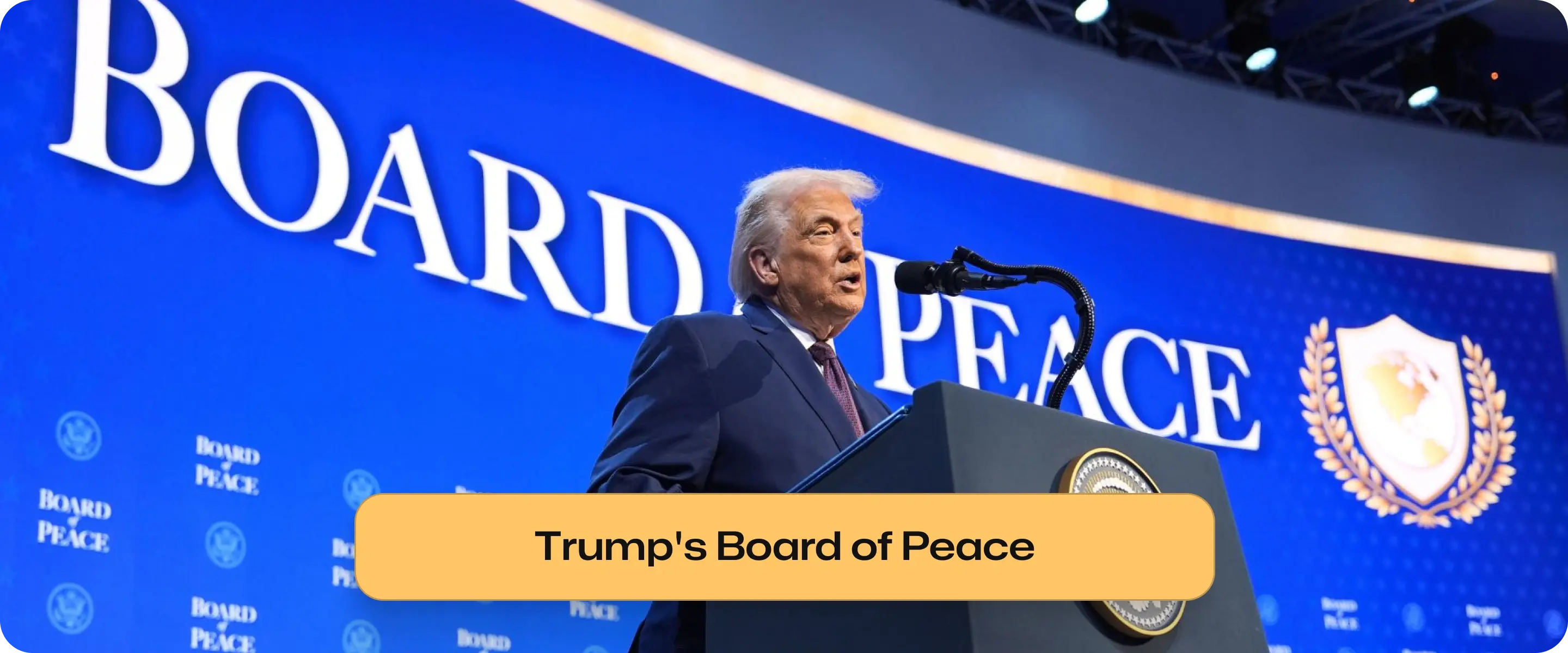
Trump’s Board of Peace on Gaza: India’s Cautious Stand
Trump's Board of Peace for Gaza reconstruction under UNSC 2803. Why India hesitates to join amid UN bypass and Pakistan role

Gajendra Singh Godara
Last updated
8
mins read
Key Highlights
US-Led Governance: Trump’s Board of Peace manages Gaza’s reconstruction and governance under UN Security Council Resolution 2803.
Core Objectives: The framework prioritizes demilitarization, economic stabilization, and technocratic governance through the independent NCAG.
Three-Tiered Structure: Chaired by Donald Trump, the board utilizes a unique $1 billion fee for permanent membership.
India’s Hesitation: New Delhi remains cautious due to UN bypass concerns and Pakistan's participation in the forum.
Security Framework: The International Stabilization Force (ISF) manages security, focusing on demilitarization and border protection.
Why in the news?
Global Initiative: In January 2026, the US unveiled the Board of Peace to manage Gaza's reconstruction and governance.
India’s Stance: India has received an invitation to join. However, it is thinking about the risks of skipping traditional UN systems.
The start of 2026 has brought a seismic shift in West Asian geopolitics with the formal unveiling of Trump’s Board of Peace. The World Economic Forum in Davos introduced this US-led initiative. It aims to manage the rebuilding and governance of the Gaza Strip. This marks a shift from the usual United Nations-led diplomacy.
For UPSC aspirants, understanding this framework is important. It relates to International Relations (GS Paper II). This includes bilateral groupings and agreements that affect India’s interests.
Join our WhatsApp Community
Trump’s Board of Peace is a US-led group that helps manage global conflicts. Its main focus is on rebuilding Gaza after the war.
The UN Security Council created the Board under Resolution 2803. It represents "Phase Two" of a 20-point peace plan. US President Donald Trump arranged this plan after the long conflict that grew worse in late 2023.
The Board works with the support of the UNSC. However, the US mainly leads it, not a typical UN command. It functions as an "invitation-only" body, prioritizing executive-led decision-making over universal representation.
Accepted Invitations:
Countries that have joined Trump’s Board of Peace include:
Israel
Saudi Arabia
UAE
Egypt
Turkey
Qatar
Pakistan
Indonesia
Vietnam Other confirmed participants include Argentina, Hungary, Albania, Belarus, Kazakhstan, Uzbekistan, Morocco, and Azerbaijan.
Notable Absentees (Declined): Major European countries have mostly stepped back from the Board of Peace. France, Germany, and the United Kingdom turned down the invitation. They are worried about going around the United Nations.
Non-committal (Wait-and-Watch): India has received an invitation but is being careful. It wants to see how this will affect its multilateral principles in the long run. China and Russia are also not committing. Both countries did not vote in the initial UN vote that supported the board's framework.
Gaza Peace Plan
The Board of Peace is the enforcement mechanism for the Comprehensive Plan to End the Gaza Conflict. Unlike the political-heavy Oslo Accords of the past, this plan prioritizes security demilitarization and massive economic investment.
Key Pillars of the Framework
Demilitarization: Designation of Gaza as a "terror-free zone," necessitating the total dismantling of Hamas' military infrastructure.
Technocratic Governance: Establishing the National Committee for the Administration of Gaza (NCAG) to handle day-to-day civil administration.
Economic Stabilization: Creation of a Special Economic Zone with preferred tariffs to attract international capital.
Hostage and Prisoner Exchange: Immediate cessation of hostilities coupled with the return of hostages and release of prisoners.
Funding: An estimated $67 to $70 billion required for full-scale reconstruction.
Institutional Structure: A Three-Tiered Model
The Board of Peace utilizes a hierarchical structure designed for rapid, business-like execution.
1. The Board of Peace (Top Tier)
Chaired by President Donald Trump, this tier includes heads of state and ensures high-level political backing. It uses a special financing model. To become a permanent member, you need to contribute $1 billion to the Gaza reconstruction fund. Non-contributing members can renew their three-year terms.
2. The Executive Board (Operational)
Tasked with "operationalizing the vision," this board comprises experts in diplomacy, finance, and infrastructure.
Key Members: US Secretary of State Marco Rubio, Jared Kushner, former UK PM Tony Blair, and World Bank President Ajay Banga.
Portfolios: They oversee specific areas like capital mobilization, investment attraction, and governance capacity-building.
3. The Gaza Executive Board & NCAG (Local)
This is the regional interface. It includes mediators from Turkey, Qatar, Egypt, and the UAE. They work together to coordinate security and finance on the ground.
The NCAG: A group of 15 independent experts, led by Dr. Ali Sha'ath, manages important services. They focus on health, education, and finance.
High Representative: Bulgarian diplomat Nickolay Mladenov acts as the primary liaison between the Board and the local Palestinian administration.
Add as a preferred Source on Google
India has received an official invitation from the US to join the Board of Peace for Gaza. However, as of January 2026, New Delhi is taking a "wait and watch" approach. While welcoming "Phase One" (hostage releases and humanitarian aid), India is weighing several critical factors:
Why India is Taking a Cautious Stand
Bypassing the UN: India has long championed multilateralism and the primacy of the United Nations. Joining a body that bypasses traditional UN mechanisms could undermine India's credibility in its push for UNSC reform.
The "Pay-to-Enter" Model: The need for a $1 billion payment for permanent status goes against the idea of equal sovereignty.
The Pakistan Factor: Pakistan's acceptance of the invitation and possible troop contribution to the International Stabilization Force (ISF) complicates India's situation. This affects both India's domestic issues and its diplomatic image.
Military Red Lines: India will not take part in the ISF. This is because it is not a peacekeeping mission approved by the UN..
Balancing Act:India should keep its promise to a two-state solution. At the same time, it must balance its strong ties with Israel and its role in the Global South.
Authorized by UNSC Resolution 2803, the ISF is commanded by Major General Jasper Jeffers. Its primary mission is to:
Fill the security gap during the IDF withdrawal.
Support the comprehensive demilitarization of Gaza.
Secure borders against smuggling.
Train a new, vetted Palestinian police force.
Frequently asked question (FAQs)
What is the primary objective of Trump’s Board of Peace for Gaza?
Which UN resolution authorizes the Board of Peace?
Has India joined the Board of Peace for Gaza?
Why is India cautious about the Board of Peace?
What is the NCAG and who leads it?



Research methodology
PadhAI's research methodology ensures every article is accurate, UPSC-ready, and beginner-friendly. We curate current affairs analysis based on UPSC exam relevance by cross-referencing The Hindu, Indian Express, and PIB. General Studies (GS) topics are drafted from NCERTs and standard books such as M. Laxmikanth, Spectrum, and GC Leong, then reviewed by subject matter experts to eliminate factual errors. Additionally, we update aspirants with verified government exam notifications alongside expert blogs suggesting the best resources, syllabus, and comprehensive Prelims and Mains strategies.


No comments yet. Be the first to join the discussion!