World Inequality Report 2026: India’s Rising Wealth Gap

India's top 10% hold 65% of wealth while bottom 50% earn 15% income. Understand World Inequality Report 2026 findings on India's rising wealth gap and policy solutions.

UPSC Prelims

Current affairs

Latest Update

Gajendra Singh Godara

Dec 12, 2025

8

mins read

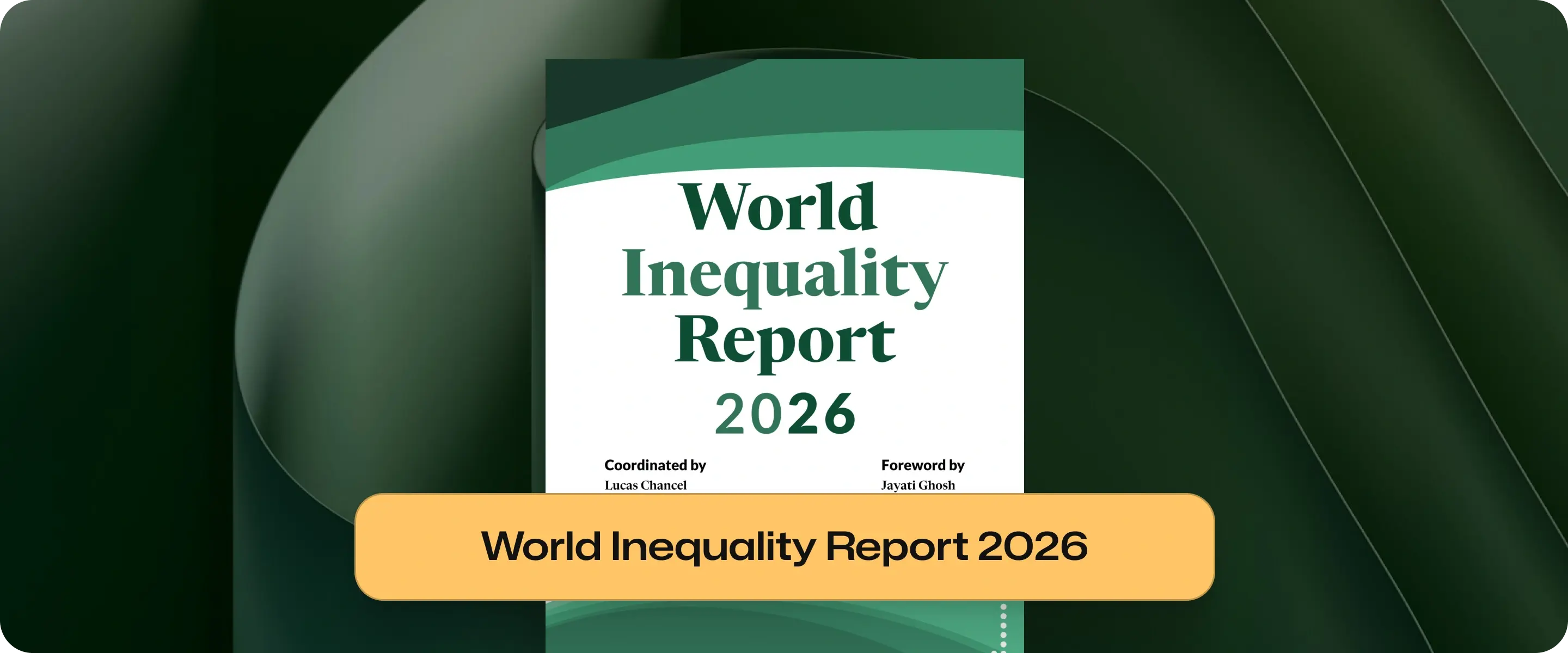
World Inequality Report 2026

Why in the News?

Why in the News?

Why in the News?

Why in the News?

  • The World Inequality Report 2026, released by the World Inequality Lab, reveals alarming disparities globally and in India. In India, the top 10% earn 58% of national income while the bottom 50% earn only 15%.

  • The report highlights widening income, wealth, gender, and climate inequalities, demanding urgent policy intervention for inclusive growth and social justice.

  • This is the 3rd edition of World Inequality Report after 2018 and 2022.
World Inequality Report 2026

World Inequality Report 2026

World Inequality Report 2026

World Inequality Report 2026

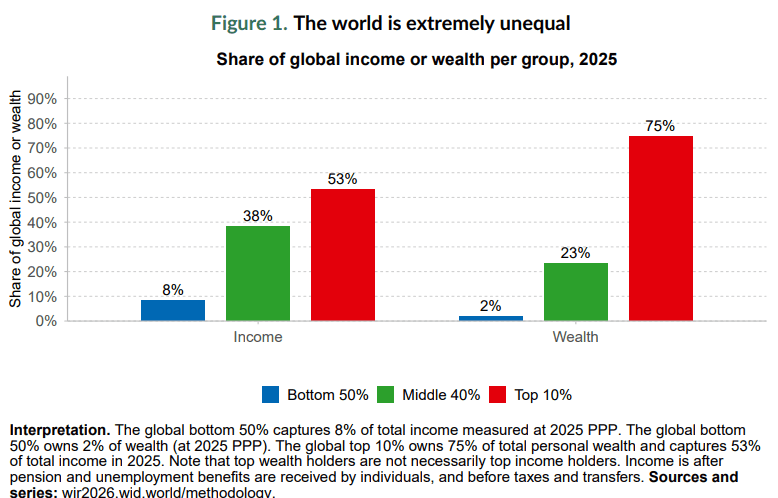
Share of Global Income or Wealth per Group, 2025 showing on Bar Graph

The World Inequality Report 2026 reveals that global inequality has reached historic levels. This report outlines how wealth concentration, gender gaps, and climate responsibility are skewed heavily toward the very top.

Here is what you need to know about the report and how India stands in the global ranking.

Join our WhatsApp Community

Join our WhatsApp Community

Join our WhatsApp Community

Join our WhatsApp Community

World Inequality Report Released By

World Inequality Report Released By

World Inequality Report Released By

World Inequality Report Released By

The World Inequality Report released by the World Inequality Lab provides the most up-to-date data on global economic disparities.

Leading economists like Lucas Chancel, Ricardo Gómez-Carrera, Rowaida Moshrif, and Thomas Piketty spearheaded this research. It is the third major edition of the report, following the 2018 and 2022 releases.

The World Inequality Report published by this team serves a specific purpose. It aims to inform public debate and push for policies that support inclusive growth and social justice.
UPSC Current Affairs Magazines

UPSC Current Affairs Magazines

Add as a preferred Source on Google

Add as a preferred Source on Google

Global Inequality Trends

Global Inequality Trends

Global Inequality Trends

Global Inequality Trends

Extrem Wealth Inequality Chart

The report paints a worrying picture of how wealth is distributed worldwide.

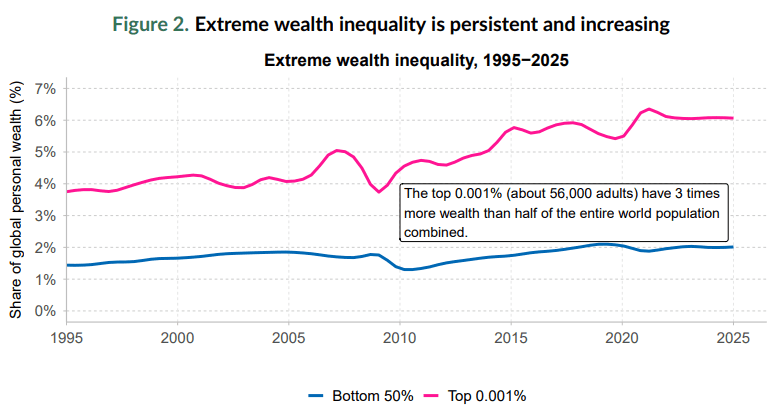
  • The Ultra-Rich Get Richer: The top 0.001% (about 60,000 people) own three times more wealth than the poorest 50% of humanity combined. Their share of wealth rose from 4% in 1995 to 6% in 2025.

  • Wealth Concentration: The global top 10% own 75% of the world's wealth. In contrast, the bottom 50% own just 2%.

  • Top 1% Control: The top 1% alone control 37% of global wealth. This is eighteen times more than the wealth of the entire bottom half of the global population.

Add as a preferred Source on Google

Add as a preferred Source on Google

UPSC Current Affairs Magazines

UPSC Current Affairs Magazines

World Inequality Report 2026 India: Key Findings

World Inequality Report 2026 India: Key Findings

World Inequality Report 2026 India: Key Findings

World Inequality Report 2026 India: Key Findings

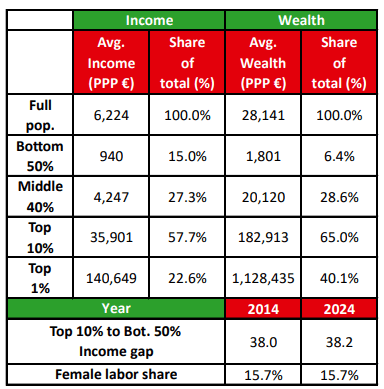
The data for India is particularly alarming. The World Inequality Report India section highlights deep structural divides. India has lost ground globally. In 1980, many Indians were in the "middle 40%" of global distribution. Today, almost all are in the bottom 50%.
Income and Wealth Inequality in India

Income Inequality in India

  • Top Earners Dominate: The top 10% of earners capture 58% of the national income.

  • The Bottom Struggles: The bottom 50% receive only 15% of the national income.

  • Comparison: This gap has widened since the 2022 report, where the top 10% held 57% and the bottom 50% held 13%.

  • Average Income: The average annual income per capita in India is around €6,200 (Purchasing Power Parity).

Wealth Inequality in India

  • Extreme Concentration: The richest 10% hold 65% of India's total wealth.

  • Top 1% Share: The top 1% capture 23% of national income while holding 40% of total wealth, revealing extreme wealth concentration.

  • Average Wealth: The average wealth stands at approximately €28,000.

Gender Inequality: Women Left Behind

Gender Inequality: Women Left Behind

Gender Inequality: Women Left Behind

Gender Inequality: Women Left Behind

The report also sheds light on the economic status of women.
Female Labor Income Share Chart
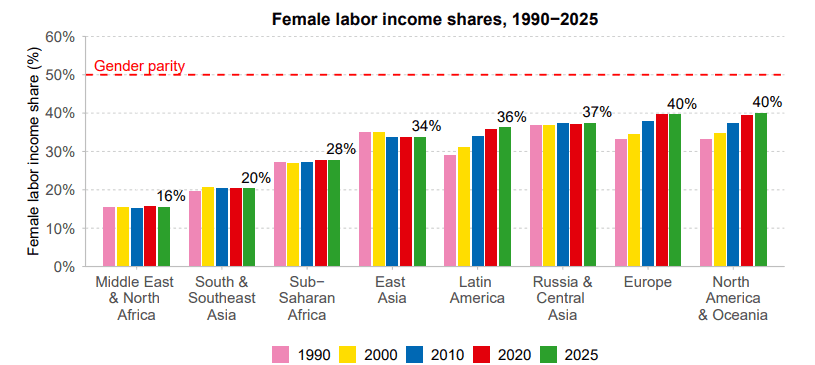
  • India's Participation: Female labor force participation in India remains extremely low at 15.7%.

  • Global Pay Gap: Globally, women earn only 61% of what men earn per working hour. If you include unpaid work, this figure drops to 32%.

  • Labor Income Share: Women capture just 25% of global labor income. This share has barely changed since 1990.

  • Regional Data: In South and Southeast Asia, women's share of labor income is only 20%.

Climate Inequality: Who Pollutes the Most?

Climate Inequality: Who Pollutes the Most?

Climate Inequality: Who Pollutes the Most?

Climate Inequality: Who Pollutes the Most?

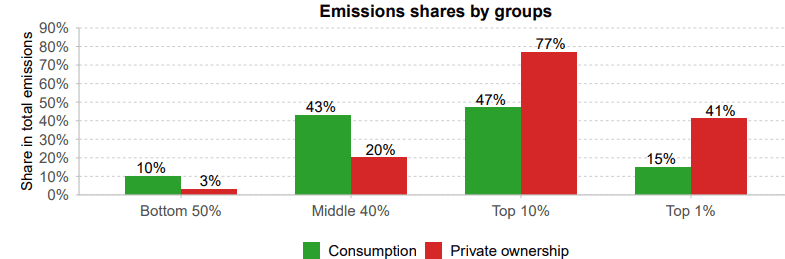
Wealth drives carbon emissions. The report links private capital ownership directly to climate damage.
Emissions Shares by Groups Chart
  • The Polluters: The top 10% account for 77% of emissions linked to private capital.

  • The Disparity: The wealthiest 1% create 41% of these emissions. This is nearly double the amount produced by the entire bottom 90% combined.

  • The Bottom 50%: The poorest half of the population contributes only 3% of these emissions.

Reasons Behind Increasing Inequality in India and World

Reasons Behind Increasing Inequality in India and World

Reasons Behind Increasing Inequality in India and World

Reasons Behind Increasing Inequality in India and World

Inequality across income, wealth, and gender dimensions reveals deep structural divides within economies that demand urgent attention:

  • Persistent Gender Disparities: Women earn only 61% of men's hourly income in paid work, dropping to just 32% when unpaid domestic and care labor is included, restricting career advancement and wealth accumulation.

  • Ultra-Wealth Concentration: The richest increasingly control disproportionate wealth while effective tax rates for billionaires and centi-millionaires remain lower than middle-income earners due to tax loopholes.

  • Regressive Tax Systems: Weak taxation frameworks favor the ultra-rich with preferential capital income treatment, while ordinary workers face higher tax burdens on labor income.

  • Unequal Global Financial Architecture: Developing nations face expensive debts and continuous income outflows, constraining investment in education, healthcare, and infrastructure.

  • Unequal Access to Opportunities: Disparities in education, jobs, and services fragment social cohesion, limiting political representation for working-class voters and entrenching inequality.

Solutions and The Way Forward

Solutions and The Way Forward

Solutions and The Way Forward

Solutions and The Way Forward

The report does not just list problems. It offers concrete solutions to fix these divides.

  • Progressive Taxation: Governments must tax the ultra-rich more effectively. Billionaires currently pay lower effective tax rates than many average citizens. A wealth tax and closing loopholes are essential steps.

  • Invest in People: Public investment in free, high-quality education and universal healthcare will reduce early-life disparities.

  • Social Protection: Expanding cash transfers, pensions, and unemployment benefits can support vulnerable households directly.

  • Climate Justice: High emitters must face accountability. We need a framework that shares emissions responsibility equitably and incentivizes green technology.

  • Gender Equity: Societies must recognize and reduce unpaid care work through public services. Increasing female labor participation through skilling and childcare is vital.

Note: *Source of all Chart Images is "wir2026.wid.world"

Frequently asked question (FAQs)

Who released the World Inequality Report 2026?
What is India's rank in the World Inequality Report 2026?
What are the major findings of the World Inequality Report 2026 regarding India's income and wealth inequality?
What is the average income in India according to the report?
How can governments reduce this inequality?


Latest UPSC Exam 2025 Updates

Latest UPSC Exam 2025 Updates

Latest UPSC Exam 2025 Updates

UPSC Calendar 2026 is released on 15th May, 2025.

UPSC Mains Result 2025 is now released.

Check out the updated and latest UPSC Syllabus 2026 here.

UPSC Notification 2025 was released on 22nd January 2025.

UPSC Prelims 2026 will be conducted on 24th May, 2026 & UPSC Mains 2026 will be conducted on 21st August 2026.

The UPSC Prelims 2026 is scheduled for May 24, 2026, while the UPSC Mains 2026 will be conducted from August 21, 2026.

The UPSC Selection Process is of 3 stages-Prelims, Mains and Interview.

UPSC Result 2024 is released with latest UPSC Marksheet 2024. Check Now!

Suggested posts

Australia Bans Social Media for Under-16s: A Global First

The Australian government has passed legislation that makes it illegal for social media platforms to allow children under 16 to hold accounts. This strict new law shifts the responsibility entirely onto tech giants. It demands that they redesign their systems to protect young users from online harms.

Here is a detailed breakdown of how Australia bans social media for minors and what this means for digital privacy and safety globally.

Australia Social Media Ban

The Australian government has passed legislation that makes it illegal for social media platforms to allow children under 16 to hold accounts. This strict new law shifts the responsibility entirely onto tech giants. It demands that they redesign their systems to protect young users from online harms.

Here is a detailed breakdown of how Australia bans social media for minors and what this means for digital privacy and safety globally.

Australia Bans Social Media for Under-16s: A Global First

The Australian government has passed legislation that makes it illegal for social media platforms to allow children under 16 to hold accounts. This strict new law shifts the responsibility entirely onto tech giants. It demands that they redesign their systems to protect young users from online harms.

Here is a detailed breakdown of how Australia bans social media for minors and what this means for digital privacy and safety globally.

Australia Social Media Ban

The Australian government has passed legislation that makes it illegal for social media platforms to allow children under 16 to hold accounts. This strict new law shifts the responsibility entirely onto tech giants. It demands that they redesign their systems to protect young users from online harms.

Here is a detailed breakdown of how Australia bans social media for minors and what this means for digital privacy and safety globally.

Human Rights Day 2025: History, Theme & Why It’s Celebrated

Every year, the global community unites to uphold the dignity of the individual on International Human Rights Day. For a Civil Services aspirant, this day is not merely an event but a syllabus touchpoint linking International Institutions (UN), the Constitution of India (Fundamental Rights), and Statutory Bodies (NHRC).

Here is a detailed analysis of Human Rights Day, its 2025 theme, and its relevance to the Indian politico-legal framework.

Human Rights Day 2025

Every year, the global community unites to uphold the dignity of the individual on International Human Rights Day. For a Civil Services aspirant, this day is not merely an event but a syllabus touchpoint linking International Institutions (UN), the Constitution of India (Fundamental Rights), and Statutory Bodies (NHRC).

Here is a detailed analysis of Human Rights Day, its 2025 theme, and its relevance to the Indian politico-legal framework.

Human Rights Day 2025: History, Theme & Why It’s Celebrated

Every year, the global community unites to uphold the dignity of the individual on International Human Rights Day. For a Civil Services aspirant, this day is not merely an event but a syllabus touchpoint linking International Institutions (UN), the Constitution of India (Fundamental Rights), and Statutory Bodies (NHRC).

Here is a detailed analysis of Human Rights Day, its 2025 theme, and its relevance to the Indian politico-legal framework.

Human Rights Day 2025

Every year, the global community unites to uphold the dignity of the individual on International Human Rights Day. For a Civil Services aspirant, this day is not merely an event but a syllabus touchpoint linking International Institutions (UN), the Constitution of India (Fundamental Rights), and Statutory Bodies (NHRC).

Here is a detailed analysis of Human Rights Day, its 2025 theme, and its relevance to the Indian politico-legal framework.

Armed Forces Flag Day Celebration 2025: Date, History & Theme

National security relies on soldier morale as much as it relies on modern weapons. The defence budget covers operational needs, but the duty of society to care for the veteran and the war-widow finds its expression through a special system: the Armed Forces Flag Day.

For a civil services student, understanding this day requires more than a ceremonial look. You must study the administrative structure of the Kendriya Sainik Board (KSB), the management of the Armed Forces Flag Day Fund (AFFDF), and the idea of the 'Social Contract' between a nation and its defenders.

Armed Forces Flag Day 2025

National security relies on soldier morale as much as it relies on modern weapons. The defence budget covers operational needs, but the duty of society to care for the veteran and the war-widow finds its expression through a special system: the Armed Forces Flag Day.

For a civil services student, understanding this day requires more than a ceremonial look. You must study the administrative structure of the Kendriya Sainik Board (KSB), the management of the Armed Forces Flag Day Fund (AFFDF), and the idea of the 'Social Contract' between a nation and its defenders.

Armed Forces Flag Day Celebration 2025: Date, History & Theme

National security relies on soldier morale as much as it relies on modern weapons. The defence budget covers operational needs, but the duty of society to care for the veteran and the war-widow finds its expression through a special system: the Armed Forces Flag Day.

For a civil services student, understanding this day requires more than a ceremonial look. You must study the administrative structure of the Kendriya Sainik Board (KSB), the management of the Armed Forces Flag Day Fund (AFFDF), and the idea of the 'Social Contract' between a nation and its defenders.

Armed Forces Flag Day 2025

National security relies on soldier morale as much as it relies on modern weapons. The defence budget covers operational needs, but the duty of society to care for the veteran and the war-widow finds its expression through a special system: the Armed Forces Flag Day.

For a civil services student, understanding this day requires more than a ceremonial look. You must study the administrative structure of the Kendriya Sainik Board (KSB), the management of the Armed Forces Flag Day Fund (AFFDF), and the idea of the 'Social Contract' between a nation and its defenders.

a close up of a cell phone with a blurry background

About Author

Gajendra Singh Godara

Growth | FTE| Resident at SigIQ

Gajendra Singh Godara brings authentic UPSC preparation insights from his four-attempt journey, having successfully cleared Prelims and written Mains multiple times. His deep expertise spans Polity, Modern History, International Relations, and Economy. At PadhAI, Gajendra transforms his extensive exam experience into accessible content that simplifies complex concepts for aspirants at every preparation stage. His firsthand understanding of UPSC's demands enables him to create targeted materials that save time while maximizing learning efficiency for current affairs, general studies, and optional subjects.

a close up of a cell phone with a blurry background

About Author

Gajendra Singh Godara

Growth | FTE| Resident at SigIQ

Gajendra Singh Godara brings authentic UPSC preparation insights from his four-attempt journey, having successfully cleared Prelims and written Mains multiple times. His deep expertise spans Polity, Modern History, International Relations, and Economy. At PadhAI, Gajendra transforms his extensive exam experience into accessible content that simplifies complex concepts for aspirants at every preparation stage. His firsthand understanding of UPSC's demands enables him to create targeted materials that save time while maximizing learning efficiency for current affairs, general studies, and optional subjects.

a close up of a cell phone with a blurry background

About Author

Gajendra Singh Godara

Growth | FTE| Resident at SigIQ

Gajendra Singh Godara brings authentic UPSC preparation insights from his four-attempt journey, having successfully cleared Prelims and written Mains multiple times. His deep expertise spans Polity, Modern History, International Relations, and Economy. At PadhAI, Gajendra transforms his extensive exam experience into accessible content that simplifies complex concepts for aspirants at every preparation stage. His firsthand understanding of UPSC's demands enables him to create targeted materials that save time while maximizing learning efficiency for current affairs, general studies, and optional subjects.

a close up of a cell phone with a blurry background

About Author

Gajendra Singh Godara

Growth | FTE| Resident at SigIQ

Gajendra Singh Godara brings authentic UPSC preparation insights from his four-attempt journey, having successfully cleared Prelims and written Mains multiple times. His deep expertise spans Polity, Modern History, International Relations, and Economy. At PadhAI, Gajendra transforms his extensive exam experience into accessible content that simplifies complex concepts for aspirants at every preparation stage. His firsthand understanding of UPSC's demands enables him to create targeted materials that save time while maximizing learning efficiency for current affairs, general studies, and optional subjects.

PadhAI UPSC App

We're PadhAI - a free UPSC prep app built by IITians, AI PhDs & top UPSC experts.

Why choose PadhAI?

Read daily top news (TH & IE) & Solve Current Affairs MCQs
Topic-wise search of 30+ yrs PYQs
24×7 AI tutor for doubt resolution
Practice 30k+ MCQs & full GS + CSAT mocks
Play Duel UPSC quizzes with fellow aspirants

Why choose PadhAI?

Read daily top news (TH & IE) & Solve Current Affairs MCQs

Topic-wise search of 30+ yrs PYQs

24×7 AI tutor for doubt resolution

Practice 30k+ MCQs & full GS + CSAT mocks

Play Duel UPSC quizzes with fellow aspirants

PadhAI UPSC App

We're PadhAI - a free UPSC prep app built by IITians, AI PhDs & top UPSC experts.

Why choose PadhAI?

Read daily top news (TH & IE) & Solve Current Affairs MCQs

Topic-wise search of 30+ yrs PYQs

24×7 AI tutor for doubt resolution

Practice 30k+ MCQs & full GS + CSAT mocks

Play Duel UPSC quizzes with fellow aspirants

PadhAI UPSC App

We're PadhAI - a free UPSC prep app built by IITians, AI PhDs & top UPSC experts.

Suggested posts

Australia Social Media Ban

Australia Bans Social Media for Under-16s: A Global First

The Australian government has passed legislation that makes it illegal for social media platforms to allow children under 16 to hold accounts. This strict new law shifts the responsibility entirely onto tech giants. It demands that they redesign their systems to protect young users from online harms.

Here is a detailed breakdown of how Australia bans social media for minors and what this means for digital privacy and safety globally.

Human Rights Day 2025

Human Rights Day 2025: History, Theme & Why It’s Celebrated

Every year, the global community unites to uphold the dignity of the individual on International Human Rights Day. For a Civil Services aspirant, this day is not merely an event but a syllabus touchpoint linking International Institutions (UN), the Constitution of India (Fundamental Rights), and Statutory Bodies (NHRC).

Here is a detailed analysis of Human Rights Day, its 2025 theme, and its relevance to the Indian politico-legal framework.

Armed Forces Flag Day 2025

Armed Forces Flag Day Celebration 2025: Date, History & Theme

National security relies on soldier morale as much as it relies on modern weapons. The defence budget covers operational needs, but the duty of society to care for the veteran and the war-widow finds its expression through a special system: the Armed Forces Flag Day.

For a civil services student, understanding this day requires more than a ceremonial look. You must study the administrative structure of the Kendriya Sainik Board (KSB), the management of the Armed Forces Flag Day Fund (AFFDF), and the idea of the 'Social Contract' between a nation and its defenders.

Australia Social Media Ban

Australia Bans Social Media for Under-16s: A Global First

The Australian government has passed legislation that makes it illegal for social media platforms to allow children under 16 to hold accounts. This strict new law shifts the responsibility entirely onto tech giants. It demands that they redesign their systems to protect young users from online harms.

Here is a detailed breakdown of how Australia bans social media for minors and what this means for digital privacy and safety globally.

Human Rights Day 2025

Human Rights Day 2025: History, Theme & Why It’s Celebrated

Every year, the global community unites to uphold the dignity of the individual on International Human Rights Day. For a Civil Services aspirant, this day is not merely an event but a syllabus touchpoint linking International Institutions (UN), the Constitution of India (Fundamental Rights), and Statutory Bodies (NHRC).

Here is a detailed analysis of Human Rights Day, its 2025 theme, and its relevance to the Indian politico-legal framework.

Armed Forces Flag Day 2025

Armed Forces Flag Day Celebration 2025: Date, History & Theme

National security relies on soldier morale as much as it relies on modern weapons. The defence budget covers operational needs, but the duty of society to care for the veteran and the war-widow finds its expression through a special system: the Armed Forces Flag Day.

For a civil services student, understanding this day requires more than a ceremonial look. You must study the administrative structure of the Kendriya Sainik Board (KSB), the management of the Armed Forces Flag Day Fund (AFFDF), and the idea of the 'Social Contract' between a nation and its defenders.

World Soil Day 2025

World Soil Day 2025: Theme, History, and Significance

Every year on December 5, the global community observes World Soil Day to highlight the critical importance of healthy soil in sustaining life on Earth. For a UPSC aspirant, this day is not merely an observance but an opportunity to understand the geopolitical and ecological dimensions of soil degradation, food security, and sustainable urban planning.

The year 2025 marks a pivotal shift in the narrative of soil conservation, moving the focus from rural agricultural fields to the concrete jungles of our rapidly expanding urban centers.

Download PadhAI App

Don't get left behind in your preparation

Download PadhAI App

Don't get left behind in your preparation

Download PadhAI App

Don't get left behind in your preparation

Download PadhAI App

Don't get left behind in your preparation

Embark on your journey!

Address

3rd floor, Electrical and Electronic, ALG Towers, Plot no. 48, main road, Industrial Estate, Perungudi, Chennai, Tamil Nadu 600096

PadhAI is a product of SigIQ AI, and Metayb is a recognized reseller authorized to sell PadhAI subscriptions.

Embark on your journey!

Address

3rd floor, Electrical and Electronic, ALG Towers, Plot no. 48, main road, Industrial Estate, Perungudi, Chennai, Tamil Nadu 600096

PadhAI is a product of SigIQ AI, and Metayb is a recognized reseller authorized to sell PadhAI subscriptions.

Embark on your journey!

Address

3rd floor, Electrical and Electronic, ALG Towers, Plot no. 48, main road, Industrial Estate, Perungudi, Chennai, Tamil Nadu 600096

PadhAI is a product of SigIQ AI, and Metayb is a recognized reseller authorized to sell PadhAI subscriptions.

Embark on your journey!

Address

3rd floor, Electrical and Electronic, ALG Towers, Plot no. 48, main road, Industrial Estate, Perungudi, Chennai, Tamil Nadu 600096

PadhAI is a product of SigIQ AI, and Metayb is a recognized reseller authorized to sell PadhAI subscriptions.

Current Affairs

UPSC Resources

UPSC updates

General studies

UPSC Preparation

Pricing