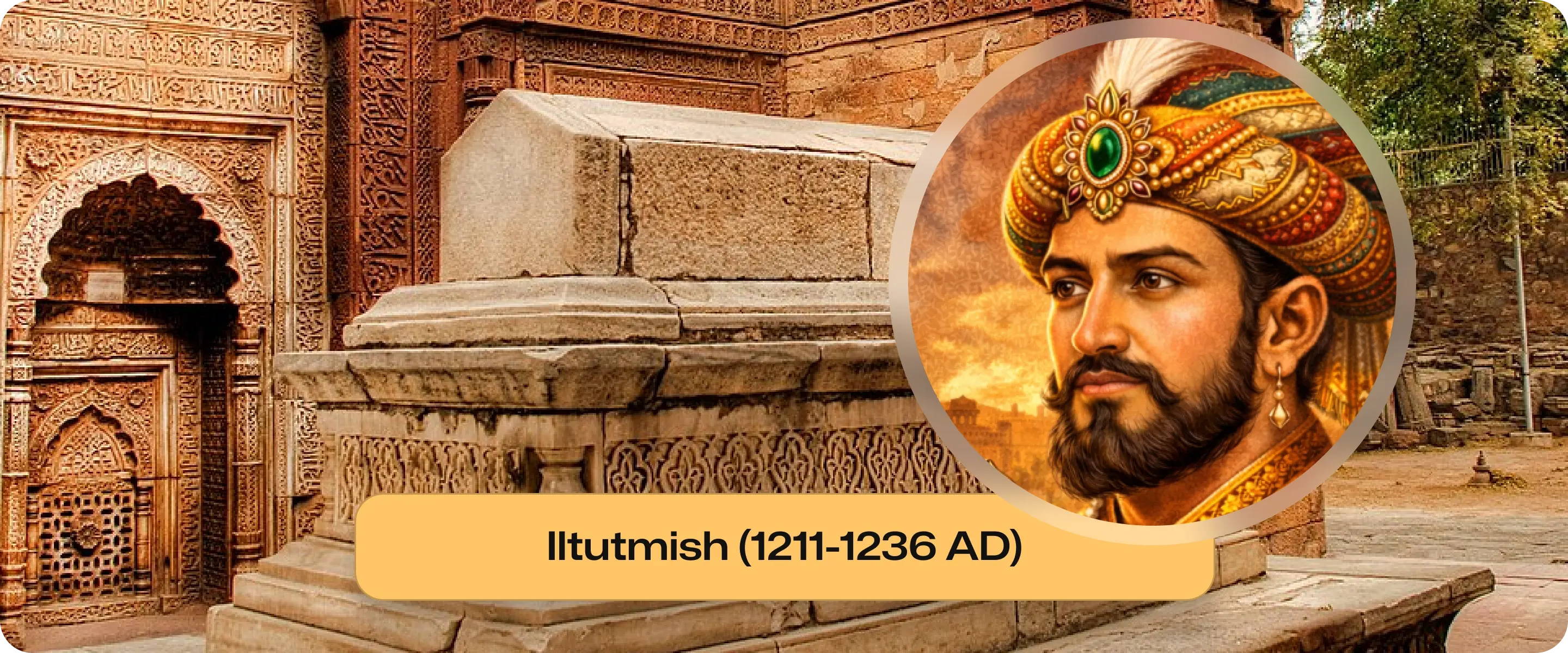
Shamsuddin Iltutmish (1211–1236 AD) transformed the Delhi Sultanate into a centralized and sovereign state through military consolidation, administrative reforms, and economic measures.

Gajendra Singh Godara
Last updated
9
mins read
Key highlights:
Role: Third ruler of Delhi Sultanate; real founder
Capital Shift: Lahore → Delhi
Military: Defeated Yildiz and Qubacha; consolidated North India
Mongol Policy: Strategic neutrality; avoided invasion
Administration: Introduced Iqta system; created Turkan-i-Chahalgani
Economy: Introduced silver Tanka and copper Jital
Legitimacy: Recognized by Abbasid Caliph (1229)
Architecture: Expanded Qutub Minar; built Hauz-i-Shamsi & Sultan Ghari
Succession: Nominated Razia Sultan based on merit
Legacy: Transformed Sultanate into a stable, centralized state
Shamsuddin Iltutmish was not merely the successor of Qutb-ud-din Aibak. He was the true architect of the Delhi Sultanate. He transformed a fragile dominion into a centralized and sovereign state.
Born into the Ilbari Turkic tribe of Central Asia, Iltutmish rose from slavery to power through exceptional administrative ability and military skill.
He strengthened internal administration, secured external legitimacy, and laid the foundations of governance that later rulers would build upon. For this reason, he is widely regarded as the real founder of the Delhi Sultanate.
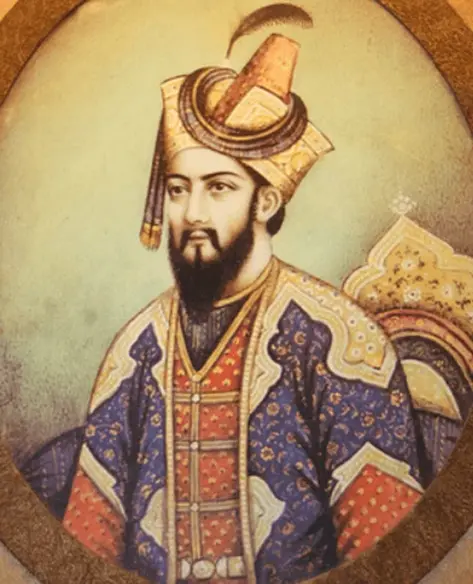
Shamsuddin Iltutmish was the third ruler of the Delhi Sultanate (1211–1236 AD) and the most important ruler of the Mamluk dynasty, known for consolidating the Sultanate into a stable and cohesive political structure.
Key Contributions:
Shifted the capital from Lahore to Delhi
Introduced silver Tanka and copper Jital coinage
Strengthened administrative and revenue systems
Received investiture from the Abbasid Caliph Al-Mustansir Billah in 1229
These measures laid the foundation of a stable Delhi Sultanate and ensured its political legitimacy.
Table of Key Events During Iltutmish’s Reign:
Year | Event | Significance |
1211 AD | Iltutmish ascends the throne of Delhi | Beginning of consolidation of the Delhi Sultanate |
1215–1216 AD | Defeats Tajuddin Yalduz at the Third Battle of Tarain | Ends Ghazni’s claim over Delhi; asserts independence |
1217 AD | Campaign against Nasiruddin Qubacha; captures Lahore | Establishes control over Punjab |
1221 AD | Faces Mongol threat under Genghis Khan | Adopts diplomacy; avoids invasion |
1226–1227 AD | Rajput campaigns (Ranthambore, Mandore) | Expands territorial control in North India |
1228 AD | Final defeat of Qubacha (Bhakkar campaign) | Secures Sindh and north-western frontier |
1229 AD | Receives investiture from Al-Mustansir Billah | Gains legal and religious legitimacy |
1230 AD | Construction of Hauz-i-Shamsi | Public works and urban development |
1231 AD | Builds Sultan Ghari tomb; nominates Razia Sultan | Start of Indo-Islamic tomb architecture; succession planning |
1236 AD | Death of Iltutmish | Beginning of succession struggle |
Join our WhatsApp Community

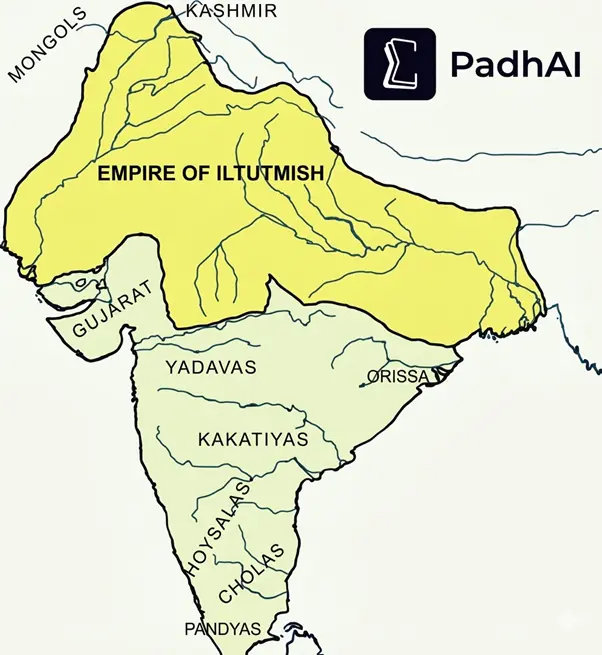
When Iltutmish ascended the throne in 1211 AD, the Delhi Sultanate was politically fragile and territorially unstable.
It faced internal rebellions, rival claimants, and the external threat of the Mongol Empire.
His reign marked the transformation of a weak conquest state into a stable and consolidated empire through decisive military action and strategic diplomacy.
By eliminating external threats like Yalduz and regional rivals like Qubacha, Iltutmish established Delhi as the dominant power center in North India.
Defeat of Yalduz
Tajuddin Yildiz (Yalduz), the ruler of Ghazni, attempted to assert his authority over Delhi as the successor of the Ghurid Empire.
Assertion of Suzerainty: He sent royal symbols such as the chhatri (canopy) and durbash (baton) to Iltutmish, demanding submission
Diplomatic Response: Iltutmish accepted them tactically but did not acknowledge real subordination
Third Battle of Tarain (1215–1216 AD): Iltutmish defeated Yalduz, captured, and executed him
Significance:
Ended Ghazni’s claims over Delhi
Marked a decisive political break from Central Asian control
Established the independent status of the Delhi Sultanate
Defeat of Qubacha
After defeating Yalduz, Iltutmish turned against Qubacha, who controlled Multan, Uch, and Sindh.
Initial Position: Qubacha accepted nominal suzerainty but remained politically unreliable
Campaign of 1217 AD: Iltutmish captured Lahore, forcing Qubacha to retreat
Battle near Chenab (Mansura): Qubacha was defeated and pushed further into Sindh.
Iltutmish did not immediately annex Sindh due to concerns over the north-western frontier and Mongol threat
He instead consolidated Punjab and appointed his son Nasiruddin Mahmud as governor of Lahore
Final Phase (1228 AD): Qubacha was ultimately defeated during the Bhakkar campaign and died while fleeing across the Indus
Significance:
Secured Punjab and frontier regions
Eliminated a major regional rival
Strengthened Delhi’s control over north-western India
Control over Rajput and Eastern Regions
Iltutmish restored control over regions that had become independent after the death of Qutb-ud-din Aibak.
Rajput Campaigns: Captured Ranthambore (1226) and Mandalor (1227); later annexed Gwalior and Bayana
Bengal and Bihar: Suppressed rebellion of Ghiyasuddin Iwaz Khalji and re-integrated Bengal by 1230 AD
These campaigns ensured territorial unity and administrative control.
Foreign Policy and the Mongol Threat
In 1221 AD, the Delhi Sultanate faced a major threat as Mongol forces under Genghis Khan reached the Indus. Iltutmish adopted a cautious and strategic approach, avoiding direct conflict to ensure survival.
The crisis arose when Jalaluddin Mangbarani sought refuge and proposed an alliance against the Mongols. Accepting this would have triggered a full-scale invasion, so Iltutmish refused asylum.
This policy is often described as one of strategic non-intervention, ensuring survival against a superior Mongol force.
Outcome: Mongols did not cross the Indus and the Sultanate survived its most vulnerable phase
Iltutmish transformed the Delhi Sultanate from a conquest-based regime into a structured administrative state.
He shifted focus from a plunder-based economy to a governance-based economy, laying the institutional foundations that sustained the Sultanate for the long term.
The Iqta System: Land and Revenue Administration
The Iqta system was the most important administrative feature of the Mamluk period. It involved assigning revenue rights from land to officials in return for military and administrative service.
Key Features:
Iqtadars (Muqtis): Officers responsible for revenue collection, law and order, and troop maintenance
Revenue Flow: Surplus revenue (Fawazil) was remitted to the central treasury
Military Link: Land revenue was directly tied to military obligations
Non-hereditary system: Frequent transfers prevented the rise of regional power centers
Centralization: Maintained control of the Sultan over provincial administration
Resource efficiency: Enabled maintenance of an army without a large standing treasury
Turkan-i-Chahalgani
To strengthen central authority, Iltutmish created the Turkan-i-Chahalgani, an elite group of trusted Turkish nobles.
Key Features:
Composed of loyal slave-officers
Held key administrative and military positions
Functioned as the core governing elite
Counter-elite strategy: Reduced dominance of older nobles who questioned his authority
Power consolidation: Ensured loyalty and stability during his reign
Long-term issue: Later became a dominant oligarchy, influencing succession and weakening central authority
Analysis: Iltutmish vs the Nobility
Feature | Iltutmish’s Strategy | Strategic Objective |
Land Revenue | Frequent transfer of Iqtas | Prevent power concentration |
Bureaucracy | Creation of the Corps of Forty | Build a loyal administrative elite |
Legitimacy | Recognition from Abbasid Caliph Al-Mustansir Billah | Strengthen political authority |
Add as a preferred Source on Google
Iltutmish introduced a standardized currency system that gave the Delhi Sultanate a clear monetary identity.
Before his reign, the economy functioned on a mix of Ghurid coins, local currencies, and barter, leading to inconsistency in trade and revenue.
His reforms marked the shift toward a fully monetized economy, strengthening both state authority and commercial activity.
Introduction of Tanka and Jital
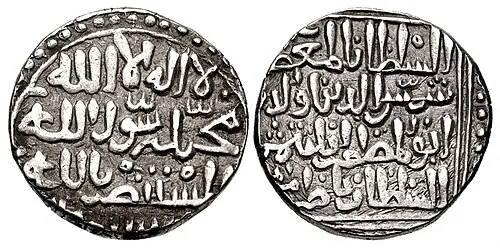
Iltutmish introduced a uniform coinage system based on metal and weight standards.
Silver Tanka:
Standard weight of 175 grains (approx. 11.3 grams)
High-purity silver coin used for large transactions
Coins carried the name of the Sultan, mint, and date
Copper Jital:
Used for daily transactions
Functioned as fractional currency of the Tanka
This system ensured uniformity in currency across the Sultanate.
Significance of Monetary Reforms
Dimension | Key Insight | Significance |
Trade & Economic Impact | Standardized currency reduced exchange inconsistencies | Boosted trade integration from Bengal to Punjab |
Political Authority | Coins issued in the Sultan’s name; inclusion of Al-Mustansir Billah | Strengthened centralized control and enhanced legitimacy |
Long-term Impact | Tanka influenced later systems, including reforms by Sher Shah Suri | Shaped India’s monetary evolution and improved fiscal predictability |
The reign of Iltutmish marked the emergence of a distinct Indo-Islamic architectural style.
He used architecture and cultural patronage to strengthen political legitimacy and transform Delhi into a major cultural center.
Architecture: Rise of Indo-Islamic Style
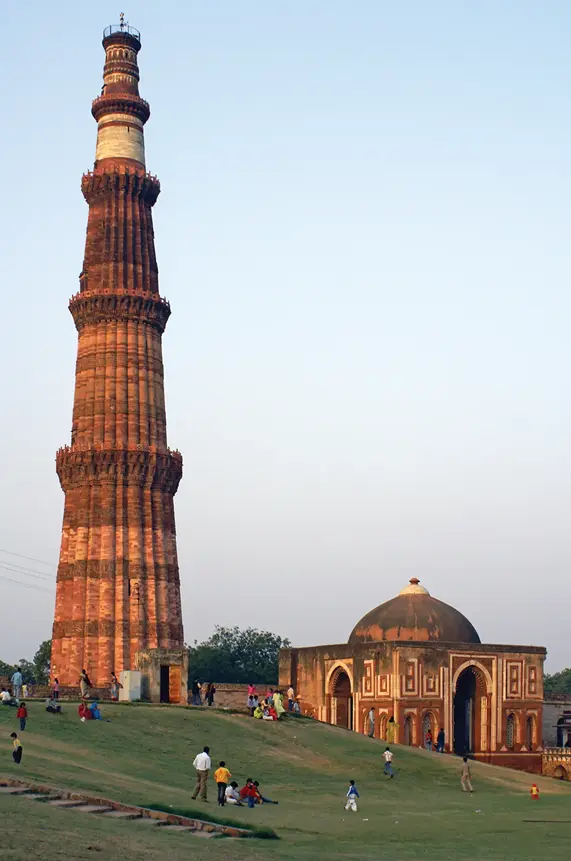
Iltutmish expanded earlier Ghurid constructions and gave them a distinct Indian-Islamic character.
Key Contributions:
Qutub Minar: Completed additional storeys, transforming it into a symbol of political authority. It is currently a UNESCO World Heritage site.
Mehrauli Complex: Developed as a political and religious center of early Delhi
Hauz-i-Shamsi (1230 AD): Large reservoir built for water supply and public welfare
Gandhak ki Baoli: One of the earliest stepwells in Delhi, associated with Sufi traditions
Sultan Ghari (1231 AD): First Islamic mausoleum in India, built for his son
Use of arches and domes with local techniques reflects synthesis of Indian and Islamic styles
Architecture served both practical and political purposes, marking the transition from early Ghurid forms to a distinct Indo-Islamic style.
Patronage of Scholars and Culture
Iltutmish’s court became a center of learning, especially as Central Asian institutions declined under Mongol invasions.
Minhaj-us-Siraj’s Tabaqat-i-Nasiri was a major source for the period
Fakhr-i-Mudir wrote Adab-ul-Harb wa-sh-Shuja’at, an early work on warfare and governance
Delhi emerged as a new intellectual center of the Islamic world
Court patronage strengthened historical documentation and administrative thought
Sufi Influence and Social Legitimacy
Iltutmish maintained close ties with the Chishti Sufi order, especially Qutbuddin Bakhtiyar Kaki.
Helped bridge the gap between ruling elites and local population
Enhanced the moral and social legitimacy of the Sultanate
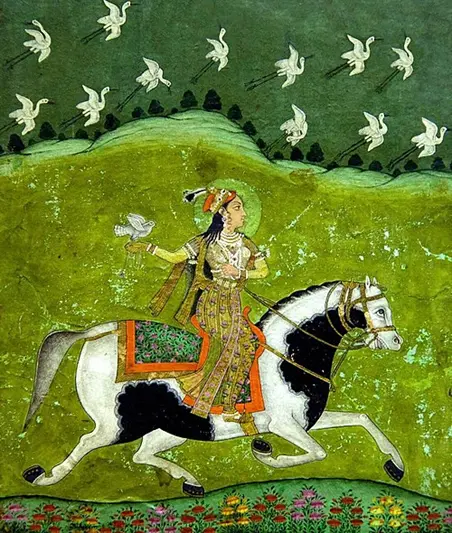
The later years of Iltutmish were marked by a succession crisis. His capable son Nasiruddin Mahmud died in 1229 AD, and his remaining sons were considered ineffective. In this context, Iltutmish made a significant political decision by nominating his daughter Razia Sultan as his successor.
Appointed Razia as regent (1231) during Gwalior campaign
Declared her heir-apparent based on competence
Rejected norms of gender and seniority
Faced opposition from Turkish nobles and orthodox groups
After his death (1236):
Nobles ignored his will
Installed Ruknuddin Firuz as Sultan
His misrule triggered instability and rebellion
Razia mobilized support and claimed the throne
Significance:
First woman ruler of the Delhi Sultanate
Highlighted Crown vs Nobility power struggle
Exposed the fragility of centralized authority in the absence of a strong ruler
Early attempt at merit-based succession
Set precedent later stabilized by Ghiyasuddin Balban
History widely regards Iltutmish as the real founder of the Delhi Sultanate. While Qutb-ud-din Aibak established the dynasty, Iltutmish transformed it into a stable, sovereign, and institutionalized state.
Dimension | Key Measures by Iltutmish | Outcome |
Political Transformation | Defeated rivals like Yalduz; recognition from Caliph Al-Mustansir Billah (1229); made Delhi the capital | Established independent and sovereign state |
Institutional Development | Introduced Iqta system; created Turkan-i-Chahalgani; strengthened central control | Shift from personal rule to stable governance |
Economic Reforms | Introduced Tanka and Jital coinage; standardized currency | Promoted trade and economic integration |
Cultural Consolidation | Patronized scholars and Sufis; developed Delhi as cultural hub | Built cultural legitimacy and continuity |
UPSC Civil Services (Prelims) | 2021
Q. Consider the following statements:
It was during the reign of Iltutmish that Chengiz Khan reached the Indus in pursuit of the Khwarezm prince.
It was during the reign of Muhammad bin Tughluq that Taimur occupied Multan and crossed the Indus.
It was during the reign of Deva Raya II of the Vijayanagara Empire that Vasco da Gama reached the coast of Kerala.
Which of the statements given above is/are correct?
(a) 1 only
(b) 1 and 2
(c) 3 only
(d) 2 and 3
Answer: (a) 1 only
Frequently asked question (FAQs)
Why is Iltutmish considered the real founder of the Delhi Sultanate?
Who succeeded Iltutmish as Sultan?
What were the major administrative reforms of Iltutmish?
What were the economic reforms introduced by Iltutmish?
What was the role of Iltutmish in Qutub Minar?
Iltutmish consolidated the Delhi Sultanate through military strength, administrative reform, and diplomatic skill. He secured the state from external threats, established effective governance systems, and ensured political legitimacy.
His reign marked the transition from a fragile conquest regime to a stable and durable empire.
Iltutmish’s ability to handle the Mongol threat with caution and his decision to nominate Razia Sultan reflect a focus on pragmatism and merit over tradition. Thus, Iltutmish transformed conquest into governance, ensuring the long-term survival of the Delhi Sultanate. He is an important figure for the competitive exams due to his impact on India’s history.



Gajendra Singh Godara
Ex-UPSC Aspirant | Exam Preparation Expert
Gajendra Singh Godara is an IIT Bombay graduate and a UPSC aspirant with 4 attempts, including multiple Prelims and Mains appearances. He specializes in Polity, Modern History, International Relations, and Economy. At PadhAI, Gajendra leverages his firsthand exam experience to simplify complex concepts, creating high-efficiency study materials that help aspirants save time and stay focused.
No comments yet. Be the first to join the discussion!