The Vijayanagar Empire was a South Indian empire founded by brothers Harihara I and Bukka I in 1336, renowned for its administration and architecture.
Gajendra Singh Godara
Last updated
11
mins read
Key Highlights
Founded: 1336 by Harihara I & Bukka Raya I
Capital: Hampi
Dynasties: Sangama → Saluva → Tuluva → Aravidu
Golden Age: Krishnadevaraya’s rule
System: Nayankara military-feudal administration
Decline: Post the Battle of Talikota (1565)
Legacy: Last great Hindu empire of medieval South India
About the Vijayanagar Empire
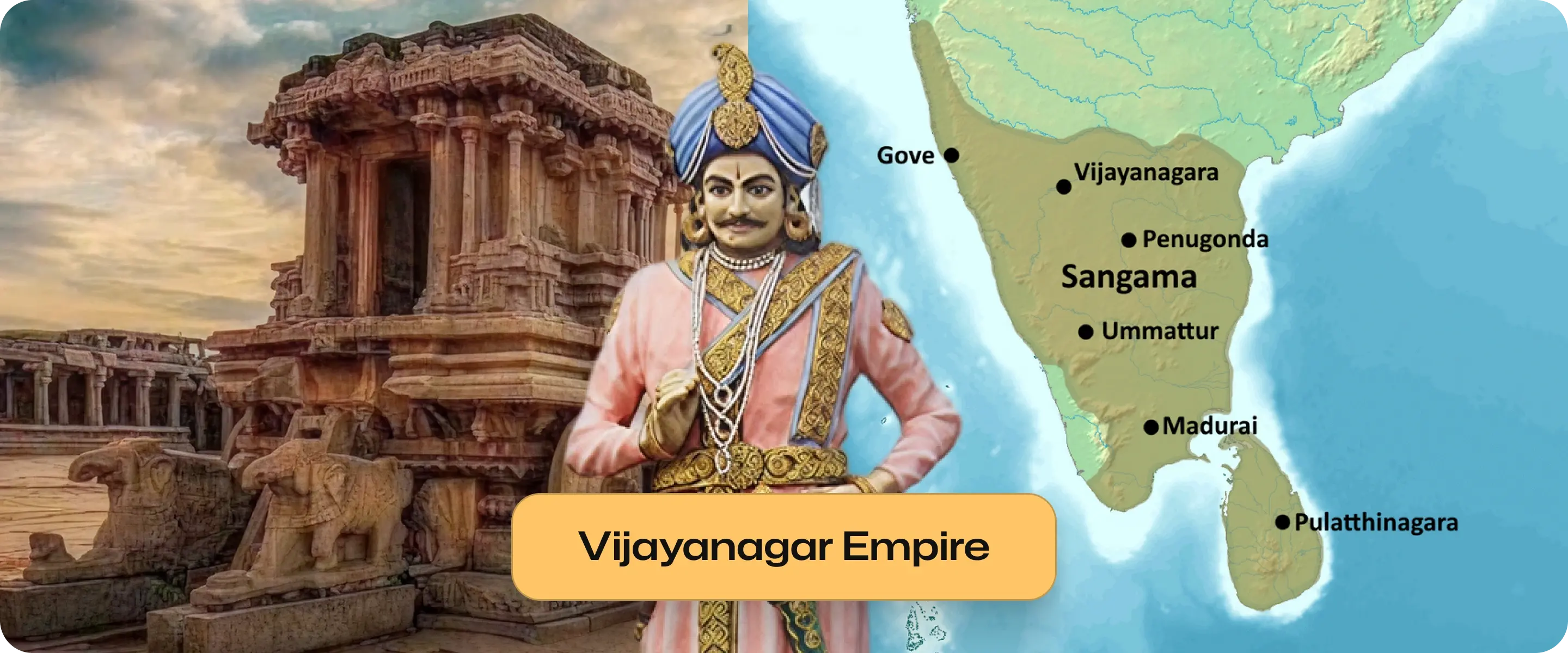
The Vijayanagar Empire was powerful in South India, founded in 1336 by the two brothers Harihara I and Bukka I, with its capital at Hampi. It had considerable dominance over the area until the 17th century. It had four important ruling dynasties-
The Sangama Dynasty
The Saluve Dynasty
The Tuluva Dynasty
The Aravidu Dynasty
The Vijayanagar Empire was widely regarded for its well-organized polity, robust administration, and a thriving economy dependent on agriculture, trade, and industry.
From a cultural perspective, this era saw growth in art, literature, and architecture. Ultimately, the Vijayanagar Empire declined due to internal conflicts, succession disputes, and the Battle of Talikota in 1565.
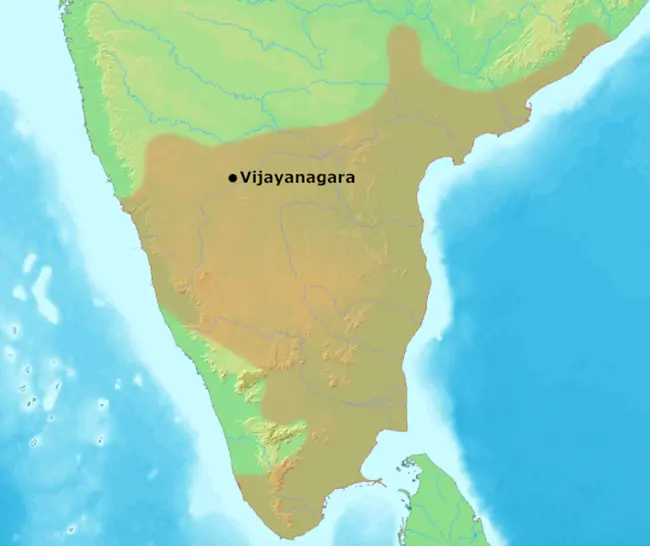
Harihara I and Bukka Raya I founded the dominant Vijayanagara Empire in South India. They belonged to the Sangama Dynasty.
They were originally feudatories of the Kakatiyas of Warangal. Afterwards, the brothers became ministers in the kingdom of Kampili in Karnataka.
When Mohammed Bin Tughlaq captured Kampili, he imprisoned the two brothers and converted them to Islam.
Their Guru, Vidyaranya, motivated them to reconvert to Hinduism.
They also declared independence and founded the new kingdom of Vidyanagar, or Vijayanagar (City of Victory), in 1336 AD.
Join our WhatsApp Community
The kingdom of Vijayanagara extended to Rameshwaram, encompassing the entire South India, including Tamil Nadu and the Chera territories in Kerala.
There were sixteen kings of the Vijayanagara Empire, belonging to four dynasties. They ruled the region from 1336 to 1646 AD.
Sangama dynasty (1336-1485): It was the first dynasty to rule Vijayanagar. Its founders, Harihara and Bukka, were part of it.
Saluva dynasty (1485-1505): Its founder was Narasimha, and it ruled over almost the entire South India
Tuluva dynasty (1505-1570): Vir Narasimha founded it. Krishnadeva Raya, the most famous Vijayanagar king, belonged to it.
Aravidu dynasty (1570-1650): King Tirumala founded it, and it was the last Hindu dynasty to rule Vijayanagar.
The following table shows all major rulers from the Vijayanagar Empire:
Dynasty | King | Reign | Key Facts |
Sangama | Harihara I | 1336–1356 | Founder of the empire |
Sangama | Bukka Raya I | 1356–1377 | Co-founder, consolidated territories |
Sangama | Harihara II | 1377–1404 | Expanded empire northwards |
Sangama | Deva Raya I | 1406–1422 | Known as “Defender of the Land” |
Sangama | Deva Raya II | 1424–1446 | Golden age of arts & administration |
Sangama | Mallikarjuna Raya | 1446–1465 | Weak ruler, decline begins |
Sangama | Virupaksha Raya II | 1465–1485 | Last significant Sangama king |
Saluva | Saluva Narasimha Deva Raya | 1485–1491 | Stabilized empire during chaos |
Saluva | Narasimha Raya II | 1491–1505 | Consolidated South India |
Tuluva | Viranarasimha Raya | 1503–1509 | Founder of Tuluva dynasty |
Tuluva | Krishnadevaraya | 1509–1529 | Most famous king, cultural & military peak |
Tuluva | Achyuta Deva Raya | 1529–1542 | Maintained Krishnadevaraya’s legacy |
Tuluva | Sadasiva Raya | 1542–1570 | Puppet ruler under Aliya Rama Raya |
Aravidu | Aliya Rama Raya | 1542–1565 | Key administrator, killed at Talikota |
Aravidu | Tirumala Deva Raya | 1565–1572 | First official Aravidu king |
Aravidu | Venkata II | 1586–1614 | Last strong ruler before decline |
Sangama Dynasty (1336–1485 AD)
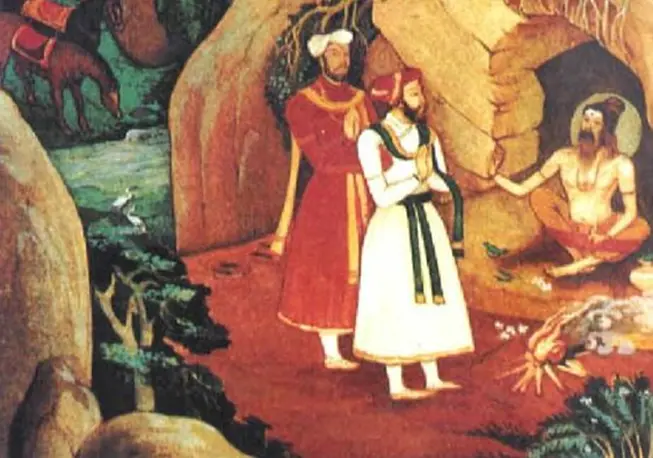
The Sangama dynasty comprised rulers such as Harihara I, Bukka Raya I, Deva Raya I, and Deva Raya II.
This dynasty played a huge role in building the empire from the ground up. It strengthened the empire’s authority, administration, and military power.
They dominated South India throughout their reign.
Harihara I
The eldest son of Bhavana Sangama and a descendant of the Kuruba clan, Harihara was also known as ‘Hakka’ or ‘Vira Harihara’.
He was one of the founders of the Vijayanagar Empire and the Sangama Dynasty.
He governed the northern regions of the Hoysala Empire. Harihara took over the reins of the empire after the death of Hoysala Veera Ballala III.
After coming to power, he constructed a fort at Barkuru on the western coast of Karnataka.
The Nayankara system was established under him. Military officers were designated as ‘nayakas’ (local governors) and were responsible for estate management and troop mobilisation.
Harihara and his minister Anantarasa Chikka Udaiya restructured the civil administration- kingdom was divided into sthalas, nidus, and simas. Officers were assigned for revenue collection and administration in these regions.
Bukka Raya I
Bukka Raya ruled from 1356 to 1377. The Vijayanagar empire expanded significantly during his 21-year reign.
By 1360, he conquered the Kingdom of Arcot and the Reddis of Kondavidu. The annexation of Penukonda followed this.
Bukka made Vijayanagar the empire's capital, replacing Anegondi for enhanced security.
The Sanskrit text “Madura Vijayam” says that Bukka Raya defeated the Madurai Sultanate. He also extended his control to Rameswaram. His son Kumara Kampana supported him in these campaigns.
During the reigns of Mohammed Shah I and Mujahid Shah Bahmani, he faced multiple conflicts with the Bahmani Sultanate.
His court poet was Telugu poet Nachana Soma, and he also supported intellectuals like Vidyaranya and Sayana. Commentaries on the Vedas were created in his reign.
Harihara II
The Vijayanagara Empire expanded to the eastern seacoast under Harihara II (1377-1406).
He fought wars with the Reddis of Kondavidu for Andhra Pradesh, between Nellore and Kalinga, and succeeded in conquering the territories of Addanki and Srisailam.
Harihara II succeeded in holding his own despite the Bahmani Warangal alliance.
His major victory was over Belgaum and Goa on the west side of the Bahmani kingdom.
He was given the titles Vaidikamarga Sthapanacharya and Vedamarga Pravartaka for his contributions to religious and literary scholarship.
He patronised the Kannada poet Madhura, a Jaina.
An important work on the Vedas was completed during his reign.
Deva Raya I
Deva Raya I (1406 to 1422) was a proficient leader and fighter, engaged in ongoing battles with the Velamas of Telangana, the Bahmani Sultan of Gulbarga, the Reddis of Kondavidu, and Vijayanagara's longstanding foes, the Gajapatis of Kalinga.
In 1420, he defeated Firoz Shah at Pangal. By 1422, he ruled lands up to the Krishna–Tungabhadra doab.
He built a dam on the Tungabhadra River and another on the Haridra River. This helped secure water for his realm.
He enhanced the Vijayanagar army by upgrading the cavalry, recruiting Turkic archers, and acquiring horses from Arabia and Persia.
He upheld a secular stance on administration issues. He commanded an army of 10,000 Muslims, becoming the first king of Vijaynagar to achieve this.
The Italian traveller Niccolò Conti (1420) visited during his rule.
Deva Raya II
Deva Raya II (1424-1446) was the most prominent ruler of the Sangama dynasty, recognized for his effective administration and his aspirations as a warrior.
He wrote notable pieces in Kannada (Sobagina Sone and Amaruka) and in Sanskrit (Mahanataka Sudhanidhi).
During his rule, notable Kannada poets like Chamarasa and Kumara Vyasa received his support.
The Sanskrit poet Gunda Dimdima and the Telugu poet Kavisarvabhauma Srinatha, writer of Haravilasam, were also in attendance at his court.
He obtained the title of Gajabetegara (Elephant Hunter).
Persian historian Abdur Razzak stated that his realm extended from Ceylon to Gulbarga and from Orissa to Malabar.
Saluva Dynasty (1485–1505 AD)
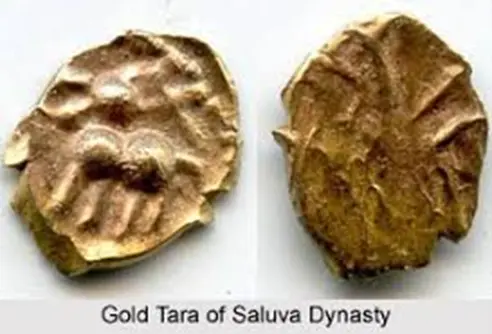
The second dynasty to rule the Vijayanagar Empire was the Saluva Dynasty.
According to the Gorantla Inscription, it originated in the Kalyani Region of North Karnataka.
Mangaldeva, the great-grandfather of Saluva Narasimha Deva Raya, founded it. He played a crucial role in Bukka Raya’s conflicts with the Madurai Sultanate.
There were three rulers in this dynasty.
Saluva Narasimha Deva Raya was the first emperor of this dynasty, ruling from 1485 to 1491. He focused on suppressing rebellions and fought against the expansion of the Gajapati Empire.
After his passing, his minister Narasa Nayaka took over and ruled until 1503.
Narasa Nayaka’s son, Vira Narsimha, became the next ruler and founder of the Tuluva dynasty.
Tuluva Dynasty
The Tuluva Dynasty traces its origin to Tuluva Narasa Nayaka.
His son, Narsimha Nayaka, assassinated Narsimha Raya II and took the throne as Vira Narsimha. He is the Tuluva Dynasty founder.
The Tuluva rule reached its peak under Krishnadeva Raya, the second son of Tuluva Narasa Nayaka.
Other important rulers of this dynasty are Achyuta Deva Raya and Sadashiva Deva Raya.
This dynasty was known for its military conquests over the Gajapatis and several Muslim rulers.
Krishna Deva Raya (1509-1539 AD)
Regarded as one of the greatest rulers of this era, Krishnadeva Raya was also known as ‘Abhinava Bhoja’, ‘Andhra Pitamah’, and ‘Andhra Bhoja’ for his great patronage of art and literature.
He was an efficient ruler and a skilled commander.
Personally he was a Vaishnavite, but he respected all religions equally.
He wrote works such as Amukthamalyadha in Telugu, Jambavati Kalyanam and Ushaparinayam in Sanskrit.
He also oversaw the construction of beautiful temples such as Vittalaswamy and Hazara Ramaswamy temples at Vijayanagar.
His court was adorned by a group of eight famous scholars known as “Ashtadiggajas”. Their works and contributions are given in the table below:
Scholar | Notable Work(s) | Literary Style / Contribution |
Allasani Peddanna (known as Andhra Kavitapitamaha) | Manucharitram | Classical Telugu poetry; elegant style, praised for romantic and epic themes |
Nandi Thimmana | Parijathapaharanam | Devotional and narrative poetry; skillful use of similes and metaphors |
Madayagari Mallana | Raghava Pandaveeyam | Blend of Sanskrit and Telugu; known for intricate poetic structure |
Dhurjati | Kalahasti Mahatyam | Devotional poetry dedicated to Lord Shiva; vivid imagery |
Ayyalaraju Ramabhadra Kavi | Sakala Kavi Kosham | Scholarly compositions; contribution to Telugu literary compilation |
Pingali Surana | Raghava Pandaveeyam, Kalapurnodayam | Master of dual-meaning poetry (Dwipada) |
Ramaraja Bhushana | Haravilasam | Narrative poetry; adept in storytelling and Sanskrit-Telugu fusion |
Tenali Ramakrishna | Various witty poems and stories | Known for humor, satire, and clever wordplay; court poet of Krishnadevaraya |
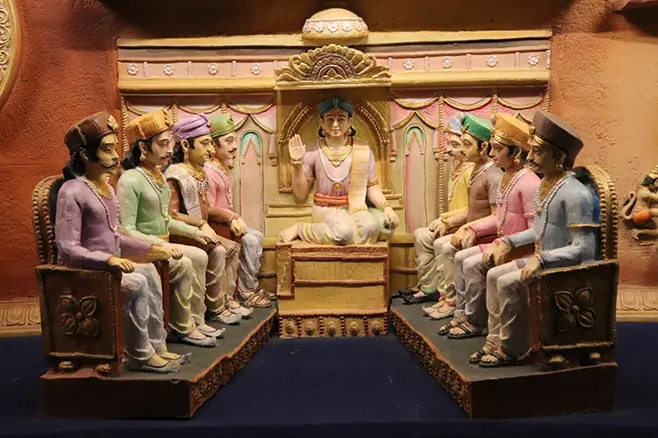
Aravidu Dynasty (1570-1650)
The Aravidu dynasty governed the Vijayanagara kingdom from Penukonda and later Chandragiri (near Tirupati) for roughly another century.
Thirumala, Sri Ranga, and Venkata II were significant monarchs of this dynasty.
The last monarch of the Vijayanagar was Sri Ranga III (1642–1646)
Under the Vijayanagar empire’s administrative system, Rayas (kings) had the final authority in executive, judicial and legislative matters. The succession to the throne was mostly hereditary.
The empire was divided into provinces as stated in the following table:
Administrative Level | Term(s) | Meaning |
Largest Province | Rajya, Mandala | Overseen by governors/Nayakas |
District/Regional Unit | Nadu | Cluster of villages |
Smaller Area / Field Cluster | Sthala, Sima | Revenue sub‑units within or across villages |
Village | Grama | Local basic unit |
Royal princes initially governed the provinces. Provincial governors enjoyed a great autonomy - holding their own courts, appointing their officers and maintaining their own army.
The governor was known as Mandaleswara or Nayak.
The raya or king also granted amaram (territory) along with a fixed revenue to military chiefs. The Military officers were known as Nayaks or Palaiyagar.
They collected taxes in the region assigned to them and used the revenue to maintain the army they provided to the ruler of Vijayanagar.
Land revenue was the major source of income, and peasants paid about one-third to one-sixth of the produce, depending on the quality of the land.
Add as a preferred Source on Google
The society of the Vijayanagar empire followed a caste hierarchy. Manucharitam mentions four castes: Brahmins, Kshatriyas, Vaishyas and Shudras.
According to Nicoli Conti, slavery was a common practice in this kingdom.
Women of the Vijayanagar empire were active in fields such as administration, fine arts, and trade. However, Sati was also prevalent at this time.
Some common forms of cultural entertainment were dancing, music, wrestling and cockfighting.
The rulers of the Sangama dynasty were majorly followers of Shaivism and Virupaksha.
Later dynasties leaned more towards Vaishnavism.
However, Vijayanagar kings were known to be secular and tolerant. Many Muslims held important positions in the administration, and they were allowed to practice their religion and build places of worship.
Vijayanagar enjoyed great economic wealth across various sectors, as evident from accounts of foreign travellers.
New dams were constructed across rivers such as the Tungabhadra, and new tanks were also built.
While the economy was initially agrarian, it shifted to a commercial economy in the 14th century.
The major imports were horses, pearls, copper, coral, mercury, Chinese silk and velvet clothes.
The major export goods were spices, rice, iron, saltpetre, sugar, cotton, and silk.
Goa, Chaul,Dabhol, Honavar, Bhatkal, Bakanur and Mangalore were the important seaports of the Vijayanagar Kingdom.
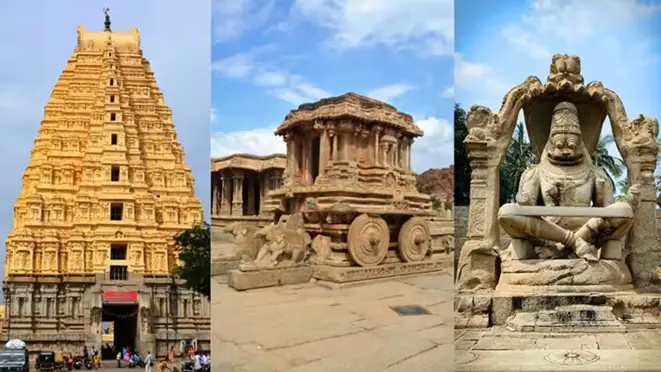
The art and architecture of the Vijayanagar kingdom are known for their beauty and intricacy. The walls of the great temples often depicted scenes from epics such as the Ramayana or the Mahabharata.
The defining characteristics of Vijayanagar architecture are tall Raya Gopurams (gateways) and the Kalyanmandapam, indicative of Dravidian-style architecture, which also featured carved pillars.
The metal images of Krishnadevaraya and his queens at Tirupati depict the excellence of the techniques used in metal sculpture in this period.
Famous Vijayanagar Temples include:
Temple | Location | Dedicated To | Importance |
Virupaksha Temple | Hampi | Shiva (Virupaksha) | Still active pilgrimage site; core temple of Hampi |
Vittala (Vitthala) Temple | Hampi | Vishnu (Vitthala) | Famous for stone chariot & 56 musical pillars |
Hazara Rama Temple | Hampi | Rama | Royal temple with detailed Ramayana reliefs |
Achyutaraya Temple | Hampi | Vishnu (Tiruvengalanatha) | Built in 1534 AD; late Vijayanagar style |
Pattabhirama Temple | Hampi | Rama (Vishnu avatar) | Vaishnavite temple from 16th century |
Balakrishna Temple | Hampi | Krishna/Balakrishna | Built under Krishnadevaraya’s period |
Ganagitti (Jain) Temple | Hampi | Jain (Kunthunatha) | Built 1385–1386 AD by a commander under Harihara II |
Sasivekalu Ganesha Temple | Hampi | Ganesha | Large Ganesha image; 15th century |
Hemakuta Hill Temples | Hampi | Shiva & others | Cluster of small temples, early site |
Chandranatha (Jain) | Mudabidri | Jain | Known as the 1000-pillared temple |
Narayana Temple (Cheluva Narayana) | Melkote | Vishnu | Built 1458 AD by local chief |
Narasimha Swamy Temple | Melkote | Vishnu (Narasimha) | Massive gateway gopura; unfinished |
Someshwara Temple | Kolar | Shiva | Early 14th‑century temple of Vijayanagar period |
Vidyashankara Temple | Sringeri | Shiva | 16th‑century temple with Hoysala influence |
Mallikarjuna Temple (Mallapanagudi) | Hospet region | Shiva | Built 1406‑1422 AD |
The ruins at Hampi are considered a UNESCO World Heritage Site.
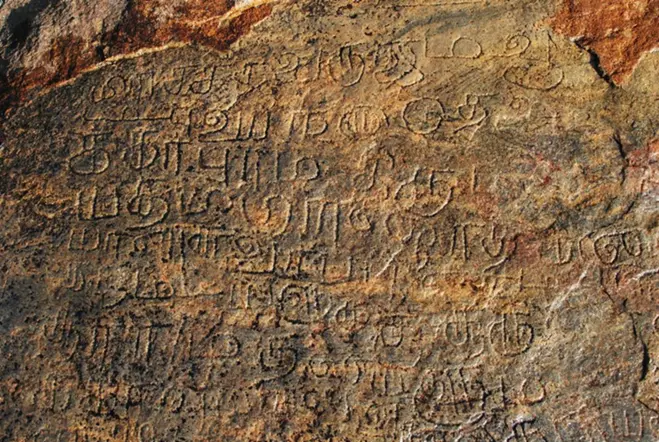
Literature flourished in the Vijayanagar Empire across various languages, including Sanskrit, Kannada, and Telugu. Some notable authors and works are mentioned in the table below:
Language | Author | Notable Works |
Sanskrit | Gangadevi | Madhuravijayam |
Krishnadevaraya | Usha Parinayan, Jambavanti Kalyanam, Madalasa Charita | |
Vidyaranya | Raja Kalanirnaya | |
Kannada | Chamarasa | Prabhulingaleele |
Purandara Dasa | Keertanas | |
Kanakadasa | Ramadhanacharite, Nala Charite, Mohantarangini | |
Kumaravyasa | Karnataka Katha Manjari | |
Telugu | Krishnadevaraya | Amuktamalyada |
Allasani Peddanna | Manucharitram | |
Nandi Thimmana | Parijathapaharanam |
The major reasons for the decline of the Vijayanagar empire are internal tensions, succession conflicts, and weak successors. The causes of decline can be traced from the Battle of Talikota:
In the Battle of Talikota (1565), forces of Ahmednagar, Bijapur, Golconda, and Bidar declared war on Vijayanagar during the rule of Aliya Rama Raya. He was defeated and the empire was pillaged and ruined. It proved to be the trigger for the empire's decline.
Moreover, provincial governors misused their autonomy to assert independent rule.
The Aravidu Dynasty ruled for a brief period, but its rulers were relatively weak, and the empire ended by 1646.
The architectural innovation under the empire and the stability of the last great Hindu empire in South India, as North Indian regimes collapsed, are the legacy of the Vijayanagar empire.
Following are the previous year Ancient History questions about the Vijayanagar Empire. Going over them will help aspirants in their UPSC History Preparation.
Q1. Who among the following rulers of the Vijayanagara Empire constructed a large dam across the Tungabhadra River and a canal-cum-aqueduct several kilometres long from the river to the capital city? (UPSC Prelims 2023)
a) Devaraya I
b) Mallikarjuna
c) Vira Vijaya
d) Virupaksha
Ans: (a)
Q2. According to Portuguese writer Nuniz, the women in the Vijayanagara Empire were experts in which of the following areas? (UPSC Prelims 2021)
Wrestling
Astrology
Accounting
Soothsaying
Select the correct answer using the code given below:
a) 1, 2 and 3 only
b) 1, 3 and 4 only
c) 2 and 4 only
d) 1, 2, 3 and 4
Ans: (d)
Q3. Which of the following was a major temple constructed during the Vijayanagar Empire? (UPSC Prelims 2019)
a) Brihadeeswara Temple
b) Konark Sun Temple
c) Meenakshi Temple
d) Virupaksha Temple
Ans: (d)
Q4. Krishnadeva Raya, the king of Vijayanagar, was not only an accomplished scholar himself but was also a great patron of learning and literature. Discuss. (UPSC Mains 2016)
Frequently asked question (FAQs)
Who founded the Vijayanagara Empire?
What are the four dynasties that ruled over the Vijayanagara Empire?
What was the capital of Vijayanagar?
Which Vijayanagar king is famous?
What led to the decline of the Vijayanagar Empire?
Vijayanagar's history marked an era of tremendous growth and stability in the South Indian region. It has left a legacy in a unique architectural style. This is called the Vijayanagara Style. It combines Central and Southern Indian styles. Efficient administration and strong overseas trade enabled the adoption of new technologies, including irrigation water management.
The emperors of each Vijayanagar dynasty supported the arts and literature. This support helped fine arts and literature grow in Kannada, Telugu, Tamil, and Sanskrit.

Gajendra Singh Godara
Ex-UPSC Aspirant | Exam Preparation Expert
Gajendra Singh Godara is an IIT Bombay graduate and a UPSC aspirant with 4 attempts, including multiple Prelims and Mains appearances. He specializes in Polity, Modern History, International Relations, and Economy. At PadhAI, Gajendra leverages his firsthand exam experience to simplify complex concepts, creating high-efficiency study materials that help aspirants save time and stay focused.

No comments yet. Be the first to join the discussion!