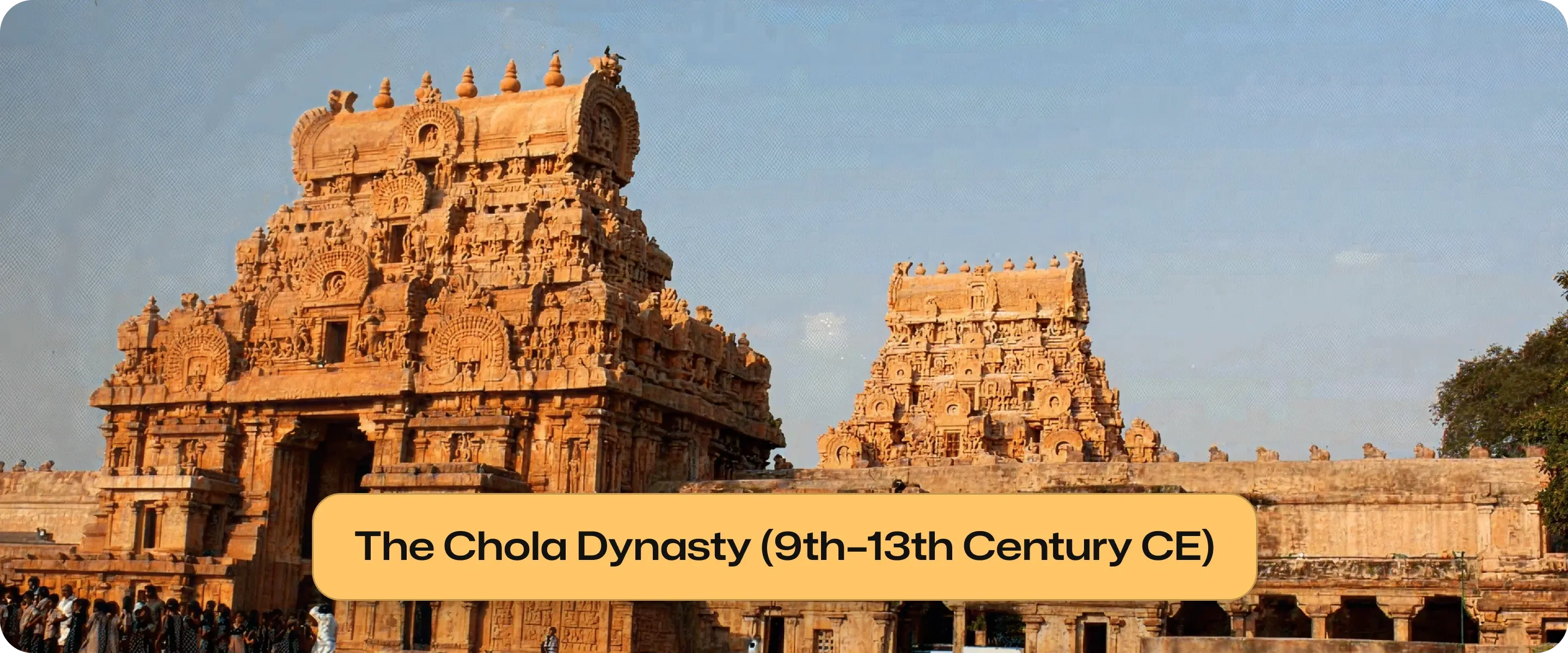
The Chola Dynasty (9th–13th CE) excelled in naval power, administration, trade, and temple architecture. This UPSC-focused guide covers rulers, inscriptions, economy, navy, and Dravidian cultural achievements for Prelims and Mains.

Gajendra Singh Godara
Last updated
10
mins read
Key highlights:
Timeline: Sangam Cholas → Imperial Cholas → Later Cholas (850–1279 CE)
Rulers: Vijayalaya Chola, Parantaka I, Rajaraja I, Rajendra I, Kulothunga I
Administration: Centralized monarchy + strong local self-governance; Uttaramerur Inscription & Kudavolai system
Economy & Trade: Kaveri Delta agriculture, Anjuvannam & Ayyavole-500 guilds, ports at Poompuhar & Nagapattinam
Navy: Maritime dominance, Srivijaya expedition, protection of trade routes
Art & Architecture: Brihadeeswarar, Gangaikonda Cholapuram, Airavatesvara temples; bronze Nataraja sculptures
Decline: Rise of Pandyas & Hoysalas, weak rulers, shifting trade and geopolitics
The Chola Dynasty (9th–13th Century CE) was not merely a powerful South Indian empire. It was a maritime force, an administrative innovator, and a cultural high point of early medieval India.
Its legacy still shapes today’s debate. This includes installing the Sengol in the new Parliament. It also includes India’s growing Indo-Pacific outreach.
For UPSC aspirants, the Cholas represent a high-return, multi-dimensional topic, spanning:
Art & Culture: Iconic bronze sculptures and the UNESCO-recognized Great Living Chola Temples
Polity & Governance: The Uttaramerur Inscription, offering early evidence of structured local self-government and electoral processes
International Relations: A powerful navy that enabled overseas expeditions, including the Chola expedition to Srivijaya, establishing dominance across the Bay of Bengal
This blog gives a clear, exam-focused breakdown of the Chola period. It helps you understand, recall facts for Prelims, and add depth for Mains.
Historians can divide the history of the Cholas into three broad phases. For UPSC, the Imperial Chola period (9th–11th century CE) has the highest weightage. It matters most for questions on administration, temple architecture, and maritime expansion.
Phase 1: Sangam Cholas (c. 300 BCE – 300 CE)
Karikala Chola: A leading early ruler. People credit him with building the Kallanai (Grand Anicut) on the Kaveri River. It is one of the world’s oldest working dams.
Post-Sangam Decline: After this phase, the Cholas declined. They stayed politically insignificant during the Kalabhra Interregnum. This was a disruptive period in South Indian history.
Phase 2: Imperial Cholas (c. 850 CE – 1070 CE)
This period marks the peak of Chola power, with territorial expansion, administrative consolidation, and naval dominance.
Year (CE) | Ruler / Event | UPSC-Relevant Significance |
850 | Vijayalaya Chola | Captured Thanjavur from the Muttaraiyars and established the Imperial Chola line |
907–955 | Parantaka I | Expanded into Pandya territory; inscriptions such as Uttaramerur Inscription provide details on village administration |
985–1014 | Rajaraja Chola I | Built the Brihadeeswarar Temple; consolidated control over Sri Lanka; strengthened naval power |
1014–1044 | Rajendra Chola I | Extended campaigns up to the Ganges; led the Chola expedition to Srivijaya; founded Gangaikonda Cholapuram |
1044–1054 | Rajadhiraja I | Died in the Battle of Koppam, a rare instance of a ruler killed in active combat |
Phase 3: Later Cholas (c. 1070 CE – 1279 CE)
Kulothunga I (1070–1122 CE): Integrated the Eastern Chalukya territories with the Chola kingdom. Known by the title Sungam Tavirtta for abolishing certain taxes and promoting trade.
Decline: Ongoing conflicts with the Pandyas, Hoysalas, and Kakatiyas weakened the empire. This led to its decline by the late 13th century.
UPSC Tip: Focus on the Imperial phase, especially rulers, inscriptions, and administrative innovations. Questions increasingly test specific terms, institutions, and chronological clarity rather than broad narratives.
Join our WhatsApp Community

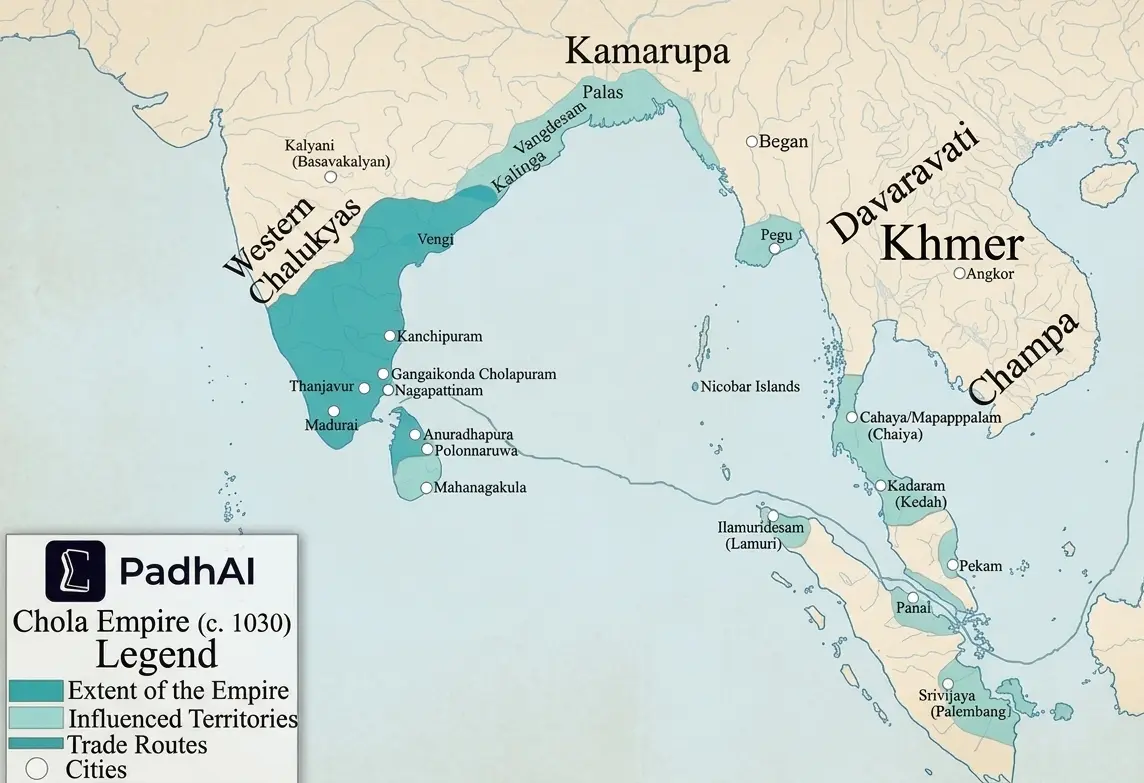
The rise of the Imperial Cholas reflects a strategic expansion during a period of political transition in South India. After staying mostly unknown after the Sangam age, the Cholas rose again as the Pallavas and Pandyas declined.
Key Drivers of Rise
Strategic Geography: The fertile Kaveri delta enabled high agricultural surplus, which supported a standing army and administrative expansion
Political Opportunity: Weakening of regional powers created space for Chola consolidation
Turning Point: Around 850 CE, Vijayalaya Chola captured Thanjavur from the Muttaraiyar chiefs. This marked the start of the Imperial Chola line. It also shifted the capital from Uraiyur to Thanjavur.
Consolidation of Power: Aditya I, Vijayalaya’s successor, defeated the Pallava ruler Aparajita. This victory established Chola dominance over Tondaimandalam and marked their emergence as a major regional power
Key Rulers of the Chola Dynasty
For UPSC, focus on titles, military campaigns, administrative contributions, and architectural achievements.
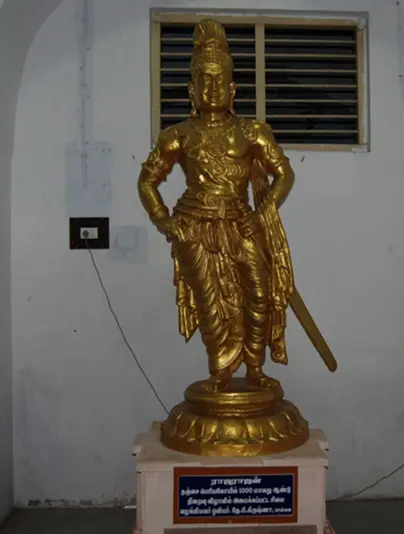
Rajaraja Chola I (985–1014 CE): Consolidator of Power
Naval Achievement: Defeated the Chera fleet at Kandalur Salai, marking the rise of Chola naval strength
Expansion: Extended control over Sri Lanka and parts of South India
Architecture: Built the Brihadeeswarar Temple (1010 CE)
Titles: Mummudi Chola, Sivapadasekhara
Rajendra Chola I (1014–1044 CE): Architect of Expansion
Northern Campaign: Defeated the Pala ruler Mahipala I and commemorated the victory at Gangaikonda Cholapuram
Naval Power: Led the Chola expedition to Srivijaya to control Southeast Asian trade routes
Titles: Gangaikonda, Kadaram Kondan
Parantaka I (907–955 CE): Administrative Reformer
Territorial Expansion: Defeated the Pandyas; later faced defeat at Takkolam
Governance: The Uttaramerur Inscription provides key insights into village assemblies and the Kudavolai system
UPSC Focus: Early model of decentralized administration
Kulothunga I (1070–1122 CE): Economic Reformer
Tax Reforms: Abolished internal tolls, earning the title Sungam Tavirtta
Trade & Diplomacy: Strengthened ties with the Song dynasty of China
UPSC Focus: Trade expansion and economic integration
The Chola administrative system combined a centralised monarchy with strong local self-governance. While the king held supreme power, local officials ran most daily tasks through well-structured institutions. Historians such as Burton Stein describe this as a segmentary state, where multiple levels shared power.
Administrative Hierarchy
The empire followed a clear hierarchical structure:
Mandalam (Province): The largest unit, governed by royal princes or trusted officials
Valanadu (Sub-Province): A cluster of Nadus, introduced for efficient revenue administration under Rajaraja Chola I
Nadu (District): The most important unit of administration, governed by an assembly known as the Nattar
Kurram / Ur (Village): The basic unit of governance
Key Administrative Terms
Perundanam & Sirudanam: Categories of higher and lower officials
Puravuvari-tinaikkalam: Department responsible for land revenue collection
Variyapothagam: Village-level account records
Local Self-Governance under the Cholas
A defining feature of Chola administration was the autonomy granted to local institutions, especially at the village level.
a) Types of Assemblies
Ur: Assembly of common villagers in non-Brahmin settlements
Sabha / Mahasabha: Assembly of Brahmins in Brahmadeya villages
Nagaram: Association of merchants and traders in urban centres
b) Uttaramerur Inscription
This inscription provides detailed information about the functioning of local self-government during the Chola period.
Kudavolai System
Names of eligible candidates were written on palm leaves and placed in a pot
A random draw was conducted to select members of committees
This method ensured a structured and transparent selection process
c) Committees (Variyams)
Specialised committees carried out the local administration.
Samvatsara Variyam: Annual executive committee
Eri Variyam: Managed irrigation and water resources
Totta Variyam: Supervised gardens and agricultural lands
Pon Variyam: Managed financial resources and temple wealth
Nyaya Variyam: Handled judicial functions and disputes
Add as a preferred Source on Google
The Chola economy rested on two strong pillars: agricultural surplus and maritime trade. This combination generated the wealth that sustained temple construction, administrative systems, and military expansion.
1. Agricultural Base: Foundation of Prosperity
The Kaveri Delta functioned as the core agrarian zone, often described as the rice-producing heartland of the empire
Irrigation System: Extensive use of canals (vaykkal), tanks, and stone embankments ensured stable agricultural output
Land Classification: Revenue assessment was systematic and based on fertility
Important Terms:
Vellanvagai: Land held by peasant cultivators
Brahmadeya: Tax-free land granted to Brahmins
Devadana: Land endowed to temples, which also functioned as economic centres
2. Chola Trade Guilds: Organised Commercial Networks
Trade during the Chola period was conducted through powerful and organised guilds that operated across regions.
Anjuvannam: Guild of West Asian traders, including Arab, Jewish, and Christian communities settled in port towns
Manigramam: Inland trade guild active within the subcontinent
Ayyavole-500 (Nanadesi): A major merchant guild with a wide network across South and Southeast Asia
These guilds kept control of their trade and business. They supported long-distance trade and linked the Chola economy to global markets.
3. Ports and Trade Networks
The Cholas built a strong sea trade network across the Bay of Bengal. It linked India with Southeast Asia, China, and West Asia.
Major Ports:
Poompuhar (Kaveripattinam): An important early port associated with the Kaveri delta region
Nagapattinam port: A major port and naval base. It has active links to Southeast Asia. It is also a centre of cultural exchange.
Mahabalipuram: Continued as a key port in the northern region
Trade Network:
The Chola Empire acted as a bridge between East and West, linking regions such as China and West Asia.
Region | Exports | Imports |
China & Southeast Asia | Cotton textiles, spices, ivory, pearls, precious stones | Silk, porcelain, incense |
Arabia & Persia | Spices, teak wood, sandalwood | Horses, dates, aromatic goods |
Rulers such as Rajaraja Chola I and Kulothunga I sent missions to the Song dynasty of China. These expeditions strengthened trade relations and ensured direct access to valuable goods such as silk and ceramics.
Analytical Insight
The Chola state actively supported trade through naval strength, port infrastructure, and diplomatic engagement. Their navy kept sea routes safe. They also built strong ties with other countries. This made them one of the most outward-looking powers in early medieval India.
The Chola navy was one of the most advanced maritime forces of early medieval India. It did not limit itself to coastal defence. It let the Cholas project power across the Bay of Bengal. They gained influence over key trade routes and regions in Southeast Asia.
1. Evolution of Naval Power
Under rulers like Rajaraja Chola I and Rajendra Chola I, the Chola navy became a long-range sea force.
Strategic Expansion: Control over Sri Lanka and island territories such as the Maldives strengthened maritime reach
Use of Monsoon Winds: Chola sailors effectively utilised seasonal wind patterns to navigate across the Bay of Bengal
Maritime Routes: Enabled direct contact with Southeast Asia and China
2. Naval Organisation
The Cholas maintained a structured naval system with defined military units:
Kappalpadai: The naval division of the military
Kaikkola Perumpadai: Elite troops who likely functioned as marines during expeditions
Nilaipadai: Military garrisons stationed in overseas or coastal territories
This organisation supported both naval warfare and the protection of trade routes.
3. Naval Expeditions and Achievements
Sri Lanka Campaigns: Established control over parts of the island, securing strategic dominance in the region
Southeast Asia: The Chola expedition to Srivijaya led by Rajendra Chola I targeted key ports of the Srivijaya Empire
These expeditions helped the Cholas secure maritime trade routes and expand their political influence
4. Role in Trade and Diplomacy
The navy played a crucial role in:
Protecting merchant vessels and trade guilds
Ensuring safe passage across major sea routes
Supporting diplomatic and commercial missions to Southeast Asia and China
Analytical Insight
The strength of the Chola navy lay in its ability to integrate military power with trade interests. By securing sea routes and building strategic dominance, the Cholas became a major maritime power in the Indian Ocean.
The Chola period represents a high point in South Indian temple architecture and artistic expression. While earlier dynasties like the Pallavas built the base of the Dravidian style, the Cholas grew it. They made it into grand stone architecture, known for size, precision, and artistic detail.
H3: The Great Living Chola Temples
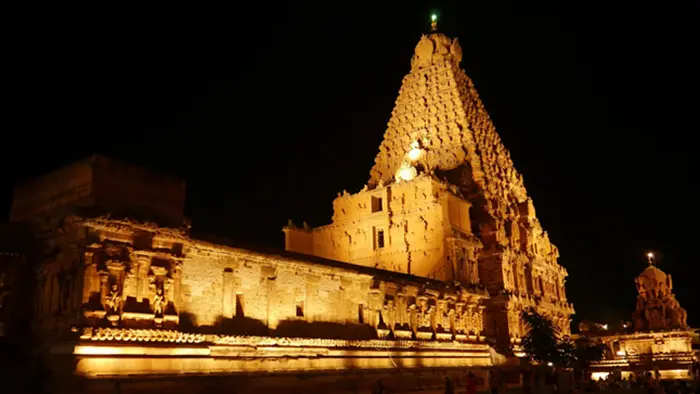
UNESCO World Heritage Sites List recognizes the most prominent examples under the “Great Living Chola Temples.”
Brihadeeswara Temple
Built by Rajaraja Chola I, known for its towering vimana (about 64 metres), finial (stupi) which is 3.81 metres in height, and the sikhara (the crowning cupola block) that is the single stone weighing 80 tons.
Gangaikonda Cholapuram Temple
Built by Rajendra Chola I; noted for its relatively more elaborate and refined structural form
Airavatesvara Temple, Darasuram
Built by Rajaraja II; known for intricate carvings and chariot-like mandapa
H3: Features of Chola Art & Architecture

Chola temples represent the mature phase of the Dravidian style, with well-defined structural and decorative elements.
1. Key Structural Elements
Vimana: Tower above the sanctum; the most prominent feature in Chola temples
Garbhagriha: Inner sanctum housing the deity
Mandapa: Pillared hall for rituals and gatherings
Gopuram: Entrance gateway, less dominant in early Chola phase
Dvarapalas: Guardian figures at entrances
Important Technical Terms:
Adhistana: The base or plinth of the temple structure
Stupi: The crowning element at the top of the vimana
Kudus: Horseshoe-shaped decorative motifs found on temple walls
2. Sculpture and Bronze Casting
Chola art reached exceptional refinement, especially in bronze sculpture.

The iconic Nataraja form represents Shiva in cosmic dance
Sculptures exhibit balance, proportion, and fluid movement
Lost Wax Technique (Cire Perdue):
Wax model replaced by molten metal
Enabled high precision and lifelike detailing
3. Paintings and Inscriptions
Murals: The Brihadeeswarar Temple contains mural paintings depicting royal and religious themes
Inscriptions: Record land grants, administrative orders, and temple management details
Analytical Perspective
The Brihadeeswarar Temple reflects a more monumental and rigid architectural style, while Gangaikonda Cholapuram shows relatively softer and more elaborate features. This variation highlights the evolution within the Chola architectural tradition.
The decline of the Chola Empire was gradual and unfolded over more than a century. A combination of external pressures, internal weaknesses, and changing trade dynamics shaped it.
1. Resurgence of the Pandyas
The most immediate challenge came from the revival of the Pandya power in southern India.
Under rulers such as Maravarman Sundara Pandya I, the Pandyas began reclaiming lost territories
They eventually defeated Chola forces and weakened their hold over core regions, including the capital
The Cholas increasingly depended on the Hoysalas for military support, reducing their political autonomy
2. Internal Weakening and Rise of Local Powers
The decentralised administrative system gradually weakened central authority.
Local chiefs such as the Sambuvarayars and Kadavarayas asserted independence
Decline in central control reduced the efficiency of revenue collection through the Puravuvari-tinaikkalam
This affected the state’s ability to sustain temple construction and military strength
3. Succession Issues and Weak Rulers
The later Chola period was marked by political instability and dynastic conflicts.
Disputes among successors weakened the monarchy
Rulers after the peak period had less authority than earlier emperors like Rajaraja Chola I and Rajendra Chola I.
By the time of Rajendra Chola III, the empire had significantly declined in power and influence
4. Changing Geopolitical and Economic Conditions
Broader regional shifts further contributed to the decline.
The rise of the Kakatiyas in the Deccan limited Chola expansion
Control over trade routes weakened, affecting maritime dominance
Campaigns led by Malik Kafur disrupted existing political structures in South India
UPSC Mains 2013:
“Chola architecture represents a high watermark in the evolution of South Indian temples.” Discuss.
Frequently asked question (FAQs)
Who founded the Chola Dynasty?
What is the Uttaramerur Inscription?
What was the Kudavolai system?
Why was the Chola Navy important?
What are the Great Living Chola Temples?
The Chola Dynasty represents a high point in administration, maritime power, and cultural achievement in early Indian history. Their systems of governance and expansive trade networks highlight a balance between central authority and local autonomy.
For UPSC aspirants, the Cholas show that ideas like decentralised governance and maritime strength have deep roots in India. The Uttaramerur Inscription and monuments like the Brihadeeswarar Temple remain key to understanding this legacy.



Gajendra Singh Godara
Ex-UPSC Aspirant | Exam Preparation Expert
Gajendra Singh Godara is an IIT Bombay graduate and a UPSC aspirant with 4 attempts, including multiple Prelims and Mains appearances. He specializes in Polity, Modern History, International Relations, and Economy. At PadhAI, Gajendra leverages his firsthand exam experience to simplify complex concepts, creating high-efficiency study materials that help aspirants save time and stay focused.
No comments yet. Be the first to join the discussion!