2026 UPSC New Cadre Allocation Policy | PDF Download

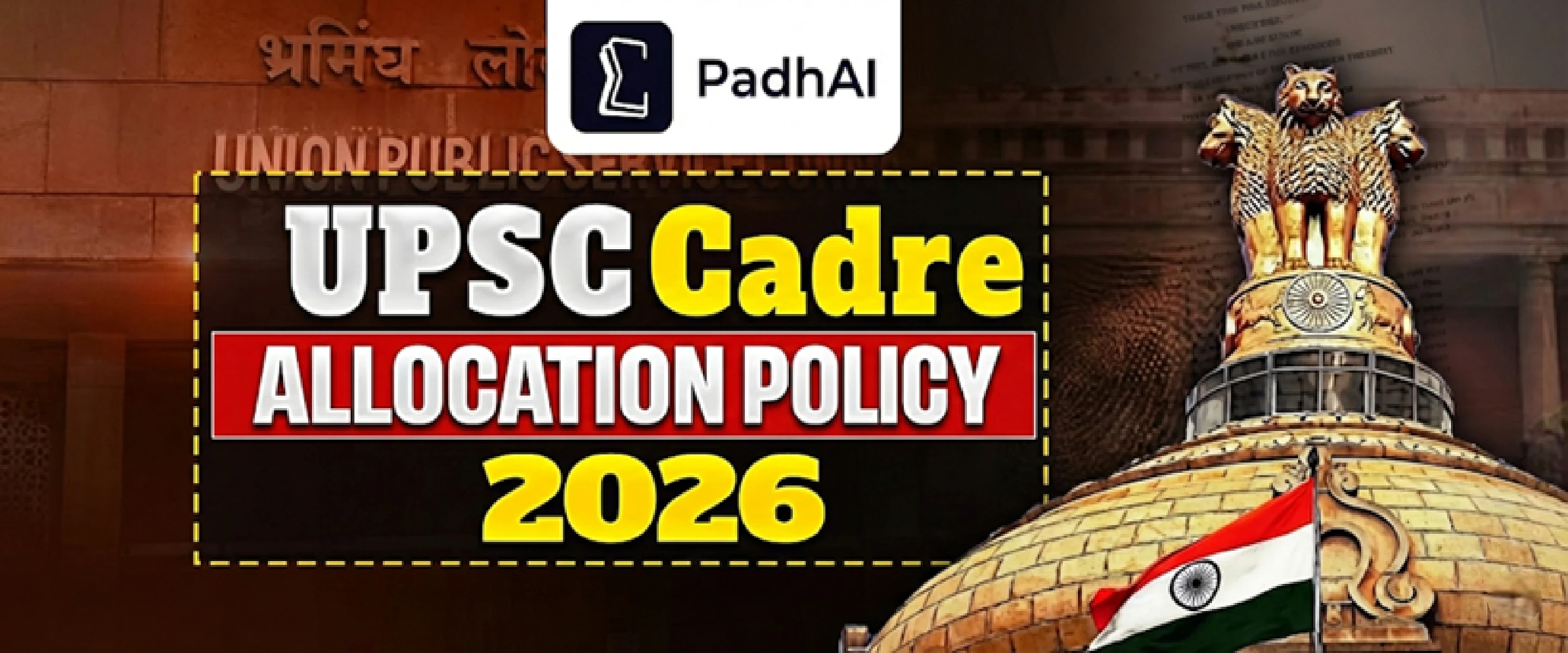
The UPSC New Cadre Allocation Policy 2026 replaces the zonal system with four state groups to guarantee balanced officer distribution. It mandates annual group rotation and strict insider-outsider vacancy cycles for IAS, IPS, and IFoS officers starting with the Civil Services Examination 2026

UPSC Prelims

Current affairs

Latest Update

Gajendra Singh Godara
Jan 24, 2026
5
mins read
UPSC New Cadre Allocation Policy

The Department of Personnel & Training (DoPT) released the UPSC New Cadre Allocation Policy 2026 on January 23, 2026. This framework mandates how the government assigns successful Civil Services Examination candidates to specific state or joint cadres. The policy applies strictly to the Indian Administrative Service (IAS), Indian Police Service (IPS), and Indian Forest Service (IFoS).

The central government revised these rules to balance regional representation and maintain administrative efficiency. The most significant structural shift is the removal of the "Zonal" system in favor of four distinct "Groups". This modification alters how aspirants submit their preferences and how the Department allocates final postings.

Key Highlights of the 2026 Policy

Zone Abolition: The policy replaces the previous five zones with four alphabetical state groups (I–IV) to simplify the preference submission process.

Dynamic Rotation: The allocation roster rotates groups annually; Group I moves to the bottom of the list in the second year to prevent permanent regional dominance.

Insider Cycles: Authorities allocate home state vacancies using strict cycles of 25 based on merit rank and category availability.

Vacancy Exchange: Unfilled insider slots trigger a specific waterfall exchange mechanism (e.g., UR vacancy offers to ST → SC → OBC) before conversion to outsider slots.

EWS Integration: The Department classifies Economically Weaker Section (EWS) vacancies under Unreserved (UR) slots for roster calculations.

What Is the UPSC Cadre Allocation Policy?

What Is the UPSC Cadre Allocation Policy?

What Is the UPSC Cadre Allocation Policy?

What Is the UPSC Cadre Allocation Policy?

UPSC Cadre Allocation is the process that assigns a state or joint cadre to an officer. This happens after the selection of the officer. An officer serves the majority of their career within this assigned region. The policy operates on a merit-cum-preference basis.

New Cadre Allocation Policy Notification

The government designed this system to distribute talent evenly across the nation. It prevents the concentration of high-ranking officers in popular states. The policy guarantees that every state administration receives a steady influx of skilled civil servants.
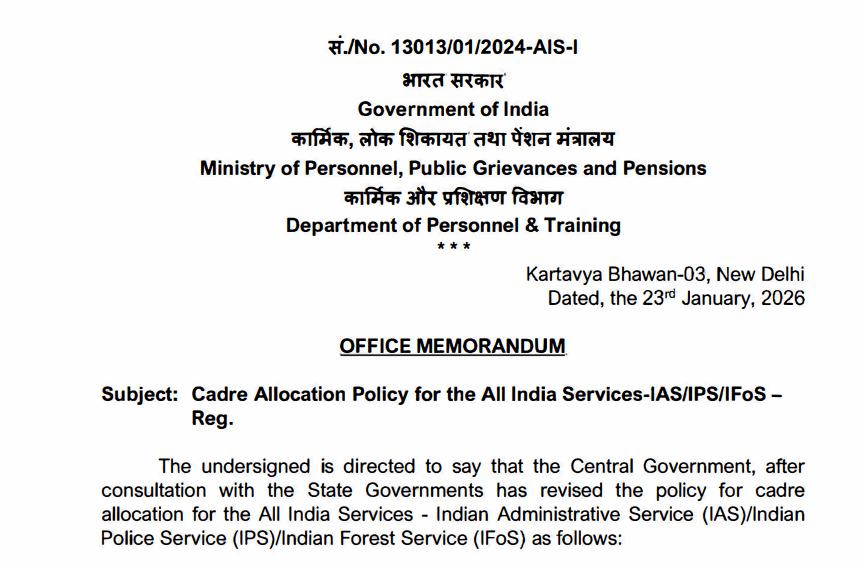
UPSC New Cadre Allocation Policy 2026 Notification

Download New UPSC Cadre Allocation Policy PDF

Join our WhatsApp Community

Join our WhatsApp Community

Join our WhatsApp Community

Join our WhatsApp Community

The 4 New State Groups (Replacing Zones)

The 4 New State Groups (Replacing Zones)

The 4 New State Groups (Replacing Zones)

The 4 New State Groups (Replacing Zones)

The previous policy divided states into five zones. The new cadre policy abolishes these zones. It organizes all State Cadres and Joint Cadres into four specific groups based on alphabetical order. This grouping directs the flow of "outsider" allocation.

The composition of the four groups is listed below:

Group

State Cadres / Joint Cadres Included

Group I

AGMUT, Andhra Pradesh, Assam–Meghalaya, Bihar, Chhattisgarh

Group II

Gujarat, Haryana, Himachal Pradesh, Jharkhand, Karnataka, Kerala, Madhya Pradesh

Group III

Maharashtra, Manipur, Nagaland, Odisha, Punjab, Rajasthan, Sikkim, Tamil Nadu

Group IV

Telangana, Tripura, Uttarakhand, Uttar Pradesh, West Bengal

UPSC Current Affairs Magazines

UPSC Current Affairs Magazines

UPSC Current Affairs Magazines

UPSC Current Affairs Magazines

Read Latest UPSC Current Affairs

Read Latest UPSC Current Affairs

Read Latest UPSC Current Affairs

Read Latest UPSC Current Affairs

How the Annual Group Rotation Works

How the Annual Group Rotation Works

How the Annual Group Rotation Works

How the Annual Group Rotation Works

The 2026 policy introduces a dynamic rotation system. The order of these groups changes every examination year. This rotation prevents any specific block of states from permanently occupying the top or bottom of the allocation roster.

The rotation logic follows a specific sequence:

  1. Current Year: Allocation follows the order Group I → Group II → Group III → Group IV.

  2. Next Year: Group I moves to the bottom of the list. The sequence becomes Group II → Group III → Group IV → Group I.

  3. Subsequent Years: This cycle repeats annually.

This mechanism distributes officers from different merit ranges equally across all regions over time.

Allocation Against Insider Vacancies

An "Insider" is a candidate who expresses a willingness to serve in their home state. The upsc cadre allocation process fills these vacancies first.

Allocation Rules for Insiders:

  • Merit Priority: The Department allocates insider slots strictly by rank.

  • Cycle System: Authorities use cycles of 25 to distribute vacancies. Only the highest-ranked candidate occupies a cycle; others move to the next cycle.

  • Category Lists: The Department prepares separate merit lists for General, OBC, SC, and ST categories.

  • Unfilled Slots: If an insider vacancy remains unfilled, the system converts it into an outsider vacancy. The government does not carry these vacancies forward to the next year.

Candidates must note that vacancy calculations rely on the status as of January 1st of the year following the exam.

Allocation Against Outsider Vacancies

Outsider vacancies refer to slots filled by candidates from other states. This allocation begins only after the completion of insider adjustments.

The Roster System: The allocation follows a roster-based system using the groups defined above.

  1. PwBD Priority: Candidates with benchmark disabilities receive the first opportunity. They may request a specific non-home cadre.

  2. Non-PwBD Candidates: The system allocates remaining officers using the group rotation (I, II, III, IV).

  3. Home Cadre Lock: If the roster assigns a candidate to their home state as an outsider, the system exchanges them with the next candidate.

Aspirants must understand these mechanics before filling out the upsc application form detailed preference forms.

Add as a preferred Source on Google

Add as a preferred Source on Google

Add as a preferred Source on Google

Add as a preferred Source on Google

Exchange Mechanism for Unfilled Slots

Exchange Mechanism for Unfilled Slots

Exchange Mechanism for Unfilled Slots

Exchange Mechanism for Unfilled Slots

The policy mandates a strict exchange protocol when specific category insider vacancies remain empty. The system does not leave these high-priority slots vacant.

The Exchange Order:

  • UR Vacancy: Offered to Insider ST → Insider SC → Insider OBC.

  • OBC Vacancy: Offered to Insider ST → Insider SC → Insider UR.

  • SC Vacancy: Offered to Insider ST → Insider OBC → Insider UR.

  • ST Vacancy: Offered to Insider SC → Insider OBC → Insider UR.

This waterfall mechanism maximizes the chances of officers serving in their home regions.

Can You Change Your Assigned Cadre?

Can You Change Your Assigned Cadre?

Can You Change Your Assigned Cadre?

Can You Change Your Assigned Cadre?

The cadre system in upsc is rigid. Transfers are exceptionally rare. The central government permits changes only under specific "Inter-Cadre Transfer" rules.

Valid Grounds for Transfer:

  • Marriage: Two officers (e.g., IAS and IPS) can apply for transfer to the same cadre.

  • Medical Emergencies: Severe medical conditions may justify a transfer request.

Acceptance requires the concurrence of both state governments and the central government. This rigidity underscores the importance of the ias salary structure and career stability within a single state.

Is the EWS Category Separate?

Is the EWS Category Separate?

Is the EWS Category Separate?

Is the EWS Category Separate?

The new cadre policy clarifies the status of the Economically Weaker Section (EWS). The policy treats EWS vacancies as part of the Unreserved (UR) vacancies. EWS candidates are plotted against UR slots in the roster system. This integration simplifies the upsc cadre list calculations.

Implementation Timeline

Implementation Timeline

Implementation Timeline

Implementation Timeline

The government applies these rules starting with the Civil Services Examination 2026 and the Indian Forest Service Examination 2026. The LBSNAA training commencement deadlines necessitate that IAS allocation concludes before the foundation course begins.

Frequently asked question (FAQs)

How does the UPSC New Cadre Allocation Policy 2026 organize state cadres?
How does the "Exchange Mechanism" function for unfilled insider vacancies?
Does the new policy reserve specific roster slots for EWS candidates?
How does the annual group rotation system affect cadre allocation?
Can an officer transfer their assigned cadre after the final allocation?

Conclusion

Conclusion

The UPSC New Cadre Allocation Policy 2026 introduces a streamlined group-based approach. It eliminates complex zones and mandates annual rotation to guarantee fair distribution. The policy prioritizes merit while accommodating home-state preferences through a strict cycle system. Aspirants must study these rules to optimize their preference lists.
Suggested posts

IAS Civil List: Cadre-Wise Officer Data | PDF Download

Key Highlights

  • Official Registry: The Civil List 2025 documents IAS officers as of January 1, 2025.

  • Cadre Strength: AGMUT holds the highest authorized strength among listed cadres.

  • Pay Matrix: Officers range from Level 10 (Entry) to Level 17 (Apex).

  • Jurisdiction: Defines allocations for states like UP, Bihar, and Maharashtra.

IAS Civil List
Download PDF of IAS Civil List. Explore state-wise officer data, cadre strength, and pay matrix levels for UPSC aspirants. Current as of January 2025.

IAS Civil List: Cadre-Wise Officer Data | PDF Download

Key Highlights

  • Official Registry: The Civil List 2025 documents IAS officers as of January 1, 2025.

  • Cadre Strength: AGMUT holds the highest authorized strength among listed cadres.

  • Pay Matrix: Officers range from Level 10 (Entry) to Level 17 (Apex).

  • Jurisdiction: Defines allocations for states like UP, Bihar, and Maharashtra.

IAS Civil List
Download PDF of IAS Civil List. Explore state-wise officer data, cadre strength, and pay matrix levels for UPSC aspirants. Current as of January 2025.

UPSC CSE Mains 2026 Interview Postponed: New Dates & Official Notice

Key Highlights

  • Postponed Event: UPSC CSE Mains 2025 Personality Test (Interview).

  • Affected Group: Candidates scheduled for Jan 22, 2026 (Afternoon).

  • New Slot: Feb 27, 2026 (Forenoon).

  • Reason: Republic Day Parade Full Dress Rehearsal.

  • Next Cycle Status: The CSE 2026 notification is delayed beyond its Jan 14 schedule.

  • Total Qualified: 2,736 candidates cleared the Mains to reach this interview stage.

UPSC CSE Mains Interview Date 2026 postponed
The UPSC revised the schedule for the CSE Mains 2025 Personality Test for specific candidates. This modification impacts aspirants originally assigned to the afternoon session on January 22, 2026. The Commission cited administrative requirements regarding Republic Day celebrations as the cause for this shift.

UPSC CSE Mains 2026 Interview Postponed: New Dates & Official Notice

Key Highlights

  • Postponed Event: UPSC CSE Mains 2025 Personality Test (Interview).

  • Affected Group: Candidates scheduled for Jan 22, 2026 (Afternoon).

  • New Slot: Feb 27, 2026 (Forenoon).

  • Reason: Republic Day Parade Full Dress Rehearsal.

  • Next Cycle Status: The CSE 2026 notification is delayed beyond its Jan 14 schedule.

  • Total Qualified: 2,736 candidates cleared the Mains to reach this interview stage.

UPSC CSE Mains Interview Date 2026 postponed
The UPSC revised the schedule for the CSE Mains 2025 Personality Test for specific candidates. This modification impacts aspirants originally assigned to the afternoon session on January 22, 2026. The Commission cited administrative requirements regarding Republic Day celebrations as the cause for this shift.

2026 UPSC OMR Sheet Filling Details | PDF Download

The Union Public Service Commission (UPSC) Preliminary examination relies entirely on Optical Mark Recognition (OMR) technology for evaluation. A single mistake in the Booklet Series or Roll Number leads to immediate disqualification. This happens no matter how much the candidate knows.

This guide defines the structural requirements of the UPSC OMR sheet and provides strict protocols for marking answers. PadhAI integrates these technical instructions to help aspirants standardize their practice sessions before the 2025 examination.

UPSC OMR Sheet
Download the official UPSC OMR sheet PDF format. Learn to fill Roll Numbers, Booklet Series, and Subject Codes correctly to avoid disqualification in Prelims.

2026 UPSC OMR Sheet Filling Details | PDF Download

The Union Public Service Commission (UPSC) Preliminary examination relies entirely on Optical Mark Recognition (OMR) technology for evaluation. A single mistake in the Booklet Series or Roll Number leads to immediate disqualification. This happens no matter how much the candidate knows.

This guide defines the structural requirements of the UPSC OMR sheet and provides strict protocols for marking answers. PadhAI integrates these technical instructions to help aspirants standardize their practice sessions before the 2025 examination.

UPSC OMR Sheet
Download the official UPSC OMR sheet PDF format. Learn to fill Roll Numbers, Booklet Series, and Subject Codes correctly to avoid disqualification in Prelims.
a close up of a cell phone with a blurry background

About Author

Gajendra Singh Godara

Growth | FTE| Resident at SigIQ

Gajendra Singh Godara brings authentic UPSC preparation insights from his four-attempt journey, having successfully cleared Prelims and written Mains multiple times. His deep expertise spans Polity, Modern History, International Relations, and Economy. At PadhAI, Gajendra transforms his extensive exam experience into accessible content that simplifies complex concepts for aspirants at every preparation stage. His firsthand understanding of UPSC's demands enables him to create targeted materials that save time while maximizing learning efficiency for current affairs, general studies, and optional subjects.

a close up of a cell phone with a blurry background

About Author

Gajendra Singh Godara

Growth | FTE| Resident at SigIQ

Gajendra Singh Godara brings authentic UPSC preparation insights from his four-attempt journey, having successfully cleared Prelims and written Mains multiple times. His deep expertise spans Polity, Modern History, International Relations, and Economy. At PadhAI, Gajendra transforms his extensive exam experience into accessible content that simplifies complex concepts for aspirants at every preparation stage. His firsthand understanding of UPSC's demands enables him to create targeted materials that save time while maximizing learning efficiency for current affairs, general studies, and optional subjects.

a close up of a cell phone with a blurry background

About Author

Gajendra Singh Godara

Growth | FTE| Resident at SigIQ

Gajendra Singh Godara brings authentic UPSC preparation insights from his four-attempt journey, having successfully cleared Prelims and written Mains multiple times. His deep expertise spans Polity, Modern History, International Relations, and Economy. At PadhAI, Gajendra transforms his extensive exam experience into accessible content that simplifies complex concepts for aspirants at every preparation stage. His firsthand understanding of UPSC's demands enables him to create targeted materials that save time while maximizing learning efficiency for current affairs, general studies, and optional subjects.

a close up of a cell phone with a blurry background

About Author

Gajendra Singh Godara

Growth | FTE| Resident at SigIQ

Gajendra Singh Godara brings authentic UPSC preparation insights from his four-attempt journey, having successfully cleared Prelims and written Mains multiple times. His deep expertise spans Polity, Modern History, International Relations, and Economy. At PadhAI, Gajendra transforms his extensive exam experience into accessible content that simplifies complex concepts for aspirants at every preparation stage. His firsthand understanding of UPSC's demands enables him to create targeted materials that save time while maximizing learning efficiency for current affairs, general studies, and optional subjects.

Latest UPSC Exam 2026 Updates

UPSC Calendar 2026 is released on 15th May, 2025.

UPSC Mains Result 2025 is now released.

Check out the updated and latest UPSC Syllabus 2026 here.

UPSC Notification 2025 was released on 22nd January 2025.

UPSC Prelims 2026 will be conducted on 24th May, 2026 & UPSC Mains 2026 will be conducted on 21st August 2026.

The UPSC Prelims 2026 is scheduled for May 24, 2026, while the UPSC Mains 2026 will be conducted from August 21, 2026.

The UPSC Selection Process is of 3 stages-Prelims, Mains and Interview.

UPSC Result 2024 is released with latest UPSC Marksheet 2024. Check Now!

Latest UPSC Exam 2026 Updates

UPSC Calendar 2026 is released on 15th May, 2025.

UPSC Mains Result 2025 is now released.

Check out the updated and latest UPSC Syllabus 2026 here.

UPSC Notification 2025 was released on 22nd January 2025.

UPSC Prelims 2026 will be conducted on 24th May, 2026 & UPSC Mains 2026 will be conducted on 21st August 2026.

The UPSC Prelims 2026 is scheduled for May 24, 2026, while the UPSC Mains 2026 will be conducted from August 21, 2026.

The UPSC Selection Process is of 3 stages-Prelims, Mains and Interview.

UPSC Result 2024 is released with latest UPSC Marksheet 2024. Check Now!

Latest UPSC Exam 2026 Updates

UPSC Calendar 2026 is released on 15th May, 2025.

UPSC Mains Result 2025 is now released.

Check out the updated and latest UPSC Syllabus 2026 here.

UPSC Notification 2025 was released on 22nd January 2025.

UPSC Prelims 2026 will be conducted on 24th May, 2026 & UPSC Mains 2026 will be conducted on 21st August 2026.

The UPSC Prelims 2026 is scheduled for May 24, 2026, while the UPSC Mains 2026 will be conducted from August 21, 2026.

The UPSC Selection Process is of 3 stages-Prelims, Mains and Interview.

UPSC Result 2024 is released with latest UPSC Marksheet 2024. Check Now!

Latest UPSC Exam 2026 Updates

UPSC Calendar 2026 is released on 15th May, 2025.

UPSC Mains Result 2025 is now released.

Check out the updated and latest UPSC Syllabus 2026 here.

UPSC Notification 2025 was released on 22nd January 2025.

UPSC Prelims 2026 will be conducted on 24th May, 2026 & UPSC Mains 2026 will be conducted on 21st August 2026.

The UPSC Prelims 2026 is scheduled for May 24, 2026, while the UPSC Mains 2026 will be conducted from August 21, 2026.

The UPSC Selection Process is of 3 stages-Prelims, Mains and Interview.

UPSC Result 2024 is released with latest UPSC Marksheet 2024. Check Now!

PadhAI UPSC App

PadhAI UPSC App

PadhAI UPSC App

We're PadhAI - a free UPSC prep app built by IITians, AI PhDs & top UPSC experts.

Why choose PadhAI?

Why choose PadhAI?

Why choose PadhAI?

Read daily top news (TH & IE) & Solve Current Affairs MCQs
Topic-wise search of 30+ yrs PYQs
24×7 AI tutor for doubt resolution
Practice 30k+ MCQs & full GS + CSAT mocks
Play Duel UPSC quizzes with fellow aspirants
Practice 30k+ MCQs & full GS + CSAT mocks
Play Duel UPSC quizzes with fellow aspirants
Practice 30k+ MCQs & full GS + CSAT mocks
Play Duel UPSC quizzes with fellow aspirants

Why choose PadhAI?

Read daily top news (TH & IE) & Solve Current Affairs MCQs

Topic-wise search of 30+ yrs PYQs

24×7 AI tutor for doubt resolution

Practice 30k+ MCQs & full GS + CSAT mocks

Play Duel UPSC quizzes with fellow aspirants

PadhAI UPSC App

We're PadhAI - a free UPSC prep app built by IITians, AI PhDs & top UPSC experts.

Why choose PadhAI?

Read daily top news (TH & IE) & Solve Current Affairs MCQs

Topic-wise search of 30+ yrs PYQs

24×7 AI tutor for doubt resolution

Practice 30k+ MCQs & full GS + CSAT mocks

Play Duel UPSC quizzes with fellow aspirants

PadhAI UPSC App

We're PadhAI - a free UPSC prep app built by IITians, AI PhDs & top UPSC experts.

Suggested posts

Suggested posts

Suggested posts

IAS Civil List
IAS Civil List
IAS Civil List: Cadre-Wise Officer Data | PDF Download
Download PDF of IAS Civil List. Explore state-wise officer data, cadre strength, and pay matrix levels for UPSC aspirants. Current as of January 2025.
UPSC CSE Mains Interview Date 2026 postponed
UPSC CSE Mains 2026 Interview Postponed: New Dates & Official Notice
The UPSC revised the schedule for the CSE Mains 2025 Personality Test for specific candidates. This modification impacts aspirants originally assigned to the afternoon session on January 22, 2026. The Commission cited administrative requirements regarding Republic Day celebrations as the cause for this shift.
UPSC OMR Sheet
UPSC OMR Sheet
2026 UPSC OMR Sheet Filling Details | PDF Download
Download the official UPSC OMR sheet PDF format. Learn to fill Roll Numbers, Booklet Series, and Subject Codes correctly to avoid disqualification in Prelims.
IAS Civil List
IAS Civil List: Cadre-Wise Officer Data | PDF Download
Download PDF of IAS Civil List. Explore state-wise officer data, cadre strength, and pay matrix levels for UPSC aspirants. Current as of January 2025.
UPSC CSE Mains Interview Date 2026 postponed
UPSC CSE Mains 2026 Interview Postponed: New Dates & Official Notice
The UPSC revised the schedule for the CSE Mains 2025 Personality Test for specific candidates. This modification impacts aspirants originally assigned to the afternoon session on January 22, 2026. The Commission cited administrative requirements regarding Republic Day celebrations as the cause for this shift.
UPSC OMR Sheet
2026 UPSC OMR Sheet Filling Details | PDF Download
Download the official UPSC OMR sheet PDF format. Learn to fill Roll Numbers, Booklet Series, and Subject Codes correctly to avoid disqualification in Prelims.
UPSC Notification Postponed 2026
UPSC Notification 2026 Postponed: Revised Dates & Exam Status
The UPSC Notification 2026 is officially postponed due to administrative reasons. The Civil Services Preliminary Examination remains scheduled for 24 May 2026, though the registration window is delayed. The Commission will announce revised dates on the official website in due course.

Download PadhAI App

Don't get left behind in your preparation

Download PadhAI App

Don't get left behind in your preparation

Download PadhAI App

Don't get left behind in your preparation

Download PadhAI App

Don't get left behind in your preparation

PadhAI is a product of SigIQ AI, and Metayb is a recognized reseller authorized to sell PadhAI subscriptions.

Address

3rd floor, Electrical and Electronic, ALG Towers, Plot no. 48, main road, Industrial Estate, Perungudi, Chennai, Tamil Nadu 600096

© 2025-2026, All Rights Reserved

PadhAI is a product of SigIQ AI, and Metayb is a recognized reseller authorized to sell PadhAI subscriptions.

Address

3rd floor, Electrical and Electronic, ALG Towers, Plot no. 48, main road, Industrial Estate, Perungudi, Chennai, Tamil Nadu 600096

© 2025-2026, All Rights Reserved

PadhAI is a product of SigIQ AI, and Metayb is a recognized reseller authorized to sell PadhAI subscriptions.

Address

3rd floor, Electrical and Electronic, ALG Towers, Plot no. 48, main road, Industrial Estate, Perungudi, Chennai, Tamil Nadu 600096

© 2025-2026, All Rights Reserved

PadhAI is a product of SigIQ AI, and Metayb is a recognized reseller authorized to sell PadhAI subscriptions.

Address

3rd floor, Electrical and Electronic, ALG Towers, Plot no. 48, main road, Industrial Estate, Perungudi, Chennai, Tamil Nadu 600096

© 2025-2026, All Rights Reserved

Current Affairs

UPSC Resources

UPSC updates

General studies

UPSC Preparation