Anti-Defection Law: 10th Schedule Features & 2026 Debate
The Anti-Defection Law removes any MP or MLA from their seat if they abandon their party after winning an election. It lives in the 10th Schedule, inserted by the 52nd Constitutional Amendment in 1985.

Gajendra Singh Godara
10
mins read
Key Highlights:
Anti Defection Law: 10th Schedule inserted by 52nd Amendment Act, 1985
Applies to Lok Sabha, Rajya Sabha, all state assemblies and councils
Four grounds: voluntary resignation, defying whip, independent joining party, nominated member joining party after 6 months
Two-thirds of party members needed for valid merger
One-third split protection was deleted by 91st Amendment, 2003
Ministers capped at 15% of House strength (91st Amendment, 2003)
Speaker/Chairman decides; decision is subject to judicial review (Kihoto Hollohan, 1992)
Speakers must decide within 3 months (Keisham Meghchandra Singh, 2020)
2nd ARC (2008) recommends the Election Commission advise the President/Governor to decide.
The Anti-Defection Law is a constitutional provision under the 10th Schedule that removes elected legislators from office if they abandon their party after winning an election.
Added by the 52nd Constitutional Amendment, 1985, it covers Parliament and every state legislature.
This article covers every provision, all key Supreme Court judgments (including the 2026 development), statistics with official sources, criticisms, reform suggestions, and UPSC exam angles.
What Is the Anti-Defection Law?
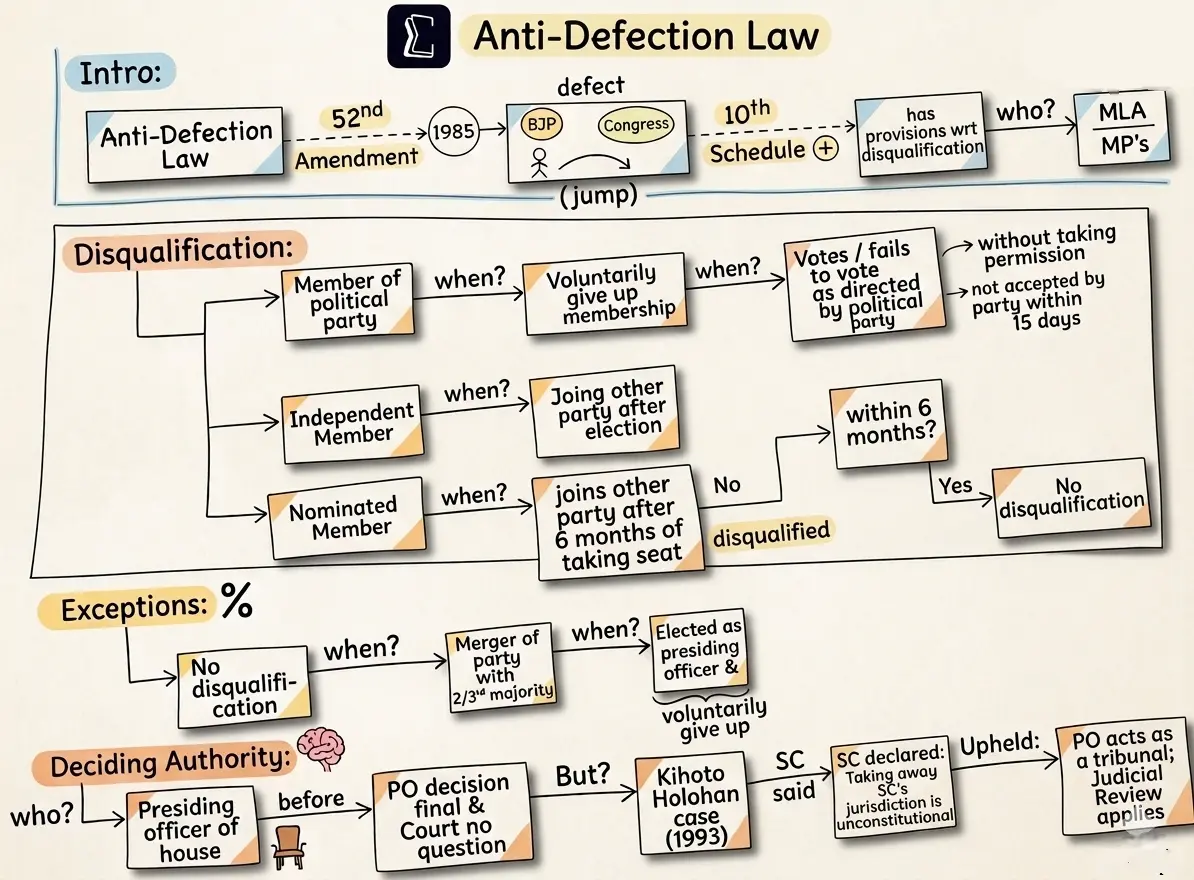
The Anti-Defection Law is a set of rules in the 10th Schedule of the Indian Constitution that strips an elected member of their legislative seat if they voluntarily leave their party or defy the party's voting direction without permission.
Key facts Table
Feature | Detail |
Constitutional Location | 10th Schedule of the Constitution |
Inserted By | 52nd Constitutional Amendment Act, 1985 |
Strengthened By | 91st Constitutional Amendment Act, 2003 |
Applies To | Lok Sabha, Rajya Sabha, all State Assemblies, State Legislative Councils |
Decision-Making Authority | Speaker (Lok Sabha/State Assembly) or Chairman (Rajya Sabha/State Council) |
Judicial Review Available? | Yes, after Kihoto Hollohan v. Zachillhu (1992) |
Time Limit for Speaker's Decision | No statutory limit; Supreme Court directed 3 months (2020) |
Is the 10th Schedule Part of the Constitution?
Yes. It carries the same legal weight as the main body. The word "political party" did not exist in the original Constitution text; the 52nd Amendment introduced it through this Schedule.
Join our WhatsApp Community
Case Study: AAP-BJP Rajya Sabha Merger (2026)
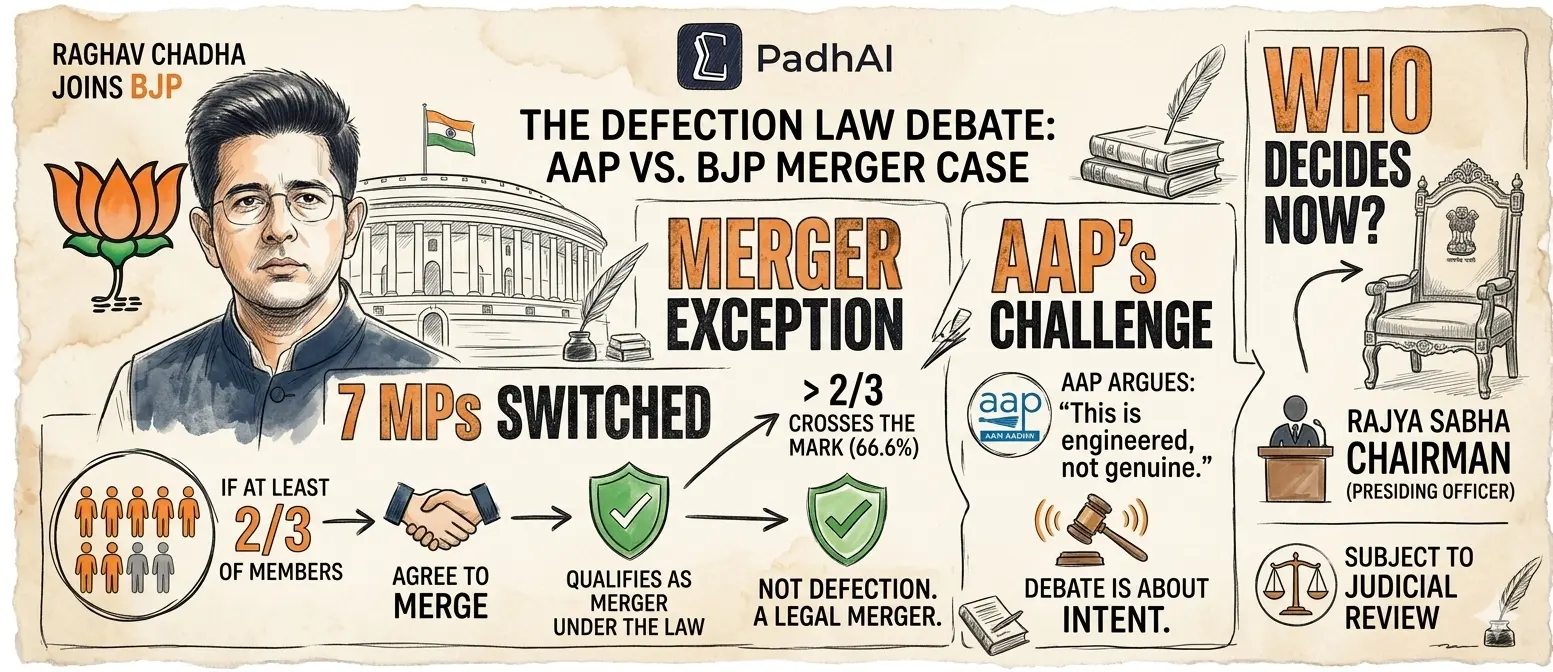
On April 24, 2026, 7 of AAP's 10 Rajya Sabha MPs resigned from the party and merged the AAP legislature party in the Upper House with the BJP.
The seven were:
Raghav Chadha
Sandeep Pathak
Swati Maliwal
Harbhajan Singh
Ashok Mittal
Vikramjit Sahney
Rajinder Gupta
AAP is now left with only three Rajya Sabha members:
Sanjay Singh
N.D. Gupta
Balbir Singh Seechewal
Why they said it was not defection: They invoked Paragraph 4 (merger exception). 7 of 10 members = 70%, which crosses the two-thirds threshold.
Why AAP disagrees: For a valid merger, the original political party, not just the legislature party, must initiate it. A legislative party cannot unilaterally announce a merger to escape disqualification. AAP's national leadership never merged with BJP. Only its Rajya Sabha group did.
Issue | Status (April 2026) |
AAP RS strength | Reduced from 10 to 3 |
NDA gap to 2/3 majority (out of 244) | 18 seats remaining |
Chairman's ruling | Pending |
Legal outcome | Likely to reach Supreme Court |
Source: The Tribune; Deccan Herald; LiveLaw, April 24, 2026
The matter will ultimately have to be settled by the Supreme Court.
This one case tests four things at once:
Disqualification grounds under the 10th Schedule,
Merger exception and its exact conditions,
"Original political party vs. legislature party" distinction,
Chairman's delay problem.
To understand what made this case legally complicated, we must trace the reason Anti-defection law was created, its significance and challenges.
Why Was the Anti-Defection Law Created?
Before 1985, floor-crossing was so widespread that political commentators called it a "goldrush" (former Karnataka CM Virendra Patil's phrase).
Key Statistics: Pre-Law Defection Crisis
Period | Data |
1957-1967 | 542 MPs and MLAs switched parties |
1967-1971 | 142 Parliamentary defections; 1,969 MLA defections |
1967-1971 | 32 state governments collapsed |
1967-1971 | 212 defectors rewarded with ministerial positions |
1967-1971 | ~50% of 4,000 legislators elected in 1967 and 1971 eventually defected |
1957-1967 | Congress lost 98 legislators but gained 419 through defections |
The "Aaya Ram-Gaya Ram" Incident
Haryana MLA Gaya Lal changed his party three times within a single fortnight in 1967, including three switches in nine hours on one day.
His case gave Indian politics its most famous phrase for opportunistic defection.
Rajiv Gandhi's government acted after the 1984 landslide, and Parliament passed the anti-defection bill unanimously: Lok Sabha on 30 January 1985 and Rajya Sabha on 31 January 1985.
The President gave assent on 15 February 1985.
Dinesh Goswami Committee Recommendations
The Dinesh Goswami Committee on Electoral Reforms (1990) recommended that the adjudication of defection cases should NOT rest with the Speaker, citing the inherent conflict of interest. Parliament accepted the law but ignored this specific recommendation; that omission remains the law's deepest structural flaw.
Add as a preferred Source on Google
Key Provisions of the 10th Schedule
4 Grounds for Disqualification under Anti-Defection Law
A member faces disqualification in any of these four situations:
Voluntary resignation from the political party (formal or inferred from conduct)
Defying the party whip by voting against or abstaining, without prior permission, and the act is not condoned within 15 days
Independent member joining a party after election
Nominated member joining a party more than 6 months after taking their seat
What Does "Voluntary" Mean Here?
The Supreme Court in Ravi S. Naik v. Union of India (1994) held that a formal resignation letter is not needed. Disqualification can be triggered by conduct alone, such as public endorsement of a rival party.
Table: Exceptions in the law
Exception | Condition | Status Post-2003 |
Merger | At least 2/3 of all party members in that House merge with another party | Still valid |
Split (1/3 members) | At least 1/3 members breaking away | Deleted by 91st Amendment, 2003 |
Presiding Officer | Speaker/Deputy Speaker who resigned from party for constitutional office | Still valid |
Deciding Authority
The Speaker of the Lok Sabha or State Assembly, and the Chairman of the Rajya Sabha or State Legislative Council, holds the sole power to decide all disqualification questions. Any member of the House can file a petition.
The 91st Amendment (2003)
Changes Introduced
Provision | Before 2003 | After 2003 (91st Amendment) |
Split protection | 1/3 members could split safely | Deleted entirely |
Merger threshold | Not clearly addressed | 2/3 members required |
Ministers cap | No cap | Max 15% of House strength (min 12 in states) |
Defectors becoming ministers | Allowed | Disqualified defectors cannot be appointed as ministers |
Why Was the Split Provision Removed?
Parties were engineering artificial "splits" by funding opposition legislators to organise a one-third breakaway group, which then merged with the ruling coalition.
The 91st Amendment deleted Paragraph 3 completely, raising the threshold to two-thirds and making orchestrated defections far harder to execute legally.
What is the significance of the 15% Cap?
Yes. A state assembly with 200 seats cannot have more than 30 ministers. The minimum is 12 ministers even for the smallest assemblies. This cap directly removed a key incentive for defection: the promise of a ministerial position.
The Role of the Speaker
The Speaker acts as a quasi-judicial tribunal under the 10th Schedule. They examine evidence, hear both sides, and pass a disqualification order. Their decision can be challenged in court, but only after they have decided; courts cannot intervene while the case is pending before the Speaker.
Why Is the Speaker's Role Criticised?
The Speaker is elected on a party ticket and naturally carries political loyalties
No statutory time limit exists for their decision, allowing delays of months or years
In several states (Andhra Pradesh, Telangana, West Bengal), Speakers sat on petitions for over 18 months
The Dinesh Goswami Committee (1990), Law Commission 170th Report (1999), and Law Commission 255th Report (2015) all flagged the same problem: a partisan decision-maker with no deadline
Documented Delay Cases
Case | State | Delay |
Mukul Roy disqualification plea | West Bengal | Nearly 1 year; Speaker rejected plea (June 2022) |
BRS MLA defection petitions | Telangana | Unresolved for over a year; SC intervened in 2026 |
Andhra Pradesh opposition MLAs | Andhra Pradesh | 18+ months pending; opposition boycotted 12-day assembly session in protest |
Source: PRS Legislative Research; The Print (2022)
Significance of Anti-Defection Law
The law has three concrete, measurable effects on Indian democracy that hold up even after 40 years:
Government stability: Individual floor-crossing, the "retail" defection of the 1960s and 70s, dropped sharply after 1985. The 32 government collapses recorded between 1967 and 1971 have no post-1985 equivalent at the same scale. (Source: PRS Legislative Research)
Voter mandate protection: A legislator elected on Party A's ticket cannot personally profit by switching to Party B mid-term. The law ties the seat to the party symbol, not just the individual.
Party discipline in coalition governments: In a country where coalition governments are common, the law gives ruling alliances a reasonable expectation that their numbers will hold on confidence votes.
None of these benefits have disappeared. The problem is that the law produces them at a cost, which brings us to its criticisms.
Criticisms of the Anti-Defection Law
Criticism Summary Table
Criticism | Explanation | Source |
Suppresses legislative dissent | MPs cannot vote against their party even for genuine policy reasons | PRS Legislative Research |
Partisan Speaker | Speaker belongs to a political party; decisions often delayed for allies | Dinesh Goswami Committee (1990); Law Commission (1999, 2015) |
Changed the form of defections | Replaced individual floor-crossing with mass mergers | PRS Legislative Research (2023) |
Reduces constituency accountability | MPs cite party whip to justify every vote, reducing personal accountability | Oxford Journal of Constitutional Law (2024) |
Weakens Parliament's oversight function | Majority party MPs cannot hold the executive accountable independently | PRS Legislative Research; Oxford International Journal of Constitutional Law |
Key Supreme Court Judgments
Judgment Comparison Table
Case | Year | Key Ruling | UPSC Relevance |
Kihoto Hollohan v. Zachillhu | 1992 | 10th Schedule valid; Paragraph 7 (barring judicial review) struck down | High: Constitutionality question |
Ravi S. Naik v. Union of India | 1994 | Conduct can prove voluntary resignation; formal letter not required | Medium: Scope of disqualification |
Rajendra Singh Rana v. Swami Prasad Maurya | 2007 | SC decided disqualification itself without sending back to Speaker | High: Judicial override |
Keisham Meghchandra Singh v. Speaker | 2020 | Speakers must decide within 3 months | High: Reform; frequently tested |
Kihoto Hollohan v. Zachillhu (1992)
A 5-judge Constitution Bench upheld the 10th Schedule by a 3:2 majority.
The Court struck down Paragraph 7 (which had barred courts from reviewing the Speaker's decisions) using the doctrine of severability.
It kept the rest of the Schedule intact.
From 1992 onwards, Speaker orders are challengeable under Articles 32 and 226.
Keisham Meghchandra Singh v. Speaker (2020)
The Supreme Court noted a growing pattern of deliberate delay.
It directed that disqualification petitions must be decided within three months of filing.
The Court also repeated the call to transfer adjudicatory power from Speakers to an independent tribunal.
2026: Supreme Court on Telangana Speaker
A bench headed by Chief Justice B.R. Gavai ordered the Telangana Assembly Speaker in April 2026 to decide pending anti-defection petitions against BRS MLAs within three months.
The Court clarified that Article 212, which protects legislative proceedings from court interference, does not shield a Speaker's inaction.
This is the most recent judicial push for structural reform.
Recommended Reforms for Anti-defection Law
Official Recommendations: A Comparison Table
Body | Year | Key Recommendation |
Dinesh Goswami Committee | 1990 | Move adjudication from Speaker to independent body |
Law Commission (170th Report) | 1999 | Independent tribunal headed by retired SC judge; repeal merger exemption |
NCRWC (National Commission to Review Working of Constitution) | 2002 | Raise defection threshold to 3/4 of party members |
Halim Committee | 2003 | Redefine "voluntarily giving up membership" more precisely |
2nd Administrative Reforms Commission | 2008 | President/Governor to decide on binding advice of Election Commission |
Law Commission (255th Report) | 2015 | Fixed timeline; independent tribunal; transparency in party whips |
Supreme Court (Keisham Meghchandra Singh) | 2020 | 3-month deadline; transfer power from Speaker |
Is There Any Reform That Has Actually Been Implemented?
No. All of the above recommendations remain pending. Parliament has not passed any constitutional amendment to move adjudication away from the Speaker or to set a statutory time limit.
The Supreme Court's 3-month direction in 2020 carries judicial authority, but violating it does not automatically disqualify the pending defector.
Comparison of Global Anti-Defection Laws
Table: Global laws regarding defection
Country | Anti-Defection Law? | What Happens If a Legislator Defects? |
India | Yes (10th Schedule, 1985) | Loses legislative seat |
Bangladesh | Yes (Article 70) | Loses seat |
South Africa | Yes (Constitutional provision) | Must vacate seat |
Singapore | Yes (Article 46) | Loses seat |
Namibia | Yes | Loses seat |
United Kingdom | No | May face de-selection by party; no legal penalty |
United States | No | No legal penalty; primary challenge possible |
Canada | No | No legal penalty |
Germany | No | No legal penalty |
Australia | No | No legal penalty |
India's 10th Schedule is considered among the most extensive anti-defection frameworks globally, as per the International Journal of Constitutional Law (Oxford Academic, 2024), which notes that India's experiment has directly informed constitutional debates in South Africa and Israel.
UPSC PYQs and Exam Strategy
Previous Year Questions
Year | Exam | Question |
2025 | Prelims | Statements on disqualification authority and "political party" in Constitution |
2021 | Mains GS-II | "The noble purpose of the anti-defection law is to bring stability. However, it is said to be against the true spirit of democracy. Discuss." (150 words) |
2014 | Prelims | Which Schedule contains anti-defection provisions? (Answer: Tenth Schedule) |
Answer to UPSC Prelims 2025
The question asked: Statement 1 says the President decides disqualification on advice of the Council of Ministers; Statement 2 says "political party" is not mentioned in the Constitution.
Correct answer: (b) - Only Statement 2 is correct.
Statement 1 is wrong: The Speaker/Chairman decides, not the President
Statement 2 is technically correct: The phrase "political party" appears only in the 10th Schedule (a later addition), not in the original constitutional text
Mains Answer Strategy (2021 Question)
A strong 150-word answer covers three layers:
Purpose: Stopped retail defections; protected voter mandate; reduced government instability
Democratic concern: Suppresses legislative dissent; partisanship of Speaker; no intra-party democracy; changed defections from individual to wholesale
Way forward: Independent tribunal (Law Commission 1999, 2015); statutory 3-month deadline; move power to Election Commission (2nd ARC, 2008)
Cite Kihoto Hollohan (1992) for judicial backing and the PRS data (1,969 MLA defections in 1967-71) for historical context.
What is the role of the Whip in the Anti-Defection Law?
What is the 52nd Amendment Act?
How does the anti-defection law protect electoral mandates?
Can a member be disqualified for voting against the party?
What major change did the 91st Amendment Act make to the Anti-Defection Law regarding party splits?
The Anti-Defection Law ended the era of retail floor-crossing that collapsed 32 state governments between 1967 and 1971.
What it did not fix is the form defections take today: bulk mergers engineered to hit the two-thirds mark and Speakers sitting on petitions for months with no statutory deadline. Every body from the Dinesh Goswami Committee (1990) to the Supreme Court (2026) has recommended the same two fixes: an independent adjudicator and a fixed timeline.
As political dynamics evolve, continuous reforms may be necessary to address the loopholes in the law.
Suggestion Blogs





Research methodology
PadhAI's research methodology ensures every article is accurate, UPSC-ready, and beginner-friendly. We curate current affairs analysis based on UPSC exam relevance by cross-referencing The Hindu, Indian Express, and PIB. General Studies (GS) topics are drafted from NCERTs and standard books such as M. Laxmikanth, Spectrum, and GC Leong, then reviewed by subject matter experts to eliminate factual errors. Additionally, we update aspirants with verified government exam notifications alongside expert blogs suggesting the best resources, syllabus, and comprehensive Prelims and Mains strategies.


Gajendra Singh Godara is an IIT Bombay graduate and a UPSC aspirant with 4 attempts, including multiple Prelims and Mains appearances. He specializes in Polity, Modern History, International Relations, and Economy. At PadhAI, Gajendra leverages his firsthand exam experience to simplify complex concepts, creating high-efficiency study materials that help aspirants save time and stay focused.
No comments yet. Be the first to join the discussion!