RBI Digital Payments Index (RBI-DPI), Digital Payment Trends, UPI Role

Gajendra Singh Godara
8
mins read
In recent years, India has seen a rapid shift from cash to digital payment methods such as mobile banking, online transfers, cards, and UPI-based apps. To capture this trend, the RBI introduced a composite Digital Payments Index (DPI) in January 2021. The DPI uses March 2018 as the base year (index = 100), and combines multiple parameters to measure the extent of digitisation of payments across India A steadily rising DPI indicates wider use of online transactions and helps policymakers track progress in financial inclusion and payment infrastructure.
Why in the News?
The Reserve Bank of India (RBI) reported that its Digital Payments Index (DPI) rose to 493.22 by March 2025, up from 465.33 in September 2024.
RBI noted that overall digital transactions grew ~11–12% year-on-year (measured by DPI) through FY2024. This reflects improved payments infrastructure and growing adoption of online transfers.
Join our WhatsApp Community
What is the RBI Digital Payments Index (RBI-DPI)?
Composite Measure: A first-of-its-kind RBI index to gauge spread of digital payments nationwide. It aggregates data on payment technology, usage, and user engagement.
Launch & Frequency: Launched January 2021, DPI is released semi-annually (with a four-month lag) on the RBI website
Base Year & Scale: March 2018 is the base period (score set at 100). Subsequent DPI values show how much digital payments have expanded since 2018.
Purpose: Tracks growth in digital payments in India – credit/debit card use, UPI transactions, mobile banking, etc. Policymakers use DPI to identify gaps in infrastructure and plan improvements.
Key Parameters of the RBI Digital Payments Index
RBI-DPI comprises five broad parameters, each with a weightage, to capture different aspects of the digital payments ecosystem:
Payment Enablers (25%) – Factors like internet and mobile penetration, and regulatory support that facilitate digital payments.
Demand-side Infrastructure (10%) – Consumer-facing infrastructure such as digital payment apps, user interfaces, and ease of access.
Supply-side Infrastructure (15%) – Merchant-side infrastructure including POS terminals, merchant apps, and payment gateway coverage.
Payment Performance (45%) – Transaction metrics: volume, value, and frequency of digital payments (e.g., number of UPI/IMPS/NEFT transfers).
Consumer Centricity (5%) – Measures how user-friendly and accessible payment systems are, including customer service and complaints mechanisms.
Each parameter consists of sub-indicators; together they offer a holistic view of digital transaction adoption
Add as a preferred Source on Google
RBI-DPI Trends and Growth
Steady Climb: Since its base of 100 in Mar 2018, the DPI has surged nearly 5×. By Mar 2025 it reached 493.22
Key Milestones: (Semi-annual data) Mar 2019: 153.47; Mar 2020: 207.84; Mar 2021: 270.59; Mar 2022: 349.30; Mar 2023: 395.57; Mar 2024: 445.50; Sep 2024: 465.33; Mar 2025: 493.22
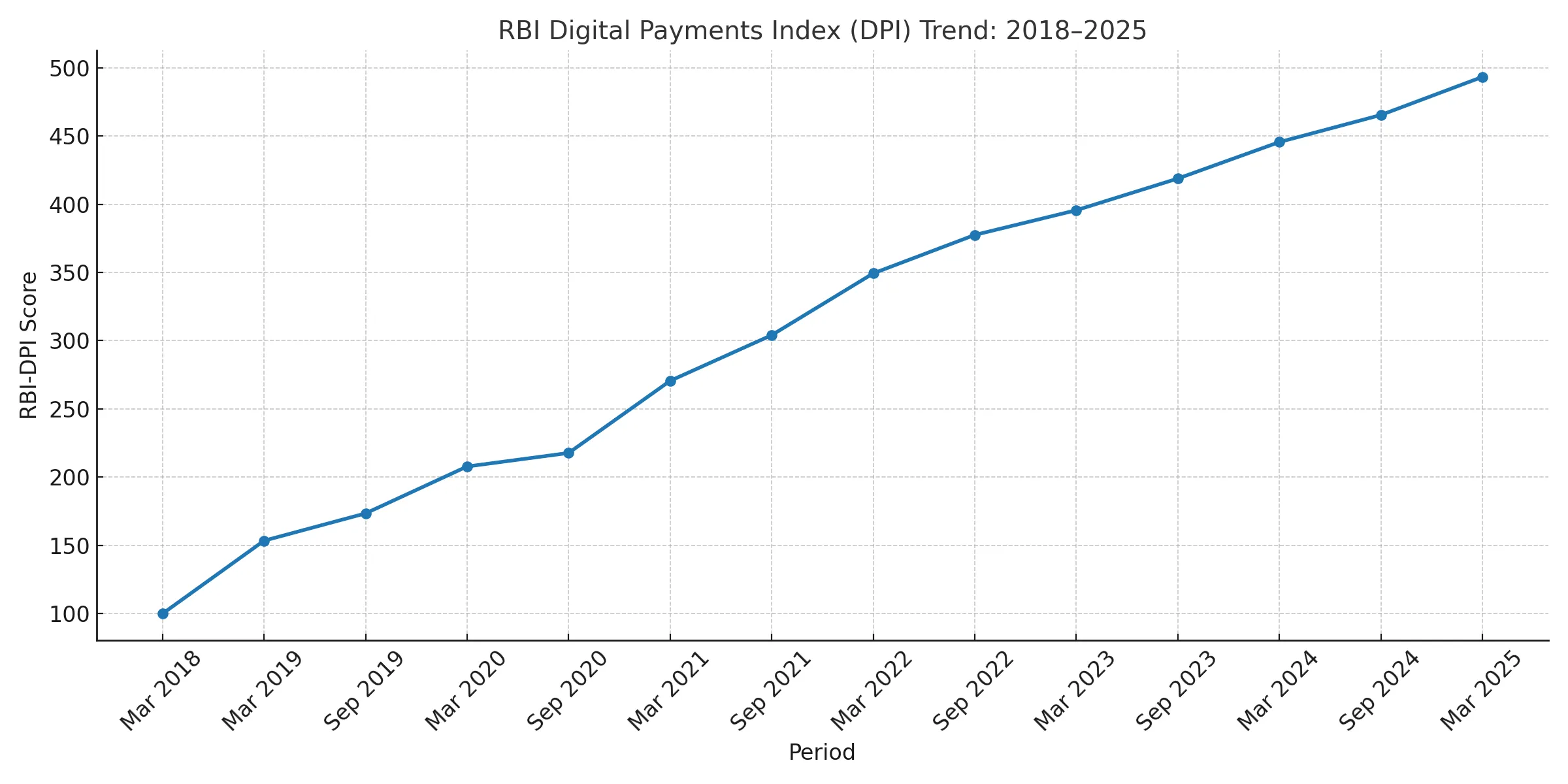
Digital Growth: RBI reported an 11.1% increase in digital payments by Sep 2024 (YOY), attributing this to broader infrastructure and usage. Enhanced payment infrastructure and performance have driven the DPI rise.
UPI and Mobile: The explosive uptake of UPI is a key driver of DPI. UPI’s share of digital payments jumped from ~34% in 2019 to 83% in 2024, while having a 5-year CAGR of ~74%. Factors include zero transaction fees and convenient features (QR-code payments, AutoPay for recurring bills).
Role of UPI and Other Digital Payment Systems
Unified Payments Interface (UPI): Launched in 2016 by NPCI, UPI allows instant P2P and P2M transfers via mobile apps. Users pay just with UPI IDs or QR codes. It is free of charge and supports any transaction size, boosting its appeal.
Dominant Growth: UPI has established dominance in India’s digital payments. As usage grew, it helped drive DPI higher UPI’s user-friendly design and interoperability have made it India’s leading digital payment method.
Other Methods: Payment methods like mobile wallets (Paytm, Google Pay) and card payments complement UPI. These channels have expanded merchant acceptance and online commerce, contributing to the overall digitization of transactions in India.
Impact of Higher Digital Payments Index
Accelerated Financial Inclusion: The rise in digital payments signifies deeper financial penetration and improved accessibility for underserved populations, particularly MSMEs and rural communities.
Support for Digital Credit Models: Initiatives like the New Digital Credit Assessment Model for MSMEs show a shift toward real-time, data-driven credit evaluation, supporting faster and fairer financing.
Strengthening of Digital Ecosystem: Highlights India’s evolving, resilient payment ecosystem driven by policy support, fintech innovation, and growing consumer trust.
Challenges & Way Forward
Challenges: Despite gains, RBI notes issues like limited connectivity and awareness in rural areas, increasing frauds/data breaches, and compatibility gaps between different payment platforms. These can slow digital uptake in some regions.
Way Forward: The RBI recommends expanding internet/mobile access in villages, strengthening cybersecurity and fraud-detection, launching user awareness campaigns, and creating unified standards for seamless transactions. Implementing these can further boost the DPI.
The RBI Index highlights India’s rapid shift towards cashless transactions. A DPI of 493.22 (Mar 2025) reflects record digital transaction volumes, driven largely by UPI and improved banking infrastructure. This composite index helps policymakers identify where to strengthen the payment ecosystem (e.g. rural connectivity, security). Continued rise in the DPI signals progress in financial inclusion and online commerce. Understanding DPI is essential for UPSC aspirants studying India’s digital economy. For more UPSC-focused insights on indices and current affairs, see Padhai Blogs.
Internal Linking Suggestions
Glacial Lake Outburst Floods(GLOFs), Meaning, Causes, Effects & Mitigation Strategies
Tsunami UPSC, Meaning, Characteristics, Causes, Impacts & Mitigation Measures
How to Begin Your UPSC Preparation : The Ultimate Guide For Beginners
40 Most Important Supreme Court Judgements of India : Landmark Judgements UPSC
Article 32 of the Indian Constitution: Right to Constitutional Remedies, 5 Writs, Significance
External Linking Suggestions
UPSC Official Website – Syllabus & Notification: https://upsc.gov.in/
Press Information Bureau – Government Announcements: https://pib.gov.in/
NCERT Official Website – Standard Books for UPSC: https://ncert.nic.in





Research methodology
PadhAI's research methodology ensures every article is accurate, UPSC-ready, and beginner-friendly. We curate current affairs analysis based on UPSC exam relevance by cross-referencing The Hindu, Indian Express, and PIB. General Studies (GS) topics are drafted from NCERTs and standard books such as M. Laxmikanth, Spectrum, and GC Leong, then reviewed by subject matter experts to eliminate factual errors. Additionally, we update aspirants with verified government exam notifications alongside expert blogs suggesting the best resources, syllabus, and comprehensive Prelims and Mains strategies.


Gajendra Singh Godara is an IIT Bombay graduate and a UPSC aspirant with 4 attempts, including multiple Prelims and Mains appearances. He specializes in Polity, Modern History, International Relations, and Economy. At PadhAI, Gajendra leverages his firsthand exam experience to simplify complex concepts, creating high-efficiency study materials that help aspirants save time and stay focused.
No comments yet. Be the first to join the discussion!