National Panchayati Raj Day: Date, History and Theme 2026
National Panchayati Raj is celebrated on 24 April every year to mark the enactment of 73rd Amendment Act. The theme for 2026 is "Sashakt Panchayat, Sarvangeen Vikas"

Gajendra Singh Godara
Last updated
10
mins read
Key Highlights
National Panchayati Raj Day is celebrated on 24 April every year.
The first National Panchayati Raj Day was observed on 24 April 2010, inaugurated by then Prime Minister Dr. Manmohan Singh.
The day commemorates the 73rd Constitutional Amendment Act, 1992, which came into effect on 24 April 1993.
The 2026 theme is "Sashakt Panchayat, Sarvangeen Vikas" (Empowered Panchayats, Comprehensive Development).
The Ministry of Panchayati Raj organises the central national event.
2026 marks 33 years since the 73rd Amendment came into force.
National Panchayati Raj Day is celebrated on 24 April every year. This single date connects constitutional law, local governance, and current affairs. The day marks the coming into force of the 73rd Constitutional Amendment Act which gave constitutional recognition to Panchayati Raj Institutions (PRIs) as the third tier of India's democratic governance structure.
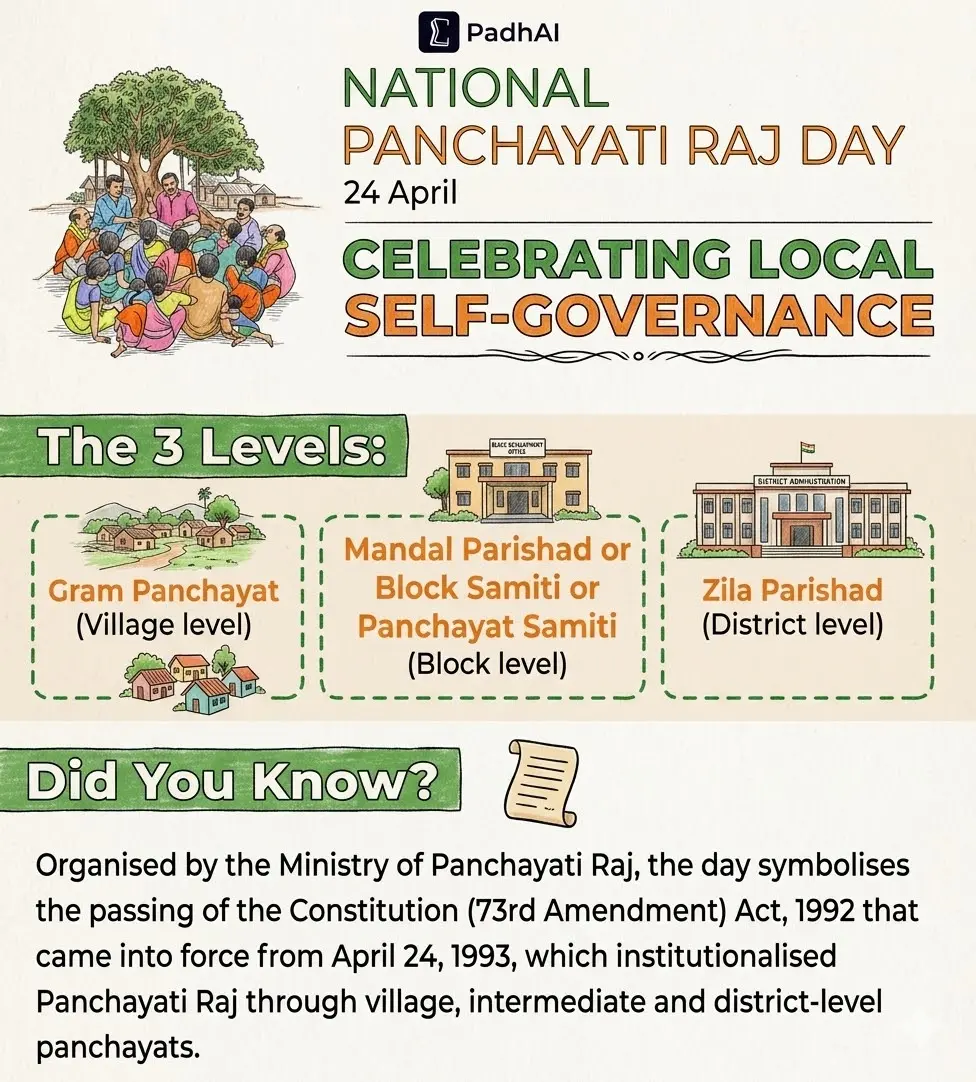
National Panchayati Raj Day is an annual observance organised by the Ministry of Panchayati Raj, to mark the day India's village governance bodies received constitutional protection.
The day commemorates the enactment of the 73rd Constitutional Amendment Act on 24 April 1993. Before that date, state governments could create or dissolve panchayats at will and no constitutional guarantee existed. The amendment changed that by inserting Part IX (Articles 243 to 243-O) and the Eleventh Schedule (29 subjects) into the Constitution of India.
On this day each year, the Government of India recognises top Gram Panchayats through the National Panchayat Awards. It also releases governance reports and holds Gram Sabha meetings in villages across the country. Vigyan Bhawan in New Delhi hosted the 2026 national event.
When Was National Panchayati Raj Day First Celebrated?
Then Prime Minister Dr. Manmohan Singh declared 2010 as the year of the first National Panchayati Raj Day, and people celebrated it that year.
Before 2010, India had no formal annual observance to mark the 73rd Amendment milestone. Dr. Manmohan Singh's declaration in 2010 established 24 April as a fixed national observance.
Since then, each year's event has a specific theme and a national-level ceremony. The awards, the annual governance reports, and the Gram Sabha meetings all date from this 2010 foundation.
Join our WhatsApp Community
The 2026 theme is "Sashakt Panchayat, Sarvangeen Vikas," meaning Empowered Panchayats, Comprehensive Development.
This theme links grassroots governance to the government's Viksit Bharat 2047 goal. It aims for a developed India by the centenary of Independence. The message is that village-level bodies cannot be peripheral; they are the delivery point for national development targets.
24 April is the date because the 73rd Constitutional Amendment Act, 1992 took effect on 24 April 1993. It gave Panchayati Raj Institutions constitutional status for the first time.
The law was passed by Parliament in 1992 under Prime Minister P. V. Narasimha Rao. Two earlier governments had failed to pass the same law in the Rajya Sabha. Those governments were led by Rajiv Gandhi and V. P. Singh.
The Act's operationalisation on 24 April 1993 converted panchayats from state-created bodies into constitutionally protected institutions. States could no longer simply ignore or dissolve them.
The Constitution now required five-year terms and regular elections by State Election Commissions. It also reserved 1/3rd seats for women. The Act reserved seats for Scheduled Castes and Scheduled Tribes too.
The Act added financial oversight through State Finance Commissions.
Add as a preferred Source on Google
The modern Panchayati Raj system traces back to the Balwant Rai Mehta Committee of 1957, which first recommended the three-tier structure that eventually became law in 1993.
India experimented with village-level governance through the Community Development Programme (launched in 1952) and the National Extension Service (1953), but both relied on bureaucratic delivery rather than elected local bodies.
When outcomes disappointed, the Government of India set up a series of committees to rethink the approach. Each committee found a deeper problem than the last one. Each one moved the solution closer to a constitutional fix.
Table: Key Committees in Panchayati Raj History
Committee | Year | Key Contribution & Impact |
Balwant Rai Mehta | 1957 | Pioneered the concept of "Democratic Decentralisation" and the foundational three-tier structure. |
Ashok Mehta | 1977 | Focused on political invigoration; proposed a two-tier system and official participation of political parties. |
G. V. K. Rao | 1985 | Famously critiqued the system as "grass without roots" and emphasized the District Development Commissioner's role. |
L. M. Singhvi | 1986 | A major turning point; recommended Constitutional recognition and revitalized the importance of the Gram Sabha. |
P. K. Thungon | 1988 | Reinforced the need for constitutional status and suggested a fixed five-year tenure for PRIs. |
Source: Ministry of Panchayati Raj records; Laxmikanth, Indian Polity
What Did the Balwant Rai Mehta Committee Recommend?
The Balwant Rai Mehta Committee (1957) recommended India's three-tier Panchayati Raj structure:
Gram Panchayat at the village level
Panchayat Samiti at the block level
Zila Parishad at the district level
Appointed on 16 January 1957 to review the Community Development Programme and the National Extension Service, the committee submitted its report in November 1957.
It coined the phrase "democratic decentralisation" and argued that real rural development required elected bodies with genuine power, not government officials making top-down decisions.
The National Development Council approved these recommendations in January 1958.
Rajasthan became the first state to implement the Panchayati Raj system on 2 October 1959, with Prime Minister Jawaharlal Nehru inaugurating the launch at Nagaur.
What Did the Ashok Mehta Committee Find?
The Ashok Mehta Committee (1977) found that panchayats had stalled across India. It cited lack of funds, irregular elections, and state government interference.
By the mid-1970s, the three-tier structure recommended in 1957 existed on paper in most states but had little real power.
The Ashok Mehta Committee, formed in 1977 under the Janata government, recommended shifting to a two-tier structure to reduce administrative complexity.
More significantly, it proposed that political parties openly participate in panchayat elections - a recommendation that acknowledged panchayats as political, not just administrative, institutions.
The Janata government fell before any legislation could follow. The recommendations were never enacted, but they shaped later reforms.
What Did L. M. Singhvi Committee Recommend?
The L. M. Singhvi Committee (1986) made the decisive recommendation: give panchayats constitutional status, so no state government could dissolve them on a whim.
Previous committees recommended structural changes. But L. M. Singhvi found the real problem. Panchayat depended on the state government’s willingness to let them function.
The committee stressed that the Gram Sabha, the village assembly of all adult voters, is central to direct democracy.
It recommended Nyaya Panchayats, or village courts, to resolve disputes. It also called for enough financial resources to be transferred to panchayats.
These recommendations became the direct blueprint for the 73rd Amendment. Without the Singhvi Committee's report, the constitutional fix might never have been framed.
The 73rd Constitutional Amendment Act, 1992 inserted Part IX (Articles 243 to 243-O) and the Eleventh Schedule (29 subjects) into the Constitution, making Panchayati Raj Institutions a constitutionally recognised third tier of government.
The act came into force on 24 April 1993 and applies to all states except Nagaland, Meghalaya, and Mizoram, which have distinct tribal governance structures.
What Are the Mandatory Provisions of the 73rd Amendment?
The mandatory provisions are those every state must follow without exception: five-year terms, regular elections supervised by a State Election Commission, seat reservations for women (minimum one-third), SCs, and STs, and a State Finance Commission every five years. These are non-negotiable
A state cannot legally opt out of holding panchayat elections every five years,
A state cannot refuse to set up a State Election Commission,
A state cannot skip the State Finance Commission.
The reservation floor of one-third for women applies to all panchayat seats and the offices of Chairpersons at all three tiers. Some states, including Bihar, Uttarakhand, and Rajasthan, have raised this reservation to 50 percent.
What Are the Discretionary Provisions?
The discretionary provisions give state legislatures the choice of whether to actually transfer the 29 subjects in the Eleventh Schedule to panchayats and most states have not done so fully.
This is the central reason devolution of power to panchayats remains incomplete across India.
A 2022 Ministry of Panchayati Raj report found that fewer than 20 percent of states have fully transferred all 29 subjects to their panchayats. The subjects include
Agriculture
Land improvement
Minor irrigation
Animal husbandry
Fisheries
Social forestry
Primary and secondary education
Technical training
Adult and non-formal education
Libraries
Cultural activities, markets and fairs
Public health
Family welfare
Women and child development
Social welfare
Maintenance of community assets.
What Is the Eleventh Schedule?
The Eleventh Schedule lists the 29 subjects that state legislatures may transfer to panchayats under Article 243-G of the Constitution.
Added by the 73rd Amendment, the Eleventh Schedule covers a broad range of rural governance responsibilities, from agriculture and land reforms to public distribution systems and poverty alleviation.
The word "may" in Article 243-G is the source of the devolution problem: states are permitted to transfer these functions but are not required to.
As a result, panchayats in many states still wait for funds, staff, and authority that the Constitution intended them to have.
What Is Article 40 and How Does It Connect to Panchayati Raj?
Article 40 of the Constitution directs the state to organise village panchayats. It also asks the state to give them powers to act as units of self-government.
However, it was not enforceable until the 73rd Amendment. The 73rd Amendment gave panchayats direct constitutional protection.
Article 40 sits under the Directive Principles of State Policy (DPSP) in Part IV of the Constitution. DPSPs are guidelines for the government, not enforceable rights. For four decades after 1950, Article 40 existed as a moral direction, not a legal command.
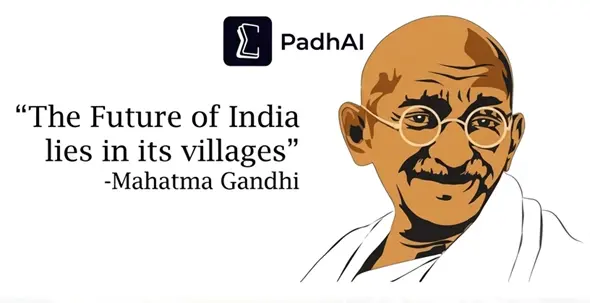
The 73rd Amendment converted that aspiration into Part IX, a justiciable constitutional provision. This is the connection between Gandhi's vision of "Gram Swaraj" (village self-rule) and the legal architecture that National Panchayati Raj Day celebrates. The two ideas travel together: one philosophical, one legal.
Does the 73rd Amendment Apply to All States Equally?
No. The 73rd Amendment does not apply to Nagaland, Meghalaya, or Mizoram. It applies in a modified form to Fifth Schedule areas under the PESA Act, 1996.
These three northeastern states have distinct tribal governance traditions recognised by the Constitution under Articles 371-A (Nagaland) and related provisions. Their customary governance systems were considered adequate and separate from the three-tier panchayat model.
For tribal areas under the Fifth Schedule, covering parts of states like Andhra Pradesh, Chhattisgarh, Jharkhand, Gujarat, and others, Parliament enacted the Panchayats (Extension to Scheduled Areas) Act, 1996, commonly called PESA.
PESA gives Gram Sabhas in these areas extra powers. They can approve land acquisition and manage minor water bodies and minor minerals. They can regulate money lending to tribal communities. PESA is a separate, but an important companion to the 73rd Amendment.
Why Does Panchayati Raj Still Face Problems Despite the 73rd Amendment?
The core problem is that the 73rd Amendment's most important provisions (transferring functions, funds, and functionaries to panchayats) are discretionary, not mandatory, leaving states with little incentive to genuinely share power.
This gap between constitutional intent and ground reality is the most common issue of Panchayati Raj. The three challenges that are crucial are financial weakness, incomplete devolution, and administrative dependence.
On finances: the 15th Finance Commission (2021-26) noted that only 8 states formed their 6th State Finance Commission on time. The deadline was 2019-20. This meant most states did not complete the minimum financial review the Constitution requires.
On devolution, a 2022 report by the Ministry of Panchayati Raj found that fewer than 20% of states had transferred all 29 subjects.
On administration: most panchayats still rely on state-appointed officials for daily work. This reduces their autonomy in practice.
The three tiers are:
Gram Panchayat (village level),
Panchayat Samiti (block level),
Zila Parishad (district level).
This structure is mandated by the 73rd Amendment for all states with a rural population above 2 million. States below that threshold are not required to maintain the intermediate (block) tier and may operate a two-tier system.
Members of the Gram Panchayat are directly elected by voters. Members at the Panchayat Samiti and Zila Parishad levels may be directly or indirectly elected, depending on state law.
The Gram Sabha functions as the foundational democratic institution. It must meet at least twice a year, approve the Gram Panchayat's development plan, and conduct social audits of schemes.
The Gram Sabha is the only institution in India's governance structure that operates as a form of direct democracy.
The Panchayat Advancement Index (PAI) is a composite ranking tool developed by the Ministry of Panchayati Raj to measure how each Gram Panchayat performs across nine development themes aligned with India's Sustainable Development Goals.
PAI 1.0 (FY 2022-23) served as the baseline, covering 2.16 lakh Gram Panchayats across 29 states and union territories.
On National Panchayati Raj Day 2026, the Ministry released the PAI 2.0 Report for FY 2023-24.
PAI 2.0 rationalised the number of indicators from 516 to 147, making data collection more accurate and the rankings more reliable.
The nine themes it measures are:
Poverty alleviation
Health
Education
Water sufficiency
Clean environment
Infrastructure
Governance
Social justice
Women's empowerment
PAI uses 21 data sources and is the government's primary tool for performance-based planning at the village level.
National Panchayat Awards are given every year on National Panchayati Raj Day to recognise high-performing Gram Panchayats, Intermediate Panchayats, and District Panchayats, with cash grants ranging from Rs. 5 lakh to Rs. 50 lakh.
The awards align with the nine LSDG themes and incentivise panchayats to improve their performance on measurable development indicators.
The main award categories are:
Deen Dayal Upadhyaya Panchayat Sashaktikaran Puraskar (DDUPSP) for overall best performance;
Nanaji Deshmukh Rashtriya Gaurav Gram Sabha Puraskar (NDRGGSP) for outstanding Gram Sabha functioning;
Child-Friendly Gram Panchayat Award (CFGPA);
Gram Panchayat Development Plan (GPDP) Award;
e-Panchayat Puraskar, awarded only to states, for progress in digital panchayat governance.
Frequently asked question (FAQs)
What is the theme of National Panchayati Raj Day 2026?
Why is 24th April celebrated as Panchayati Raj Day?
Who declared the first National Panchayati Raj Day?
Who is known as the father of Panchayati Raj?
In which district did Panchayati Raj start?
National Panchayati Raj Day marks the 73rd Constitutional Amendment Act. This Act gave village governance bodies constitutional protection for the first time. The observance itself began in 2010, declared by PM Dr. Manmohan Singh. The 2026 theme is "Sashakt Panchayat, Sarvangeen Vikas," and 2026 marks 33 years of the amendment.






Research methodology
PadhAI's research methodology ensures every article is accurate, UPSC-ready, and beginner-friendly. We curate current affairs analysis based on UPSC exam relevance by cross-referencing The Hindu, Indian Express, and PIB. General Studies (GS) topics are drafted from NCERTs and standard books such as M. Laxmikanth, Spectrum, and GC Leong, then reviewed by subject matter experts to eliminate factual errors. Additionally, we update aspirants with verified government exam notifications alongside expert blogs suggesting the best resources, syllabus, and comprehensive Prelims and Mains strategies.


Gajendra Singh Godara is an IIT Bombay graduate and a UPSC aspirant with 4 attempts, including multiple Prelims and Mains appearances. He specializes in Polity, Modern History, International Relations, and Economy. At PadhAI, Gajendra leverages his firsthand exam experience to simplify complex concepts, creating high-efficiency study materials that help aspirants save time and stay focused.
No comments yet. Be the first to join the discussion!