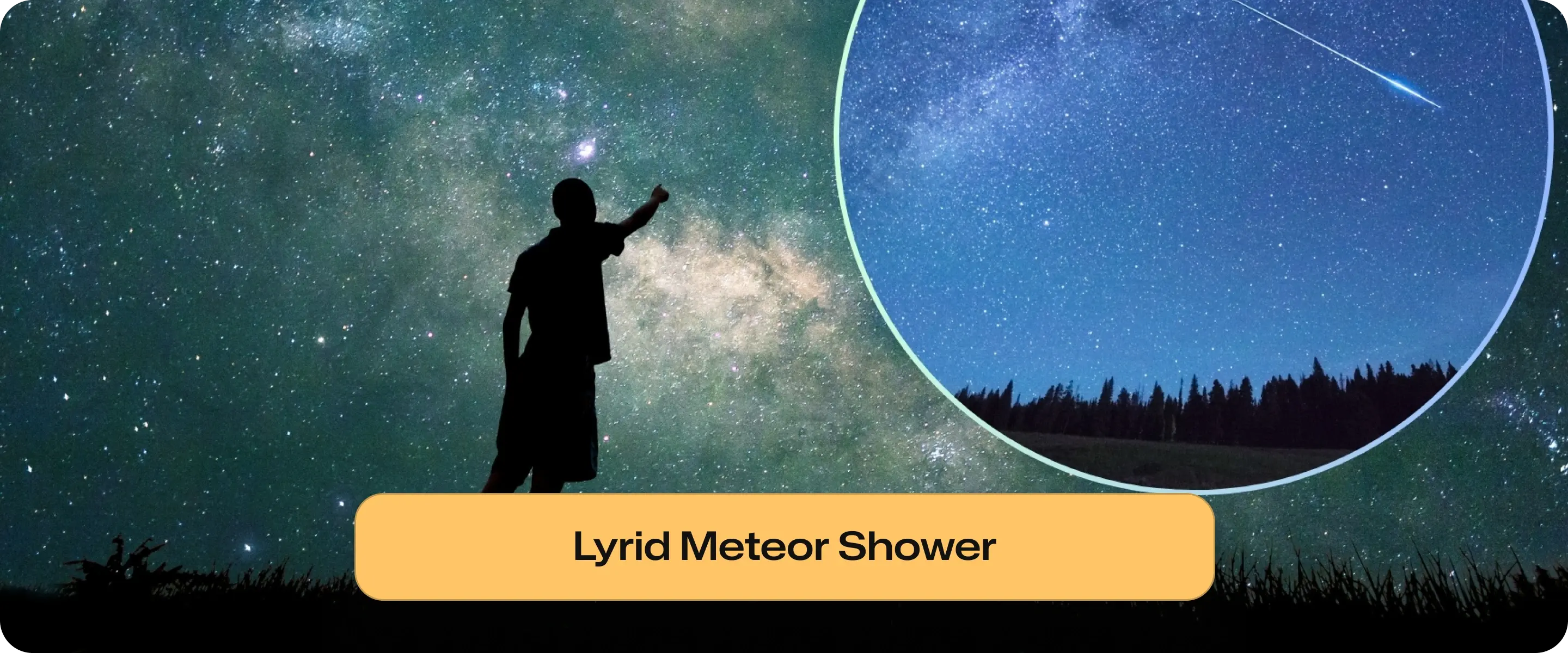
Lyrid Meteor Shower 2026: Peak Dates and Significance
The Lyrid meteor shower is observed every year in April. It is the oldest recorded meteor shower known for bright and fast meteors.

Gajendra Singh Godara
Last updated
4
mins read
Key Highlights:
Peak Dates: April 21-22, 2026
Peak Time: 01:00 AM to 05:00 AM IST
Expected Rate: 15-18 meteors per hour
Parent Body: Comet C/1861 G1 Thatcher
Radiant Point: Lyra Constellation (near Vega)
Historical Record: Oldest recorded shower (since 687 BCE)
Visibility: High (early moonset provides dark skies)
Key Feature: Occasional bright fireballs and glowing trains
Scientific Monitoring: NASA MEO and ISRO NETRA tracking Entry
Velocity: 48 kilometers per second
The Lyrid meteor shower is observed every year in late April characterised by bright and fast moving meteors.
While sky-watchers appreciate the visual display, aspirants should focus on the scientific significance, the composition of meteors, and the role of international space agencies in monitoring near-Earth objects.
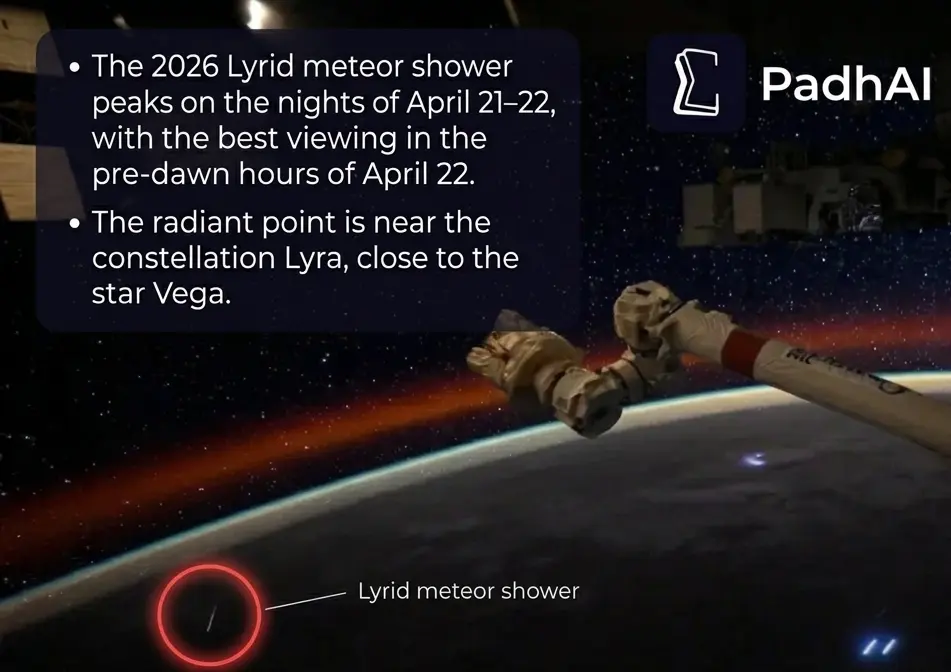
Image: NASA Astronaut Jessica Meir shared a photo of a Lyrid Meteor Streak visible from International Space Station (ISS) on 20 April 2026
The Lyrid meteor shower is currently in the news because its peak activity occurs between April 16 and April 25, 2026.
Astronomers expect the highest visibility during the pre-dawn hours in the Northern Hemisphere.
In 2026, the lunar phase provides a dark sky, which will improve the visibility of the Lyrid showers for observers.
Join our WhatsApp Community
The Lyrids are meteor showers originating from the dusty wake of the long-period comet C/1861 G1 Thatcher.
Meteor showers are named after a star or constellation close to their origin. The Lyrid Meteor shower gets its name from the point of light that comes from the Lyra constellation, which is close to the bright star Vega.
The Lyrid meteor shower is one of the oldest known meteor showers. People have seen it for more than 2,700 years, with the first record coming from China in 687 BCE.
The Lyrids sometimes make bright fireballs, even though the average rate is 18 meteors per hour. These fireballs occur when larger pieces of debris create intense light through friction with atmospheric gases.
Space debris changes its name based on its location relative to Earth.
Meteoroids
They are small rocks that move through space. They can be as small as dust grains or as big as small asteroids. Most meteoroids come from the tails of comets or from asteroids colliding with each other.
Meteor
A meteor is the visible path of a meteoroid that enters Earth's atmosphere. High-speed entry causes the object to heat up and glow. People often refer to these as shooting stars.
Meteorite
A meteorite is a piece of a meteoroid that survives its journey through the atmosphere and hits the ground. Scientists study meteorites to learn more about the early history of the solar system.
Term | Location | State |
Meteoroid | Outer Space | Moving through vacuum |
Meteor | Atmosphere | Burning/Incandescent |
Meteorite | Earth's Surface | Solid remnant |
Data Source: NASA Solar System Exploration (2026)
Add as a preferred Source on Google
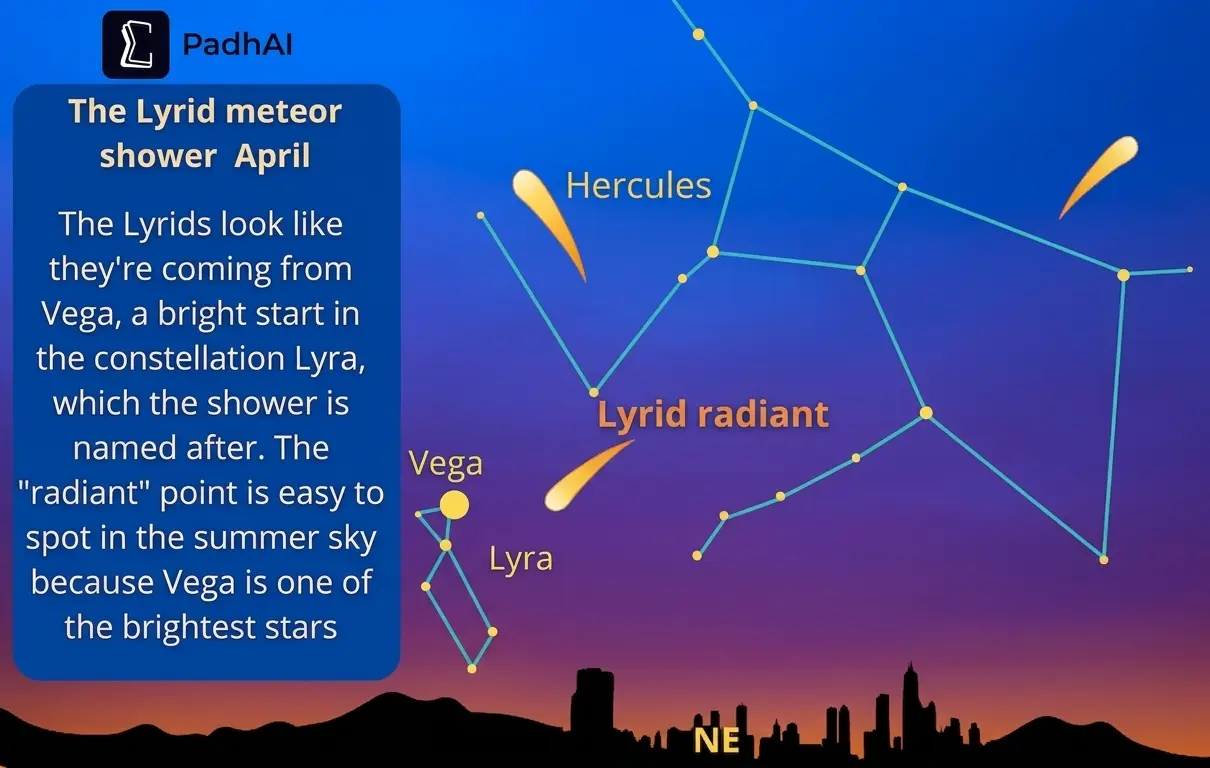
No, the Lyra constellation is not the actual source of the meteor shower. It only serves as the radiant point, which is the point from which the meteors appear to originate.
The actual source is the orbital path of Comet C/1861 G1 Thatcher. It was discovered by and named after A. E. Thatcher.
Space agencies monitor meteor showers to protect their assets in space and do scientific research.
NASA’s Planetary Defense
NASA uses the Meteoroid Environment Office (MEO) to track debris and predict meteor shower intensity.
This data helps engineers protect the International Space Station (ISS) and satellites from high-speed impacts.
NASA’s CAMS (Cameras for Allsky Meteor Surveillance) project traces meteor orbits using cameras.
Technology of ISRO
ISRO runs the NETRA (Network for Space Object Tracking and Analysis) project.
NETRA acts as an early warning system for space debris that might threaten Indian satellites.
The Lyrids are small, but ISRO keeps an eye on bigger Near-Earth Objects (NEOs) to make sure that assets like Gaganyaan are safe.
The Lyrid meteor shower in India will peak on the night of April 22 and the early morning of April 23, 2026.
The best time to see it is between midnight and dawn (01:00 AM to 05:00 AM IST). The moon will set early in the night on April 22, 2026, leaving a dark sky that makes it easier to see fainter meteors.
Looking directly at the radiant makes meteors appear short. Observers should look toward the surrounding sky to see longer, more dramatic streaks.
Frequently asked question (FAQs)
What is the oldest meteor shower in the world?
Can we watch the Lyrid meteor shower in India?
How long does the Lyrid shower last?
How rare is a Lyrid meteor shower?
Where is the best place to watch a meteor shower?
The Lyrid Meteor Shower is a historic event in space history. It is known for its bright meteors and fireballs. The best way to view the meteor shower this year is to find dark areas of sky away from lights and smoke. As viewers get a chance to observe the scientific space phenomenon tracing back 2,700 years ago, it beautifully links the history of humans to the future of space technology. For aspirants, it is relevant for current affairs and science and technology domains.





Research methodology
PadhAI's research methodology ensures every article is accurate, UPSC-ready, and beginner-friendly. We curate current affairs analysis based on UPSC exam relevance by cross-referencing The Hindu, Indian Express, and PIB. General Studies (GS) topics are drafted from NCERTs and standard books such as M. Laxmikanth, Spectrum, and GC Leong, then reviewed by subject matter experts to eliminate factual errors. Additionally, we update aspirants with verified government exam notifications alongside expert blogs suggesting the best resources, syllabus, and comprehensive Prelims and Mains strategies.


Gajendra Singh Godara is an IIT Bombay graduate and a UPSC aspirant with 4 attempts, including multiple Prelims and Mains appearances. He specializes in Polity, Modern History, International Relations, and Economy. At PadhAI, Gajendra leverages his firsthand exam experience to simplify complex concepts, creating high-efficiency study materials that help aspirants save time and stay focused.
No comments yet. Be the first to join the discussion!