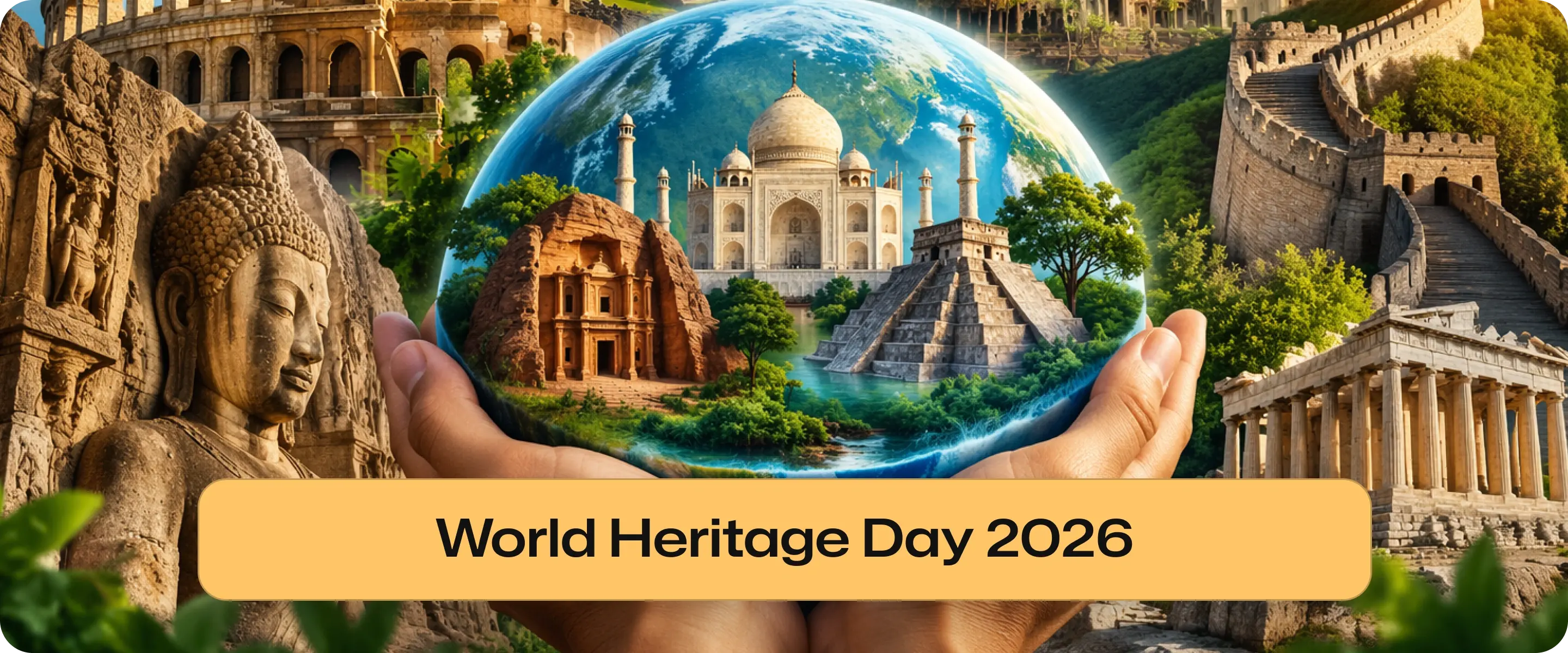
World Heritage Day 2026: Emergency Response for Living Heritage
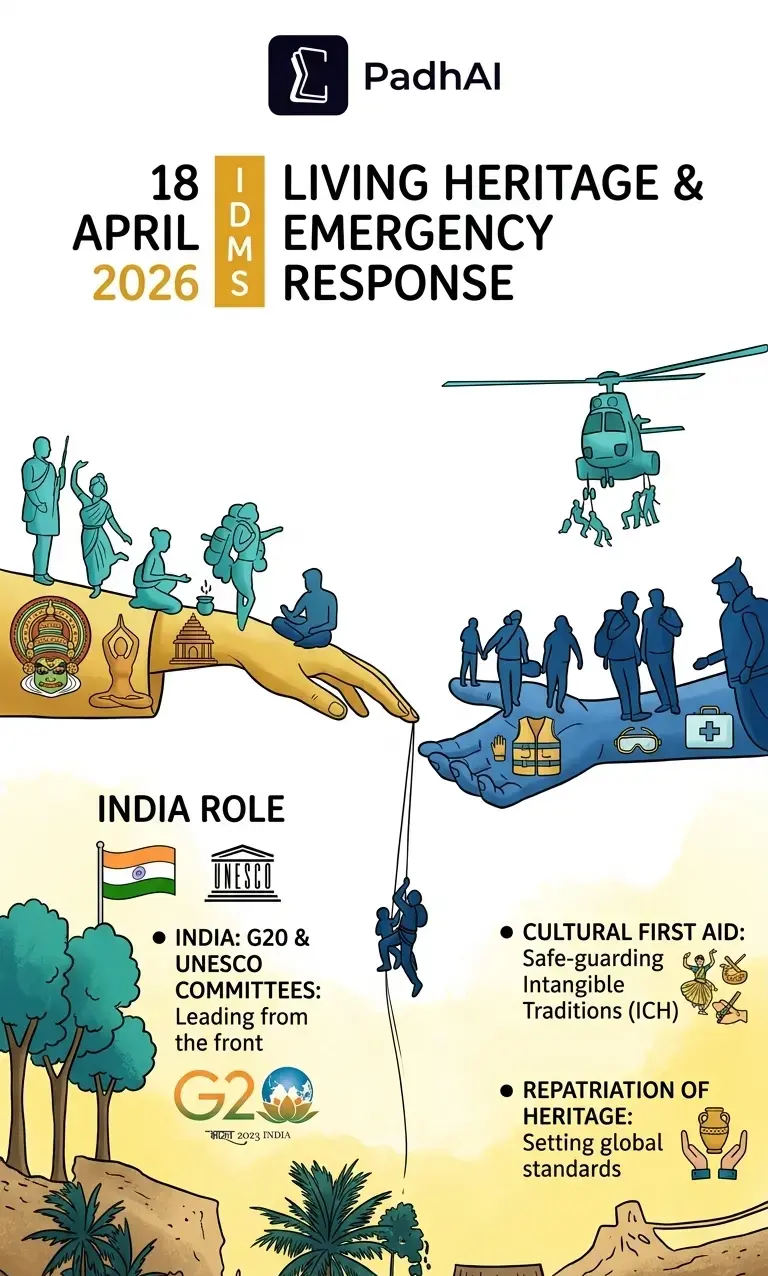
World Heritage Day (April 18) is an international event to celebrate and protect heritage. In 2026, the focus is on "Emergency Response for Living Heritage in Contexts of Conflicts and Disasters” highlighting the need to preserve people and traditions during disasters.

Gajendra Singh Godara
Last updated
11
mins read
Key highlights:
World Heritage Day Date: April 18, 2026.
Also Known As: International Day for Monuments and Sites (IDMS).
Organized by: ICOMOS and UNESCO
2026 Theme: "Emergency Response for Living Heritage in Contexts of Conflicts and Disasters." Part of the ICOMOS Triennial Plan (2024–2027).
Heritage Selection Criteria: Divided into Cultural (i–vi) and Natural (vii–x). A site needs only one to qualify.
Indian heritage sites: 44 UNESCO Sites (36 Cultural, 7 Natural, 1 Mixed).
India’s Global Rank: 6th in total number of UNESCO World heritage sites
Latest Indian Entry to UNESCO list (2025): Maratha Military Landscapes (12 forts showcasing Guerilla warfare strategy).
Milestone: India has retrieved over 650 stolen antiquities, with many returned in 2025.
World Heritage Day is observed every year on 18 April to spread awareness about the global cultural heritage. It is also known as International Day for Monuments and Sites, highlighting the need for preserving historical places that symbolise this diversity. The theme chosen for World Heritage Day 2026 by the International Council on Monuments and Sites (ICOMOS) is “ Emergency Response for Living Heritage in Contexts of Conflicts and Disasters.”
World Heritage Day was created by the International Council on Monuments and Sites (ICOMOS) in 1982 and endorsed by UNESCO in 1983.
It is observed to celebrate the rich cultural global heritage and to raise awareness among institutions, governments and individuals about heritage conservation.
Every year, ICOMOS chooses a theme for this day that reflects the most urgent challenges or opportunities for global heritage. Activities are organised around this theme- ranging from workshops, publications, training programmes, emergency response drills and public events.
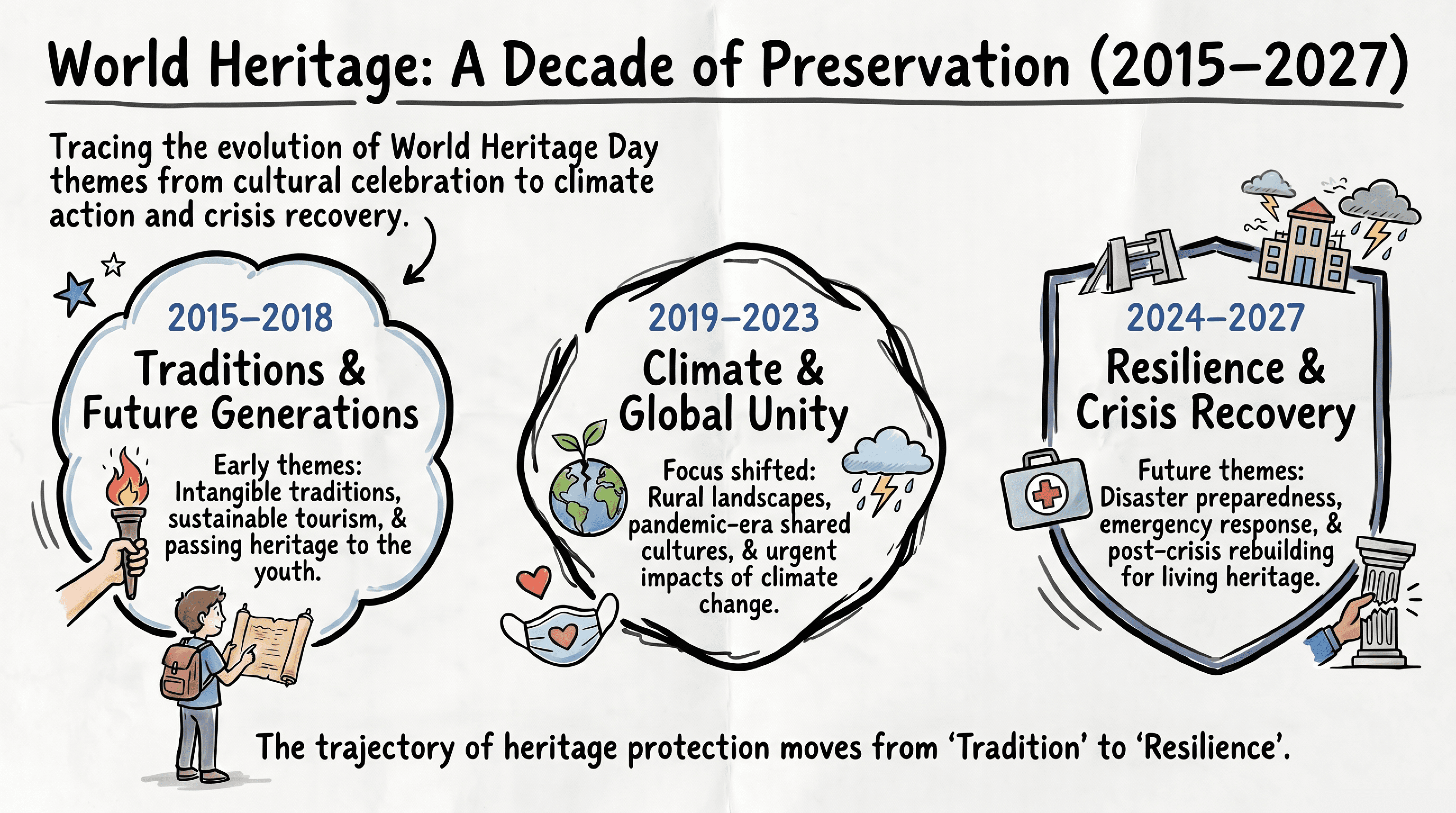
Table: World Heritage Day Themes 2015-2027
Year | Theme | Focus Area |
2027 | Recovery for Living Heritage | Post-crisis rebuilding (Planned) |
2026 | Emergency Response for Living Heritage | Real-time crisis action |
2025 | Heritage at Risk: Preparedness | Prevention and 60 years of ICOMOS |
2024 | Disasters and Conflicts (Venice Charter) | Historical context of protection |
2023 | Heritage Changes | Climate action and transformation |
2022 | Heritage and Climate | Environmental impact on sites |
2021 | Complex Pasts: Diverse Futures | Inclusivity and global narratives |
2020 | Shared Cultures, Shared Heritage | Global unity during the pandemic |
2019 | Rural Landscapes | Agricultural and aquatic heritage |
2018 | Heritage for Generations | Youth and intergenerational transfer |
2017 | Cultural Heritage & Sustainable Tourism | Development and local communities |
2016 | Heritage for the Future | Sustainable preservation |
2015 | The Intangible Heritage of Humanity | Living traditions and folklore |
Join our WhatsApp Community
The theme for World Heritage day 2026 is “Emergency Response for Living Heritage in Contexts of Conflicts and Disasters.” It is part of ICOMOS Triennial Scientific Plan for 2024-2027. The plan has three stages:
2025: Focus was on preparedness. Strategies that governments and communities will use to prevent damage to heritage before disaster strikes.
2026: Focus has shifted to emergency response. Looking at ongoing conflicts and natural disasters, the emphasis is on real-time intervention to preserve heritage.
2027: The next stage will be recovery after the crisis. Plans to rebuild and restore heritage and the communities it represents.
Importance of “Living Heritage”
Living Heritage includes cultural practices, traditions, language and knowledge that define a community and are passed down to future generations.
The 2026 theme acknowledges that culture dies when people are displaced. When a community is forced to flee a conflict zone (like the recent West Asia tensions) or a disaster zone (like the Wayanad landslides), they leave behind their tools, rituals, and communal spaces.
Therefore the goal this year is ensuring that “emergency response” includes saving the people who carry the knowledge and the practices that give them identity.
Heritage is a collection of tangible (buildings, monuments, artifacts, landscapes and books) and intangible (folklore, traditions, language, knowledge) legacy of a group or society that is inherited from past generations.
UNESCO and ICOMOS categorise heritage into broadly these types:
Cultural Heritage
Natural Heritage
Mixed Heritage
Digital Heritage
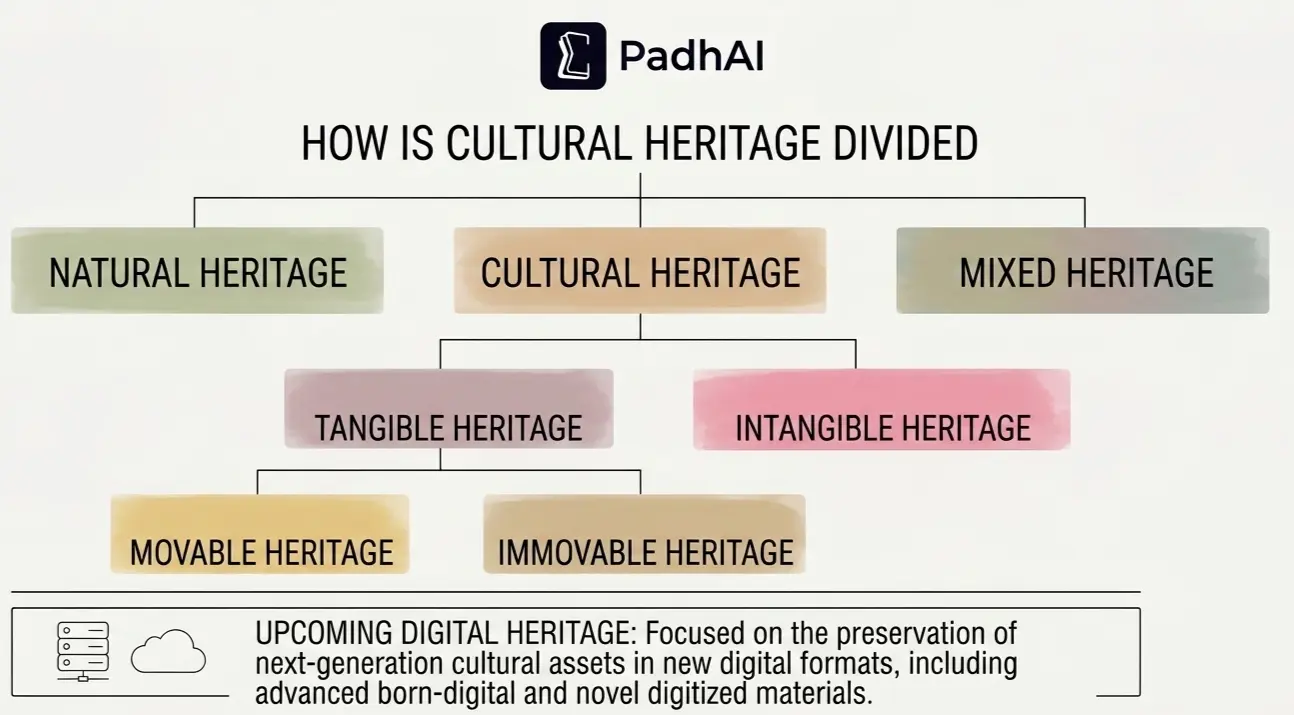
Cultural Heritage
Cultural Heritage is the physical record of human history and the living traditions of past generations. It is further divided into
A) Tangible Heritage: Tangible cultural heritage is physical artifacts and locations. It includes:
Movable: Artifacts like paintings, coins, sculptures, manuscripts and traditional clothing
Indian Examples:
Paintings: The Pahari or Mughal miniatures found in the National Museum.
Sculptures: The "Dancing Girl" bronze statue from the Indus Valley Civilization.
Manuscripts: The ancient Birch-bark manuscripts of Kashmir or the Palm-leaf manuscripts of Odisha.
Coins: Gold dinars from the Gupta Empire (often called the Golden Age).
Immovable: Large structures like monuments, historical sites, ancient cities, etc.
Indian Examples:
Monuments: The Taj Mahal (Agra) or Agra Fort.
Archaeological Sites: The Harappan city of Dholavira in Gujarat.
Historic Cities: Ahmedabad (India’s first UNESCO Heritage City) or the pink city of Jaipur.
Industrial Sites: The Mountain Railways of India (Darjeeling, Nilgiri, and Kalka-Shimla).
Underwater: Shipwrecks, underwater ruins and caves.
Indian Examples:
Submerged Cities: The archaeological ruins of Dwarka off the coast of Gujarat, where remains of walls and structures have been found underwater.
Shipwrecks: Ancient merchant shipwrecks found near the Lakshadweep Islands and the coast of Odisha.
B) Intangible Heritage: Non-physical traditions and living expressions of culture like oral traditions, performing arts, rituals, festivals and craftsmanship. The 2026 theme focuses on preservation of “Living heritage” that comes under this.
Indian examples:
Deepavali (Diwali): Officially added in late 2025 as a global symbol of the victory of light over darkness.
Garba of Gujarat: dance performed during Navratri.
Yoga: Ancient wellness tradition
Durga Puja in Kolkata: Massive art and street festival
Vedic Chanting: ancient oral tradition
Natural Heritage
Natural heritage includes biodiversity, ecosystems and geological formations that have scientific, environmental or aesthetic importance.
Indian Examples:
Kaziranga National Park (Assam): Famous for the one-horned rhinoceros.
The Sundarbans (West Bengal): World’s largest mangrove forest and home to the Royal Bengal Tiger.
Western Ghats: Recognized as one of the world's eight "hottest hotspots" of biological diversity.
Great Himalayan National Park (Himachal Pradesh): Known for its high-altitude alpine meadows and glaciers.
Mixed Heritage
Mixed Heritage consists of sites that have cultural and natural significance both.
Indian Example: Khangchendzonga National Park in India is a Mixed Site because it contains unique biodiversity (Natural) and is also a sacred landscape for local indigenous communities (Cultural).
Digital Heritage
A new category involving resources that are "born digital" (created only in digital form) or physical heritage that has been digitized for preservation (like 3D scans of monuments at risk).
Add as a preferred Source on Google
Since 2005, UNESCO has used a set of ten criteria, divided between Cultural and Natural values.
Cultural Criteria (i – vi)
(i) Masterpiece: Represents a masterpiece of human creative genius (e.g., Taj Mahal).
(ii) Interchange of Values: Exhibits an important interchange of human values over time or within a cultural area, specifically in architecture, technology, or town planning.
(iii) Unique Testimony: Bears a unique or exceptional testimony to a cultural tradition or a civilization (living or extinct).
(iv) Historical Typology: Is an outstanding example of a building, architectural ensemble, or landscape that illustrates significant stages in human history.
(v) Human Settlement: Is an outstanding example of traditional human settlement or land/sea use, especially those vulnerable to irreversible change (e.g., Dholavira).
(vi) Associations: Is directly associated with events, living traditions, ideas, beliefs, or artistic works of universal significance.
Natural Criteria (vii – x)
(vii) Natural Beauty: Contains superlative natural phenomena or areas of exceptional natural beauty.
(viii) Earth’s History: Represents major stages of Earth’s history, including the record of life or significant geological processes.
(ix) Ecological Processes: Represents significant ongoing ecological and biological processes in the evolution of ecosystems.
(x) Biodiversity: Contains the most important habitats for in-situ conservation of biological diversity, including threatened species
The 3 Pillars
Meeting one of the 10 criteria is not enough. A site must satisfy the "Three Pillars" to be successfully listed:
Outstanding Universal Value (OUV): Must meet at least one of the 10 criteria.
Integrity and/or Authenticity:
Integrity: the site should include all elements necessary to express its value.
Authenticity: (Cultural sites only) the materials, design, and setting should be genuine.
Protection and Management: The site must have a legal management plan in place to ensure it survives for future generations (e.g., buffer zones, conservation laws).
With a record number of heritage sites and a leading voice in heritage preservation, India has a significant standing in the sphere of global heritage.
First milestones: India ratified the World Heritage Convention in 1977 and received its first inscriptions in 1983- Ajanta Caves, Ellora Caves, Agra Fort and Taj Mahal
Global ranking: India ranks 6th in the world for total number of UNESCO World Heritage Sites after Italy, China, Germany, France and Spain
Number of UNESCO sites: As of 2026, India has 44 UNESCO World Heritage Sites (36 Cultural, 7 Natural, and 1 Mixed)
International milestone: India is currently serving as a member of UNESCO Intergovernmental Committee for the Safeguarding of Intangible Cultural Heritage (2022–2026). As a part of this committee, India will contribute to the 2026 theme focusing on “Living Heritage.”
Antiquity Retrieval: India has successfully brought back 650 stolen antiquities from foreign countries. Majority of them have been returned in the last year.
Heritage Conservation body: In India, the Archaeological Survey of India (ASI) is the leading organisation for heritage conservation. They typically announce free entry to all protected monuments (like the Taj Mahal or Red Fort) and host local site-specific exhibitions.
Public-private partnership: The Archaeological Survey of India’s “Must-see” portal and “Adopt a Heritage 2.0” programme have enabled heritage conservation to be a mix of public and private initiatives- with individuals being encouraged to take “ownership” of local monuments.
Celebration: Uttar Pradesh Tourism has launched campaigns like "Heritage Through My Lens" and "Share Your Personal Treasure" to encourage public engagement with local heritage in 2026.
Table: Total World Heritage Sites in India
S.No | Site Name | State | Year | Category | Key Facts |
44 | MH, TN | 2025 | Cultural | 12 forts (Shivneri, Raigad, Gingee, etc.); reflects Maratha military strategy & "Guerilla Warfare" (17th–19th C). | |
43 | Moidams (Ahom Burial System) | Assam | 2024 | Cultural | Pyramid-like mound burials of the Ahom dynasty in Charaideo; often called the "Pyramids of Assam." |
42 | Sacred Ensembles of Hoysalas | Karnataka | 2023 | Cultural | Belur, Halebidu, & Somanathapur; Soapstone temples; known for the unique Stellate (Star-shaped) plan. |
41 | Santiniketan | WB | 2023 | Cultural | Founded by Maharshi Debendranath Tagore; transformed by Rabindranath Tagore into a global university. |
40 | Dholavira | Gujarat | 2021 | Cultural | Harappan city (Indus Valley); unique for its water management (reservoirs) and triple-fortification layout. |
39 | Ramappa Temple | Telangana | 2021 | Cultural | Kakatiya dynasty; "Floating bricks" used in the shikhara; only Indian temple named after its architect (Ramappa). |
38 | Jaipur City | Rajasthan | 2019 | Cultural | Founded by Sawai Jai Singh II; first planned city of Medieval India; Gridiron plan based on Vastu Shastra. |
37 | Victorian & Art Deco Ensemble | Maharashtra | 2018 | Cultural | Mumbai’s 19th-C Victorian Neo-Gothic & 20th-C Art Deco buildings (Marine Drive) around the Oval Maidan. |
36 | Ahmedabad Historic City | Gujarat | 2017 | Cultural | First Indian heritage city; known for the "Pol" (residential clusters) and Indo-Islamic architecture. |
35 | Le Corbusier Architecture | Chandigarh | 2016 | Cultural | Capitol Complex; Modernist movement contribution; "The Open Hand" monument. |
34 | Nalanda Mahavihara | Bihar | 2016 | Cultural | Ancient Buddhist university (5th–12th C); supported by Gupta and Pala empires; Xuanzang studied here. |
33 | Khangchendzonga NP | Sikkim | 2016 | Mixed | India’s only Mixed Site; Sacred for Buddhists (Beyul); home to Snow Leopard and Red Panda. |
32 | Rani-ki-Vav | Gujarat | 2014 | Cultural | Maru-Gurjara style stepwell on the banks of Saraswati; built by Queen Udayamati (Solanki dynasty). |
31 | Great Himalayan NP | HP | 2014 | Natural | High-altitude ecosystem; protects the Western Tragopan (state bird of HP). |
30 | Hill Forts of Rajasthan | Rajasthan | 2013 | Cultural | Chittorgarh, Kumbhalgarh, Ranthambore, Gagron, Amber, Jaisalmer; Rajput military-defensive architecture. |
29 | Western Ghats | Multiple | 2012 | Natural | Global biodiversity hotspot; serial site across MH, Goa, KA, KL, TN. Older than the Himalayas. |
28 | Jantar Mantar | Rajasthan | 2010 | Cultural | Astronomical observatory built by Jai Singh II; includes the world's largest stone sundial (Samrat Yantra). |
27 | Red Fort Complex | Delhi | 2007 | Cultural | Built by Shah Jahan; transition from red sandstone to marble; Indo-Islamic and Persian influence. |
26 | Champaner-Pavagarh Park | Gujarat | 2004 | Cultural | Unchanged pre-Mughal Islamic city; confluence of Hindu-Muslim architecture; Kalika Mata Temple. |
25 | Chhatrapati Shivaji Terminus | Maharashtra | 2004 | Cultural | Formerly Victoria Terminus; Victorian Italianate Gothic Revival architecture (F.W. Stevens). |
24 | Rock Shelters of Bhimbetka | MP | 2003 | Cultural | Mesolithic rock paintings; earliest traces of human life in India; discovered by V.S. Wakankar. |
23 | Mahabodhi Temple | Bihar | 2002 | Cultural | Built by Ashoka; location where Buddha attained Enlightenment; brick architecture. |
22 | Mountain Railways | WB/TN/HP | 1999 | Cultural | Darjeeling, Nilgiri, and Kalka-Shimla; colonial-era engineering to connect plains to hills. |
21 | Humayun’s Tomb | Delhi | 1993 | Cultural | First Mughal Garden-Tomb (Charbagh); prototype for the Taj Mahal; Persian-inspired double dome. |
20 | Qutub Minar & Monuments | Delhi | 1993 | Cultural | Tallest brick minaret; started by Aibak, finished by Iltutmish; houses the Gupta-era Iron Pillar. |
19 | Sanchi Stupa | MP | 1989 | Cultural | Oldest stone structures in India; Toranas (gateways) depicting Jataka tales; Ashokan lion capital. |
18 | Nanda Devi & Valley of Flowers | Uttarakhand | 1988 | Natural | Trans-Himalayan transition zone; Nanda Devi is the 2nd highest peak in India. |
17 | Elephanta Caves | Maharashtra | 1987 | Cultural | Dedicated to Lord Shiva; Trimurti sculpture; Konkan Maurya and Rashtrakuta connection. |
16 | Pattadakal Monuments | Karnataka | 1987 | Cultural | Chalukya dynasty; Vesara style (blend of Nagara and Dravida); site of royal coronations. |
15 | Sundarbans NP | WB | 1987 | Natural | World's largest estuarine mangrove forest; Royal Bengal Tiger habitat. |
14 | Great Living Chola Temples | Tamil Nadu | 1987 | Cultural | Thanjavur, Gangaikondacholapuram, & Darasuram; Zenith of Dravidian architecture. |
13 | Churches of Goa | Goa | 1986 | Cultural | "Rome of the East"; Basilica of Bom Jesus (stalls of St. Francis Xavier); Portuguese influence. |
12 | Fatehpur Sikri | UP | 1986 | Cultural | Akbar's planned city; Buland Darwaza (victory over Gujarat); blend of Hindu and Persian styles. |
11 | Hampi Group of Monuments | Karnataka | 1986 | Cultural | Capital of Vijayanagara Empire; Dravidian style; Vitthala temple’s musical pillars. |
10 | Khajuraho Monuments | MP | 1986 | Cultural | Chandela dynasty; Nagara style; famous for erotic sculptures and Panchayatana plan. |
9 | Manas Wildlife Sanctuary | Assam | 1985 | Natural | Located on the Manas River; Tiger, Rhino, and Elephant reserve; Project Tiger site. |
8 | Kaziranga NP | Assam | 1985 | Natural | World's highest population of the One-horned Rhinoceros; 1:1 conservation success story. |
7 | Keoladeo NP | Rajasthan | 1985 | Natural | Formerly Bharatpur Bird Sanctuary; man-made wetland; critical for migratory Siberian Cranes. |
6 | Sun Temple, Konark | Odisha | 1984 | Cultural | Chariot-shaped temple (Kalinga architecture); built by Narasimhadeva I (Eastern Ganga dynasty). |
5 | Mahabalipuram Monuments | Tamil Nadu | 1984 | Cultural | Pallava dynasty; Rathas (monolithic temples), Shore Temple, and "Descent of the Ganges" relief. |
4 | Agra Fort | UP | 1983 | Cultural | Seat of Mughal power; red sandstone walls; Jahangiri Mahal and Moti Masjid. |
3 | Ajanta Caves | Maharashtra | 1983 | Cultural | 30 rock-cut Buddhist caves; Fresco paintings (Padmapani & Vajrapani); Hinayana & Mahayana phases. |
2 | Ellora Caves | Maharashtra | 1983 | Cultural | 34 caves (Buddhist, Hindu, Jain); Kailasa Temple (Cave 16) is the largest monolithic excavation. |
1 | Taj Mahal | UP | 1983 | Cultural | Indo-Islamic masterpiece by Shah Jahan; Pietra Dura (stone inlay) work; symmetrical marble tomb. |
[Prelims 2021]
With reference to Chausath Yogini Temple situated near Morena, consider the following statements:
It is a circular temple built during the reign of the Kachchhapaghata dynasty.
It is the only circular temple built in India.
It was meant to promote the Vaishnava cult in the region.
Its design has given rise to a popular belief that it was the inspiration behind the Indian Parliament building.
Which of the statements given above are correct?
(a) 1 and 4 only
(b) 2, 3 and 4 only
(c) 1, 2 and 3 only
(d) 1, 2, 3 and 4
Answer: (a) 1 and 4 only
[Mains 2023] GS Paper-I (Culture)
"Explain the main features of the Hoysala architecture with special reference to the Sacred Ensembles of the Hoysalas inscribed in the UNESCO World Heritage List." (150 words, 10 marks)
[Prelims 2017]
Which of the following is/are famous for Sun temples?
Arasavalli
Amarakantak
Omkareshwar
Select the correct answer using the code given below: (a) 1 only (b) 2 and 3 only (c) 1 and 3 only (d) 1, 2 and 3
Answer: (a) 1 only
[Prelims 2014]
With reference to the cultural history of India, the term 'Panchayatana' refers to:
(a) An assembly of village elders
(b) A religious sect
(c) A style of temple construction
(d) An administrative functionary
Answer: (c) A style of temple construction.
Note: This is highly relevant to UNESCO sites like Khajuraho, which follow this specific layout (a central shrine surrounded by four smaller subsidiary shrines).
As we celebrate World Heritage Day 2026, it is a reminder that heritage requires active preservation especially in uncertain times. The vast heritage of India has survived centuries in various forms and it is important that it continues to thrive in future on a global scale. On April 18- visit a site, learn about a tradition, and take part in protecting the legacy that defines our past and inspires our future.






Research methodology
PadhAI's research methodology ensures every article is accurate, UPSC-ready, and beginner-friendly. We curate current affairs analysis based on UPSC exam relevance by cross-referencing The Hindu, Indian Express, and PIB. General Studies (GS) topics are drafted from NCERTs and standard books such as M. Laxmikanth, Spectrum, and GC Leong, then reviewed by subject matter experts to eliminate factual errors. Additionally, we update aspirants with verified government exam notifications alongside expert blogs suggesting the best resources, syllabus, and comprehensive Prelims and Mains strategies.


Gajendra Singh Godara is an IIT Bombay graduate and a UPSC aspirant with 4 attempts, including multiple Prelims and Mains appearances. He specializes in Polity, Modern History, International Relations, and Economy. At PadhAI, Gajendra leverages his firsthand exam experience to simplify complex concepts, creating high-efficiency study materials that help aspirants save time and stay focused.
No comments yet. Be the first to join the discussion!