PadhAi guide to the Chalukya Dynasty- the Deccan powerhouses. From the boar emblem to the rock-cut caves of Badami, PadhAi experts provide the UPSC-ready breakdown.

Gajendra Singh Godara
Last updated
12
mins read
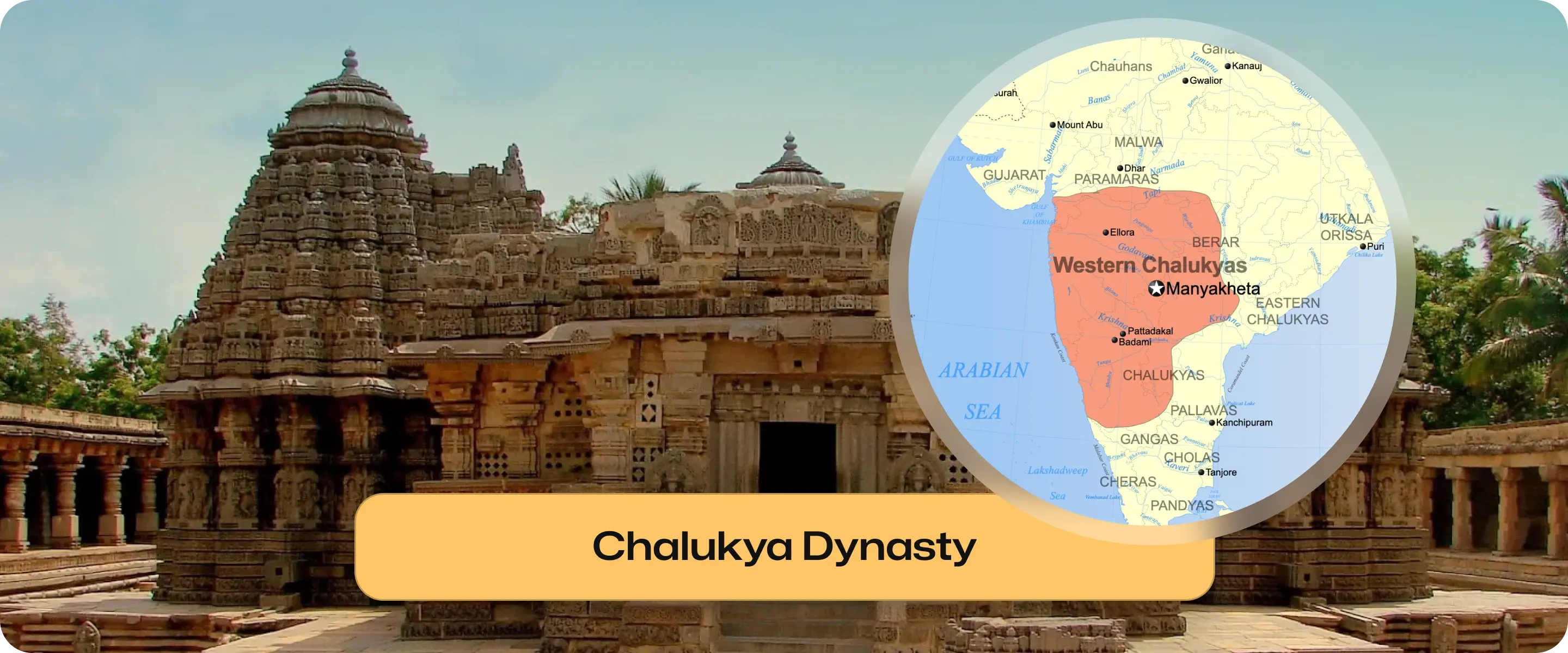
The Chalukya Dynasty was a dominant power in southern and central India between the 6th and 12th centuries. They originated in the Deccan region.
The dynasty played a critical role in Indian history by halting the southward expansion of northern empires. They also pioneered a unique style of temple architecture that influenced the entire Indian subcontinent.
This guide covers the full history of the Chalukyas. It spans from their founding at Vatapi to the eventual rise of the Rashtrakutas and the later revival at Kalyani. UPSC aspirants find this era vital for both Prelims and Mains GS-1. This article provides a one-stop reference for all three branches of the empire.
Key Highlights
Founder: Pulakesi I (543 CE) established the core of the empire at the strategic capital of Vatapi.
Military Legend: Pulakesi II famously defeated northern Emperor Harsha Vardhana at the Narmada River in 618 CE.
Artistic Pioneers: Developed the Vesara style of architecture. They blended northern and southern traditions in masterpieces like the Badami Cave Temples.
The Boar Emblem: Adopted the Varaha (boar) as their royal symbol. It signified their role as protectors of the earth.
The Three Branches: The dynasty flourished through the Badami, Eastern (Vengi), and Western (Kalyani) lineages.
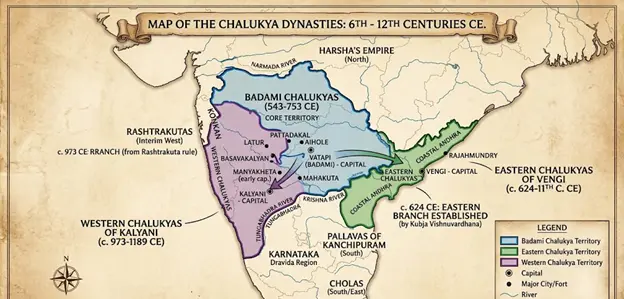
The Chalukya Dynasty refers to a lineage of Indian rulers. They governed the Deccan plateau for several centuries. They are famous for their military victories.
The Chalukyas also contributed the Vesara style of architecture to Indian history.
The dynasty operated through three distinct branches:
Badami Chalukyas,
Eastern Chalukyas,
Western Chalukyas.
They established a standard for political stability in South India after the Vakatakas.
Quick Facts Table
Metric | Quick Fact
|
|---|---|
Period | 543 CE – 1189 CE |
Founder | Pulakesi I |
Primary Capitals | Vatapi (Badami), Vengi, Kalyani |
Primary Religions | Shaivism, Vaishnavism, Jainism |
Official Languages | Sanskrit, Old Kannada, Telugu |
Royal Emblem | Varaha (Boar) |
Government | Monarchy with a feudal administrative structure |
Join our WhatsApp Community
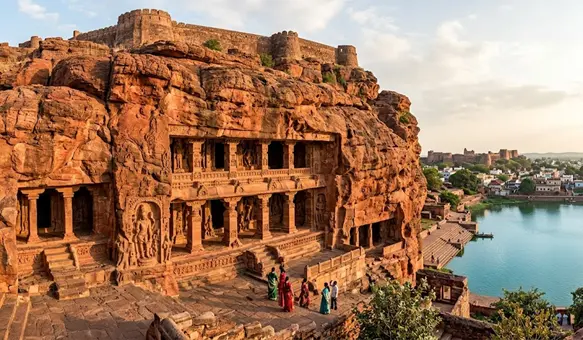
Pulakesi I: The Architect of the Chalukya Kingdom (543–566 CE)
Pulakesi I founded the Chalukya Dynasty in 543 CE. He was a local chieftain who transformed his small territory into a sovereign kingdom. He established his capital at Vatapi. This city is modern-day Badami in the Bagalkot district of Karnataka.
Pulakesi I was the son of Ranaraga. He was the grandson of Jayasimha. Pulakesi I performed several royal rituals to legitimize his rule:
He conducted the Ashvamedha (Horse Sacrifice) ritual.
He also performed the Hiranyagarbha ceremony.
These rituals placed the Chalukyas on the same political level as the established dynasties of northern India. He claimed the title Satyashraya which means the abode of truth.
Why Was the Founding of Vatapi Significant?
Vatapi served as a strategic military base:
The city is located within red sandstone cliffs. These cliffs provided a natural fortification.
The Agastya Lake provided a steady water source for the capital.
The choice of Vatapi allowed the Chalukyas to control the trade routes between the northern and southern parts of the Deccan. It sat near the Malaprabha River.
The site was historically part of the Kadamba kingdom before the Chalukyas gained independence.
The Chalukya era spanned over 600 years through its different branches:
The Badami Chalukyas ruled from 543 CE to 753 CE. The
Eastern Chalukyas emerged around 624 CE. They lasted until the 11th century.
The Western Chalukyas revived the lineage in 973 CE. They ruled until 1189 CE.
This long duration makes them one of the most enduring powers in the history of the Deccan.
Add as a preferred Source on Google
The dynasty functioned through three major geopolitical branches. Each branch maintained its own administration and capital.
Chalukya Branches Table
Branch | Capital | Period | Region Controlled
|
|---|---|---|---|
Badami Chalukyas | Vatapi | 543–753 CE | Northern Karnataka, Maharashtra |
Eastern Chalukyas | Vengi | 624–11th Century | Coastal Andhra Pradesh |
Western Chalukyas | Kalyani | 973–1189 CE | Deccan Plateau, Central India |
Badami Chalukyas (543–753 CE)
This is the founding branch:
They are the most studied branch in the UPSC syllabus.
They built the famous cave temples at Badami.
They created the temple complexes at Aihole and Pattadakal. This branch unified the Deccan for the first time under a single central authority.
Eastern Chalukyas of Vengi (624–11th Century CE)
Pulakesi II appointed his brother, Kubja Vishnuvardhana, as the governor of the Vengi region.
Vishnuvardhana eventually declared independence.
This branch focused on the development of the Telugu language and literature.
They became closely linked with the Cholas through marriage.
Western Chalukyas of Kalyani (973–1189 CE)
Tailapa II overthrew the Rashtrakutas in 973 CE.
He established the Western Chalukya Empire.
Their capital was at Kalyani. This branch reached its peak under Vikramaditya VI.
They are often called the Later Chalukyas.
Badami Chalukya Rulers
Badami Rulers Table
Ruler | Reign (CE) | Key Contributions
|
|---|---|---|
Pulakesi I | 543–566 | Founder; established Vatapi; performed Ashvamedha. |
Kirtivarman I | 566–597 | Expanded kingdom to Konkan and Goa; defeated Mauryas of Konkan |
Mangalesha | 597–609 | Patronized Badami Cave 3; expanded territory into Gujarat. |
Pulakesi II | 609–642 | Greatest King; defeated Harsha; received Xuanzang. |
Vikramaditya I | 655–680 | Restored the kingdom after the Pallava occupation. |
Vinayaditya | 680–696 | Campaigned against northern rulers; maintained peace. |
Vijayaditya | 696–733 | Longest reign (37 years); built many temples. |
Vikramaditya II | 733–745 | Defeated the Pallavas thrice; patron of Pattadakal. |
Kirtivarman II | 745–753 | Last Badami ruler; overthrown by the Rashtrakutas. |
Western Chalukya Rulers
Western Rulers Table
Ruler | Reign (CE) | Key Notes
|
|---|---|---|
Tailapa II | 973–997 | Re-established the dynasty; defeated Rashtrakutas. |
Someshvara I | 1042–1068 | Shifted capital from Manyakheta to Kalyani. |
Vikramaditya VI | 1076–1126 | The greatest Western ruler who started the Chalukya-Vikrama era. |
Tailapa III | 1151–1164 | Faced rebellions; power of the empire declined. |
Kirtivarman II and the Rashtrakuta Overthrow (753 CE)
Kirtivarman II was the last ruler of the Badami Chalukya line. He lacked the military strength of his predecessors.
His feudatory, Dantidurga, led a rebellion. Dantidurga defeated Kirtivarman II in 753 CE. This victory led to the rise of the Rashtrakuta Empire.
The defeat marked the end of the first phase of Chalukya rule. Kirtivarman II had previously campaigned in the Pallava kingdom. He failed to sustain the empire against internal revolts.
End of Western Chalukyas
The Western Chalukya Empire ended around 1189 CE.
Tailapa III was a weak ruler.
The Kalachuris and other feudatories declared independence.
The Hoysalas and the Yadavas eventually divided the remnants of the Western Chalukya territory.
Someshvara IV attempted to recover the kingdom. He eventually lost to the Seuna (Yadava) rulers.
Vatapi was the political and cultural heart of the early Chalukyas.
It is located in the Bagalkot district of Karnataka.
The site features high sandstone cliffs on three sides.
Pulakesi I recognized the military advantage of this terrain. He fortified the hill in 543-44 CE. Vatapi became a center for art.
The kings commissioned four large rock-cut cave temples here. These caves contain detailed sculptures of Hindu and Jain deities.
The city also served as a hub for the Chalukya administrative network. Modern archaeological surveys identify it as a plateau kingdom.
Water management was critical in this location.
The Chalukyas chose the Varaha (boar) as their royal symbol. This choice reflects their religious affiliation with Vaishnavism.
The Varaha avatar represents Lord Vishnu saving the earth from the ocean. The emblem appears on royal seals. It is visible on copper plate grants.
It is carved on temple walls. The use of the Varaha symbol demonstrated the King's role as a protector.
It differentiated the Chalukyas from their rivals. Some rulers used variations of a lion emblem.
The boar remained the most prominent symbol of the dynasty. This emblem influenced the later Vijayanagara Empire.
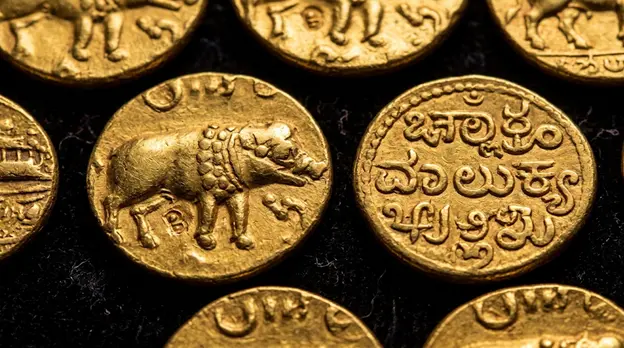
The Chalukya economy was prosperous.
The kings issued gold, silver, and copper coins. The gold coins were known as Pagodas or Gadyanas. Most coins featured the Varaha emblem on the front side. The flip side was often blank.
The coins reveal the dynasty's involvement in trade. They contain inscriptions in the Old Kannada script. Nagari script was also used.
These inscriptions often mention the name of the reigning king. They include his royal titles.
The high quality of the gold coinage indicates a stable financial system. It shows active maritime trade with foreign regions.
Western Chalukya coins also featured temples or lions.
Eastern Chalukyan coins displayed a boar insignia in the center.
The Chalukyas made a lasting impact on Indian architecture. They created the Vesara style which is a hybrid.
It combines the northern Nagara style with the southern Dravida style. This innovation is a hallmark of Deccan architecture.
Comparison table: Nagara vs Dravidian style:
Feature | Nagara | Dravidian |
Tower Form | Curvilinear Shikhara | Stepped pyramid |
Ground | Square | Square |
Pillars | Square or octagonal, plain | Monolithic, plain |
Wall treatment | Moderate sculpture in niches | Profuse niches with icons |
Base mouldings | Simple | Complex dravidian adhistana |
Adopted by | Rajput temples, Odisha | Chola, Vijayanagar |
Art historian Percy Brown defined Versara style as - a conscious synthesis that takes the curvilinear tower (shikhara) from the Nagara traditions of northern India and places it on the horizontal base mouldings (adhistana) and sculptural wall treatment of the Dravidian style.
Versara style is
Hybrid- partly curvilinear and partly stepped
Square/octagonal/stellate
Carved with figurines
Dense sculptural bands across the exterior
Dravidian base with Naga superstructure.
There are 4 main caves at Badami.
Cave 3 is the largest cave in Badami Cave Temples. It has a dated inscription from 578 CE.
The caves follow a specific spatial plan. This plan includes an open veranda (mukhamandapa). It includes a pillared hall (mandapa).
It includes a small inner sanctum (garbhagriha). The sculpture program covers 18 distinct panel scenes in Cave 3.
These caves represent the transition from wooden prototypes to stone construction.
Aihole contains over 125 temples.
It is known as the cradle of Indian temple architecture.
Architects here experimented with different designs using various materials.
Famous structures include the Durga Temple which has a semi-circular apsidal back. The Lad Khan Temple is another example.
These temples date between the 5th and 8th centuries CE.
Aihole temples are exceptional because of the variance of styles teste by craftsmen there. Temple architechture moved from wooden prototypes to permanent stone structures on a sustained, experimental basis.
Flat roofed assembly halls derived from timber construction, apsidal plans derived from Buddhist chaitayas, early curvilinear Nagara towers, Pyramid-form Dravidian vimanas and stellate (star-shaped plans).
No other indian site preserves this range of early medieval architechtural experimentation in one place.
Table: Important temples at Aihole
Temple Name | Key facts |
Durga temple | Apsidal plan derived from Buddhist chaitya halls; external colonnade wraps the shrine; named after the local Kannada word “durga”; structurally unique temple |
Lad Khan Temple | Among India's earliest surviving structural stone temples; flat roofed with square columns; derived from timber assembly hall (Sabha mandapa) |
Meguti Jain Temple | Only datable temple at Aihole; Aihole prasati is carved here (celebrating victory over Harsha); the Prasasti is a primary source for Chaluky Dynasty |
Huchappaya Temple | One of the earliest curvilinear Nagara Shikharas (towers) in Karnataka. Direct evidence that Chalukya craftsmen studied and adapted to north indian architectural forms |
Rvanphadi cave | Rock cut shrine at Aihole with a nataraja panel closely related to Badami Cave I. Confirms that rock-cut structural temple programmes shared a single chalukya workshop and master craftsmen traditions |
Galagantha temple | Represents the mature Vesara synthesis and curvilinear Nagara Tower as Dravidian base mouldings. The same formula Hoysala craftsmen were ins[ired by 2 years later |
Aihole Prasati
Sanskrit inscription of 19 stanzas
Composed by poet Ravikirti in 634 CE
Carved into the wall of the Meguti Jain temple at Aihole
Praises Pulakesi II’s military campaigns, records the defeat of Emperor Harsha Vardhana at the Narmada
Describes subjugation of the Kadambas and Pallavas
Ravikirti signed the inscription with his own name and compares himself to Kalidasa and Bharavi
As per historians, 634 CE is an anchor for entire Badami Chalukya chronology. Inscriptions can appear in UPSC questions on epigraphy, Pulakesi II or literary tradition of Karnataka.
Pattadakal was the site for royal coronations.
It contains a mix of Nagara and Dravida style temples.
The Virupaksha Temple is the most famous structure here. Queen Lokamahadevi commissioned it.
This celebrated the victory of Vikramaditya II over the Pallavas.
UNESCO inscribed Pattadakal as a World Heritage Site in 1987. The site sits 10 km from Aihole.
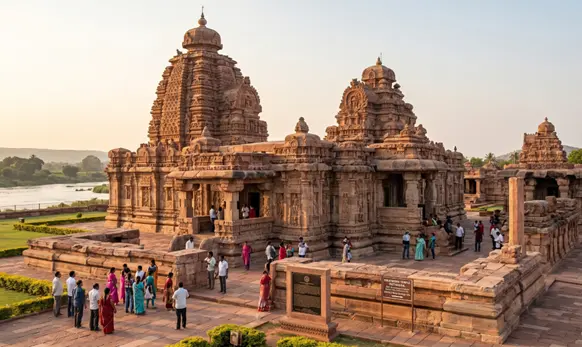
Meguti Jain Temple
Only datable temple at Aihole
Aihole Prasasti inscription celebrating victory over King Harsha is carved into its wall.
A primary historical sources for Chalukya chronology
Huchhappaya Temple
One of the earliest curvilinear Nagara Shikharas (towers) in Karnataka.
Direct evidence that Chalukya craftsmen studied and adapted north indian architectural forms for the Deccan.
Rvanpandi cave
Rock-cut shrine at Aihole with a Nagara Shikhara (towers) closely related to Badami Cave I
Confirms that rock-cut and structural temple programmes shared a single Chalukya workshop and master craftsmen tradition.
Galaganatha Temple
Represents mature Versara synthesis
Curvilinear Nagara tower on Dravidian Base mouldings
The Chalukya government was a centralized monarchy.
The King held supreme power. He was the state's highest-ranking official. He was the highest judicial authority.
He relied on a council of ministers. High-ranking officials were known as Mahasandhivigrahika. This official managed war and peace.
The empire used a feudal system. The kings granted land to local chiefs ( Mandaleshvaras or Mahasamantas.)
They also granted land to temples.
Copper plate inscriptions recording those grants are the primary source for Chalukya administrative history; more than 40 such grants have been found and studied by epigraphists including D.C. Sirkar.
Village assemblies managed local affairs. These were the Mahajanas and enjoyed significant autonomy.
High status women held respected positions in society. Royal women like Vinayavati administered provinces. Kumkumadevi patronized religious institutions. The king's chief queen was known as Pattamahishi.
The army consisted of infantry and cavalry. It included an elephant corps. A powerful navy was also maintained.
The Rashtrakuta inscriptions refer to them as Karnatabala. This shows the strength of their armies.
Trade played a larger role in Chalukya revenues than older textbooks acknowledge.
Dynasty controlled parts of the western coast of India including chaul (near modern Mumbai) and parts connected the Deccan to Arabia and Persia.
Pulakesi II ‘s diplomatic contact with the Persian king Khusrow II - depicted in a painting at the Ajanta Cave I confirms that.
The Chalukya kings were tolerant of different faiths.
They patronized Shaivism, Vaishnavism and Jainism.
The Aihole Prashasti is a key literary source. Ravikirti was the court poet of Pulakesi II. He composed this inscription. It is written in Sanskrit and uses the Kannada script.
It describes the military achievements of Pulakesi II. It details his victory over Harsha.
The Chinese traveler Xuanzang visited the kingdom. He visited during the reign of Pulakesi II. He praised the military discipline and noticed the prosperity of the cities.
Literature in Kannada flourished. Pampa, Ranna, and Ponna were the three gems of Kannada literature. Ranna flourished in the Western Chalukya court of Tailapa II and Satyashraya; Pampa and Ponna belonged to the Rashtrakuta/Vemulavada Chalukya dynasty.
Someshvara III authored Manasollasa. The Mānasollāsa, also known as Abhilashitartha Chintamani, is an early 12th-century Sanskrit text composed by the Kalyani Chalukya king Someshvara III.
Several factors led to the decline of the Badami Chalukyas.
Internal succession wars weakened the central authority.
Constant wars with the Pallavas drained the royal treasury.
The Pallavas occupied Vatapi for 13 years. This occurred after the death of Pulakesi II.
The final blow came from the Rashtrakutas. Dantidurga was a powerful subordinate chief. He exploited the weakness of Kirtivarman II and overthrew the king in 753 CE.
This ended the primary line. The Western branch also declined due to wars. They fought with Cholas and Hoysalas.
Kalachuris also contributed to the decline.
The empire eventually paved the way for the Seuna (Yadava) and Hoysala dynasties.
Q1. The Aihole inscription was composed by which of the following poets?
Answer: Ravikirti.
Q2. Which Chalukya king defeated Emperor Harsha Vardhana?
Answer: Pulakesi II.
Q3. The Virupaksha Temple at Pattadakal was built in which architectural style?
Answer: Dravida.
Q4. Who was the founder of the Western Chalukya dynasty of Kalyani?Answer: Tailapa II.
Frequently asked question (FAQs)
Who was the founder of the Chalukya Dynasty?
What was the capital of the Chalukya Dynasty?
Who was the last ruler of the Chalukya Dynasty?
What is the Chalukya Dynasty known for?
Which temples were built by the Chalukyas?
The Chalukya Dynasty remains a vital chapter in Indian history. They bridged the gap between northern and southern cultures. Their architectural experiments at Aihole and Badami laid the foundation for future temple builders. The dynasty unified large parts of the Deccan. They encouraged stability and cultural growth. For UPSC aspirants, understanding their military strategies is essential. Their artistic contributions are central to Art and Culture sections. They were a great maritime power with efficient administration.


Gajendra Singh Godara
Ex-UPSC Aspirant | Exam Preparation Expert
Gajendra Singh Godara is an IIT Bombay graduate and a UPSC aspirant with 4 attempts, including multiple Prelims and Mains appearances. He specializes in Polity, Modern History, International Relations, and Economy. At PadhAI, Gajendra leverages his firsthand exam experience to simplify complex concepts, creating high-efficiency study materials that help aspirants save time and stay focused.
No comments yet. Be the first to join the discussion!