How to Prepare for UPSC in 6 Months: 2027 Strategy
Can you prepare for UPSC in 6 months? Yes, if you follow reverse engineering. This UPSC 2027 strategy gives a month-wise study plan, a weekly breakdown, a daily timetable, a book list and a mock test schedule to help you reach UPSC Prelims on 23rd May 2027 ready.
Last updated
8
mins read

Key Highlights
Reverse engineering, not cover-to-cover reading, is what makes a 6 month UPSC preparation plan work.
UPSC Prelims 2027 is on 23rd May 2027. The CSE 2027 notification comes on 13th January 2027.
Four subjects (Polity, Economy, Modern History and Environment) have historically decided 60 to 70 percent of the GS Paper 1 score.
PadhAI's own UPSC Prelims 2026 exam analysis found 88 percent of questions were long, statement-based and needed multi-step elimination, not rote recall.
A realistic 6 month plan needs 10 to 12 focused hours a day, split across three phases: foundation, analytical subjects with answer writing, and revision with mocks.
If you are searching for how to prepare for UPSC in 6 months, the honest answer is that thousands of candidates have done it, but not by reading every book on the market.
Six months is enough time if you treat the UPSC syllabus like a puzzle to be reverse engineered rather than a library to be finished.
This guide gives you a complete UPSC 2027 strategy: a month-wise breakdown, a week-by-week plan for month one, a daily timetable, a shortlist of books that will not change every fortnight, the mistakes that quietly sink most 6 month attempts, and a separate plan for working professionals.
Every stage links back to previous year trends, including PadhAI's own analysis of the UPSC Prelims 2026 paper, so the plan is grounded in what the exam is actually testing right now, not just what worked five years ago.
Before the month-wise plan, it helps to know exactly what you are working toward.
The UPSC Civil Services Examination runs across three stages: Prelims, Mains and the Personality Test, and only Prelims falls inside a typical 6 month preparation window.
According to the official UPSC exam calendar, the CSE 2027 notification is due on 13th January 2027, with the last date to apply on 2nd February 2027.
Prelims is set for 23rd May 2027, and Mains begins on 20th August 2027, running across five days.
Stage | Papers | Marks | Counted for merit? |
Prelims | GS Paper 1 and CSAT Paper 2 | 200 each | No, only used as a screening cut-off |
Mains | Essay, GS 1 to 4, two Optional papers, plus qualifying language papers | 1,750 total across the seven counted papers | Yes |
Interview | Personality Test | 275 | Yes |
GS Paper 1 in Prelims has 100 questions for 200 marks, with a two-hour duration and a penalty of one-third of a mark for every wrong answer.
CSAT Paper 2 is qualifying only, so you need 33 percent, or 66 out of 200 marks, and nothing more from it.
This is exactly why most 6 month plans treat CSAT as a pass-or-fail hurdle rather than a scoring paper, and put the bulk of study hours behind GS Paper 1.
Join our WhatsApp Community
The honest answer is yes, with a condition attached. Six months is enough time to build a working knowledge of the GS syllabus and clear Prelims, provided you accept that you cannot read everything and you will not remember everything you do read on the first pass.
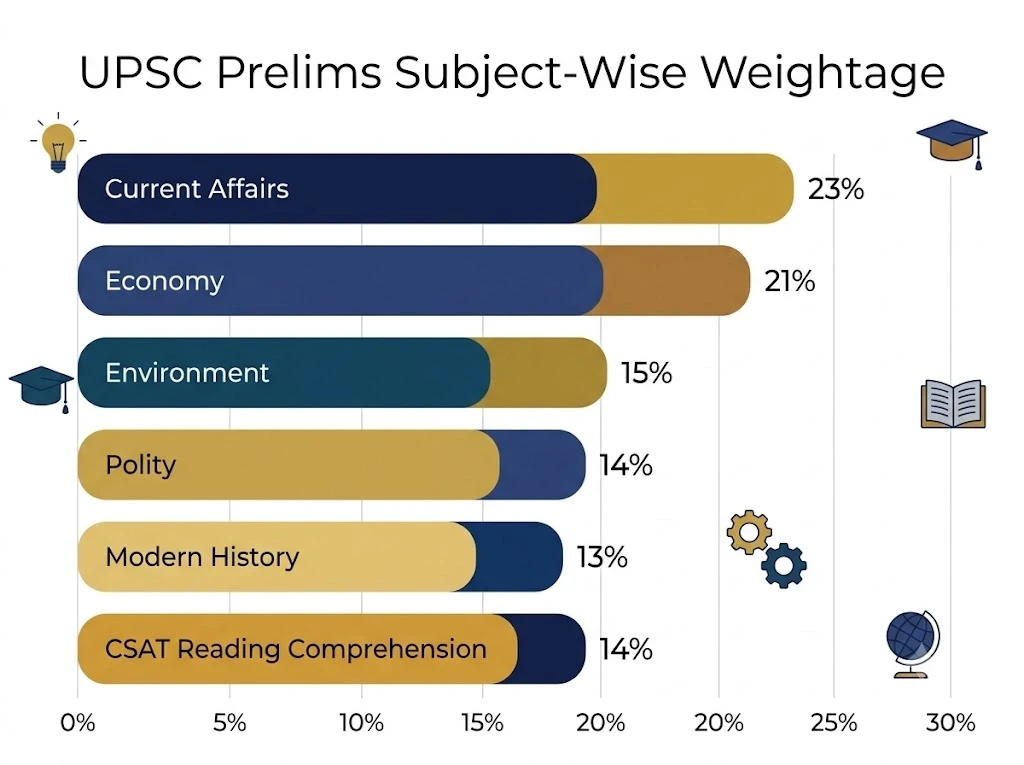
A look at the last five years of UPSC Prelims papers shows a clear pattern. Polity, Economy, Modern History and Environment together have accounted for roughly 60 to 70 percent of the 100 questions in GS Paper 1.
Current affairs, both direct and as a lens on static topics, makes up another 22 to 24 percent. That means a candidate who masters five subject areas and stays current with the news cycle is already competing for close to 90 percent of the paper.
The exam itself is also changing shape, and a 6 month plan built for 2027 has to account for that.
PadhAI's analysis of the UPSC Prelims 2026 paper (held on 24th May 2026) found that 88 percent of questions were long, statement-based items that needed multi-step elimination rather than a single fact recall.
Reading load increased by 40 to 60 percent compared to earlier years, and CSAT's Reading Comprehension section alone carried 30 to 32 questions built on dense 600 to 900 word passages.
Subject weightage also moved: Environment dropped to just 10 to 12 questions, while History and Art & Culture rose to 18 to 20. Polity got harder in a specific way, with 8 to 12 questions demanding a reading of the bare Constitution text rather than a summary from a reference book.
For the full breakdown, PadhAI's UPSC Prelims exam analysis is worth reading before you plan your months.
GS Paper 1 area | Approximate share of Prelims questions | What changed in 2026 |
Polity | 8 to 12 questions | Shifted toward bare Constitution text |
Economy | 15 to 18 questions | Stayed analytical and data heavy |
Modern History and Art & Culture | 18 to 20 questions | Rose sharply from earlier years |
Environment | 10 to 12 questions | Dropped from its usual share |
Current Affairs | 22 to 24 percent of the paper | Increasingly tested through static linkages |
CSAT Reading Comprehension | 30 to 32 questions | Passages expanded to 600 to 900 words |
Source: PadhAI UPSC Prelims 2026 Exam Analysis, based on the GS Paper 1 and CSAT Paper 2 held on 24th May 2026.
So, can I prepare for UPSC in 6 months and still handle a paper like this?
Yes, but the plan has to build reading speed and elimination skill alongside static knowledge, not just facts in isolation.
Reverse engineering means you start from the exam pattern and work backward into the syllabus, instead of starting from page one of a textbook and hoping you reach the end in time.
In practice, this comes down to three habits.
Analyse before you read. Before opening a single book, spend two or three days going through the last five years of Prelims papers. Note which chapters within Polity, History and Economy repeat, and which barely appear. This single step tells you where your hours should go.
Limit your sources on purpose. With six months on the clock, you do not have room to compare four different books on the same topic.
Pick one standard book per subject and plan to revise it three or four times rather than read five books once each.
Build around the Reading, Revision, Practice triangle. Reading gives you the base. Revision is what moves that base from recognition to recall.
Practice, through previous year questions and mock tests, is what tells you whether the first two steps actually worked.
A 6 month plan that skips any one of these three collapses under exam pressure, no matter how strong it looked on paper.
Add as a preferred Source on Google
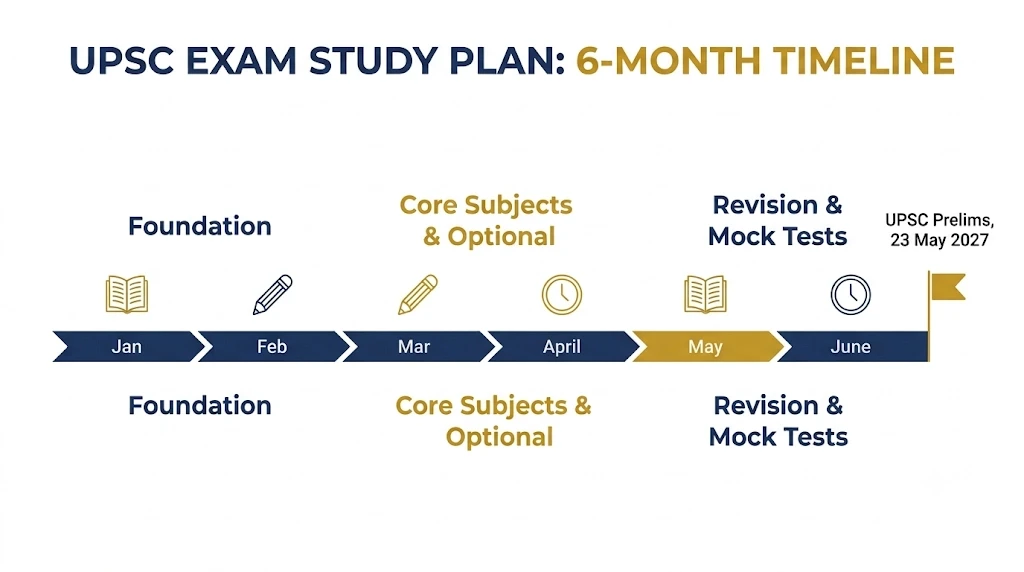
With Prelims 2027 confirmed for 23rd May 2027, a 6 month window starting in the last week of November 2026 gives you a full run at this plan before exam day.
If you are starting later, compress the phases proportionally rather than dropping a phase altogether.
Phase 1: Months 1 and 2, Foundation and Optional Subject
The goal in these first two months is a solid base in the static, high-weightage subjects and a start on your optional paper, while your reading speed is still building.
Polity. Begin with the Class 11 NCERT, Indian Constitution at Work, to get comfortable with the basic structure of Federalism and Rights.
Move on to Indian Polity by M. Laxmikanth and read it chapter by chapter rather than skimming.
Fundamental Rights, Directive Principles, Parliament and the Judiciary carry the most weight and deserve a second, slower read.
History. Modern History carries more Prelims weight than any other period, so start there.
Spectrum by Rajiv Ahir or India's Struggle for Independence by Bipan Chandra both cover 1857 to 1947 in enough depth for Prelims and give you a head start on Mains GS Paper 1.
Keep the NCERT History books from Classes 6 to 12 on hand for the timeline itself.
Geography. Stick to the NCERT textbooks for Classes 11 and 12, particularly Fundamentals of Physical Geography and India: Physical Environment.
Certificate Physical and Human Geography by G.C. Leong adds the conceptual clarity that NCERTs alone will not give you, especially on climate systems and landforms.
Optional subject. Give your optional two to three hours daily from day one. Your target for these two months is to finish Paper 1 of the optional syllabus.
Falling behind here in month one usually means dropping the optional entirely by month four, which is a bigger problem later.
With six months on the clock, you do not have the days to try out three different optional subjects before settling on one.
Pick based on three questions: do you already have background knowledge in it from graduation, is scoring material and evaluation feedback easy to find for it, and does its syllabus overlap with GS papers such as Polity, History or Sociology.
A subject that overlaps with GS reduces your total reading load twice over, once for the optional itself and again when the same material resurfaces in GS Paper 2 or 3.
Current affairs. Read one national daily and start a habit of daily notes from day one, even when the notes are short.
A current affairs magazine that compiles the month's news by subject saves hours later during revision.
Phase 2: Months 3 and 4, Analytical Subjects and Answer Writing
By month three, your static foundation should let you shift attention to subjects that move with the news and to the writing skill that Prelims alone will not test.
Economy. This subject rewards understanding over memorisation. Start with the Class 11 NCERT Indian Economic Development and Class 12 Macroeconomics, then layer on the current Union Budget and Economic Survey highlights.
Banking, inflation tools and the external sector are the areas that repeat most often in recent papers.
Environment and Ecology. This subject's Prelims share dropped in 2026, but it remains a high-return area for both Prelims and Mains GS Paper 3.
Build the base from Class 11 and 12 Biology NCERTs on ecology and biodiversity, then track climate agreements, Ramsar sites and Protected Area updates through current affairs, since these are what actually get tested.
Answer writing practice. Do not wait until after Prelims to write your first Mains answer.
Spend an hour daily practising structure: a short introduction, a body organised into two or three clear points, and a conclusion that answers the question directly.
PadhAI's guide on how to write UPSC Mains answers breaks this down question type by question type.
Ethics. Use weekends for GS Paper 4. It rewards clear thinking more than heavy reading, so short, regular sessions work better here than long cramming blocks.
Optional subject. Close out the remaining syllabus of your optional by the end of month four. This frees months five and six entirely for Prelims-focused revision.
Phase 3: Months 5 and 6, Revision, Mock Tests and the CSAT Sprint
This is the phase where a 6 month plan either pays off or falls apart.
Stop all Mains-only study, including your optional and World History, and put everything into revision, mock tests and CSAT.
Mock tests. Join a test series and aim for 25 to 30 full-length mocks before Prelims. The score matters less than the post-test review.
Spend at least 30 minutes after every mock working out why you got specific questions wrong, since that is where the actual learning happens.
Revision. Go back through your static notes and NCERTs at least three times in these two months.
Mind maps and short mnemonic devices help far more here than another full read of a reference book.
CSAT strategy. CSAT is qualifying at 33 percent, or 66 out of 200 marks, but PadhAI's 2026 analysis found Reading Comprehension alone carried 30 to 32 questions built on 600 to 900 word passages, up sharply from earlier years.
Split your CSAT practice three ways: Reading Comprehension (practise timed passages daily), Logical Reasoning (work through one topic, such as syllogisms or seating arrangements, per session), and Quantitative Aptitude (Class 8 to 10 level arithmetic is usually enough).
PadhAI's CSAT syllabus and preparation guide has a topic-wise breakdown if you need to identify weak areas fast.
Current affairs consolidation. Switch from daily newspaper reading to a yearly compilation for the last stretch, so you cover the backlog of the previous 10 to 12 months without re-reading a year of newspapers one page at a time.
A month-wise plan can feel abstract until you break down what week one actually looks like.
Use this as a template and repeat the pattern, subject by subject, for months two through six.
Week 1: Polity, historical background, Preamble, Union and Territory, Citizenship. History, the Revolt of 1857 and early socio-religious reform movements. Read the Class 11 NCERT for Polity end to end this week.
Week 2: Polity, Fundamental Rights (Articles 12 to 35, worth memorising precisely), Directive Principles and Fundamental Duties. History, the Moderate phase (1885 to 1905) and the Swadeshi Movement. Start short revision notes now, not later.
Week 3: Polity, Parliament, the single most tested chapter in the subject, along with the President, Vice President and Emergency Provisions. History, the Gandhian era and the Non-Cooperation Movement. Attempt 50 MCQs on everything covered so far.
Week 4: Polity, the federal system, Centre-State relations and the Supreme Court. History, the Quit India Movement and Partition. Revise every NCERT and note from the month before moving on.
Once you have run this pattern for Polity and History in month one, apply the same reading, note-making, MCQ and revision cycle to Geography, Economy and your optional subject across the following weeks.
Success across six months depends on a routine you can actually sustain, not a schedule that looks impressive on day one and collapses by day ten.
PadhAI's guide on time and stress management during UPSC preparation covers the psychology side of this in more depth. Here is a realistic 10 to 12 hour routine.
Time Slot | Activity | Focus |
5:30 AM to 6:00 AM | Wake up and light exercise | Gets blood flow going before study |
6:00 AM to 10:00 AM | Session 1: Core static subject | Polity or History, tackled while your mind is freshest |
10:00 AM to 11:00 AM | Breakfast and break | Full rest, no reading |
11:00 AM to 2:00 PM | Session 2: Optional subject or answer writing | Optional in months 1 to 4, answer writing from month 3 |
2:00 PM to 3:00 PM | Lunch and a short nap | Aids memory consolidation |
3:00 PM to 5:00 PM | Session 3: Current affairs | Newspaper plus monthly compilation |
5:00 PM to 6:00 PM | Break or walk | Outdoor time, away from the desk |
6:00 PM to 8:00 PM | Session 4: Revision or CSAT | Revise the morning's reading or practise CSAT |
8:00 PM to 9:00 PM | Dinner | Light meal |
9:00 PM to 10:00 PM | MCQ practice | 20 to 30 MCQs or one PYQ set before sleep |
The biggest time drain in a short preparation window is not slow reading. It is switching between too many sources for the same subject.
This list is deliberately short.
Subject | Recommended Source |
Polity | Indian Polity by M. Laxmikanth, plus Class 11 NCERT Indian Constitution at Work |
History | Spectrum (Modern India), plus NCERT Themes in Indian History |
Geography | Class 11 and 12 NCERTs, plus Certificate Physical and Human Geography by G.C. Leong |
Economy | Indian Economy by Ramesh Singh, plus the current Budget and Economic Survey |
Environment | Environment by Shankar IAS, plus current affairs on treaties and Protected Areas |
Art & Culture | Indian Art and Culture by Nitin Singhania (selected chapters) |
Science & Technology | NCERT Science, Classes 6 to 10, plus current affairs |
Current Affairs | One daily newspaper plus a monthly compilation |
Previous Year Papers |
PadhAI's full NCERT reading list for UPSC and guide on how to read NCERTs efficiently are useful if you are deciding which chapters to prioritise inside each book rather than reading cover to cover.
How Many Hours Should You Study Daily in a 6 Month UPSC Plan?
Ten to 12 focused hours a day is the realistic range for most candidates attempting UPSC in 6 months, split across static subjects, the optional, current affairs and revision.
PadhAI's detailed breakdown on how many hours to study for UPSC explains why raw hours matter less than what you do inside them, and how to build up to this number gradually instead of forcing it from day one.
Most 6 month attempts do not fail because the candidate lacked intelligence or effort. They fail because of a small set of repeatable mistakes.
Trying to read every page. Thick reference books are written to be comprehensive, not to be finished in six months.
Use previous year questions to identify which chapters inside a book actually get tested, and skim the rest.
Treating CSAT as an afterthought. CSAT only needs 33 percent to qualify, but PadhAI's 2026 analysis showed Reading Comprehension alone carrying 30 to 32 questions on long, dense passages.
Candidates who start CSAT practice only in month five often run out of time to build reading speed.
Collecting material instead of studying it. Downloading every free PDF that circulates on Telegram feels productive but adds anxiety, not marks.
One good book per subject, read multiple times, beats five books skimmed once.
Skipping daily revision. Twenty minutes of same-day revision protects far more information than an hour of revision a week later.
Build this into the evening slot from day one rather than treating it as optional.
Changing sources mid-way. Switching your Polity book in month four because a friend recommends a different one resets your revision cycle and usually costs more time than it saves.
Can Working Professionals Prepare for UPSC in 6 Months?
Yes, but the daily structure has to look different from a full-time aspirant's routine.
A working professional cannot study for 10 hours straight, so the six months has to be built around early mornings, evenings and weekends.
Prioritise ruthlessly. Focus on the GS papers and your optional. Anything outside the highest-weightage chapters gets dropped first, since there is no time buffer to recover it later.
Use short, intense blocks. Two hours before work, from roughly 5 AM to 7 AM, and two hours after work, from 8 PM to 10 PM, add up to four solid hours on a working day.
Use the commute for current affairs rather than treating it as dead time.
Protect your weekends. Ten to 12 hours across Saturday and Sunday, split between NCERT reading, answer writing practice and a full-length mock test, is where a working professional actually catches up to a full-time aspirant's pace.
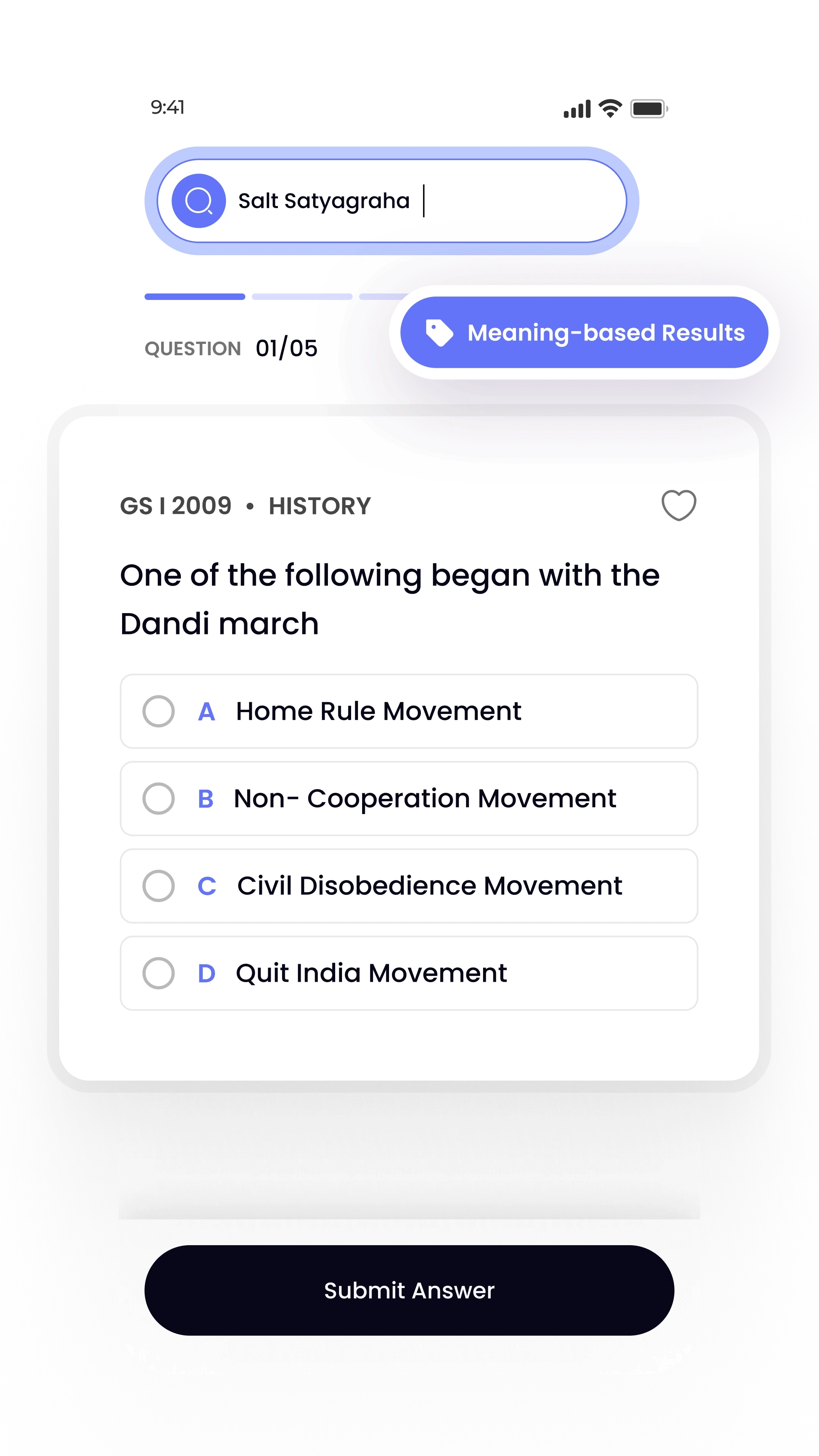
Use tools that compress reading time. A daily news summary, topic-tagged PYQs and quick doubt resolution through an AI tutor save the hours that a working professional simply does not have to spend hunting for the right material.
PadhAI's UPSC app is built around exactly this constraint, with daily summaries, PYQ search and round-the-clock doubt support.
6 Months Preparation for UPSC or a Full Year: Which Is Right for You?
How many months are actually required to prepare for UPSC depends on where you are starting from, not on a fixed number that applies to everyone.
Factor | 6 Month Plan | 1 Year Plan |
Best suited for | Repeat candidates, or those with a strong graduation-level base in GS subjects | First-time aspirants starting from scratch |
Optional subject | Must be chosen in week one, no room to explore options | Room to try a chapter or two before committing |
Daily hours needed | 10 to 12 hours, sustained without long breaks | 6 to 8 hours, with more flexibility |
Revision cycles possible | 2 to 3 full cycles of static subjects | 4 to 5 full cycles, deeper retention |
Risk if a month is lost | High, since there is no buffer month | Lower, a full year has more room to recover |
If you are new to the syllabus and have never opened an NCERT for Polity or History, a full year gives you a gentler curve and more revision cycles.
If you already have a working knowledge of GS subjects, perhaps from a previous attempt, a graduation background in one of the core subjects, or consistent current affairs reading, six months is a realistic and well-tested timeline.
Protecting Your Health During a 6 Month Sprint
A 10 to 12 hour daily routine sustained for six months puts real strain on sleep, diet and mood, and a plan that ignores this usually breaks down around month four, right when consistency matters most.
Keep at least one non-negotiable break in the day, whether that is the evening walk in the timetable above or 20 minutes of light exercise in the morning.
Sleep for six to seven hours rather than treating sleep as the first thing to cut when you fall behind schedule, since the memory consolidation that happens during sleep is part of how revision actually works.
Take one half-day off every two weeks, not to stop studying completely, but to reset before burnout forces a longer break later.
Candidates who treat the six months as a straight sprint with no recovery built in tend to lose entire weeks to fatigue or illness in months five and six, which is exactly when a lost week costs the most.
Frequently asked question (FAQs)
Can I prepare for UPSC in 6 months?
How many months are required to prepare for UPSC?
Is 6 months preparation for UPSC enough without coaching?
How much time should go into answer writing in a 6 month plan?
Can I skip NCERT books if I am short on time in a 6 month plan?
How to prepare for UPSC in 6 months comes down to one decision made early: will you try to read everything, or will you reverse engineer the syllabus around what the exam actually tests?
The candidates who clear Prelims on a 6 month timeline are almost never the ones who read the most books.
They are the ones who picked one source per subject, revised it three or four times, wrote practice answers from month three onward, and treated the last two months as a dedicated sprint of mocks and revision rather than an extension of reading.
Six months is tight, but it is not too tight. Build your plan around the phases in this guide, track your progress weekly rather than daily so a single bad day does not throw off your confidence, and adjust the hours to fit your own routine rather than copying someone else's schedule exactly.
UPSC Prelims 2027 is on 23rd May 2027. Start counting backward from there, and the six months stop feeling impossible.





No comments yet. Be the first to join the discussion!