150+ Important Topics UPSC Prelims 2026: Subject-Wise Guide
To clear the UPSC Prelims on May 24, 2026, your strategy must shift from broad reading to targeted high-weightage themes. Based on recent 5-year trends, Polity, Economy, Environment, History account for over 50% of the paper.
Last updated
16
mins read
Key highlights:
UPSC Prelims Exam Date: May 24, 2026
Polity topics include Constitutional Framework, specifically Fundamental Rights and the legislative powers of Parliament.
Economy topics include things like targeting inflation, using monetary policy tools like Repo and CRR, and the external sector (Balance of Payments).
Geography topics include mapping and physical systems, like India's drainage systems and how El Niño and La Niña affect the Indian Monsoon.
Topics about the environment include tracking Protected Areas & Conventions, connecting new Ramsar sites and updates to Wildlife Sanctuaries to their specific ecological importance.
History topics include Modern Freedom Movements (1857–1947) and the teachings of Buddhism and Jainism in Ancient History.
Science & Tech topics include space missions (ISRO), biotechnology (gene editing), and artificial intelligence.
Key Concepts in CSAT: Number Systems and Permutations has become a major elimination factor in recent years.
UPSC Preliminary examination is a two-paper objective exam to select candidates for IAS, IPS, IFS, and 18 other services. UPSC 2026 Prelims date is May 24, 2026. GS Paper 1 carries 200 marks across 100 questions. Your final rank depends entirely on GS Paper 1; CSAT (Paper 2) is qualifying at 33%.
This blog covers the highest-priority topics from UPSC Prelims syllabus 2026, ranked by a 5-year UPSC Prelims PYQ analysis (2021-2025), so you know exactly what to study, in what order, and for how long.
The Union Public Service Commission conducts the Civil Services Examination in three sequential stages:
Prelims
Mains
Personality Test (interview)
UPSC Prelims is the entry gate. You cannot write Mains if Prelims has not been cleared.
GS Paper 1 tests seven subject areas. These determine whether you qualify for the next stage.There is a negative marking of 0.667 marks for every wrong answer. This single rule changes your entire answering strategy: a wrong answer costs you more than the gain from a guess.
CSAT (Paper 2) tests reading comprehension, logical reasoning, and basic numeracy. You must score at least 66 marks out of 200 (33%) to be "qualified." After that, your CSAT score is irrelevant for ranking. Many aspirants underestimate CSAT and get eliminated with strong GS Paper 1 scores to their name. Do not let that be you.
Join our WhatsApp Community
The table below is built from a 500-question PYQ analysis across 2021-2025. Study this before you make any study plan. Time is limited; your allocation must match actual question frequency.
For your preparation, focus on prioritizing high yield subjects like Polity, Modern History, Economy, Environment and Geography. Keep track of recent updates in Science and Tech, Current Affairs and Environment for Prelims.
The General category cutoff in the past three years has been 87.98 (2024), 75.41 (2023), and 88.22 (2022). Aim for 92-96+ marks in GS Paper I to be in the safe bracket.
History is not just stories from the past. UPSC frames History questions to test your understanding of cause-and-effect, social movements, and the ideas behind major events. The key is knowing why something happened, not just when. A 5-year PYQ review shows 9 to 18 History questions per year, confirming this is never a minor subject.
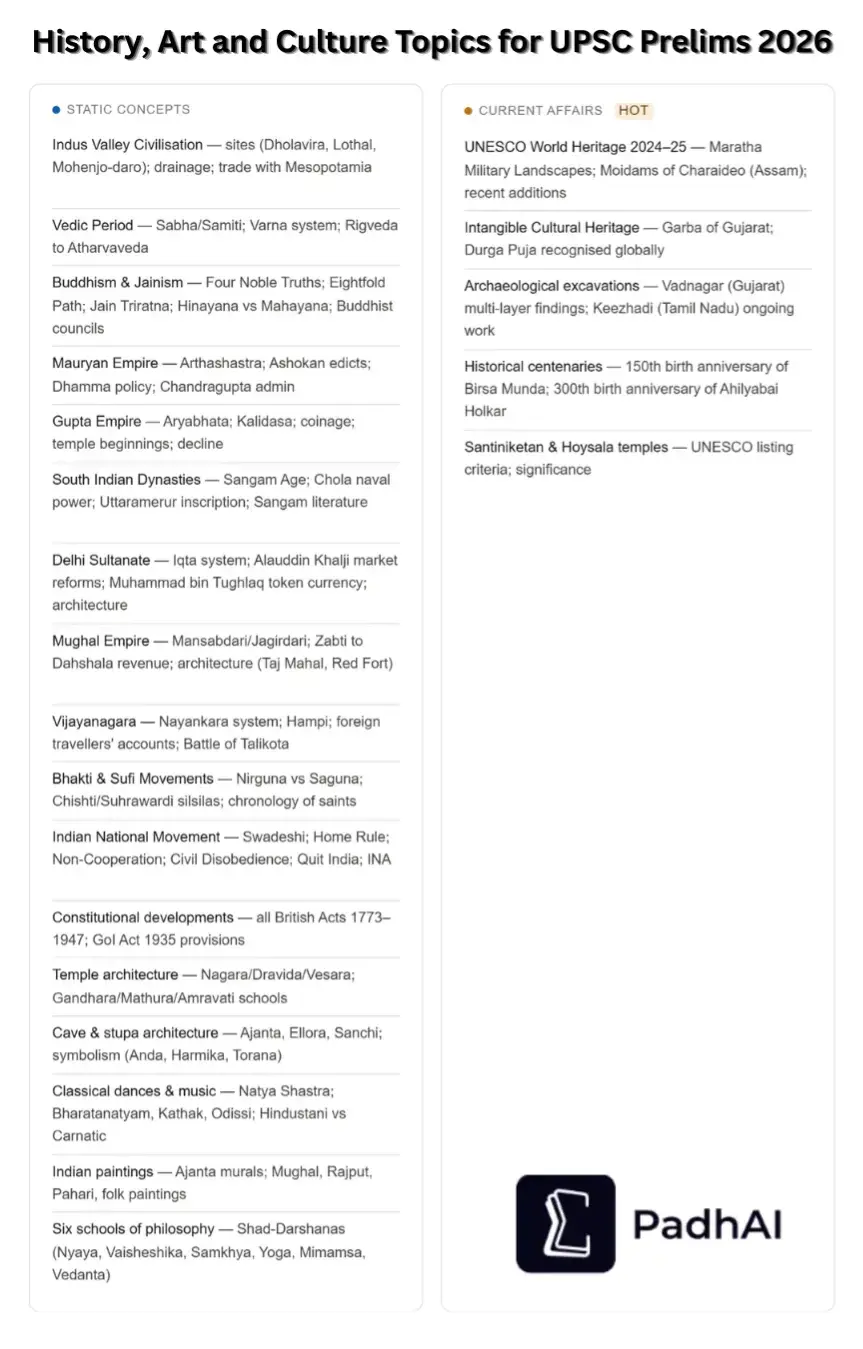
Theme | History | Art, Culture, & Literature |
Ancient India | • Indus Valley Civilisation: Site-specific findings (e.g., Harappan burials, Lothal dockyard). • Vedic period: Political terms (Gavishti, Bali, Bhagaduha). • Mahajanapadas: Rise of Magadha; Republics (Gana-Sanghas). • Empire: Mauryan Empire (Gudha Purushas); Gupta Empire Land Grants (Agrahara). | • Religion: 12 Angas (Jainism); Tripitakas & Jatakas (Buddhism); Schools of Philosophy (Sankhya, Yoga, etc.). • Architecture: Stupa architecture (Toranas, Medhi); Rock-cut caves (Ajanta, Ellora, Karle). • Literature: Sangam Epics (Silappadikaram); Scientific texts (Charaka/Sushruta Samhita). |
Medieval India | • Administration: Delhi Sultanate (Iqta, Chahalgani); Mughal (Zabt, Dahshala, Mansabdari). • South India: Chola Village Admin (Uttiramerur Inscription); Vijayanagara Nayankara system. • Foreigners: Accounts of Ibn Battuta, Marco Polo, Nicolo Conti, and Abdur Razzaq. | • Architecture: Evolution of the Dome & Arch; Pietra Dura; Charbagh Gardens; Vijayanagara’s Hampi temples. • Movements: Bhakti (Saguna vs. Nirguna); Sufi (Silsilas); Sikhism (Guru Nanak to Guru Gobind Singh). • Fine Arts: Mughal vs. Rajput Miniatures; Thanjavur paintings. |
Modern India | • British Rule: Regulating Acts (1773–1853); Govt of India Acts (1909, 1919, 1935). • Resistance: Tribal & Peasant revolts (Santhal, Munda, Indigo, Eka). • Nationalism: Swadeshi, Non-Cooperation, Civil Disobedience, Quit India. • Personalities: Focus on Subhash Chandra Bose (INA), B.R. Ambedkar, and Sardar Patel. | • Reforms: Brahmo Samaj, Arya Samaj, Satyashodhak Samaj, Self-Respect Movement. • Press/Education: Wood’s Despatch, Hunter Commission, Wardha Scheme; Vernacular Press Act. • Artistic Revival: Bengal School of Art (Abanindranath Tagore); Modern Indian Theatre. |
Post-Independence | • State-Building: State Reorganization (1956); Integration of Princely States. • Economics: Five-Year Plans (1–3); Nationalization of Banks; LPG Reforms (1991). • Foreign Policy: NAM (Non-Aligned Movement); Panchsheel; Wars of 1962, 1965, 1971. | • Institutional: Sahitya Akademi, Lalit Kala Akademi, ICCR. • Cultural Evolution: Conservation of heritage; evolution of the Indian Cinema as a cultural tool. |
Art & Heritage (Niche) | • Traditional: Classical Dances (8); Classical Music (Hindustani vs. Carnatic); Puppetry; Martial Arts (Kalaripayattu, Gatka). | • Modern Assets: UNESCO World Heritage Sites (Cultural vs. Natural vs. Mixed); UNESCO Intangible Heritage; GI Tags for handicrafts. |
Ancient and Medieval History
Ancient History yields 3-5 questions on average.Medieval History sits at 1-4 questions. Spend time here, but not at the cost of Modern History. Focus on concepts rather than dates.
Modern History
Modern History (roughly 1757 to 1947) produces the most questions within the History section. UPSC favors topics tied to freedom movements, reform movements, and the ideas of key leaders. The following topics have appeared repeatedly and carry the highest yield per hour of study.
Art and Culture
Art and Culture crashed to just 1 question in 2025, down from 5 questions in earlier years. Cover the standard topics once, revise lightly, and move on.
Add as a preferred Source on Google
Geography jumped from 8 questions in 2021 to 16 questions in 2025, a 100% increase. This is the clearest trend signal in 5 years of data. Aspirants who underweight Geography are leaving marks on the table.
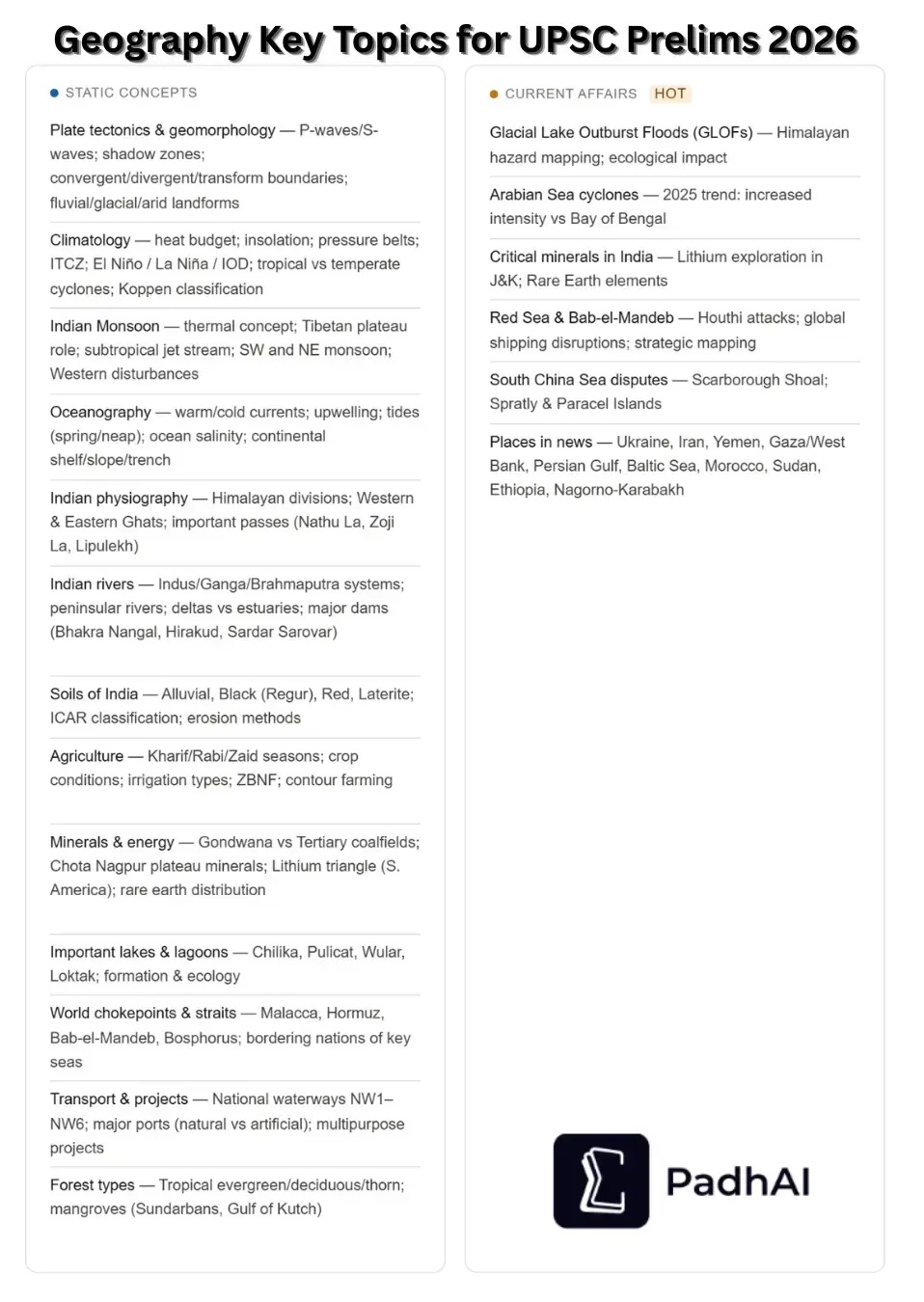
Category | Important Topics |
General & Physical Geography | • Universe & Earth: Origin theories, Earth’s rotation/revolution, and Latitudes/Longitudes. • Geomorphology: Earth’s interior, Plate Tectonics, Earthquakes, Volcanoes, and Rock cycles. • Climatology: Structure of the atmosphere, Pressure belts, Jet Streams, Cyclones (Tropical/Extra-tropical), and the Heat Budget. • Landforms: Evolution of Fluvial (River), Glacial, Aeolian (Wind), and Karst topographies. |
Oceanography & Biogeography | • Ocean Relief: Continental Shelf, Slope, and Abyssal Plains. • Oceanic Properties: Temperature, Salinity, Ocean Currents, and Tides. • Marine Resources: Coral Reefs (Bleaching), Polymetallic Nodules, and UNCLOS laws. • Biogeography: World Biomes, Soil profile, and classification of global soils. |
Indian Geography (Physical) | • Physiography: Himalayas (Trans, Greater, Lesser, Shivalik), Northern Plains, Peninsular Plateau, and Coastal Plains. • Drainage: Detailed study of Himalayan vs. Peninsular rivers, their tributaries, and Inter-linking projects. • Climate: Indian Monsoon (Onset, Withdrawal), El Niño, La Niña, IOD, and Western Disturbances. • Natural Vegetation: Forest types in India and the latest India State of Forest Report (ISFR). |
Economic & Human Geography | • Agriculture: Cropping patterns, Irrigation (Micro-irrigation), Soil Health, and Green Revolution 2.0. • Resources: Distribution of Coal, Iron Ore, Bauxite, and Rare Earth Minerals. • Industry: Location factors for Iron/Steel, Sugar, and Textile industries; Industrial Corridors. • Demography: Census 2011 (trends), Migration patterns, and Demographic Dividend. • Infrastructure: PM Gati Shakti, Bharatmala, Sagarmala, and Inland Waterways. |
Mapping & Current Affairs | • Indian Mapping: Major Passes, Peaks, National Parks, Wildlife Sanctuaries, and Ramsar Sites. • World Mapping: Strategic Straits (Hormuz, Malacca), Seas in news (Red Sea, Black Sea), and Central Asian borders. • Environmental Links: Climate change impacts, GLOFs (Glacial Lake Outburst Floods), and Heatwaves. |
Is map-based geography preparation important for Prelims 2026?
Yes. UPSC regularly asks questions that require you to locate rivers, parks, or mineral belts on a map. Practice marking major geographical features on a blank outline map of India. A 30-minute weekly map exercise over 3 months builds the spatial memory that text-reading alone cannot.
Polity Questions test whether you understand how institutions work, not just their names. M. Laxmikanth's "Indian Polity" remains the standard reference, but reading it passively is not preparation. Connect each legal provision to its real-world example.
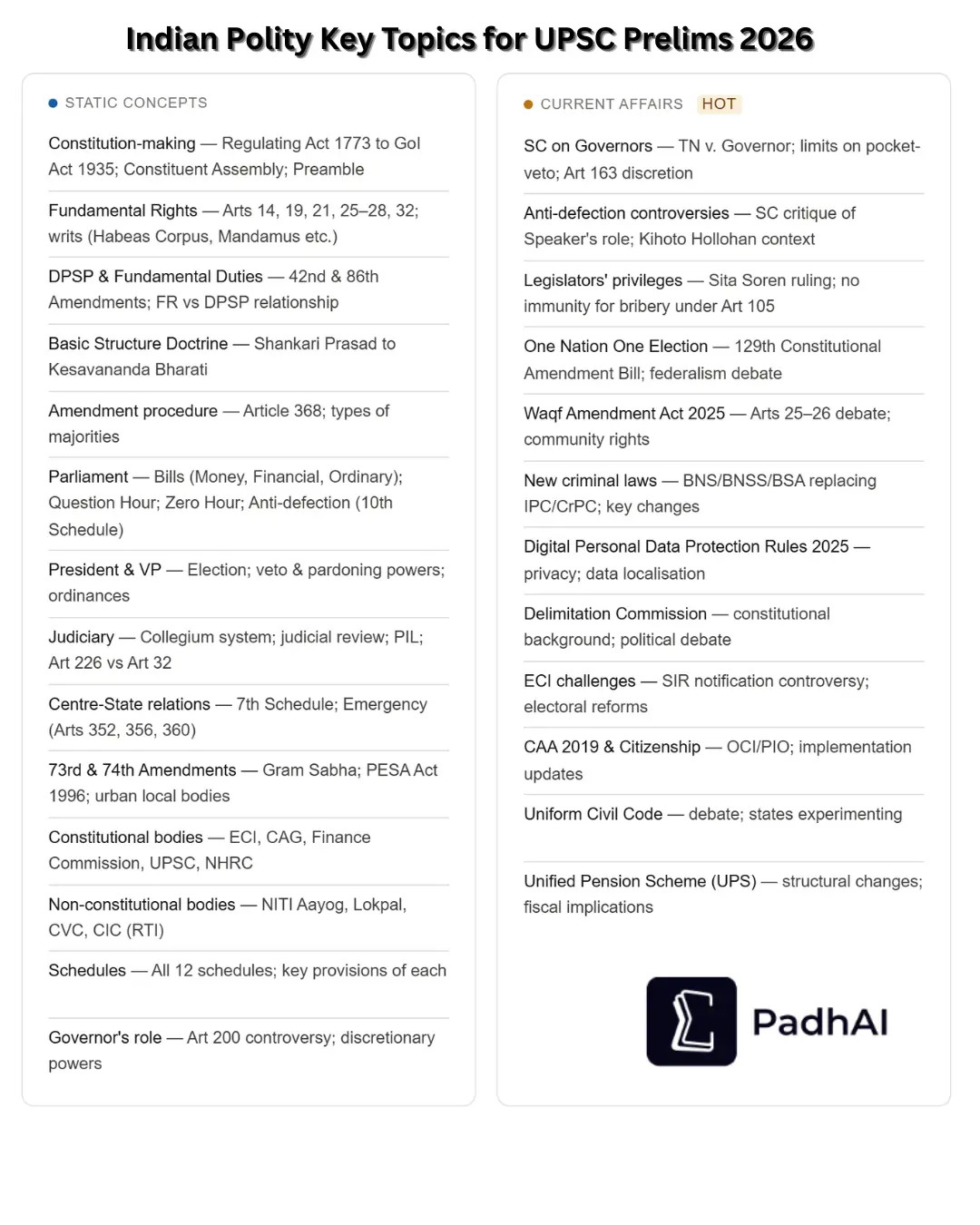
Category | Important Topics |
Constitutional Foundations | • Historical Background: Regulating Acts, GoI Acts (1909, 1919, 1935), and Independence Act 1947. • The Preamble: Key terms (Sovereign, Secular, etc.), objective resolution, and its legal status. • Salient Features: Basic Structure Doctrine, separation of powers, and sources of the Constitution. • Schedules: Special focus on the 5th, 6th, 7th (Lists), and 10th (Anti-Defection) schedules. |
Individual Rights & Duties | • Fundamental Rights: Articles 12–35, specific emphasis on Article 21 (Privacy/Life), Article 19, and Article 32 (Writs). • DPSP: Classification (Socialist, Gandhian, Liberal-intellectual) and Fundamental Rights vs. DPSP conflict. • Fundamental Duties: Swaran Singh Committee and the 11 duties. • Citizenship: Constitutional provisions and the Citizenship Amendment Act (CAA). |
The Union & State Executive | • The President: Election process, Pardoning powers (Art. 72), and Ordinance-making powers (Art. 123). • The Prime Minister & CM: Role, powers, and relationship with the Council of Ministers. • The Governor: Constitutional role, discretionary powers, and recent Centre-State friction points. • Attorney General & Advocate General: Role and limitations. |
Parliament & State Legislature | • Structure: Lok Sabha vs. Rajya Sabha, sessions, and types of majorities. • Legislative Procedure: Ordinary vs. Money Bills, Financial Bills, and Joint Sittings. • Parliamentary Control: Motions (No-Confidence, Adjournment), Question Hour, and Committees (Public Accounts, Estimates, Ethics). • Privileges: Individual and collective privileges (Art. 105). |
The Judiciary | • Supreme Court: Appointment (Collegium vs. NJAC), Original/Appellate/Advisory jurisdiction. • Judicial Principles: Judicial Review, Judicial Activism, and Public Interest Litigation (PIL). • High Courts & Subordinate Courts: Jurisdiction and the structure of District courts. • Tribunals: Administrative and National Green Tribunal (NGT). |
Federalism & Local Governance | • Centre-State Relations: Legislative, Administrative, and Financial (GST Council, Finance Commission). • Emergency Provisions: National (Art. 352), President’s Rule (Art. 356), and Financial (Art. 360). • Local Bodies: 73rd and 74th Amendments, Gram Sabha, PESA Act, and devolution of powers. |
Bodies & Governance | • Constitutional Bodies: Election Commission (ECI), CAG, Finance Commission, UPSC, National Commission for SCs/STs. • Non-Constitutional Bodies: NITI Aayog, NHRC, CVC, Lokpal, and Lokayuktas. • Electoral Reforms: Representation of the People Act (1950 & 1951), Electoral Bonds (SC Rulings), and One Nation One Election. |
PadhAI Tip for Polity: Practice identifying whether a body is constitutional (created by the Constitution), statutory (created by a law), or non-constitutional. This distinction appears in 2-3 questions every year.
In Economy questions UPSC asks a mix of conceptual definitions (what is a fiscal deficit?), current policy questions (what did Budget 2025-26 do?), and international body-related questions (what does the IMF's SDR mean?).
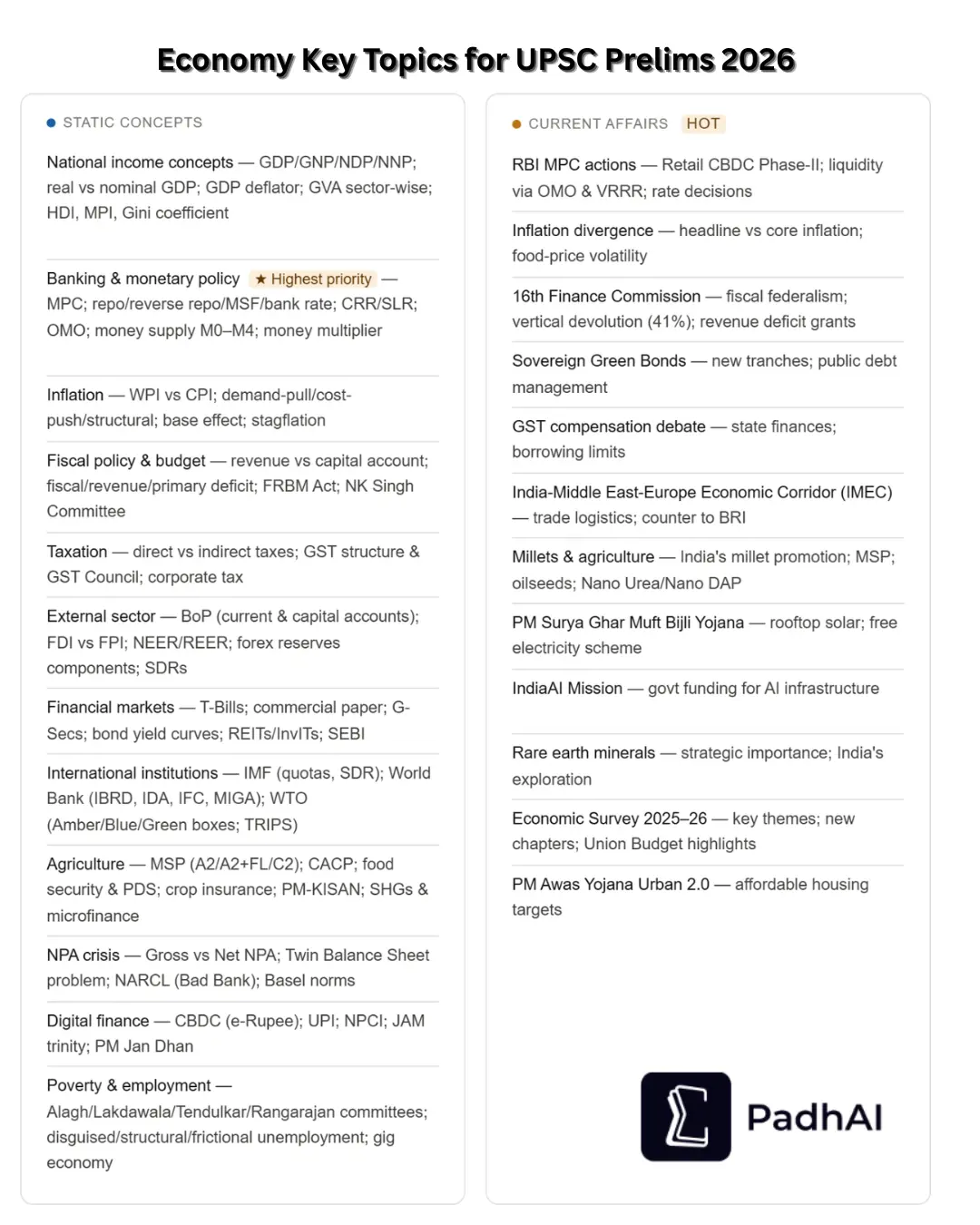
Category | Important Topics |
National Income & Growth | • Basics: GDP, GNP, NDP, NNP (Real vs. Nominal GDP). • Growth Metrics: Per Capita Income, GVA (Gross Value Added), and the "India Growth Story" (FY26-27 projections). • Development: HDI (Human Development Index), Sustainable Development Goals (SDGs), and Inclusive Growth. |
Monetary Policy & Banking | • RBI Tools: Repo Rate, Reverse Repo Rate, CRR, SLR, MSF, and the Monetary Policy Committee (MPC). • Inflation: CPI (Consumer Price Index) vs. WPI (Wholesale Price Index), Core Inflation, and Stagflation. • Banking Sector: NPAs (Non-Performing Assets), IBC (Insolvency and Bankruptcy Code), Digital Payments (UPI, CBDC/E-Rupi), and Financial Inclusion (PM Jan Dhan Yojana). |
Fiscal Policy & Budget | • Union Budget: Revenue vs. Capital Expenditure, Fiscal Deficit, and the FRBM Act. • Taxation: Direct vs. Indirect Taxes, GST Council, GST Compensation Cess, and Taxation principles (Laffer Curve). • Subsidies: Fuel, Food, and Fertilizer subsidies; Direct Benefit Transfer (DBT). |
External Sector | • Trade: Balance of Payments (BoP), Current vs. Capital Account, and Balance of Trade. • Forex: Composition of Foreign Exchange Reserves and Exchange Rate Depreciation vs. Devaluation. • Global: WTO, Foreign Direct Investment (FDI), and FPI (Foreign Portfolio Investment) trends. |
Agriculture & Industry | • Agri-Economics: MSP (Minimum Support Price), Agriculture Subsidies, e-NAM, and Food Management. • Industry: MSME sector reforms, PLI (Production Linked Incentive) schemes, and Atmanirbhar Bharat. • Infrastructure: PM Gati Shakti, National Logistics Policy, and Investment Models (PPP, HAM). |
Government Schemes (2026 Focus) | • Key Initiatives: PM Vishwakarma, Green Hydrogen Mission, PM MUDRA Yojana, PM SVANidhi, and PM Kisan. • Livelihood: PLFS (Periodic Labour Force Survey) and employment/unemployment types. |
Is reading the Economic Survey required for Prelims 2026?
Yes, you should read it, but only certain parts.The Economic Survey 2025-26 is a major source for questions on India's GDP growth rate, sectoral performance, and government scheme evaluations. Focus on the summary, agriculture, and any chapter that appears directly in recent current affairs. Budget-related questions in Prelims almost always come from the Union Budget speech and the Economic Survey, not from newspapers.
Environment and Ecology is the high-scoring subject, but its questions are strongly tied to current affairs. A protected area declared last month, a species listed on CITES Appendix I, or a new Ramsar site added in 2025: these are live exam material. This means you need both a solid static base and a running current affairs thread.
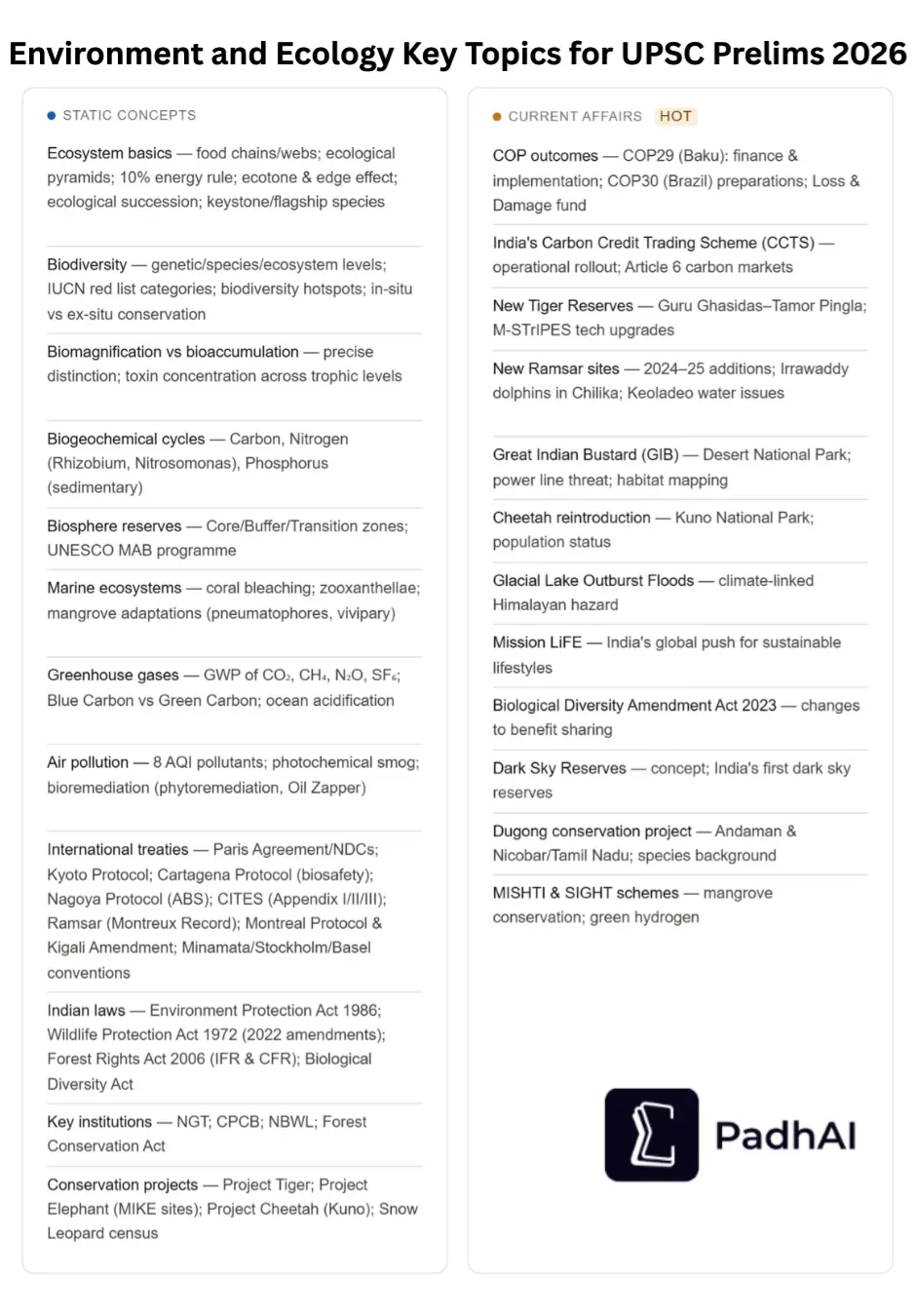
Category | Important Topics |
Ecology Fundamentals | • Core Concepts: Definitions of Environment vs. Ecology, Ecotone, Ecological Niche, and Biomes. • Ecosystem Dynamics: Food Chains, Food Webs, Trophic Levels, and Energy Flow (10% Rule). • Succession: Primary vs. Secondary succession and Climax community. • Cycles: Biogeochemical cycles (Carbon, Nitrogen, Hydrological, Phosphorus, and Sulphur). |
Biodiversity & Conservation | • Basics: Levels of Biodiversity (Genetic, Species, Ecosystem) and Biodiversity Hotspots in India. • In-situ Conservation: National Parks, Wildlife Sanctuaries, Biosphere Reserves, and Community Reserves. • Ex-situ Conservation: Seed Banks, Gene Banks, Botanical Gardens, and Zoos. • Red List: IUCN status of flagship species (Tiger, Elephant, One-horned Rhino, Snow Leopard). • Marine & Wetland: Coral Reefs, Mangroves (MISHTI Scheme), and Ramsar Sites in India. |
Climate Change | • Global Warming: Greenhouse Gases (GHGs), Global Warming Potential (GWP), and Carbon Sequestration. • Ozone Depletion: Causes, impacts, and the Montreal Protocol/Kigali Amendment. • Oceanic Changes: Marine Heatwaves, Ocean Acidification, and Blue Carbon. • International Bodies: IPCC Reports, UNFCCC, and the outcomes of the latest COP summits (e.g., COP28/COP29). |
Environmental Pollution | • Air: Air Quality Index (AQI), NCAP (National Clean Air Programme), GRAP, and Fly Ash. • Water: Eutrophication, Algal Bloom, Bioremediation, and Groundwater Arsenic/Fluoride contamination. • Modern Threats: Plastic Pollution (Single-use plastic ban), E-waste management, and Light/Noise pollution. • Waste Management: Solid Waste Management Rules and the 3Rs (Reduce, Reuse, Recycle). |
Laws, Policies & Bodies | • Statutory Acts: Wildlife Protection Act 1972 (Schedules), Environment Protection Act 1986, Biological Diversity Act 2002, and Forest Conservation Act (Amendments). • Executive Bodies: National Green Tribunal (NGT), Central Pollution Control Board (CPCB), and Animal Welfare Board. • National Missions: NAPCC (8 Missions), Namami Gange, and the National Solar Mission. |
International Environmental Agreements | • The "Big 3": CBD (Convention on Biological Diversity), UNCCD (Desertification), and UNFCCC (Climate Change). • Hazardous Substances: Stockholm (POPs), Basel (Waste), Rotterdam (Chemicals), and Minamata (Mercury). • Migratory/Trade: CITES, CMS (Bonn Convention), and the International Solar Alliance (ISA). |
Science and Technology carries high variance: 4 questions in one year, 13 in another.
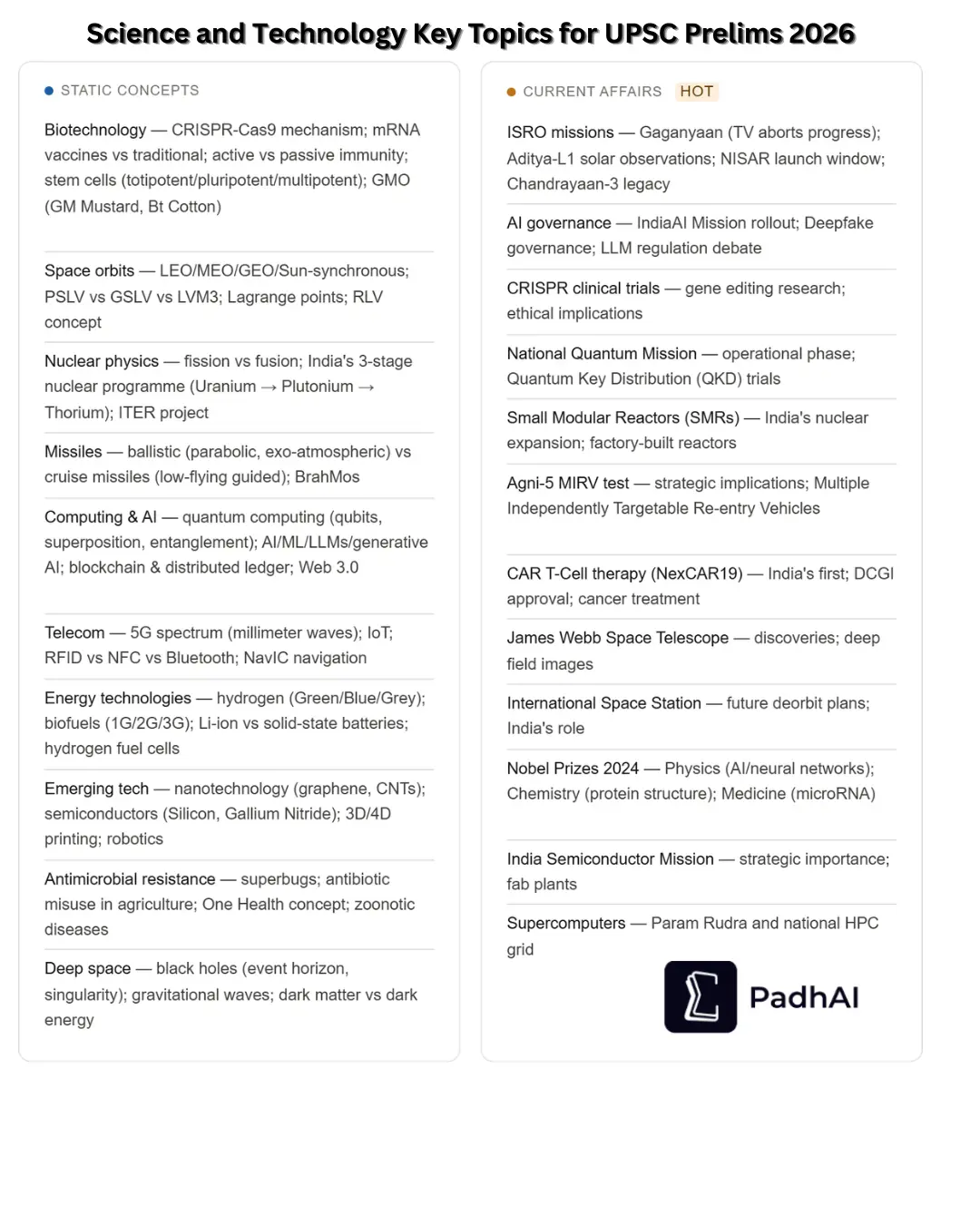
Category | Important Topics |
Space Technology | • ISRO Missions: Gaganyaan (Manned Mission), Aditya-L1 (Solar), Chandrayaan-3, Mangalyaan, and Shukrayaan-1. • Global Projects: Artemis II, James Webb Telescope, NISAR (NASA-ISRO), and Starlink. • Launch Vehicles: PSLV, GSLV Mk-III (LVM3), SSLV, and Scramjet engine tech. • Navigation: NAVIC (IRNSS), GAGAN, and GPS. • Concepts: Orbits (LEO, MEO, GEO, HEO), Lagrange Points, and Kessler Syndrome. |
Biotechnology & Health | • Genetics: DNA vs. RNA, Genome Sequencing (Genome India Project), CRISPR-Cas9, and Gene Therapy. • Healthcare: CAR T-cell therapy, Stem Cells, Organ Transplantation, and 3D Bioprinting. • Diseases: Vaccines (mRNA, Viral Vector), AMR (Antimicrobial Resistance), and specific viruses (Nipah, Zika, Monkeypox). • Agri-Biotech: GM Crops (Bt Cotton, DMH-11 Mustard) and Bio-fortification. |
IT & Emerging Tech | • Artificial Intelligence: Generative AI (LLMs), AI Governance, Machine Learning, and Deepfakes. • Computing: Quantum Computing (Qubits, Quantum Entanglement), Big Data, and Cloud Computing. • Connectivity: 5G/6G Technology, IoT (Internet of Things), Wi-Fi 7, and Li-Fi. • Digital Assets: Blockchain, Cryptocurrencies, CBDC (Digital Rupee), and NFTs. • Immersive Tech: AR, VR, and the Metaverse. |
Defense Technology | • Missile Systems: Agni Series (ICBM), BrahMos (Supersonic), S-400, and Ballistic Missile Defence (BMD). • Aviation & Naval: Tejas (LCA), INS Vikrant, Project 75 (Submarines), and Stealth technology. • Strategic: DRDO initiatives, Integrated Guided Missile Development Programme (IGMDP), and Drone technology (UAVs). |
Nuclear Technology | • Energy: India’s 3-Stage Nuclear Power Programme, PFBR (Kalpakkam), and Small Modular Reactors (SMRs). • Basics: Fission vs. Fusion (ITER Project), Radioisotopes in medicine/agriculture, and Heavy Water. |
Nanotechnology & Materials | • Nano-science: Carbon Nanotubes, Graphene, and Nanoparticles in medicine/filtration. • Modern Materials: Superconductors, Semiconductors (India Semiconductor Mission), and Lithium-ion vs. Solid State batteries. |
Intellectual Property (IPR) | • Frameworks: National IPR Policy, Patents Act 1970, and GI Tags. • Issues: Evergreening of patents, Compulsory Licensing, and Traditional Knowledge Digital Library (TKDL). |
Current Affairs for UPSC Prelims 2026
Current Affairs averaged 23.8 questions per year, with a range of 16 to 33. The wide range shows that some years are dominated by current events while others lean static. What the data makes clear: you cannot predict which way 2026 will go.
What to Read and How to Tag It to Subjects
Read one newspaper each morning (The Hindu or Indian Express works well for UPSC).
Read editorials for Mains thinking, but news briefs for Prelims accuracy.
The goal is not just reading but tagging to core concepts. Every news item connects to a static subject. When you read about a new Ramsar site, tag it to Environment. When you read about a CAG report, tag it to Polity. When you read about a GST Council decision, tag it to Economy.
PadhAI's daily news feed delivers pre-tagged current affairs mapped to Prelims topics, so you spend reading time, not sorting time.
High-Priority Current Affairs Themes for 2026
Focus on these current affair topics for this cycle:
Category | Important Topics |
Geopolitics & Mapping | • Conflict Zones: Israel-Iran tensions, Red Sea security (Bab-el-Mandeb), and Russia-Ukraine border changes. • Strategic Corridors: IMEC (India-Middle East-Europe), Chabahar Port updates, and the Arctic Northern Sea Route. • Groupings: BRICS+ expansion, G20 "Global South" initiatives, and SCO/QUAD leadership dynamics. |
Governance & Judicial | • Legal Reforms: Implementation of new Criminal Laws (BNS, BNSS, BSA) and Digital Personal Data Protection (DPDP) Act. • SC Judgments: Rulings on Electoral Bonds, Article 370, and Federalism/Centre-State disputes. • Electoral: One Nation One Election debates and Delimitation Commission updates. |
Environment & species | • Global Climate: Outcomes of COP28/COP29 (Loss and Damage Fund) and Global Biofuel Alliance. • Species in News: Project Cheetah expansion, Great Indian Bustard (habitat vs. power lines), and Gangetic Dolphin conservation. • India Specific: Newly notified Ramsar Sites and Tiger Reserves (Stage 2 Nuclear milestones often linked to local ecology). |
Economy & Finance | • Institutional: 16th Finance Commission recommendations (2026-2031) and GST Council major shifts. • Digital Economy: CBDC (Digital Rupee) adoption, UPI Global expansion, and the "Mule Hunter" AI fraud detection. • Trade: FPI "Exodus" vs. Inflows, Inverted Duty Structure issues in manufacturing, and Bilateral Free Trade Agreements (FTAs). |
Science & Emerging Tech | • Space: Gaganyaan crewed missions, Aditya-L1 data findings, and the Artemis Accords participation. • Frontier Tech: AI Governance (New Delhi AI Summit), Quantum Mission milestones, and Semiconductor Mission (Fab units in India). • Health: AMR (Antimicrobial Resistance) protocols and mRNA vaccine breakthroughs for non-COVID diseases. |
Terms & Concepts | • Niche Terms: Cyborg Botany, Bio-Bitumen, Green Hydrogen (SIGHT), and Social Stock Exchange (SSE). |
To comfortably clear Prelims, try to cover at least 12-15 months of current affairs before the date of exam.
UPSC CSAT: The Qualifying Paper
CSAT is a 200-mark qualifying paper requiring 66 marks (33%) to pass.Many aspirants treat CSAT preparation as an afterthought and pay the price. No one can get on the shortlist if they get 140 marks in GS Paper 1 but only 60 in CSAT, no matter what their GS Paper 1 rank is.
Basic Numeracy (Class 10 level): Percentages, ratios, profit-loss, time-work, time-speed-distance. The NCERT Class 9 and 10 maths chapters cover this completely.
Data Interpretation: Bar graphs, pie charts, line graphs with 2-3 question sets.
Practice interpreting data accurately, not speedily.
Decision Making: Go through short situational cases.
Focus on ethically sound, procedurally correct responses consistent with public service values.
Standard UPSC Books and Resources
One of the most common beginner mistakes is collecting too many books. UPSC rewards depth over breadth. Reading Laxmikanth twice is worth more than reading five Polity books once each. The list below covers what is essential :
For Polity, use 11th-12th NCERT and M. Laxmikanth's "Indian Polity" (6th edition).
For History, NCERT textbooks (Classes 6–12) for foundational knowledge, along with standard reference books like Spectrum (Modern), R.S. Sharma (Ancient), and Satish Chandra (Medieval) .
For Art and culture, NCERT Class 11 "An Introduction to Indian Art," Nitin Singhania's "Indian Art and Culture."
For Economy, use Ramesh Singh's "Indian Economy" (TMH) along with the Economic Survey 2025-26summary.
For Geography, use NCERT Class 11-12 Geography textbooks supplemented by Goh Cheng Leong for physical geography concepts.
For Environment, use Shankar IAS Environment notes or equivalent concise material.
For Science, use NCERTs (Class 6-10) for basics, class 11-12 Biology for biotechnology/ecology, and Ravi P. Agrahari (TMH) for core concepts. Go through monthly current affairs compilations (no separate textbook needed).
For CSAT, use TMH CSAT manual plus past CSAT papers (2011 onward).
PadhAI Study Tip: PadhAI's AI Tutor can answer your questions about a specific subject right away, day or night. Instead of spending 40 minutes looking for the answer to a Polity question, just ask PadhAI and get a clear, syllabus-linked answer in less than 30 seconds.Duel mode tests your revision against real aspirants preparing for the same exam, which builds the competitive pressure that solo study cannot replicate.
UPSC Prelims Preparation Mistakes
These are not beginner errors. Experienced aspirants make these mistakes too, which is why the Prelims cutoff eliminates candidates who have studied for months.
1. Treating CSAT as a formality: The 33% qualifying bar sounds easy until you sit for CSAT under pressure without prior practice. Thirty minutes of daily CSAT preparation from Day 1 eliminates this risk entirely.
2. Skipping negative marking strategy: The -0.667 negative marking per wrong answer means that guessing blindly on 20 questions and getting 10 wrong costs you 6.67 marks which is roughly the difference between clearing and failing the cutoff in 2024 (87.98 marks).Attempt a question only when you can eliminate at least 2 options confidently.
3. Ignoring Geography until the last month: Geography grew from 8 to 16 questions in 4 years. Map-based preparation takes 3-4 months of weekly practice to build spatial memory. Starting in the last month produces no retention.
4. Reading current affairs without connecting to static: A current event question in Prelims almost always tests a static concept through a current lens. Reading news without linking it to your static subjects produces facts that evaporate under exam pressure. Every news item should trigger a static concept review.
Frequently asked question (FAQs)
What is the UPSC Prelims 2026 exam date?
Which subject carries the most questions in UPSC Prelims?
How many months of preparation are needed to clear UPSC Prelims?
Is one newspaper enough for UPSC Prelims current affairs?
What is the expected cutoff for UPSC Prelims 2026?
UPSC Prelims 2026 is coming up soon. Based on what has happened in the past few years, more than half of the paper is about Polity, History, Economy, and Geography. While studying, make sure to connect current events to core topics and also focus on CSAT preparation. Stick to your study plan and stay consistent.




No comments yet. Be the first to join the discussion!