Exercise Talisman Sabre 2025: Australia–US Military Exercise Strengthens Indo-Pacific Defence Cooperation

Gajendra Singh Godara
Last updated
8
mins read
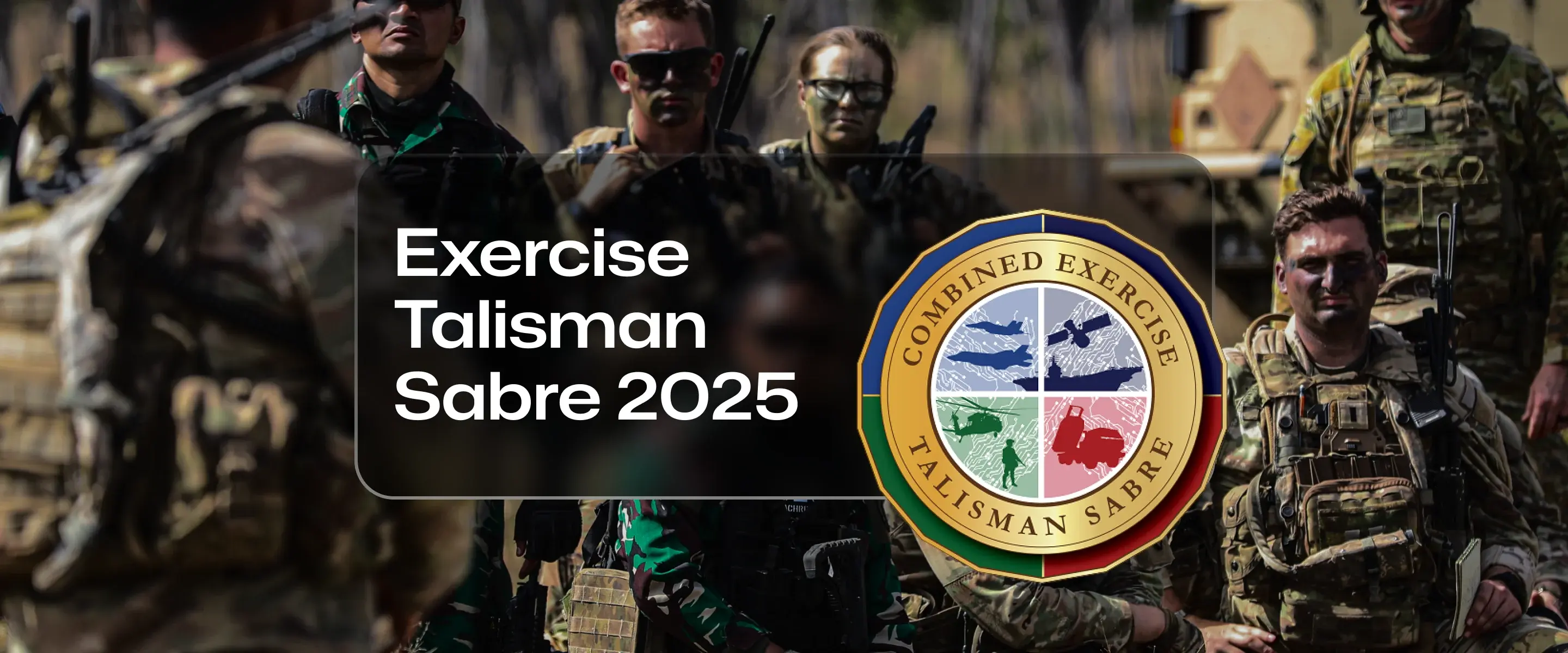
Exercise Talisman Sabre 2025 is a biennial Australia–US military exercise, now the largest of its kind Held since 2005, it has grown into a multinational joint military drill to boost combat readiness and Indo-Pacific defence cooperation In July 2025 the drill spans an unprecedented scale – over 35,000 personnel from 19 countries, with India participating for the first time.
These war games include live-fire exercises, amphibious landings, and multi-domain operations (land, sea, air, cyber and space) Notably, training has expanded beyond Australia into Papua New Guinea for the first time. The 2025 edition showcases advanced capabilities (e.g. HIMARS rocket systems) and realistic combat simulations, testing logistics and coordination across vast distances. It underscores alliance interoperability and Australia’s commitment to a “free, open and inclusive” regional security architecture
Why in the News?
India’s First Participation: India is joining the exercise for the first time, participating in the 11th edition of Exercise Talisman Sabre 2025 highlighting its growing role in regional security.
Record Scale: This 11th edition is record-breaking, involving over 35,000 troops from 19 nations including Australia, US, India, Japan, France, UK, and others, showcasing enhanced multinational coordination and capability.
Indo-Pacific Defence Cooperation: The drill reinforces a “free, open and inclusive” Indo-Pacific by enhancing readiness and interoperability among allies
Regional Tensions: The timing coincides with Chinese surveillance off Australian coast and high-level diplomacy (Australia’s leader was visiting China), underlining its strategic significance.
Join our WhatsApp Community
Overview of Exercise Talisman Sabre 2025
Origins & Frequency: Launched in 2005 as a bilateral Australia–US military exercise, Talisman Sabre is held every two years It has since expanded to multinational joint military drill including many Indo-Pacific partners of the Australian Coast.
2025 Edition: The 2025 drills are the largest ever, with 35,000+ military personnel from 19 countries. Malaysia and Vietnam also attend as observers.
Objectives: The primary goals are to enhance joint warfighting capability and reinforce the regional security architecture – essentially supporting a free, open Indo-Pacific Participants practice crisis-response and coordinated operations across domains. In other words, It aims to promote a free, open, and inclusive Indo-Pacific, enhance military readiness, interoperability, joint operational capability and reinforce the regional security architecture among allied nations.
Key Activities: Drills include live-fire artillery and missile exercises, amphibious landings, combined ground maneuvers, air combat sorties, naval operations and force-preparation training. These realistic scenarios test interoperability and high-end warfighting tactics.
Participating Nations and Forces
According to official sources, 19 countries are actively participating in Talisman Sabre 2025, reflecting broad coalition engagement. The following table groups the participating militaries:
Category | Countries |
Allies & Asia-Pacific | Australia (host), United States, United Kingdom, Canada, India, Japan, South Korea, Indonesia, Singapore, Thailand, Philippines |
Europe | France, Germany, Netherlands, Norway |
Pacific | New Zealand, Fiji, Papua New Guinea, Tonga |
Observers | Malaysia, Vietnam |
Source: Talisman Sabre 2025 announcements.
Quad and Major Allies: The exercise includes the Quad members (Australia, India, Japan, USA) and key allies like the UK, Canada and several European partners.
Regional Reach: Indo-Pacific partners (e.g. Indonesia, South Korea, Thailand, Philippines) and Pacific neighbours (Fiji, PNG, Tonga, New Zealand) also participate.
Scale of Collaboration: Such extensive involvement underscores the emphasis on coalition interoperability across geographies.
Add as a preferred Source on Google
Key Locations and Training Areas
Shoalwater Bay (Queensland): The main training ground, featuring vast live-fire ranges for ground forces and amphibious operations.
Coral Sea & Coastal Waters: Used for naval maneuvers and amphibious landings.
Northern Territory & Other Ranges: The NT’s vast tracts and other land areas support ground combat and special-ops drills.
Christmas Island & PNG: For the first time, parts of the exercise extend to Papua New Guinea. PNG’s inclusion marks a historic expansion beyond the Australian coast and territory.
Air Bases: Multiple Royal Australian Air Force bases across Australia host aircraft deployments and simulated air combat exercises.
High-Level Visits and Diplomatic Engagements
Albanese’s China visit: The commencement of Talisman Sabre 2025 coincided with PM Anthony Albanese’s Shanghai–Beijing trip, showcasing Australia’s dual diplomatic and military posture.
Global attention: These drills have drawn visits from U.S. and Quad officials, highlighting the exercise's significance.
Diplomacy vs. deterrence: Even as military operations take place, diplomatic talks continue—Albanese assured Xi that surveillance would not be contentious while reinforcing strategic readiness.
Allied visits: Officials from the U.S., Japan, and Canada toured training areas, reinforcing support and strengthening Indo-Pacific defence cooperation.
Historical Context and Evolution
Origins: The first Talisman Sabre exercise was held in 2005, then as a bilateral Australia–US military exercise. Early editions focused on basic interoperability exercises.
Growth Over Time: Each iteration expanded in size and complexity. More countries joined over the years, evolving the drill into a major multinational exercise. The 2025 edition is 11th and largest to date.
Technological Advancement: Over two decades, the drills have incorporated increasingly sophisticated elements – from simple field ops to modern domains like cyber and space This mirrors the changing nature of warfare.
Strengthening Alliances: Historically, Talisman Sabre reflects Australia’s deepening military ties not only with the U.S. but also with new partners. Its history underscores enduring commitment to joint defence readiness.
Future Implications for Regional Security
Deterrence and Balance: The exercise sends a clear message of collective resolve. It may deter potential coercion in the region, especially amid China’s growing assertiveness and Chinese surveillance.
Allied Coordination: Outcomes will inform future force planning among allies. Improved tactics and trust will carry over to other combined operations or crisis responses in the Indo-Pacific.
Strategic Signaling: Talisman Sabre’s sheer scale and inclusiveness reaffirm Australia’s leading role in regional security. It may encourage other nations to strengthen their own defences and alliances.
Policy Influence: Insights from 2025 may influence defence budgets and policy (e.g. greater investment in certain capabilities). The exercise underscores the need for continued Indo-Pacific cooperation to address evolving threats.
Impact of Exercise Talisman Sabre 2025 on India
Overview
India’s first-ever active participation in Talisman Sabre marks a historic shift from its previous observer-only role in 2023, reflecting a more assertive strategic posture.
It strengthens India-Australia defence ties, stemming from the India–Australia 2+2 ministerial dialogue, elevating their partnership into multilateral operational formats.
Strategic & Operational Benefits
Benefit Area | Details |
Operational Readiness | Joint drills in amphibious landings, live-fire, cyber, maritime and air combat enhance India’s readiness and modern warfare capability. |
Interoperability & Strategic Partnerships | Operating alongside Quad partners (Australia, USA, Japan) and European forces boosts interoperability across multi-domain operations. |
Joint Warfare Doctrine Exposure | India benefits from Australia’s institutionalized joint warfare experience, accelerating doctrinal reforms in India’s emerging theatre-command structure. |
Technology & Capability Upgradation | Exposure to interoperable platforms like HIMARS, NASAMS and complex logistics; offers opportunities for indigenous R&D and defence industry collaboration. |
Diplomatic Significance | Participation projects India as a proactive Indo‑Pacific security stakeholder. It supports India’s ambition as a net security provider and consolidates its role alongside Quad nations. |
Broader Regional Implications
The exercise aligns with India’s "Year of Defence Reforms 2025", enabling faster institutional, technological and doctrinal modernization across armed services.
Reflecting India’s evolving maritime footprint, participation underscores its contribution to regional deterrence, complementing naval deployments in the Indian Ocean Region and joint naval exercises such as Malabar and AustraHind.
What is Exercise Talisman Sabre 2025?
How many nations are participating in Talisman Sabre 2025?
What are the key locations for Talisman Sabre 2025?
What are the strategic objectives of Talisman Sabre 2025 for Australia?
How is China involved in Talisman Sabre 2025?
Exercise Talisman Sabre 2025 is a landmark event in multinational defence cooperation. Involving over 35,000 troops from 19 nations.It exemplifies joint readiness across land, sea, air, cyber and space. For Australia and its partners, the drills reinforce alliances and operational capability in the Indo-Pacific.
From live-fire naval battles to air combat sorties and cyber warfare training, the exercise covers the full spectrum of modern warfighting. As India joins for the first time and exercises extend to Papua New Guinea, Talisman Sabre 2025 highlights a shared commitment to a stable, secure region The lessons and alliances forged here will shape regional security dynamics in the years ahead.
Internal Linking Suggestions
How to Begin Your UPSC Preparation : The Ultimate Guide For Beginners
UPSC Previous Year Question Papers with Answers PDF - Prelims & Mains (2014-2024)
NITI Aayog UPSC: Composition, Functions, Challenges and Initiatives
Important Polity topics for Prelims
Indian Monsoons: Patterns, Types, Impacts, Regional Disparities & UPSC Relevance
How to Prepare Current Affairs for UPSC Exam: A Comprehensive Guide
51st G7 Summit 2025 – Countries, Key Issues, India’s Role & UPSC
17th BRICS Summit 2025: Host Country, Outcomes, Global South & India’s Strategic Role
External Linking Suggestions
UPSC Official Website – Syllabus & Notification: https://upsc.gov.in/
Press Information Bureau – Government Announcements: https://pib.gov.in/
NCERT Official Website – Standard Books for UPSC: https://ncert.nic.in





Research methodology
PadhAI's research methodology ensures every article is accurate, UPSC-ready, and beginner-friendly. We curate current affairs analysis based on UPSC exam relevance by cross-referencing The Hindu, Indian Express, and PIB. General Studies (GS) topics are drafted from NCERTs and standard books such as M. Laxmikanth, Spectrum, and GC Leong, then reviewed by subject matter experts to eliminate factual errors. Additionally, we update aspirants with verified government exam notifications alongside expert blogs suggesting the best resources, syllabus, and comprehensive Prelims and Mains strategies.


Gajendra Singh Godara is an IIT Bombay graduate and a UPSC aspirant with 4 attempts, including multiple Prelims and Mains appearances. He specializes in Polity, Modern History, International Relations, and Economy. At PadhAI, Gajendra leverages his firsthand exam experience to simplify complex concepts, creating high-efficiency study materials that help aspirants save time and stay focused.
No comments yet. Be the first to join the discussion!