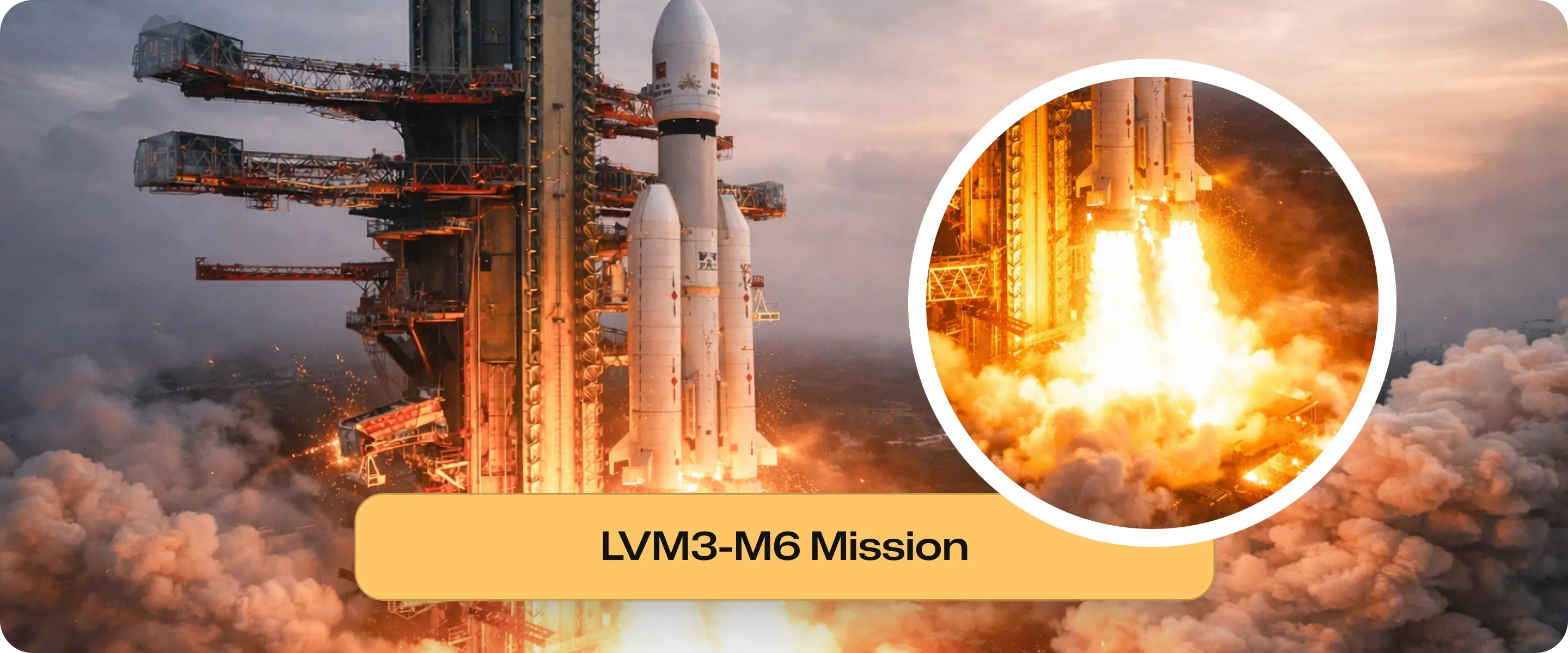
LVM3-M6 Mission: ISRO Launched Heaviest Satellite BlueBird Block-2

ISRO’s LVM3-M6 mission successfully launches the 6100kg BlueBird Block-2. Learn about India’s heaviest satellite launch, Cryogenic engine and 5G connectivity impact.

UPSC Prelims

Current affairs

Latest Update

Gajendra Singh Godara

Dec 24, 2025

4

mins read

ISRO LVM3-M6 Mission

Highlights of LVM3-M6 Mission

Highlights of LVM3-M6 Mission

Highlights of LVM3-M6 Mission

Highlights of LVM3-M6 Mission

  • Record-Breaking Payload: ISRO launched its heaviest-ever satellite, BlueBird Block-2, weighing approximately 6,100 kg, surpassing all previous Indian launch records.

  • Direct-to-Cellular Tech: The mission deployed a revolutionary satellite designed by AST SpaceMobile to provide 4G/5G connectivity directly to standard smartphones globally.

  • Commercial Milestone: This marks the third commercial success for the LVM3, positioning India as a low-cost, reliable alternative to SpaceX and the ESA.

  • Rapid Operational Turnaround: Achieving the shortest gap between two LVM3 launches (following CMS-03), ISRO demonstrated its capability for high-frequency, heavy-lift missions.

  • Path to Space Station: Future LVM3 upgrades, like semi-cryogenic engines, will boost capacity to 10,000 kg to support the upcoming Bharatiya Antariksh Station.

Why in the news?

  • The Indian Space Research Organisation (ISRO) has once again pushed the boundaries of space exploration with the successful LVM3-M6 Mission

  • On December 24, 2025, at 8:24 am, India's heaviest-ever satellite, the BlueBird Block-2, was launched into space from the Satish Dhawan Space Centre in Sriharikota.

  • It is a significant milestone in India’s commercial space journey and its future ambitions, including the Bharatiya Antariksh Station.
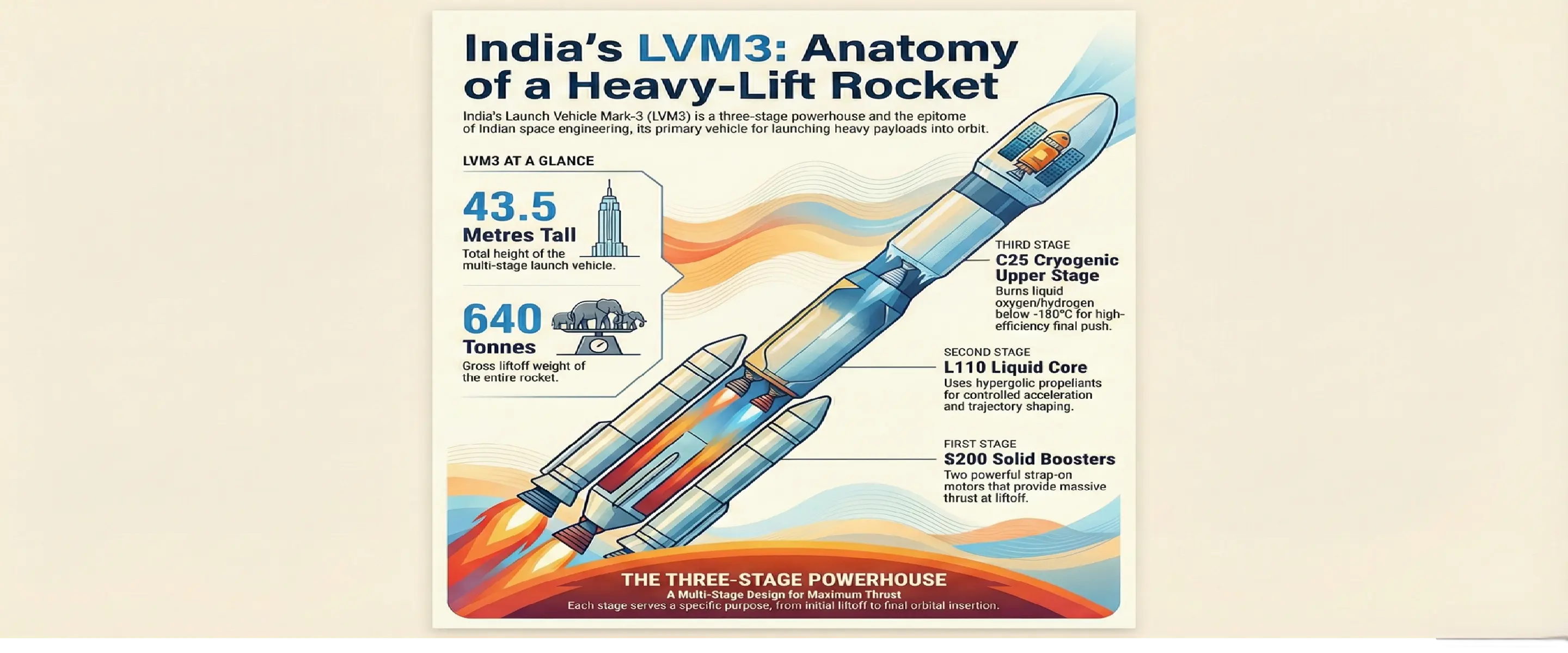
LVM 3 India’s Heavy-Lift Launch Vehicle

What is the LVM3-M6 Mission?

What is the LVM3-M6 Mission?

What is the LVM3-M6 Mission?

What is the LVM3-M6 Mission?

The LVM3-M6 Mission is a dedicated commercial flight of the Launch Vehicle Mark-3 (LVM3). This mission marks the sixth operational flight of this launch vehicle, demonstrating India's growing reliability in the global "heavy-lift" market.

The primary objective was to deploy the BlueBird Block-2 satellite into a Low Earth Orbit (LEO) at an altitude of approximately 520 km. This was achieved just 15 minutes after liftoff.

Understanding India’s Heavy-Lift Launch Vehicle (LVM3)

The LVM3 is a three-stage powerhouse designed to carry heavy payloads. Standing 43.5 metres tall and weighing 640 tonnes, it is the epitome of Indian space engineering.

Stage

Name

Description

First Stage

S200 Solid Boosters

Two powerful strap-on motors provide massive thrust at liftoff.

Second Stage

L110 Liquid Core

Uses hypergolic propellants for controlled acceleration and trajectory shaping.

Third Stage

C25 Cryogenic Upper Stage

Burns liquid oxygen and hydrogen at temperatures below -180°C for high efficiency.

BlueBird Block-2: ISRO’s Heaviest Satellite to Date

BlueBird Block-2: ISRO’s Heaviest Satellite to Date

BlueBird Block-2: ISRO’s Heaviest Satellite to Date

BlueBird Block-2: ISRO’s Heaviest Satellite to Date

A major highlight of this mission is the payload itself. At approximately 6,100 kg, the BlueBird Block-2 is ISRO’s heaviest satellite ever launched into orbit. It surpassed the previous record held by the OneWeb satellite sets, which weighed around 5,700 kg.
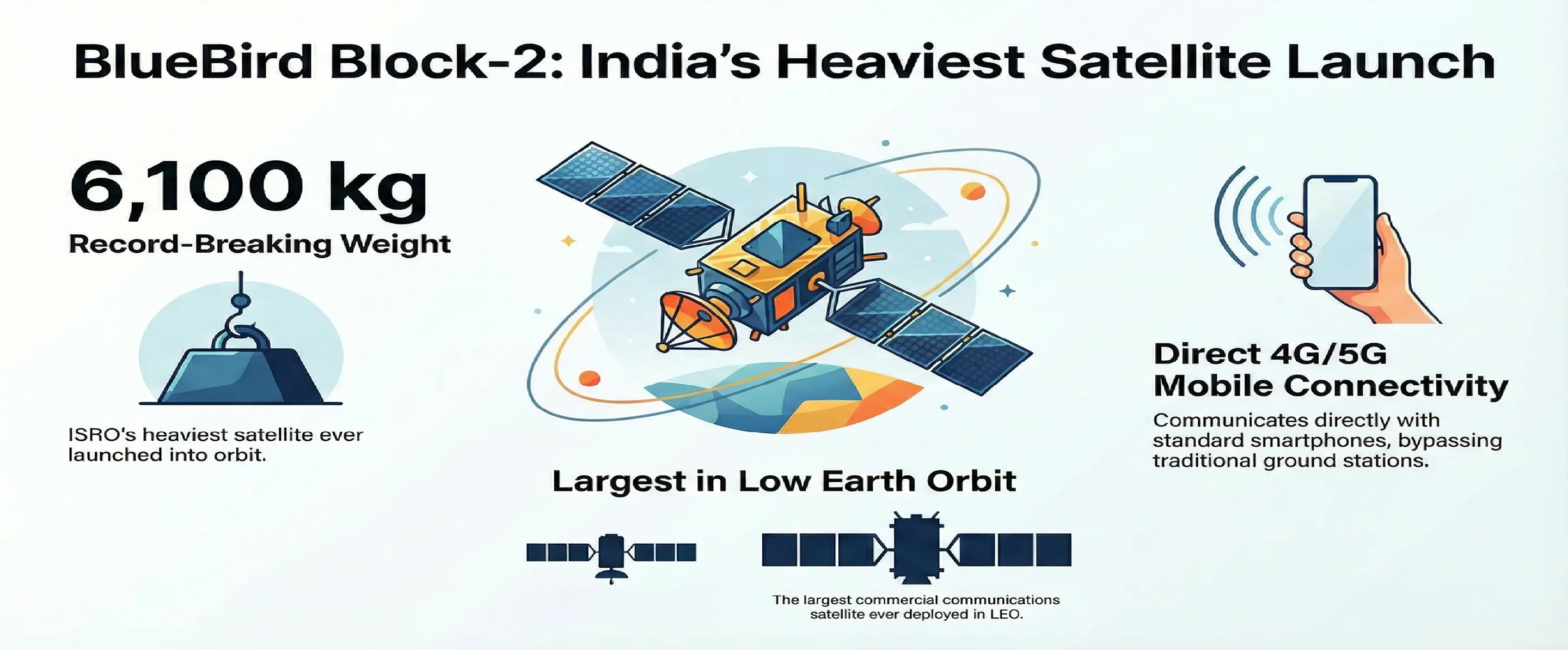
BlueBird Black 2

Why is BlueBird Block-2 Special?

Designed by the US-based company AST SpaceMobile, this satellite is part of a revolutionary constellation.

  • Direct-to-Mobile Connectivity: Unlike traditional satellites that need ground stations, this constellation communicates directly with standard smartphones.

  • Global Reach: It enables 4G and 5G voice, video, and data services for "everyone, everywhere, at all times"

  • Size: It is the largest commercial communications satellite ever deployed in Low Earth Orbit.

NISAR Mission NASA ISRO

Future-Proofing: Upgrading LVM3 Engines

Future-Proofing: Upgrading LVM3 Engines

Future-Proofing: Upgrading LVM3 Engines

Future-Proofing: Upgrading LVM3 Engines

ISRO is not stopping here. To support the upcoming Gaganyaan (human spaceflight) mission and the construction of the Bharatiya Antariksh Station, the LVM3 is undergoing significant upgrades.

  1. More Power (C32 Stage): ISRO is working on the C32 cryogenic stage, which will carry 32,000 kg of fuel (up from 28,000 kg) to increase thrust to 22 tonnes.

  2. Semi-Cryogenic Engine: There are plans to replace the second-stage liquid propellant with a semi-cryogenic engine using refined kerosene and liquid oxygen. This will boost the LEO payload capacity from 8,000 kg to 10,000 kg, essential for launching space station modules.

  3. Bootstrap Reignition: This new technology allows the cryogenic engine to restart on its own without external gases. This is vital for missions where multiple satellites must be placed in different orbits. This reduces reliance on limited onboard gas supplies, extending the mission life.

VB-G RAM G Bill

Strategic Significance of LVM3-M6 Mission for India

Strategic Significance of LVM3-M6 Mission for India

Strategic Significance of LVM3-M6 Mission for India

Strategic Significance of LVM3-M6 Mission for India

The LVM3-M6 Mission is a clear signal of India's rising dominance in the global space economy.

  • Cost Efficiency: While heavy-lift options like SpaceX’s Falcon-9 and ESA’s Ariane-6 exist, ISRO is proving it can execute these launches at a significantly lower cost.

  • Rapid Turnaround: This launch occurred shortly after the CMS-03 mission on November 2, 2025 This short gap proves ISRO's capability to assemble and launch heavy missions rapidly.

  • Commercial Reliability: Following the success of the OneWeb missions, this third commercial LVM3 flight solidifies India as a trusted partner for international satellite deployments.

Shanti Bill

Frequently asked question (FAQs)

What is the LVM3 M6 mission?
Which is the heaviest rocket of ISRO?
What is the primary difference between LEO and GTO?
What is the BlueBird mission?
What is the Bharatiya Antariksh Station?



Latest UPSC Exam 2025 Updates

Latest UPSC Exam 2025 Updates

Latest UPSC Exam 2025 Updates

UPSC Calendar 2026 is released on 15th May, 2025.

UPSC Mains Result 2025 is now released.

Check out the updated and latest UPSC Syllabus 2026 here.

UPSC Notification 2025 was released on 22nd January 2025.

UPSC Prelims 2026 will be conducted on 24th May, 2026 & UPSC Mains 2026 will be conducted on 21st August 2026.

The UPSC Prelims 2026 is scheduled for May 24, 2026, while the UPSC Mains 2026 will be conducted from August 21, 2026.

The UPSC Selection Process is of 3 stages-Prelims, Mains and Interview.

UPSC Result 2024 is released with latest UPSC Marksheet 2024. Check Now!

Suggested posts

VB-G RAM G Bill 2025: From MGNREGA to Viksit Bharat 2047

  • Parliament recently passed the VB–G RAM G Bill 2025. This important law replaces the old MGNREGA, which lasted for two decades. It aims to connect rural jobs with the Viksit Bharat 2047 vision.

  • The Bill has sparked national debate by increasing the employment guarantee to 125 days while shifting to a 60:40 fund-sharing model and introducing a 60-day mandatory "agricultural pause."

VB-G RAM G Bill 2025 Replaces MGNREGA
  • Parliament recently passed the VB–G RAM G Bill 2025. This important law replaces the old MGNREGA, which lasted for two decades. It aims to connect rural jobs with the Viksit Bharat 2047 vision.

  • The Bill has sparked national debate by increasing the employment guarantee to 125 days while shifting to a 60:40 fund-sharing model and introducing a 60-day mandatory "agricultural pause."

VB-G RAM G Bill 2025: From MGNREGA to Viksit Bharat 2047

  • Parliament recently passed the VB–G RAM G Bill 2025. This important law replaces the old MGNREGA, which lasted for two decades. It aims to connect rural jobs with the Viksit Bharat 2047 vision.

  • The Bill has sparked national debate by increasing the employment guarantee to 125 days while shifting to a 60:40 fund-sharing model and introducing a 60-day mandatory "agricultural pause."

VB-G RAM G Bill 2025 Replaces MGNREGA
  • Parliament recently passed the VB–G RAM G Bill 2025. This important law replaces the old MGNREGA, which lasted for two decades. It aims to connect rural jobs with the Viksit Bharat 2047 vision.

  • The Bill has sparked national debate by increasing the employment guarantee to 125 days while shifting to a 60:40 fund-sharing model and introducing a 60-day mandatory "agricultural pause."

Atomic Energy Bill 2025 (SHANTI Bill): Nuclear Power Sector

India is rewriting its nuclear energy rules. The Union Cabinet has approved the Atomic Energy Bill, 2025, officially branded as the SHANTI Bill. This legislation ends the government's decades-old monopoly on nuclear power generation. It opens the doors for private companies to build, own, and operate nuclear plants.

Here is a breakdown of what the SHANTI Bill means for India’s energy future.

Atomic Energy Bill ( Shanti Bill )

India is rewriting its nuclear energy rules. The Union Cabinet has approved the Atomic Energy Bill, 2025, officially branded as the SHANTI Bill. This legislation ends the government's decades-old monopoly on nuclear power generation. It opens the doors for private companies to build, own, and operate nuclear plants.

Here is a breakdown of what the SHANTI Bill means for India’s energy future.

Atomic Energy Bill 2025 (SHANTI Bill): Nuclear Power Sector

India is rewriting its nuclear energy rules. The Union Cabinet has approved the Atomic Energy Bill, 2025, officially branded as the SHANTI Bill. This legislation ends the government's decades-old monopoly on nuclear power generation. It opens the doors for private companies to build, own, and operate nuclear plants.

Here is a breakdown of what the SHANTI Bill means for India’s energy future.

Atomic Energy Bill ( Shanti Bill )

India is rewriting its nuclear energy rules. The Union Cabinet has approved the Atomic Energy Bill, 2025, officially branded as the SHANTI Bill. This legislation ends the government's decades-old monopoly on nuclear power generation. It opens the doors for private companies to build, own, and operate nuclear plants.

Here is a breakdown of what the SHANTI Bill means for India’s energy future.

Australia Bans Social Media for Under-16s: A Global First

The Australian government has passed legislation that makes it illegal for social media platforms to allow children under 16 to hold accounts. This strict new law shifts the responsibility entirely onto tech giants. It demands that they redesign their systems to protect young users from online harms.

Here is a detailed breakdown of how Australia bans social media for minors and what this means for digital privacy and safety globally.

Australia Social Media Ban

The Australian government has passed legislation that makes it illegal for social media platforms to allow children under 16 to hold accounts. This strict new law shifts the responsibility entirely onto tech giants. It demands that they redesign their systems to protect young users from online harms.

Here is a detailed breakdown of how Australia bans social media for minors and what this means for digital privacy and safety globally.

Australia Bans Social Media for Under-16s: A Global First

The Australian government has passed legislation that makes it illegal for social media platforms to allow children under 16 to hold accounts. This strict new law shifts the responsibility entirely onto tech giants. It demands that they redesign their systems to protect young users from online harms.

Here is a detailed breakdown of how Australia bans social media for minors and what this means for digital privacy and safety globally.

Australia Social Media Ban

The Australian government has passed legislation that makes it illegal for social media platforms to allow children under 16 to hold accounts. This strict new law shifts the responsibility entirely onto tech giants. It demands that they redesign their systems to protect young users from online harms.

Here is a detailed breakdown of how Australia bans social media for minors and what this means for digital privacy and safety globally.

a close up of a cell phone with a blurry background

About Author

Gajendra Singh Godara

Growth | FTE| Resident at SigIQ

Gajendra Singh Godara brings authentic UPSC preparation insights from his four-attempt journey, having successfully cleared Prelims and written Mains multiple times. His deep expertise spans Polity, Modern History, International Relations, and Economy. At PadhAI, Gajendra transforms his extensive exam experience into accessible content that simplifies complex concepts for aspirants at every preparation stage. His firsthand understanding of UPSC's demands enables him to create targeted materials that save time while maximizing learning efficiency for current affairs, general studies, and optional subjects.

a close up of a cell phone with a blurry background

About Author

Gajendra Singh Godara

Growth | FTE| Resident at SigIQ

Gajendra Singh Godara brings authentic UPSC preparation insights from his four-attempt journey, having successfully cleared Prelims and written Mains multiple times. His deep expertise spans Polity, Modern History, International Relations, and Economy. At PadhAI, Gajendra transforms his extensive exam experience into accessible content that simplifies complex concepts for aspirants at every preparation stage. His firsthand understanding of UPSC's demands enables him to create targeted materials that save time while maximizing learning efficiency for current affairs, general studies, and optional subjects.

a close up of a cell phone with a blurry background

About Author

Gajendra Singh Godara

Growth | FTE| Resident at SigIQ

Gajendra Singh Godara brings authentic UPSC preparation insights from his four-attempt journey, having successfully cleared Prelims and written Mains multiple times. His deep expertise spans Polity, Modern History, International Relations, and Economy. At PadhAI, Gajendra transforms his extensive exam experience into accessible content that simplifies complex concepts for aspirants at every preparation stage. His firsthand understanding of UPSC's demands enables him to create targeted materials that save time while maximizing learning efficiency for current affairs, general studies, and optional subjects.

a close up of a cell phone with a blurry background

About Author

Gajendra Singh Godara

Growth | FTE| Resident at SigIQ

Gajendra Singh Godara brings authentic UPSC preparation insights from his four-attempt journey, having successfully cleared Prelims and written Mains multiple times. His deep expertise spans Polity, Modern History, International Relations, and Economy. At PadhAI, Gajendra transforms his extensive exam experience into accessible content that simplifies complex concepts for aspirants at every preparation stage. His firsthand understanding of UPSC's demands enables him to create targeted materials that save time while maximizing learning efficiency for current affairs, general studies, and optional subjects.

PadhAI UPSC App

We're PadhAI - a free UPSC prep app built by IITians, AI PhDs & top UPSC experts.

Why choose PadhAI?

Read daily top news (TH & IE) & Solve Current Affairs MCQs
Topic-wise search of 30+ yrs PYQs
24×7 AI tutor for doubt resolution
Practice 30k+ MCQs & full GS + CSAT mocks
Play Duel UPSC quizzes with fellow aspirants

Why choose PadhAI?

Read daily top news (TH & IE) & Solve Current Affairs MCQs

Topic-wise search of 30+ yrs PYQs

24×7 AI tutor for doubt resolution

Practice 30k+ MCQs & full GS + CSAT mocks

Play Duel UPSC quizzes with fellow aspirants

PadhAI UPSC App

We're PadhAI - a free UPSC prep app built by IITians, AI PhDs & top UPSC experts.

Why choose PadhAI?

Read daily top news (TH & IE) & Solve Current Affairs MCQs

Topic-wise search of 30+ yrs PYQs

24×7 AI tutor for doubt resolution

Practice 30k+ MCQs & full GS + CSAT mocks

Play Duel UPSC quizzes with fellow aspirants

PadhAI UPSC App

We're PadhAI - a free UPSC prep app built by IITians, AI PhDs & top UPSC experts.

Suggested posts

VB-G RAM G Bill 2025 Replaces MGNREGA

VB-G RAM G Bill 2025: From MGNREGA to Viksit Bharat 2047

  • Parliament recently passed the VB–G RAM G Bill 2025. This important law replaces the old MGNREGA, which lasted for two decades. It aims to connect rural jobs with the Viksit Bharat 2047 vision.

  • The Bill has sparked national debate by increasing the employment guarantee to 125 days while shifting to a 60:40 fund-sharing model and introducing a 60-day mandatory "agricultural pause."

Atomic Energy Bill ( Shanti Bill )

Atomic Energy Bill 2025 (SHANTI Bill): Nuclear Power Sector

India is rewriting its nuclear energy rules. The Union Cabinet has approved the Atomic Energy Bill, 2025, officially branded as the SHANTI Bill. This legislation ends the government's decades-old monopoly on nuclear power generation. It opens the doors for private companies to build, own, and operate nuclear plants.

Here is a breakdown of what the SHANTI Bill means for India’s energy future.

Australia Social Media Ban

Australia Bans Social Media for Under-16s: A Global First

The Australian government has passed legislation that makes it illegal for social media platforms to allow children under 16 to hold accounts. This strict new law shifts the responsibility entirely onto tech giants. It demands that they redesign their systems to protect young users from online harms.

Here is a detailed breakdown of how Australia bans social media for minors and what this means for digital privacy and safety globally.

VB-G RAM G Bill 2025 Replaces MGNREGA

VB-G RAM G Bill 2025: From MGNREGA to Viksit Bharat 2047

  • Parliament recently passed the VB–G RAM G Bill 2025. This important law replaces the old MGNREGA, which lasted for two decades. It aims to connect rural jobs with the Viksit Bharat 2047 vision.

  • The Bill has sparked national debate by increasing the employment guarantee to 125 days while shifting to a 60:40 fund-sharing model and introducing a 60-day mandatory "agricultural pause."

Atomic Energy Bill ( Shanti Bill )

Atomic Energy Bill 2025 (SHANTI Bill): Nuclear Power Sector

India is rewriting its nuclear energy rules. The Union Cabinet has approved the Atomic Energy Bill, 2025, officially branded as the SHANTI Bill. This legislation ends the government's decades-old monopoly on nuclear power generation. It opens the doors for private companies to build, own, and operate nuclear plants.

Here is a breakdown of what the SHANTI Bill means for India’s energy future.

Australia Social Media Ban

Australia Bans Social Media for Under-16s: A Global First

The Australian government has passed legislation that makes it illegal for social media platforms to allow children under 16 to hold accounts. This strict new law shifts the responsibility entirely onto tech giants. It demands that they redesign their systems to protect young users from online harms.

Here is a detailed breakdown of how Australia bans social media for minors and what this means for digital privacy and safety globally.

World Inequality Report 2026

World Inequality Report 2026: India’s Rising Wealth Gap

  • The World Inequality Report 2026, released by the World Inequality Lab, reveals alarming disparities globally and in India. In India, the top 10% earn 58% of national income while the bottom 50% earn only 15%.

  • The report highlights widening income, wealth, gender, and climate inequalities, demanding urgent policy intervention for inclusive growth and social justice.

  • This is the 3rd edition of World Inequality Report after 2018 and 2022.

Download PadhAI App

Don't get left behind in your preparation

Download PadhAI App

Don't get left behind in your preparation

Download PadhAI App

Don't get left behind in your preparation

Download PadhAI App

Don't get left behind in your preparation

PadhAI is a product of SigIQ AI, and Metayb is a recognized reseller authorized to sell PadhAI subscriptions.
Address
3rd floor, Electrical and Electronic, ALG Towers, Plot no. 48, main road, Industrial Estate, Perungudi, Chennai, Tamil Nadu 600096
© 2025-2026, All Rights Reserved
PadhAI is a product of SigIQ AI, and Metayb is a recognized reseller authorized to sell PadhAI subscriptions.
Address
3rd floor, Electrical and Electronic, ALG Towers, Plot no. 48, main road, Industrial Estate, Perungudi, Chennai, Tamil Nadu 600096
© 2025-2026, All Rights Reserved
PadhAI is a product of SigIQ AI, and Metayb is a recognized reseller authorized to sell PadhAI subscriptions.
Address
3rd floor, Electrical and Electronic, ALG Towers, Plot no. 48, main road, Industrial Estate, Perungudi, Chennai, Tamil Nadu 600096
© 2025-2026, All Rights Reserved
PadhAI is a product of SigIQ AI, and Metayb is a recognized reseller authorized to sell PadhAI subscriptions.
Address
3rd floor, Electrical and Electronic, ALG Towers, Plot no. 48, main road, Industrial Estate, Perungudi, Chennai, Tamil Nadu 600096
© 2025-2026, All Rights Reserved

Current Affairs

UPSC Resources

UPSC updates

General studies

UPSC Preparation