VB-G RAM G Bill 2025: From MGNREGA to Viksit Bharat 2047
Parliament passes VB-G RAM G Bill 2025 replacing MGNREGA. Key differences include a 125-day employment guarantee, 60:40 funding model, agricultural pause.

Gajendra Singh Godara
Last updated
6
mins read

Parliament recently passed the VB–G RAM G Bill 2025. This important law replaces the old MGNREGA, which lasted for two decades. It aims to connect rural jobs with the Viksit Bharat 2047 vision.
The Bill has sparked national debate by increasing the employment guarantee to 125 days while shifting to a 60:40 fund-sharing model and introducing a 60-day mandatory "agricultural pause."
The landscape of rural India is witnessing its most significant legislative shift in two decades. With the introduction and passage of the Viksit Bharat – Guarantee for Rozgar and Ajeevika Mission (Gramin), popularly known as the VB–G RAM G Bill, the government has set the stage to replace the Mahatma Gandhi National Rural Employment Guarantee Act (MGNREGA), 2005.
This is not just a mere name change; it is a fundamental restructuring of India's social security architecture. This blog provides a walkthrough into the nuances of the VB–G RAM G Bill 2025, its impact on the rural economy, and the challenges it faces in the journey toward Viksit Bharat 2047.
Join our WhatsApp Community
The VB–G RAM G Bill 2025 (Viksit Bharat – Guarantee for Rozgar and Ajeevika Mission - Gramin) is a comprehensive piece of legislation designed to modernize rural employment. While MGNREGA was born out of a "rights-based" framework to provide a safety net, the new Bill seeks to align rural labor with productive asset creation and national infrastructure goals.
The Vision: Viksit Bharat 2047
At the heart of this transition is the vision of Viksit Bharat 2047. The government aims to transform the rural workforce from being mere wage-seekers into active contributors to a developed India. The Bill integrates rural work with the PM Gati Shakti National Master Plan, ensuring that every hour of manual labor contributes to a larger national asset.
The new legislation introduces several structural changes that differentiate it from its predecessor. Below are the standout features:
1. Enhanced Employment Guarantee
The most highlighted change is the increase in guaranteed workdays.
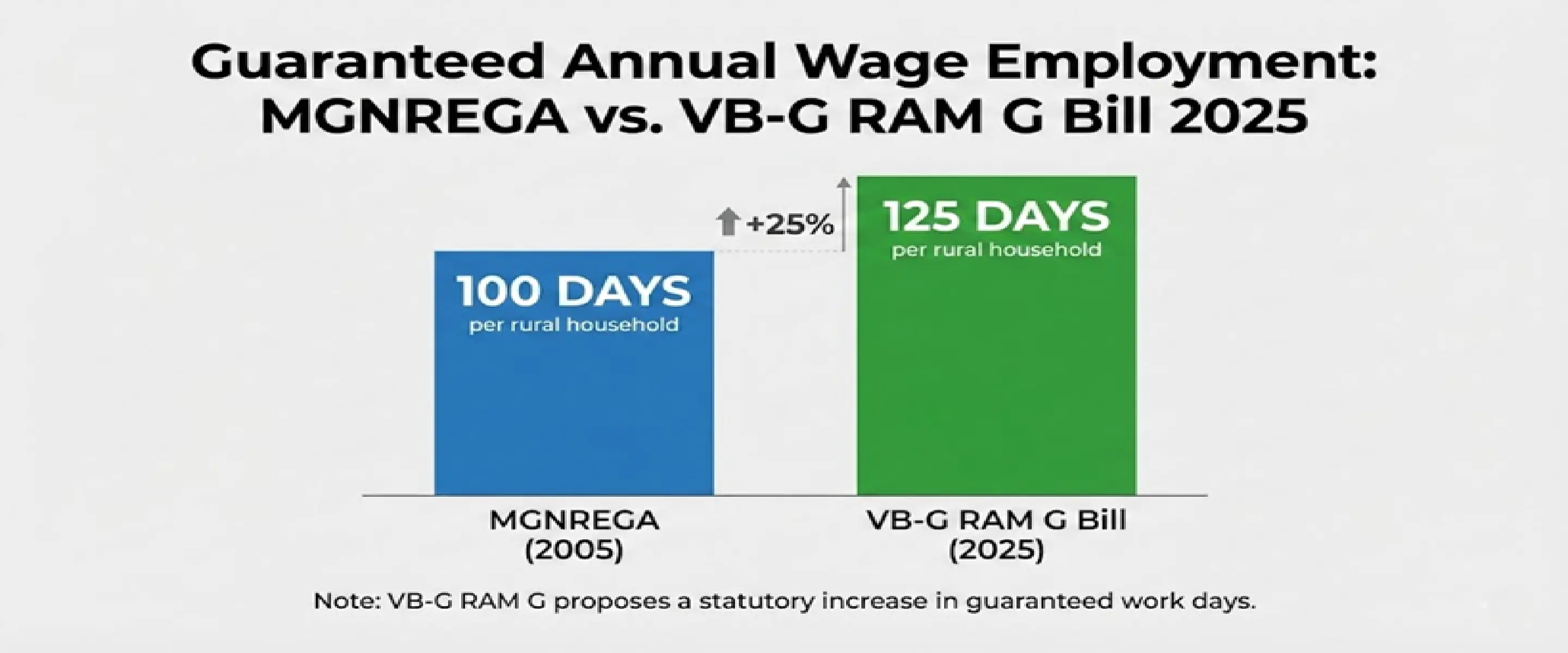
MGNREGA: Guaranteed "not less than 100 days."
VB–G RAM G: Provides a statutory guarantee of 125 days of wage employment per financial year for every rural household.
2. The 60-Day "Agricultural Pause"
Under Section 6(1) of the Bill, State governments can notify a period aggregating to 60 days during peak sowing and harvesting seasons when works under the scheme will be suspended. This "Seasonal Pause" is intended to ensure that the scheme does not compete with private farmers for labor, thereby stabilizing agricultural productivity. The notifications by states may vary by districts, blocks, gram panchayats, agro-climatic zones and local cropping patterns.
3. Shift in Funding Pattern (60:40 Split)
A major departure from the previous model is the financial sharing. Under MGNREGA, the Centre paid 100% of the unskilled wage cost. The VB–G RAM G Bill transforms this into a Centrally Sponsored Scheme (CSS):
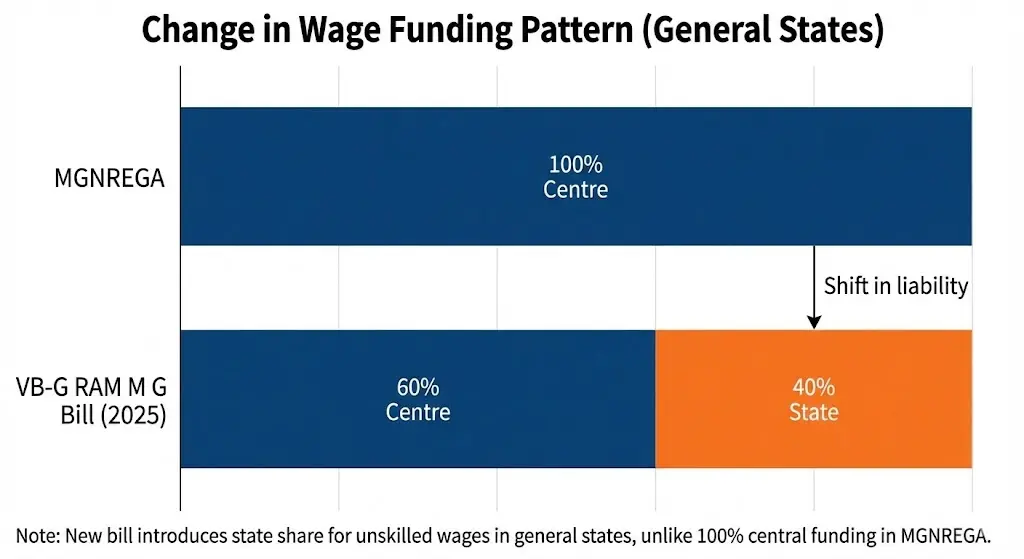
General States: 60% (Centre) : 40% (State)
NE & Himalayan States: 90% (Centre) : 10% (State)
UTs without Legislature: 100% (Centre)
Under MGNREGA, the States were primarily responsible only for providing unemployment allowance, meeting one-fourth of the material costs, and covering state-level administrative expenses.
4. Normative vs. Demand-Driven Allocation
Previously, MGNREGA was "demand-driven"—if more people asked for work, the budget expanded. The new Bill introduces Normative Allocations (Section 4(5)). The Centre will determine state-wise funds based on objective parameters. Any expenditure beyond this cap must be borne entirely by the State government.
Add as a preferred Source on Google
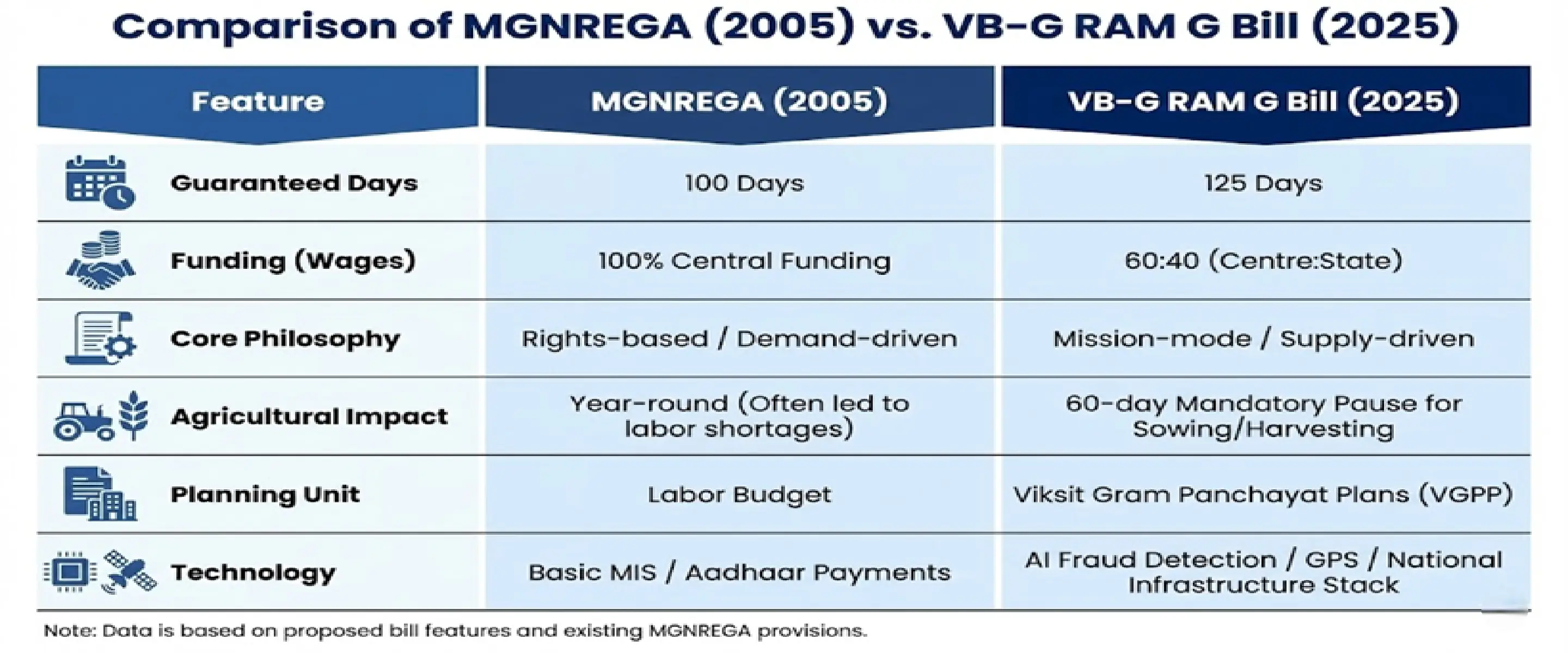
Feature | MGNREGA (2005) | VB–G RAM G Bill (2025) |
Guaranteed Days | 100 Days | 125 Days |
Funding (Wages) | 100% Central Funding | 60:40 (Centre:State) |
Core Philosophy | Rights-based / Demand-driven | Mission-mode / Supply-driven |
Agricultural Impact | Year-round (Often led to labor shortages) | 60-day Mandatory Pause for Sowing/Harvesting |
Planning Unit | Labor Budget | Viksit Gram Panchayat Plans (VGPP) |
Technology | Basic MIS / Aadhaar Payments | AI Fraud Detection / GPS / National Infrastructure Stack |
Understanding the "why" behind the policy is as important as the "what." The VB–G RAM G Bill offers several strategic benefits:
A. Productivity-Linked Assets
Unlike the "dig and fill" criticism often leveled against MGNREGA, the new Bill focuses on four thematic verticals:
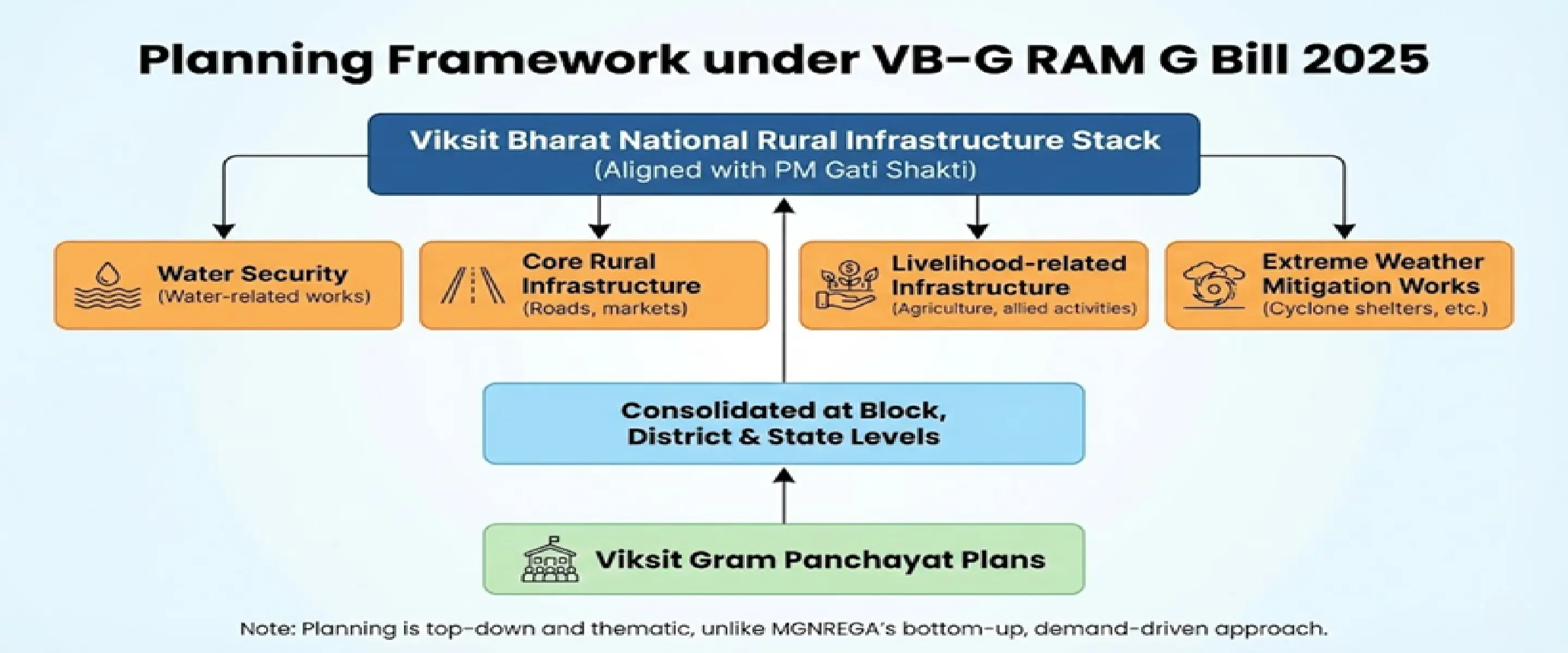
Water Security: Rejuvenation of water bodies and micro-irrigation.
Core Rural Infrastructure: Road connectivity and storage units.
Livelihood Infrastructure: Support for livestock and small-scale agro-processing.
Climate Resilience: Mitigation of extreme weather events like floods and droughts.
B. Strengthening Federalism
By making States pay 40% of the wages, the government argues it creates "skin in the game." States are expected to be more vigilant against leakages and corruption when their own budgets are at stake.
C. Digital Governance and Transparency
The Bill mandates the use of the National Rural Infrastructure Stack. This includes:
Biometric Authentication: To eliminate "ghost workers."
AI-Enabled Analytics: For real-time monitoring and fraud detection.
Weekly Public Disclosures: Enhancing social accountability.
The government introduced the VB–G RAM G Bill to modernize the two-decade-old MGNREGA framework. Key reasons include:
Vision Alignment: Transforming rural employment from a 'welfare safety net' into a 'productivity engine' is central to the government's 2025 legislative agenda, which also includes major reforms like the Atomic Energy Bill 2025 (SHANTI Bill) to power the Viksit Bharat 2047 vision.
Asset Quality: Moving beyond fragmented works to create durable, national-level infrastructure integrated with the PM Gati Shakti plan.
Agricultural Synergy: Addressing long-standing labor shortages by introducing a seasonal pause to support private farming.
Fiscal Accountability: Replacing demand-driven funding with normative allocations and a 60:40 cost-sharing model to curb leakages.
Every major reform comes with its set of hurdles. The VB–G RAM G Bill has sparked intense debate among activists and policy experts:
1. Fiscal Strain on States
The shift to a 40% share for unskilled wages puts a massive burden on state treasuries. States with high rural populations and low revenue bases (like Bihar or Odisha) might find it difficult to sustain the 125-day guarantee, potentially leading to a de facto reduction in work availability.
2. Dilution of the "Right to Work"
Critics argue that moving to a 'normative allocation' model risks excluding vulnerable populations. This is particularly concerning given the disparities highlighted in the World Inequality Report 2026, which underscores the continued need for robust, demand-driven safety nets for the bottom 50%.
3. The "Notification Trap"
Section 5(1) suggests the guarantee applies to areas "as notified by the Central Government." This gives the Centre discretionary power to decide where the scheme operates, unlike the universal application of MGNREGA.
4. Digital Exclusion
While technology reduces corruption, it can also lead to exclusion. Poor internet connectivity in remote villages or biometric failures (especially for manual laborers with worn fingerprints) could deny legitimate workers their livelihood.
As an aspirant, this topic is critical for GS Paper II (Government Policies) and GS Paper III (Economy) of the updated UPSC Syllabus 2026. You should link this Bill to the following constitutional provisions:
Article 41 (DPSP): The State shall, within its economic capacity, make effective provision for securing the Right to Work.
Article 21: Article 21: The Supreme Court has often interpreted the Right to Life to include the Right to Livelihood, a theme recently reiterated during the global observations of Human Rights Day 2025.
Article 40: Organization of Gram Panchayats. The Bill empowers Viksit Gram Panchayats to prepare local plans.
Schedule VII: Both Agriculture and Social Security are areas where Centre and States must coordinate, reflecting the essence of Cooperative Federalism.
Frequently asked question (FAQs)
What is the VB–G RAM G Bill 2025?
What is the full form of the VB–G RAM G Bill?
How many workdays does VB–G RAM G guarantee?
Is the VB–G RAM G Bill passed?
What is the 'National Rural Infrastructure Stack'?
The VB–G RAM G Bill 2025 is an ambitious attempt to pivot India's rural safety net toward a growth-oriented infrastructure mission. While the increase to 125 days and the focus on water security are positive steps, the success of this legislation hinges on how the Centre supports the States in bearing the financial load. The interpretation of these provisions by the Supreme Court, led by Chief Justice Surya Kant, will likely define the future of the 'Right to Work' in India.
The transition from "relief" to "resilience" is the core theme of Viksit Bharat. If implemented with transparency and federal cooperation, the G RAM G Bill could become the engine that drives rural India toward the middle-income status envisioned for 2047.






Research methodology
PadhAI's research methodology ensures every article is accurate, UPSC-ready, and beginner-friendly. We curate current affairs analysis based on UPSC exam relevance by cross-referencing The Hindu, Indian Express, and PIB. General Studies (GS) topics are drafted from NCERTs and standard books such as M. Laxmikanth, Spectrum, and GC Leong, then reviewed by subject matter experts to eliminate factual errors. Additionally, we update aspirants with verified government exam notifications alongside expert blogs suggesting the best resources, syllabus, and comprehensive Prelims and Mains strategies.


No comments yet. Be the first to join the discussion!