Nuclear Milestone of India : Fast Breeder Reactor at Kalpakkam
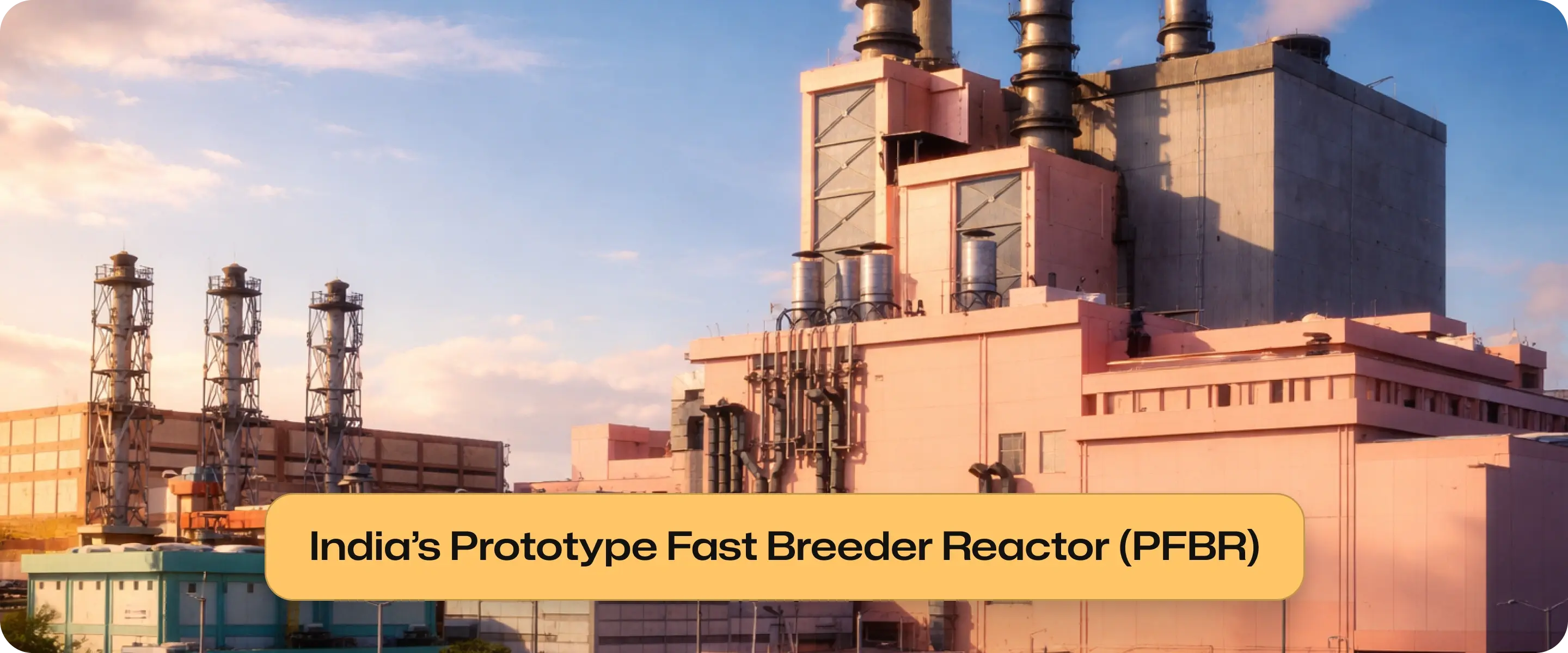
India’s Prototype Fast Breeder Reactor (PFBR) at Kalpakkam marks a historic leap into Stage 2 of its nuclear program. It not only generates power but also produces more fuel, paving the way for long-term energy security.

Gajendra Singh Godara
Last updated
4
mins read
Key highlights
Definition: 500 MWe fast breeder reactor
Location: Kalpakkam, Tamil Nadu
First Criticality milestone: April 6, 2026
Stage 2: Entry into India’s three-stage nuclear program
Fuel Type: MOX (Plutonium + Uranium)
Coolant: Liquid Sodium (fast neutron support)
Core Function: Breeds more fuel than it consumes
Institution: BHAVINI and IGCAR
Strategic Goal: Transition to Stage 3 (Thorium-based reactors)
Global Status: India became second country after Russia with commercial-scale FBR
On 6th April 2026, the Prototype Fast Breeder Reactor (PFBR) at Kalpakkam, Tamil Nadu successfully attained criticality which refers to a nuclear reactor being able to self-sustain a nuclear chain reaction.
It was designed by the Indira Gandhi Centre for Atomic Research (IGCAR) and constructed and operated by BHAVINI (Bharatiya Nabhikiya Vidyut Nigam Limited).
With this, India has achieved an important milestone in its energy independence journey with the country moving to the second stage of its three stage nuclear programme.
Join our WhatsApp Community
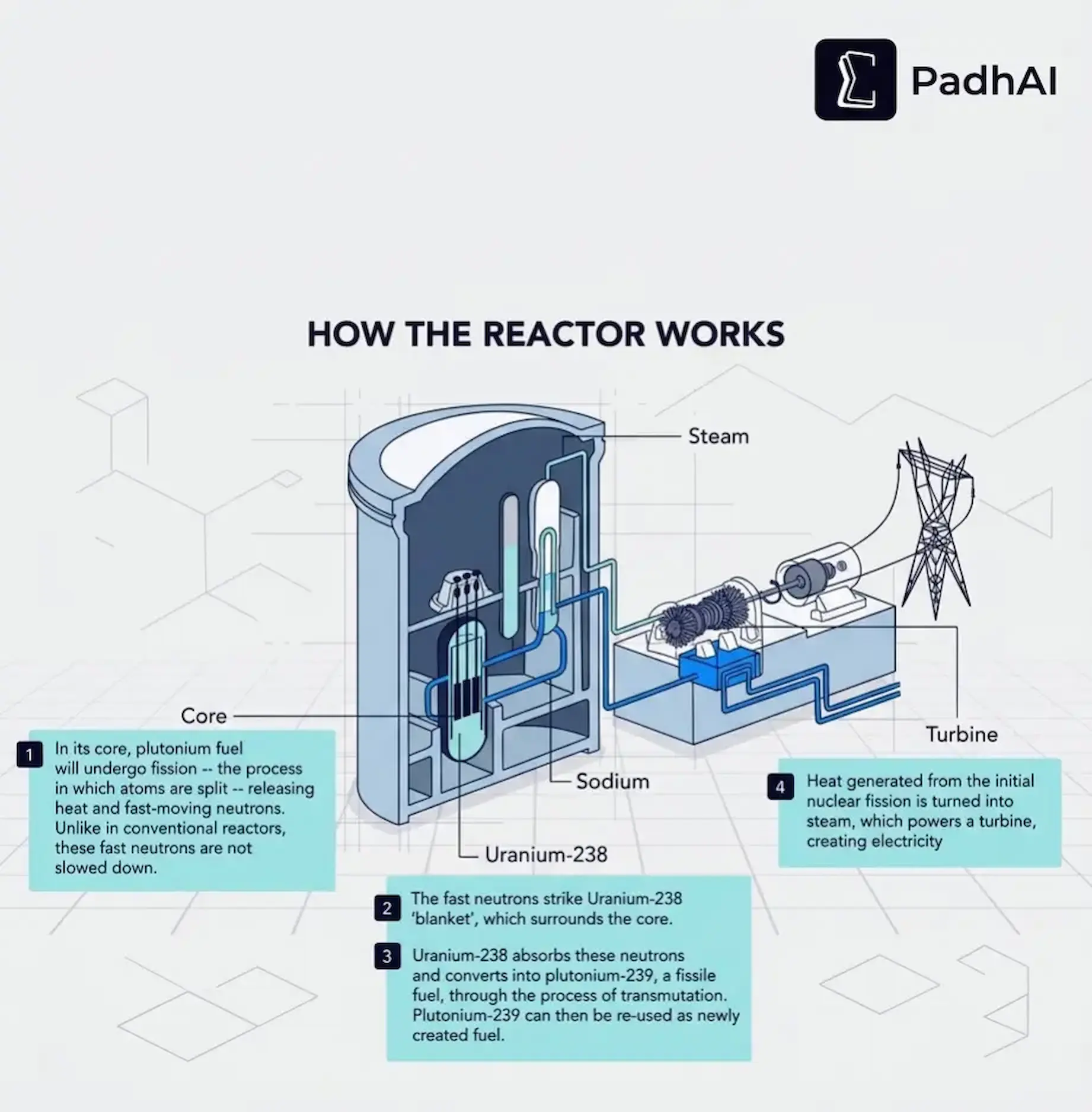
A fast breeder reactor (FBR), unlike a conventional reactor, produces more fuel that it consumes by using fast neutrons, effectively ‘breeding’ fuel.
The core uses MOX (Mixed Oxide) fuel (Plutonium + Uranium).
It is surrounded by a "blanket" of Uranium-238.
As the reactor runs, it converts the blanket into more Plutonium.
The Result: It produces more fissile material than it consumes making it the "Akshay Patra" of energy.
Coolant: It uses Liquid Sodium. Unlike water used in conventional reactors, sodium doesn't slow down neutrons (allowing them to remain "fast") and is an excellent heat conductor.
Safety: If the temperature rises too much, the physics of the reactor naturally slows the reaction down without human intervention.
Its defining feature is that it is a Closed Fuel Cycle, meaning the waste from one stage is recycled to become the fuel for the next.
India is now only the second country in the world after Russia to have a commercial-scale operating Fast Breeder Reactor (FBR). The significance of PFBR is discussed below:
Milestone: As this marks India reaching the second stage of its three stage nuclear programme, it has strengthened India's nuclear journey and mapped the road ahead to the third stage.
Strategic Autonomy: India has limited Uranium but the world's largest Thorium reserves (approx. 25%). The PFBR is the only way to eventually use that Thorium which would happen in the third stage of the nuclear programme.
Nuclear Waste Management: FBRs can "burn" long-lived radioactive waste from Stage 1, making the overall nuclear cycle much cleaner.
Decarbonization: To reach Net Zero by 2070, India needs a "baseload" power source that isn't coal. Nuclear is the most viable high-capacity alternative to renewables.
Technological Leadership: This is fully indigenous. It proves India can develop "closed fuel cycle" technology that most nations could not achieve due to complexity.
Part of Aatmanirbhar Bharat initiative: The PFBR is almost entirely indigenous. From the "Main Vessel" to the specialized sodium pumps, everything was manufactured by Indian industries based on designs by Indira Gandhi Centre for Atomic Research (IGCAR).
Add as a preferred Source on Google
During the development phase, India faced many engineering, design and precision issues. Regardless, India did not abandon the project despite international pressure and technical failures and succeeded in attaining criticality. Now, the challenges have shifted from building to stabilizing:
Handling Liquid Sodium: Sodium is a high-performance coolant but extremely dangerous. It is highly reactive (burns in air, explodes in water). It must be ensured that the liquid sodium continues to circulate smoothly without any leaks or blockages.
Experimental Phase: Over the next 8–12 months, BHAVINI must test the stability of the chain reaction at very low power levels to ensure the sensors and safety systems respond exactly as the computer models predicted.
Transition to Commercial Operation: The challenge is moving from a "scientific experiment" to a "reliable nuclear power plant" that stays on 24/7.
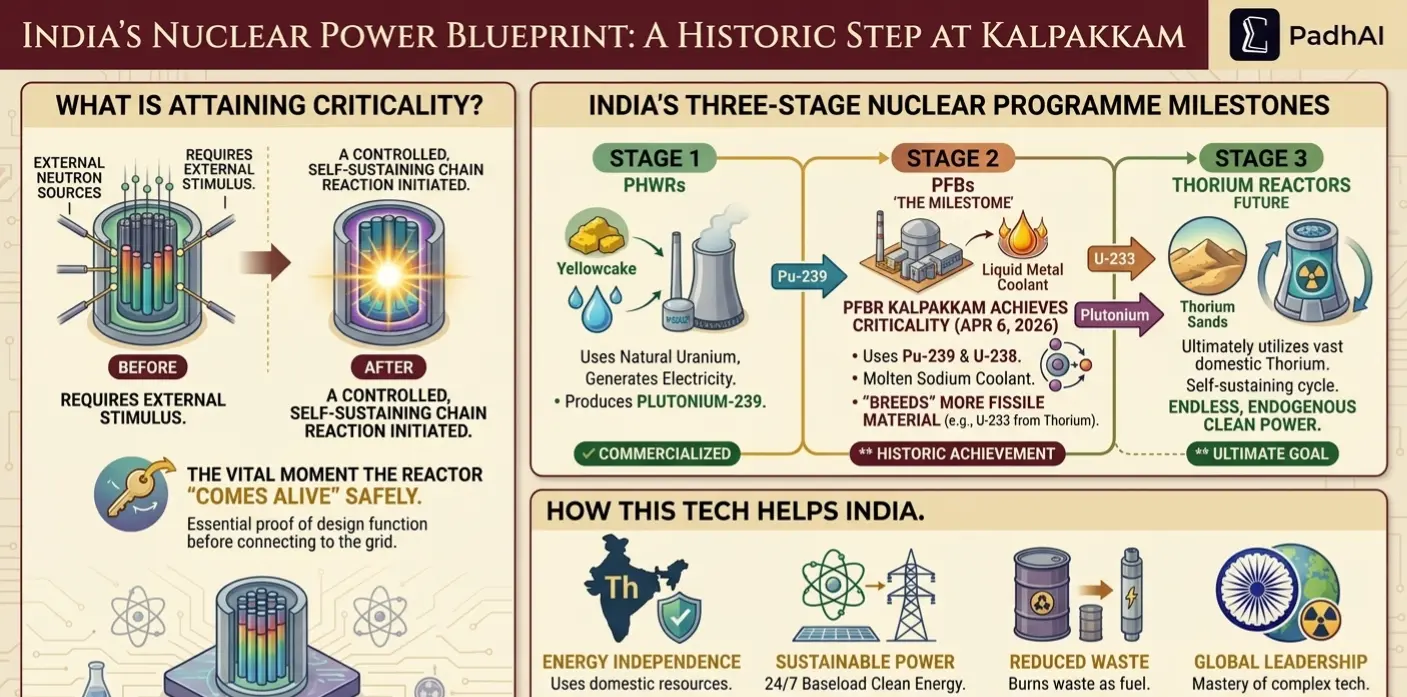
India's Three-Stage Nuclear Power Programme is a strategic nuclear roadmap formulated by Dr. Homi J. Bhabha in 1954 to help India attain energy independence.
Stage | Technology | Fuel Source | Key Outcome |
Stage 1 | PHWR (Pressurized Heavy Water Reactor) | Natural Uranium | Produces electricity + Plutonium-239 (as a byproduct). |
Stage 2 | FBR (Fast Breeder Reactor) | Plutonium-239 + Uranium Blanket | "Breeds" more fuel than it uses; prepare for Thorium. |
Stage 3 | AHWR (Advanced Heavy Water Reactor) | Thorium + Uranium-233 | Uses India’s vast Thorium reserves for centuries of clean energy. |
By reaching criticality in April 2026, the PFBR marks India’s official transition from Stage 1 to Stage 2. It will not only help generate abundance of energy but also acts as the gateway to the Thorium Age (stage 3).
Frequently asked question (FAQs)
What is the Prototype Fast Breeder Reactor (PFBR) ?
Why is the Prototype Fast Breeder Reactor called a “Breeder” reactor?
How is the Prototype Fast Breeder Reactor different from conventional nuclear reactors?
What is the significance of the Prototype Fast Breeder Reactor for India?
What does “First Criticality” mean?
The PFBR is a major achievement towards India's nuclear future. It proves that India can master the world's most difficult energy technology indigenously, moving us from "fuel scarcity" to "energy security." Dr. Homi Bhabha’s visionary roadmap remains the guiding light for India in self-reliance and innovation in nuclear energy.
For UPSC aspirants, it serves as the Stage 2 bridge in India's nuclear program by linking Science and Economy (GS3) through its breeder technology, Geography (GS1) via its utilization of thorium and International Relations (GS2) by securing strategic energy autonomy internationally.





Research methodology
PadhAI's research methodology ensures every article is accurate, UPSC-ready, and beginner-friendly. We curate current affairs analysis based on UPSC exam relevance by cross-referencing The Hindu, Indian Express, and PIB. General Studies (GS) topics are drafted from NCERTs and standard books such as M. Laxmikanth, Spectrum, and GC Leong, then reviewed by subject matter experts to eliminate factual errors. Additionally, we update aspirants with verified government exam notifications alongside expert blogs suggesting the best resources, syllabus, and comprehensive Prelims and Mains strategies.


No comments yet. Be the first to join the discussion!