Promotion and Regulation of Online Gaming (PROG) Rules 2026
The PROG Rules 2026 (effective May 1, 2026) establish a legal framework that shifts the gaming sector from self-regulation to strict government oversight via the Online Gaming Authority of India (OGAI).

Gajendra Singh Godara
Last updated
5
mins read

Key Highlights:
Base Act: Promotion and Regulation of Online Gaming Act, 2025.
Active Since: May 1, 2026.
Body: Online Gaming Authority of India (OGAI).
Rule: All wagering games (OMG) are now illegal.
E-sports: Mandatory registration with 10-year validity.
Social Games: Voluntary registration allowed.
Penalty: Banks face fines for helping illegal games.
The Promotion and Regulation of Online Gaming Rules 2026 create a mandatory legal structure for India's digital gaming industry.
These regulations provide the framework for the Promotion and Regulation of Online Gaming (PROG) Act of 2025.
MeitY introduced these rules on April 22, 2026; they became active on May 1, 2026. This shift ends the previous industry led self regulation and starts a centralized government monitoring system.
The gaming industry is made up of businesses that make, market, and make money from video games for PCs, consoles, and mobile devices.
Online gaming is when people play video games over a computer network, usually the internet, so they can interact or compete with each other in real time.
In India, this industry has grown from being a way to have fun to a complicated digital economy with big money and professional e-sports.
Join our WhatsApp Community
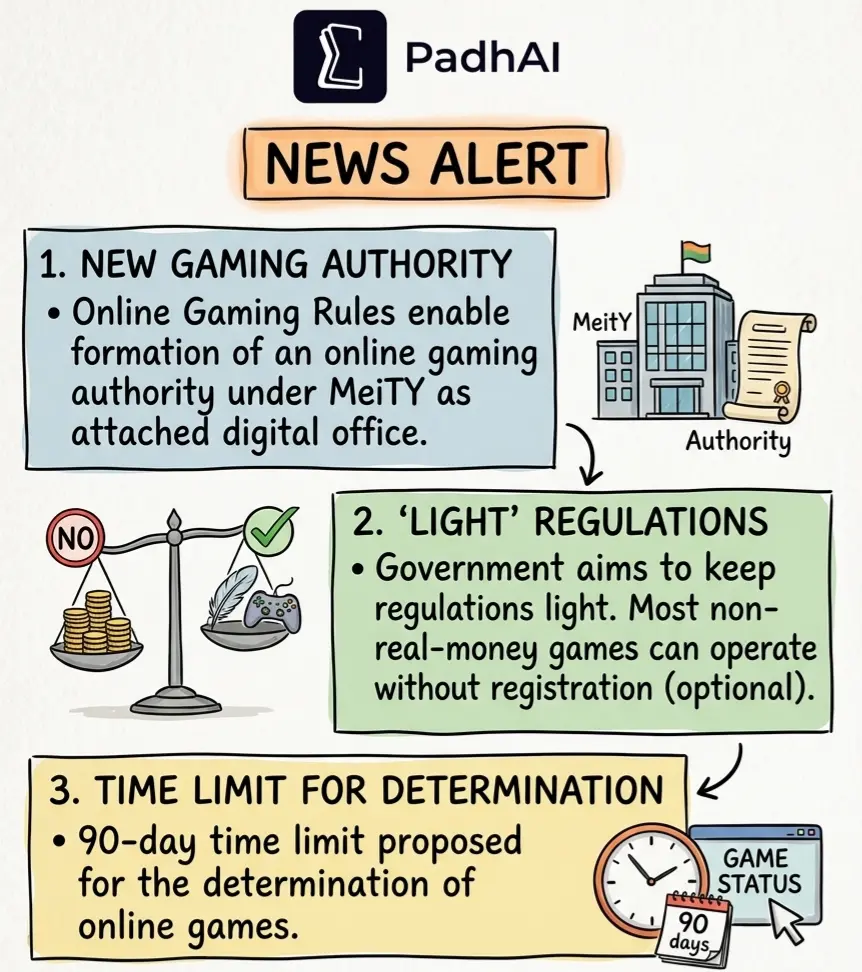
The Union Ministry of Electronics and Information Technology (MeitY) recently announced the 2026 Rules to enforce the PROG Act 2025.
This move was to tackle the rise in unregulated "Real Money Gaming" apps and concerns about financial fraud and user addiction.
By aiming to put these rules into effect on May 1, 2026, the government has officially put all digital gaming under the direct control of a legal authority.
The Promotion and Regulation of Online Gaming (PROG) Act 2025 is the main law that gives the central government the power to regulate the digital gaming industry. It gives the Online Gaming Authority of India (OGAI) the legal authority to act as a statutory regulator.
It also sets the highest fines for gaming platforms that aren't allowed, which can include up to three years in prison. This primary law ensures that digital gaming remains a controlled economic activity under the Union List of the Seventh Schedule.
The 2026 rules make a clear legal distinction between skill-based activities that are allowed and illegal betting. MeitY is the main ministry in charge of this system of government.
Add as a preferred Source on Google
The Online Gaming Authority of India (OGAI) serves as the primary statutory body for industry oversight. It functions as an attached office to MeitY and resides in the National Capital Region. A six-member committee, led by the Additional Secretary of MeitY, manages the authority.
Officials from the Finance, Sports, Home Affairs, and Information and Broadcasting ministries join the chairperson in daily operations.This group from several ministries is in charge of both the social effects of gaming and financial crimes.
The OGAI holds civil court powers to investigate platforms and issue legal penalties.
New regulations split the gaming industry into three legal groups based on their financial risks.This classification decides whether or not a platform can legally work in India.
Category | Definition | Legal Status |
Online Money Games (OMG) | Games using real money for stakes or winnings. | Prohibited |
Online Social Games | Casual play for fun without money (e.g., Ludo). | Permitted (Voluntary) |
E-sports | Skill-based competition recognized as a professional sport. | Permitted (Mandatory) |
(Data: MeitY, April 2026) | ||
India prohibits Online Money Games to stop financial debt and social harm. E-sports platforms receive 10-year registration certificates to help professional growth.
No. The 2026 laws enforce a total ban on Real Money Gaming (RMG) where users stake assets to win money. This ban covers poker, rummy, and fantasy sports when played for cash. The OGAI publishes a List of banned games to protect the public.
The OGAI applies a specific determination test to sort games that mix skill and chance. This review starts if the government notifies a category or if a developer applies for e-sports status.
The authority can also start this process on its own. The OGAI must finish its review within 90 days of the start. Approved platforms receive a unique ID that they must show on their apps.
This method ensures that the public only accesses verified e-sports and social games.
The 2026 rules place new duties on payment aggregators and the banking sector. Banks face legal liability if they process payments for illegal Online Money Games.
Financial firms must check for a valid OGAI registration before they handle any gaming transactions. These steps block the Mahadev Book syndicate and other money laundering groups.
The Enforcement Directorate works with the OGAI to stop money flow to foreign gambling websites.
Mandatory Safety Features
Every registered platform must use technical safeguards to keep users safe. These rules focus on the mental health effects of gaming and addiction.
Safety requirements include:
Strong age checks to keep children away from adult games.
A two-tier system to handle player complaints.
Time alerts and spending limits to stop gaming disorders.
A 24/7 contact point for police and investigators.
Users can go to the OGAI if a platform does not fix their problem within 30 days.
This system keeps user rights at the center of the digital economy.
Frequently asked question (FAQs)
What are the PROG Rules 2026?
What is the new rule of online gaming?
Are Real Money Games Banned in India?
What is the Online Gaming Authority of India (OGAI)?
How are online games classified under the PROG Act, 2025?
The 2026 rules show a move from letting the industry police itself to having the law actively watch over it. The old model failed to stop rising fraud and gaming-related suicides. Current laws place social safety above industry freedom.The government wants to make India a world leader in e-sports while stopping predatory apps s part of Digital India Initiative. By giving 10-year registrations, the OGAI creates a stable path for honest developers.






Research methodology
PadhAI's research methodology ensures every article is accurate, UPSC-ready, and beginner-friendly. We curate current affairs analysis based on UPSC exam relevance by cross-referencing The Hindu, Indian Express, and PIB. General Studies (GS) topics are drafted from NCERTs and standard books such as M. Laxmikanth, Spectrum, and GC Leong, then reviewed by subject matter experts to eliminate factual errors. Additionally, we update aspirants with verified government exam notifications alongside expert blogs suggesting the best resources, syllabus, and comprehensive Prelims and Mains strategies.


Gajendra Singh Godara is an IIT Bombay graduate and a UPSC aspirant with 4 attempts, including multiple Prelims and Mains appearances. He specializes in Polity, Modern History, International Relations, and Economy. At PadhAI, Gajendra leverages his firsthand exam experience to simplify complex concepts, creating high-efficiency study materials that help aspirants save time and stay focused.
No comments yet. Be the first to join the discussion!