US-Iran-Israel Conflict- Causes, Implications and Recent Events
The US-Iran-Israel conflict is a key geopolitical issue in West Asia. Tensions over Iran’s nuclear ambitions and regional power have escalated into military strikes and retaliatory attacks.

Gajendra Singh Godara
Last updated
8
mins read
Key Highlights:
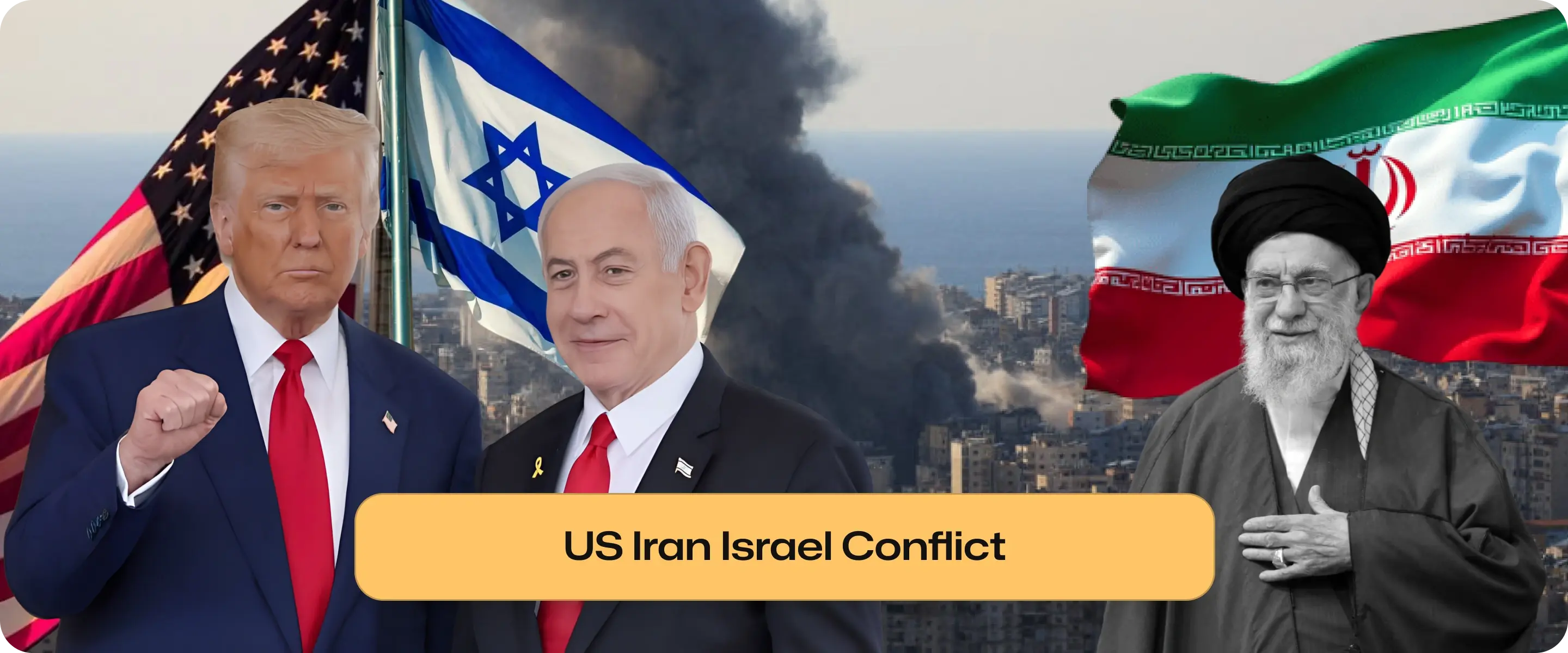
The Iran-Israel conflict has kept escalating after joint U.S. and Israeli strikes in 2026.
Iran has retaliated with missile and drone strikes on Israeli and U.S. sites in the region. This has further increased tensions in the area.
The conflict has major global effects. It threatens oil routes like the Strait of Hormuz. It also raises geopolitical tensions worldwide.
The United States and Israel launched a joint attack on Iran. It killed Iran’s Supreme Leader, Ayatollah Ali Khamenei. He was a Shia cleric. This attack and Iran’s retaliation have raised tensions in West Asia. It now threatens global energy security, trade routes, and geopolitical relations.
The escalating Israel-Iran war, with US involvement, has raised concerns about economic impacts. These include supply disruptions and higher oil prices. It has also raised concerns about the safety of people in these regions.
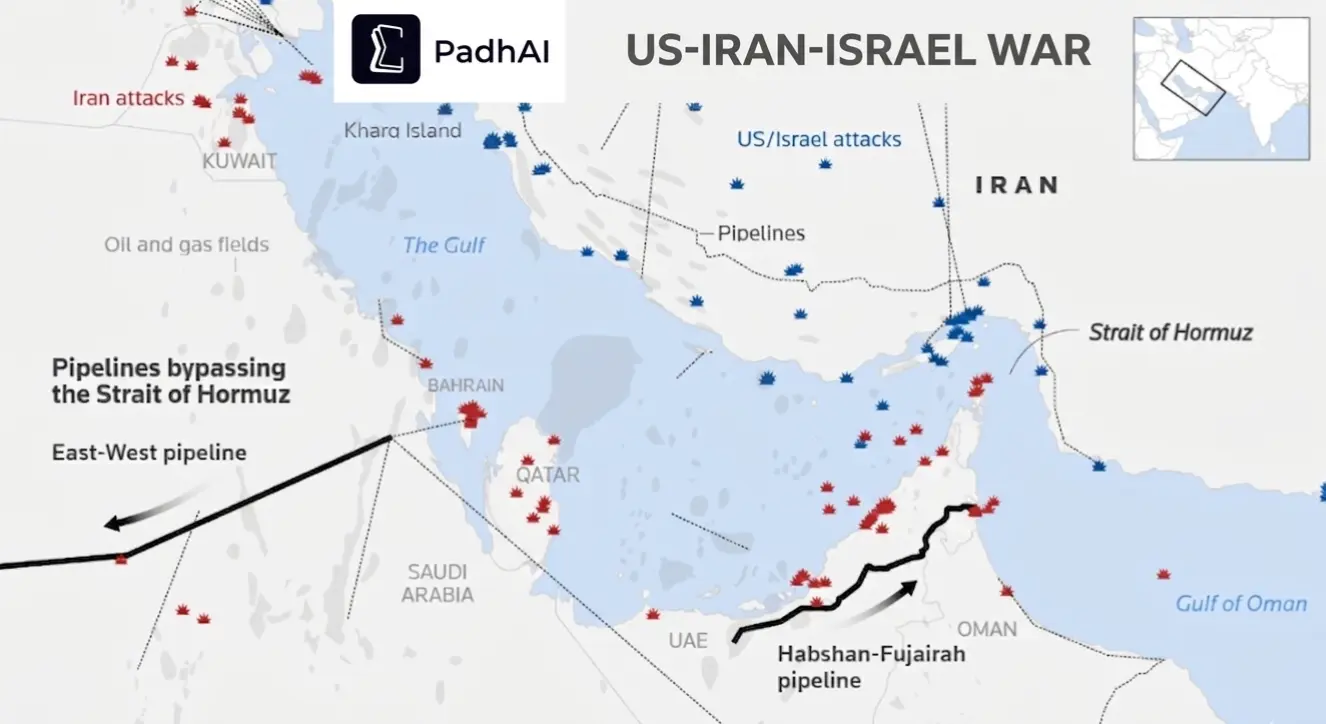
Iran has retaliated through Operation True Promise 4 wherein they attacked Israel and nearby Gulf countries.
Because of this, even after earlier US-Iran nuclear talks, tensions in West Asia have risen.
The war has broader effects on the rest of the world.
The Iran-Israel war news has affected India too. It threatens energy supplies, the safety of Indians in war zones, and geopolitical ties.
Join our WhatsApp Community
The 1953 coup: In 1953, the CIA backed a coup against Iran’s elected Prime Minister, Mohammad Mosaddegh. This coup began a rift between the US and Iran.
The Islamic Revolution of 1979: Before the 1979 Islamic Revolution in Iran, Iran and Israel were strategic allies. The new Islamic regime tried to distance itself from Western ideas. It called the US the “Great Satan” and Israel the “Little Satan.” It argued that both countries thrived on exploiting the region. The clerical regime adopted an anti-imperialist and anti-colonial point of view.
Iran’s Nuclear Program: It started in the early 2000s. Israel and the US saw Iran’s nuclear program as a threat to global security. They were especially concerned about Iran enriching uranium.
Axis of Resistance: After the US-led overthrow of Iraq’s Saddam Hussain, who was a major rival of Tehran, there emerged a power vacuum. This opportunity helped Iran create the “Axis of Resistance” - consisting of Hezbollah in Lebanon, Hamas in Gaza and Houthis in Yemen. They claimed that this was done to counter US and Israeli dominance.
JCPOA Agreement: The P5+1 (China, France, Germany, Russia, the United Kingdom, and the United States), the European Union, and Iran signed the Joint Comprehensive Plan of Action in order to put limits on Iran’s uranium enrichment.
US Withdrawal from JCPOA: US withdrew from the JCPOA citing that it ignored Iran’s ballistic missile program and the backing it provided to the “Axis of Resistance”
Collapse of the “Axis of Resistance”: After the October 2023 Hamas attack, Israel was able to weaken Hamas, undermined Hezbollah’s leadership and caused the fall of Syria’s Bashar Al-Assad. This led to Iran being stripped of any regional buffers.
Operation Midnight Hammer : In June 2025, Israel launched strikes on Natanz and Isfahan- Iran’s nuclear sites. The US also struck them with B-2 bombers and bunker-buster bombs in order to attack the fortified Fordow facility.
Organizational History of the 2026 West Asia War
The conflict is defined by the interaction, and in some cases, the collapse, of key international and regional organizations.
Category | Organization | Role / Actions in 2026 West Asia War |
Primary State & Military Organizations | IRGC (Islamic Revolutionary Guard Corps) | Architect of Iran’s “Forward Defense” since 1979. After Supreme Leader Khamenei’s death in Feb 2026, the IRGC Navy and Quds Force assumed direct control of the Strait of Hormuz and led regional retaliations. |
IDF (Israel Defense Forces) | Operating under “Pre-emptive Deterrence”, the IDF synced operations with US CENTCOM for Operation Roaring Lion. | |
US CENTCOM (Central Command) | Managed the US military strategy. Under the 2026 Trump administration, it launched Operation Epic Fury, the largest regional buildup since 2003. | |
International & Multilateral Bodies | UNSC (United Nations Security Council) | Deadlocked. Passed a resolution condemning Iran’s strikes in March 2026 but failed to authorize US-Israeli preemptive strikes, sparking debates on Article 2 violations. |
IAEA (International Atomic Energy Agency) | Confirmed the disabling of Khondab and Fordow nuclear sites. Suspension of inspections marked the effective end of the JCPOA. | |
IEA (International Energy Agency) | Released 400M barrels of strategic oil reserves after the Hormuz closure to stabilize markets. | |
GCC (Gulf Cooperation Council) | Traditionally divided, the GCC (Saudi Arabia, UAE, Kuwait, etc.) adopted a “Collective Security” approach to intercept Iranian drones despite maintaining a public neutral stance. |
Takeaway: The 2026 Iran Israel war demonstrates how organizational doctrine, leadership transitions, and multilateral effectiveness can define the trajectory of modern regional conflicts.
Ideological conflict: Iran’s Islamic regime sees Israel and the US as dominant powers. It believes they exploit the region. On the flip side, Israel sees Iran’s nuclear progress and support to armed groups as a security threat.
Security Dilemma: Each of the military powers sees their actions as defensive and the rival powers sees their opponent’s actions as aggressive. This has led to an arms race among the countries.
Regional Expansion: Iran wants a regional influence over Iraq, Syria, Lebanon and Yemen. The US and Israel are against this and want to prevent Iran’s regional hegemony.
Nuclear capabilities: The US and Israel view Iran’s Nuclear program as a global security threat. This is evident by the Operation Rising Lion launched by Israel in June 2025.
Add as a preferred Source on Google
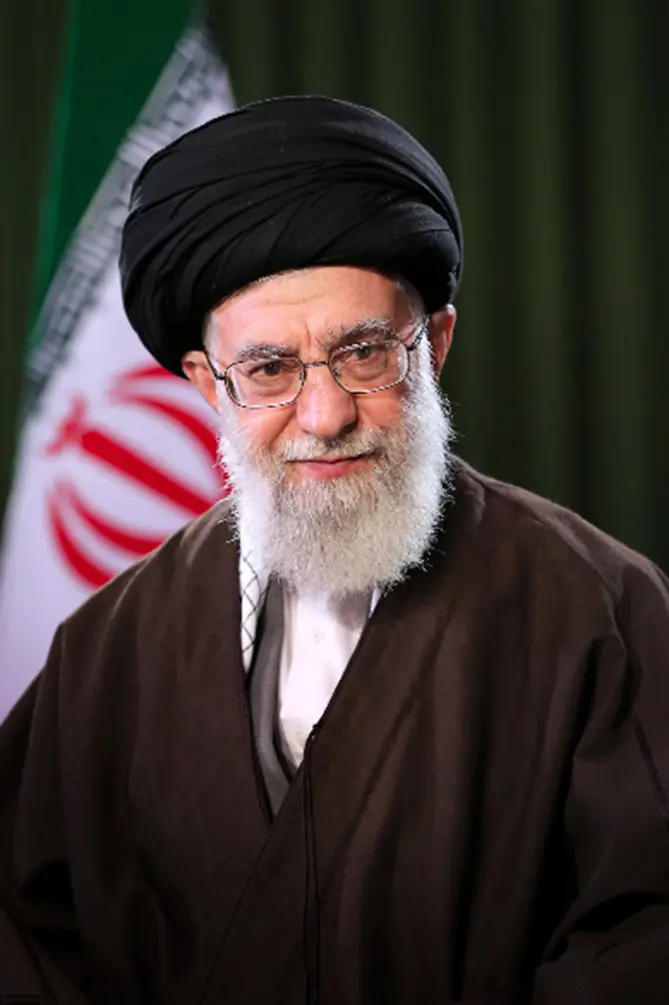
Assassination of Ali Khamenei: The joint US-Israeli strike on the Iranian leader’s compound in Tehran killed him and his family on February 28, 2026. President Donald Trump confirmed the success of the operation and said it was executed to enable regime change.
Iranian strikes on GCC states: Iran has launched multiple missiles on regions like UAE, Saudi Arabia, Qatar, Bahrain and Kuwait. They claimed to be attacking US military bases in these areas like Al Udeid in Qatar and the 5th Fleet in Bahrain.
Economic consequences: The Strait of Hormuz has become a conflict zone with nine Iranian vessels being sunk according to US reports. Iran responded by announcing closure of the Strait of Hormuz. The maritime escalation of Iran and US war has had drastic consequences like rise in global oil prices and halting international flight operations in cities like Dubai.
Domestic unrest in Iran: Iran and Israel war news and the Iranian leadership’s demise has led to celebrations and mournings breaking out simultaneously in Iranian cities.
Regional Spread: In the Israel-Iran war, Hezbollah launched rockets to support Iran. Israel then struck Hezbollah targets in Beirut on March 2, 2026.
Table: Chronology of the War (2026)
Date | Phase | Key Organizational Event |
Jan 2026 | Internal Fracture | Massive domestic protests in Iran; US/Israel begin military buildup citing "nuclear breakout" concerns. |
Feb 28, 2026 | The Spark | Operation Epic Fury (US) & Operation Roaring Lion (Israel) launch. Joint strikes kill Supreme Leader Ali Khamenei in Tehran. |
March 1, 2026 | Regional Retaliation | IRGC launches missile waves at US bases in Bahrain, Qatar, and Kuwait. Iran declares the Strait of Hormuz closed. |
March 4, 2026 | Maritime Escalation | A US submarine sinks the Iranian warship IRIS Dena off the coast of Sri Lanka. |
March 17, 2026 | Leadership Crisis | Senior Iranian official Ali Larijani is killed; Mojtaba Khamenei is named the new Supreme Leader by the Assembly of Experts. |
March 25, 2026 | Diplomatic Pivot | Pakistan delivers a "15-Point Peace Proposal" to Iran on behalf of the US. |
March 30, 2026 | Stalemate | Ground war escalates in Southern Lebanon; India chairs the BRICS emergency session on energy security. |
The Strait of Hormuz serves as one of the most strategic maritime chokepoints.
Nearly one-fourth of the world’s traded crude oil passes through the Strait of Hormuz each day. This is according to the International Energy Agency (IEA). A major share of liquefied natural gas (LNG) shipments also passes through it each day.
Therefore, a shutdown would cause delays in crude oil and LNG shipments reaching Asia, Europe and North America.
The energy markets react rapidly to perceived shortage of supply and that will lead to high rise in oil prices.
Economically, this will cause volatility in currency markets and stock exchanges globally.
The attack of the US and Israel on Iran has divided the international community. What started as a regional conflict between Iran-Israel has escalated to a full fledged world war 3.
The official stance by the United States is that they will continue to strike until “all objectives are achieved.”
Iran’s retaliatory strikes on U.S. military sites in several countries have raised concerns. These include human rights violations, civilian casualties, and damage to infrastructure. After Ali Hosseini Khamenei died, Iran’s Revolutionary Guards now hold decision-making power if tensions escalate.
Countries like the United Kingdom, France and Germany have called for restraint and immediate de-escalation.
On the other hand, Russia and China have condemned the strikes as violations of sovereignty.
There are also some Western allies who have shown support for Israel’s security concerns and stance of the US government.
Impact on India’s energy security
India imports nearly 2 million barrels of oil daily through the Strait of Hormuz.
Hence, instability in that region would lead to shortage of supply, rising costs and inflation. This would hamper India’s economic growth.
India is vulnerable to global oil price swings. The Iran-Israel conflict may drive up inflation. It could strain financial stability. Investors may shift toward bonds and gold. This is evident in weak Sensex and Nifty openings.
Impact on Indian Diaspora
Over 66% of the 1.34 crore NRIs live in the Middle East. They live in places like the UAE, Saudi Arabia, Kuwait, Qatar, Oman, and Bahrain.
A large part of the Indian diaspora in West Asia faces security risks due to the Israel-Iran war.
India has a history of mass evacuations. This is clear from the Kuwait crisis during the 1990–91 Gulf War. Such evacuations can be an ideal solution during violent escalations.
Disruption in Connectivity
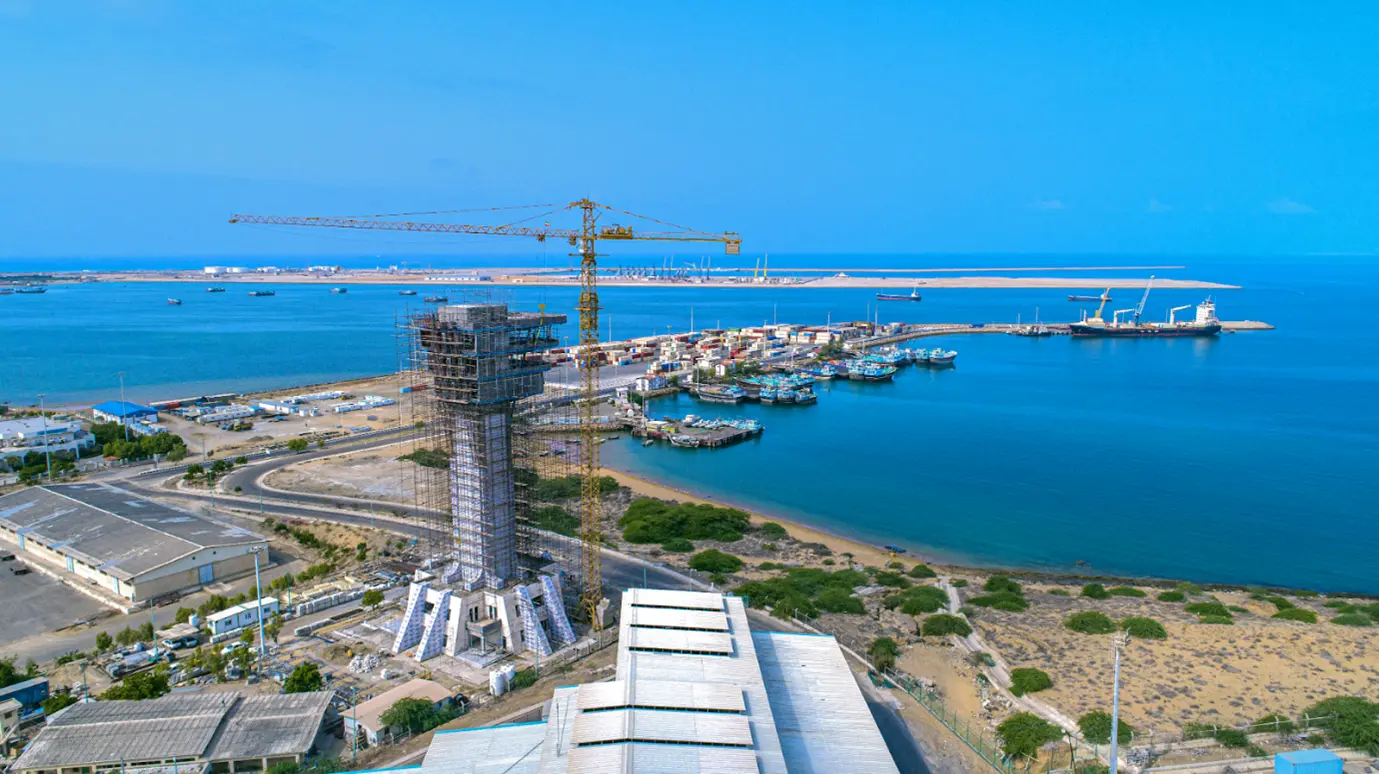
India’s major connectivity projects may be affected by this conflict. One example is Iran’s Chabahar Port. It links India to Afghanistan and Central Asia.
The India-Middle East-Europe Economic Corridor (IMEC) could face disruption due to the Iran-Israel War. This could consequently lead to detrimental effect on bilateral trade and regional economic dynamics.
Shipping disruptions in the Red Sea and nearby waters may cause delays. They could also raise shipping costs and disrupt global trade routes.
Diplomatic Relations of India
India has positive relations with Israel especially in fields of defence, technology and innovation.
The worsening Israel-Iran conflict could force India into choosing sides. This would disrupt the diplomatic relations that India has maintained with Israel, Iran and the Gulf nations.
India’s Organizational Standing: The "Third Way" Doctrine
While the 2026 West Asia conflict has polarized the world into rigid military blocs, India has maintained a distinct "Third Way." For UPSC aspirants, it is crucial to note that India’s organizational history in this war is defined by Strategic De-hyphenation, refusing to join existing military alliances while deploying sovereign frameworks to safeguard national interests.
1. Operation Sankalp: Asserting Naval Sovereignty
Distinct Role: In response to the Strait of Hormuz blockade, the Indian Navy bypassed the U.S.-led Operation Epic Fury task force to maintain an independent organizational effort. Operation Sankalp ensures safe passage and convoy protection specifically for Indian-flagged tankers and merchant vessels.
UPSC Key Term: Marks India’s evolution into a Net Security Provider in the Indian Ocean Region (IOR), insulating maritime trade from regional bloc politics.
2. ISPRL & Energy Resilience: The Internal Defense
Strategic Response: The Indian Strategic Petroleum Reserves Limited (ISPRL) acts as India’s organizational shield against global energy volatility. Using Phase I and Phase II reserves (Vishakhapatnam, Mangaluru, Padur), India stabilizes domestic energy supply independently of the IEA’s global stock management.
Economic Impact: This capacity mitigates Imported Inflation even as Brent crude prices fluctuate due to Persian Gulf chokepoint closures.
3. The BRICS/G20 Bridge: Institutional Diplomacy
BRICS 2026 Leadership: India leverages its position within BRICS to advocate a humanitarian pause and a return to the Two-State Solution, asserting itself as a neutral arbiter.
The Middle Path: By maintaining open channels with both US CENTCOM and Iran’s IRGC, India’s organizational diplomacy functions as a pressure-release valve, preventing the world from tipping into zero-sum confrontation.
Takeaway: India’s “Third Way” demonstrates how sovereign organizational frameworks, maritime strategy, energy resilience, and multilateral diplomacy can safeguard national interests while keeping strategic autonomy in a polarized conflict.
The Two State Solution
Israel should move toward a ceasefire in Gaza. It should allow international humanitarian aid to enter. It should aim to resolve the decades-long conflict.
This should follow UN resolutions and support a two-state solution.
A two -state solution would mean the existence of an independent Palestinian state alongside Israel.
It would enable Israel to maintain its security and safety of the Jewish demography while Palestinian people would have their independent statehood.
Diplomatic dialogue
Direct negotiations between Iran and Israel with international mediators like the European Union or the United Nations could pave the way towards finding common ground.
Tackling Nuclear Escalation
Iran could recommit to the Joint Comprehensive Plan of Action (JCPOA).
This would allow international bodies to verify its compliance.
Israel could then accept Iran’s right to peaceful nuclear development. It could also promise not to strike Iran’s nuclear facilities.
Regional Cooperation
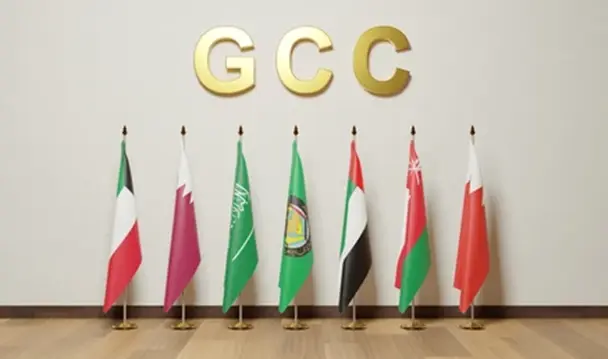
Collaboration between Iran and Israel in regional forums like the Arab League or the Gulf Cooperation Council (GCC) could aid in resolving shared security challenges and promote stability.
Normalization of Peace Initiatives
Exchanging ambassadors, reopening embassies and stepping towards people-to-people connection could lead to normalising relations between Iran and Israel similar to the peace initiative between Israel and the UAE or Bahrain.
Frequently asked question (FAQs)
Why did the US and Israel attack Iran?
What is Operation Epic Fury and Operation Lion’s Roar?
What is the Strait of Hormuz?
How did Iran respond to attacks by the US and Israel?
Which countries are directly affected by this conflict?
The Iran-Israel conflict is a threat to the security of India and the world in terms of its energy security, security of its diaspora, and economic security.
The conflict can only be resolved through diplomatic measures, nuclear non-proliferation, and regional cooperation to stop the hostilities between the two nations for the establishment of peace in West Asia.
From a UPSC preparation perspective, studying this conflict is important in order to tackle questions surrounding the current affairs in West Asia and their impact on India.



Research methodology
PadhAI's research methodology ensures every article is accurate, UPSC-ready, and beginner-friendly. We curate current affairs analysis based on UPSC exam relevance by cross-referencing The Hindu, Indian Express, and PIB. General Studies (GS) topics are drafted from NCERTs and standard books such as M. Laxmikanth, Spectrum, and GC Leong, then reviewed by subject matter experts to eliminate factual errors. Additionally, we update aspirants with verified government exam notifications alongside expert blogs suggesting the best resources, syllabus, and comprehensive Prelims and Mains strategies.


Gajendra Singh Godara is an IIT Bombay graduate and a UPSC aspirant with 4 attempts, including multiple Prelims and Mains appearances. He specializes in Polity, Modern History, International Relations, and Economy. At PadhAI, Gajendra leverages his firsthand exam experience to simplify complex concepts, creating high-efficiency study materials that help aspirants save time and stay focused.
No comments yet. Be the first to join the discussion!