Quit India Movement 1942: Causes, Leaders, Significance
Quit India Movement 1942 for UPSC: causes, the 8 August resolution, Do or Die, key freedom fighters, parallel governments, significance and real PYQs.

Gajendra Singh Godara
Last updated
11
mins read
Launched: 8 August 1942, AICC session, Gowalia Tank Maidan, Bombay
Started by: Mahatma Gandhi, with the call "Do or Die" (Karo ya Maro)
Slogan "Quit India" coined by: Yusuf Meherally, socialist and Mayor of Bombay
Leaders arrested: early hours of 9 August 1942, under the Defence of India Rules
British figures: 1,028 killed and over 1,00,000 arrested. Congress estimated 4,000 to 10,000 dead
Viceroy Linlithgow called it "by far the most serious rebellion since 1857"
Asked in UPSC Prelims in 2000 and 2021
Mahatma Gandhi launched the Quit India Movement on 8 August 1942, at the Bombay session of the All India Congress Committee.
It was the last large-scale mass struggle of the freedom movement. One demand sat at its centre: end British rule now.
August Kranti, August Movement, Bharat Chhodo Andolan. All three names refer to the same event.
Three things separated it from every earlier Gandhian campaign:
The demand was absolute. No dominion status. No reforms. Full withdrawal.
Nobody was left to lead it. Within hours, the entire Congress leadership was in jail. Ordinary citizens ran the movement themselves.
And it tolerated a level of violence Gandhi had rejected in 1922, when he pulled the plug on Non-Cooperation after Chauri Chaura.
So if you are asking when the Quit India Movement was launched, the date is 8 August 1942. The year of Quit India Movement is 1942, though the underground phase stretched well into 1944.
And if you want to know who started the Quit India Movement, it was Gandhi, acting on a resolution the full Congress had backed.
Join our WhatsApp Community
Point | Detail |
Date | 8 August 1942 |
Place | Gowalia Tank Maidan, Bombay (now August Kranti Maidan) |
Body that passed it | All India Congress Committee (AICC) |
Earlier draft | Congress Working Committee, Wardha, 14 July 1942 |
Leader | Mahatma Gandhi |
Slogan | "Do or Die" (Karo ya Maro) |
Name "Quit India" coined by | Yusuf Meherally |
Viceroy | Lord Linlithgow |
British PM | Winston Churchill |
Immediate trigger | Failure of the Cripps Mission, March to April 1942 |
Gandhi detained at | Aga Khan Palace, Pune |
Mid-1942 brought several pressures at once. None alone explains the movement. Together, they made it nearly unavoidable.
Quit India Movement causes, point by point
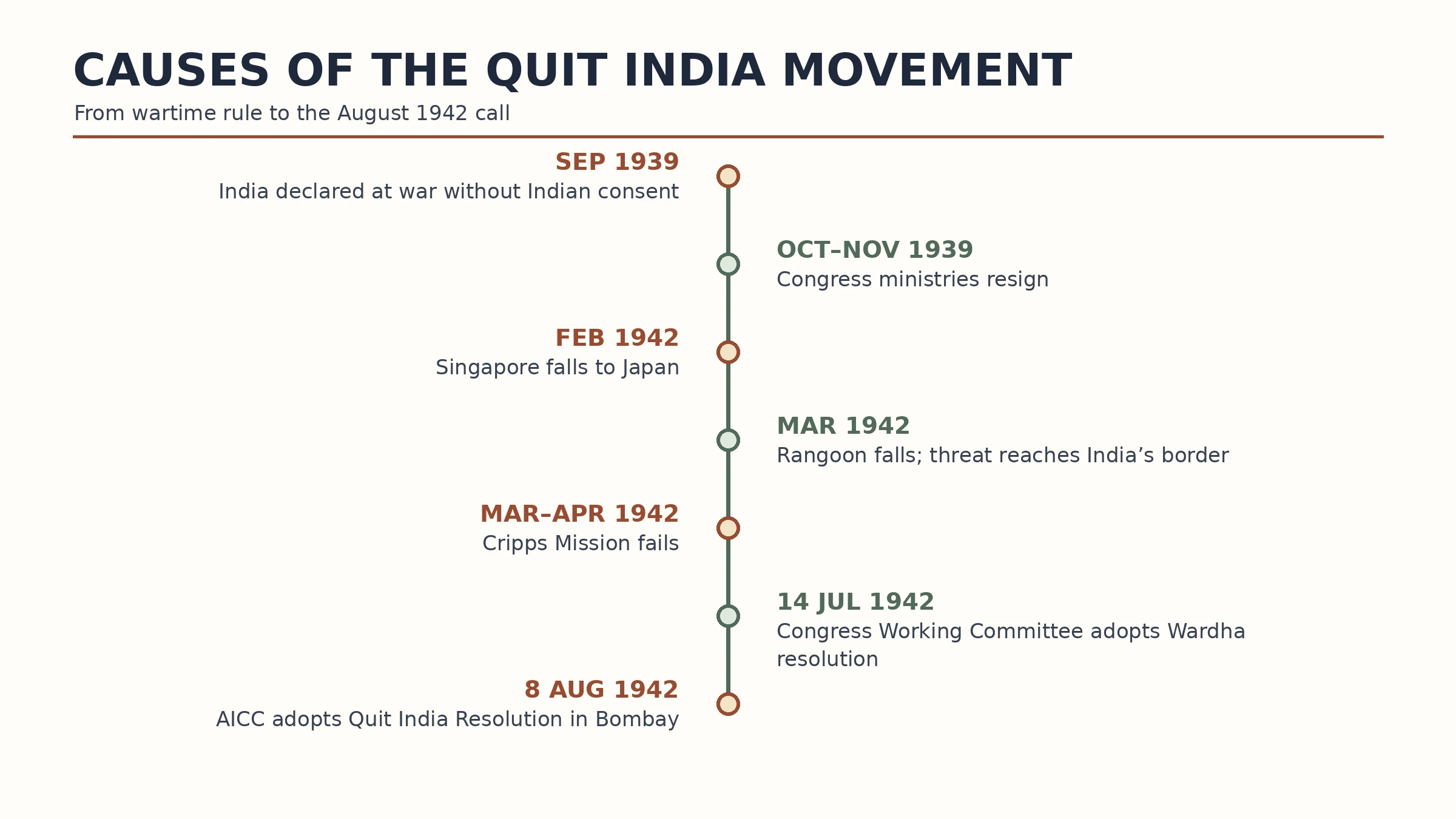
The Cripps Mission collapsed (March to April 1942). Britain sent Sir Stafford Cripps to secure Indian backing for the war. His offer: dominion status after the war, with provinces allowed to opt out of the Union. Congress saw two problems. Nothing concrete was on the table right now, and the opt-out clause opened a path to partition. Talks broke down. This became the immediate trigger.
Japan was advancing fast. Singapore fell in February 1942. Rangoon followed in March. Japanese troops stood at India's eastern border. Congress worried Britain would repeat in India what it had done in Malaya and Burma: pull out and leave the population to face an invader alone.
The British retreat was badly handled. Evacuees returning from Burma and Malaya reported that European refugees got priority while Indians were left to walk. That deepened the feeling that British protection was never really meant for Indians.
Wartime hardship hit hard. Prices shot up, essential goods ran short, and rice was being moved out of Bengal. Rural distress in Bihar, eastern UP and Bengal was acute. It fed directly into the scale of the uprising.
Britain never said what India was fighting for. India had been declared at war in September 1939 without a single Indian being consulted. Congress ministries formed under the Government of India Act 1935 resigned in protest that same year. Three years on, the war aims for India were still undefined.
A mood had been building for a while. The Individual Satyagraha of 1940 to 41 was deliberately restrained. By 1942, radicalised groups like the Congress Socialists, kisan sabhas and student bodies wanted a decisive fight.
Add as a preferred Source on Google

Date | Event |
May 1942 | Gandhi drafts a resolution calling for British withdrawal |
14 July 1942 | Congress Working Committee at Wardha adopts it |
7-8 August 1942 | AICC meets at Gowalia Tank, Bombay |
8 August 1942 | Quit India Resolution passed. Gandhi delivers the "Do or Die" speech |
9 August 1942, early morning | Gandhi and the Working Committee arrested |
9 August 1942 | Aruna Asaf Ali hoists the Congress flag at Gowalia Tank |
Speed mattered here. The British had prepared beforehand. Arrests happened before the movement had any organisation beyond a call. Everything after that was improvised.

That evening, Gandhi's speech contained the line that gave the movement its defining words: "We shall either free India or die in the attempt; we shall not live to see the perpetuation of our slavery."
Five points came out of the resolution passed on 8 August 1942:
An immediate end to British rule in India
A commitment that free India would defend itself against fascism and all forms of imperialism
Formation of a provisional government after British withdrawal
Sanction for a mass civil disobedience movement against British rule
Gandhi named leader of the struggle
Point two deserves attention. The resolution was not pro-Axis. Congress argued that a free India would fight fascism far more effectively than a subject one.
That is why it framed withdrawal as beneficial to the Allied cause as well.
Yusuf Meherally coined the slogan "Quit India". He was a socialist, a trade unionist and Mayor of Bombay. Back in 1928, during the protests against the Simon Commission, he had already coined "Simon Go Back".
Ask most aspirants who coined Quit India and they will say Gandhi. That makes it a favourite trap question. Gandhi led the movement and gave it "Do or Die". The two-word name came from Meherally.
This part gets skipped often, and it is one of the most examinable. Gandhi issued specific instructions to each section of society:
Group | Gandhi's instruction |
Government servants | Do not resign, but openly declare allegiance to the Congress |
Soldiers | Do not leave the army, but do not fire on your own people |
Peasants | Do not pay land revenue. Pay rent to zamindars only if they are anti-government |
Students | Leave studies if confident enough to see it through |
Princes | Support the people and accept their sovereignty |
People of princely states | Support the ruler only if anti-government, and declare yourselves part of the Indian nation |
Look at the soldiers and government servants rows again. Gandhi was not asking for the state machinery to collapse.
He wanted it to stop serving the British while staying in place. That was a sophisticated instruction.
The government's decision to arrest everyone at once meant it never got tested as intended.
In the early hours of 9 August 1942, the government used the Defence of India Rules to arrest Gandhi and the Congress Working Committee. Gandhi was taken to the Aga Khan Palace in Pune.
No leaders were free. The movement moved through three broad phases:
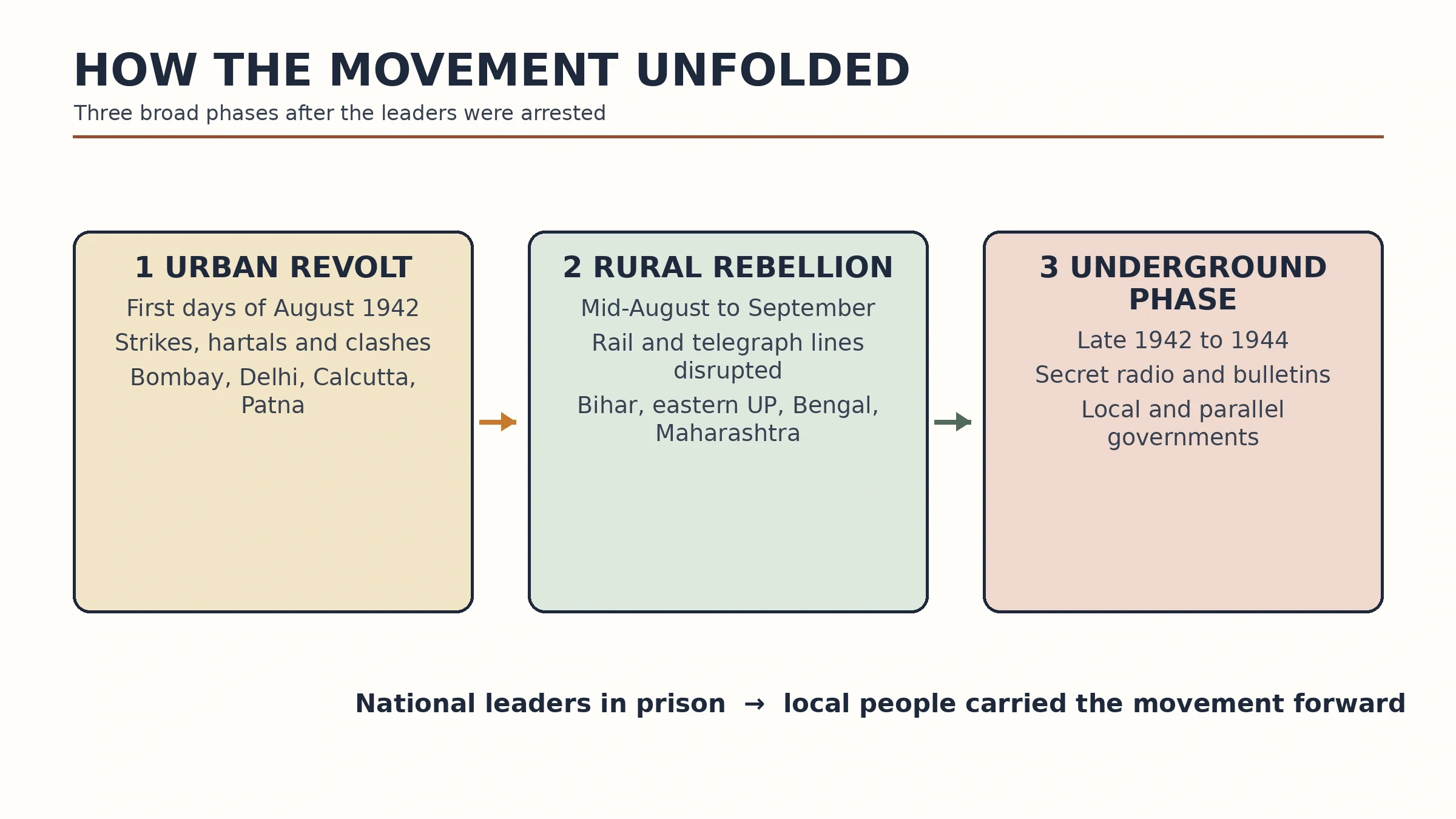
Phase | When | What happened |
Urban revolt | First days of August 1942 | Strikes, hartals and clashes in Bombay, Delhi, Calcutta, Patna, Ahmedabad and other cities |
Rural rebellion | Mid-August to September 1942 | Peasants attacked railway lines, telegraph wires, police stations and government buildings. Bihar, eastern UP, Midnapore and Maharashtra were the epicentres |
Underground and parallel governments | Late 1942 to 1944 | Sabotage, secret radio, underground bulletins, and local governments in isolated pockets |
Communications took damage on a scale the government had not faced before. In several districts, British authority simply stopped functioning for weeks. Parts of Bihar and eastern UP were machine-gunned from the air.
Parallel Governments: Ballia, Tamluk and Satara
In a few places, people went beyond protest. They took over.
Where | When | Led by | What it did |
Ballia, eastern UP | August 1942, about a week | Chittu Pandey | Seized the district, freed imprisoned Congress leaders |
Tamluk, Midnapore, Bengal | December 1942 to September 1944 | Satish Chandra Samanta | The Jatiya Sarkar ran courts, an armed wing (Vidyut Vahini), and cyclone relief |
Satara, Maharashtra | Mid-1943 into 1945 | Nana Patil | The Prati Sarkar, the longest-lasting. Held people's courts and organised land and social reform |

For Prelims, lock in the pairs. Ballia goes with Chittu Pandey. Tamluk goes with Jatiya Sarkar. Satara goes with Prati Sarkar and Nana Patil. These three show up in question after question.
If you revise geography visually, marking Ballia, Midnapore and Satara on an India map makes the spread of the movement much easier to recall.
Freedom Fighters of Quit India Movement
The leader of the Quit India Movement was Mahatma Gandhi. But he was in jail from day two.
What actually happened on the ground was driven by a second rank of leaders. Many were young. Many were women.
Freedom fighter | Contribution |
Mahatma Gandhi | Launched the movement and gave the "Do or Die" call |
Aruna Asaf Ali | Hoisted the flag at Gowalia Tank on 9 August 1942 and led the underground. Called the "Grand Old Lady of the Independence Movement" |
Usha Mehta | Ran the secret Congress Radio from Bombay, broadcasting news the government was suppressing |
Jayaprakash Narayan | Escaped from Hazaribagh Jail in November 1942 and organised armed underground resistance |
Ram Manohar Lohia | Key underground organiser and broadcaster |
Achyut Patwardhan | Underground leader, closely linked to the Satara movement |
Sucheta Kripalani | Coordinated underground activity and the network of women volunteers |
Matangini Hazra | Aged 73, shot dead at Tamluk on 29 September 1942 while leading a procession, flag in hand |
Kanaklata Barua | Aged 17, shot dead in Assam in September 1942 while trying to hoist the flag at a police station |
Biju Patnaik | Supported underground leaders and helped move them around |
Chittu Pandey | Led the Ballia parallel government |
Nana Patil | Led the Satara Prati Sarkar |
Yusuf Meherally | Coined the slogan "Quit India" |
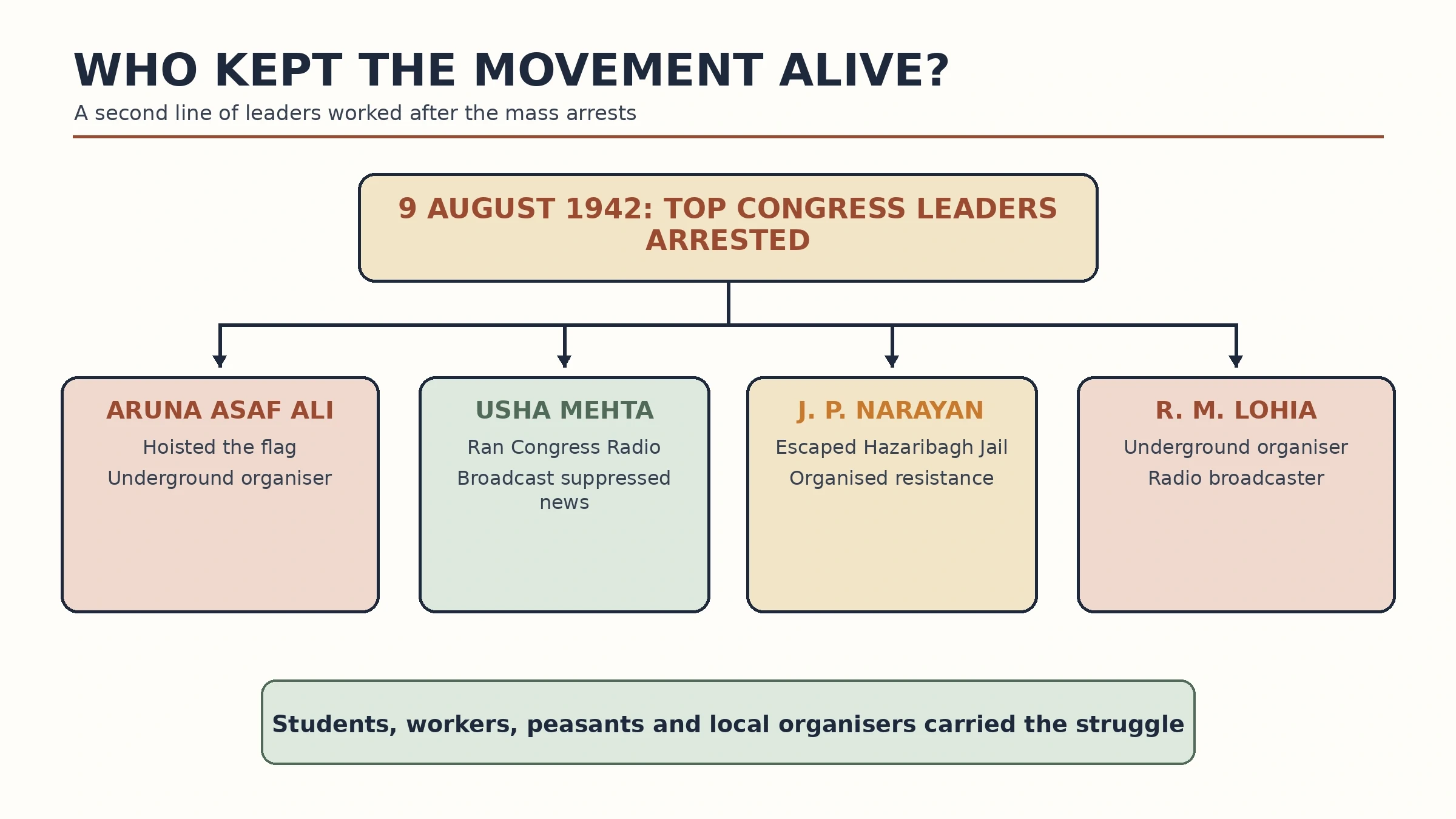
Two patterns stand out. Women led from the front, not as support, and paid with their lives. And the Congress Socialists (Jayaprakash Narayan, Lohia, Patwardhan, Aruna Asaf Ali) became the movement's organisational backbone. That is part of why they emerged as major figures after independence.
Inside the Aga Khan Palace, the cost was personal too. Gandhi's secretary Mahadev Desai died there in August 1942. Kasturba Gandhi died there in February 1944.
Who Did Not Support the Quit India Movement
UPSC examines this as often as the supporters. The reasons differ in each case.
Group | Position | Why |
Muslim League | Opposed | Feared a British withdrawal before its demand for Pakistan was settled |
Hindu Mahasabha | Opposed | Argued it would cause internal disorder during the war |
Communist Party of India | Opposed | After Germany invaded the USSR in June 1941, called it a "People's War" and supported the Allies |
B. R. Ambedkar | Did not support | Was a member of the Viceroy's Executive Council at the time |
C. Rajagopalachari | Stood apart | Had broken with the Congress line that year and resigned from the party |
Most princely states | Stayed aloof | Their rulers depended on British protection |
The CPI's position had lasting consequences. Its members got released from jail while Congress leaders stayed locked up.
The party's reputation with nationalists suffered for years afterwards.
How the British Crushed It
The response was the harshest since 1857.
Measure | Detail |
Killed (British figure) | 1,028 |
Wounded (British figure) | 3,125 |
Killed (Congress estimate) | 4,000 to 10,000 |
Arrested | Over 1,00,000 |
Tactics | Police firing, collective fines, public flogging, village burnings, and aerial machine-gunning in parts of Bihar and eastern UP |
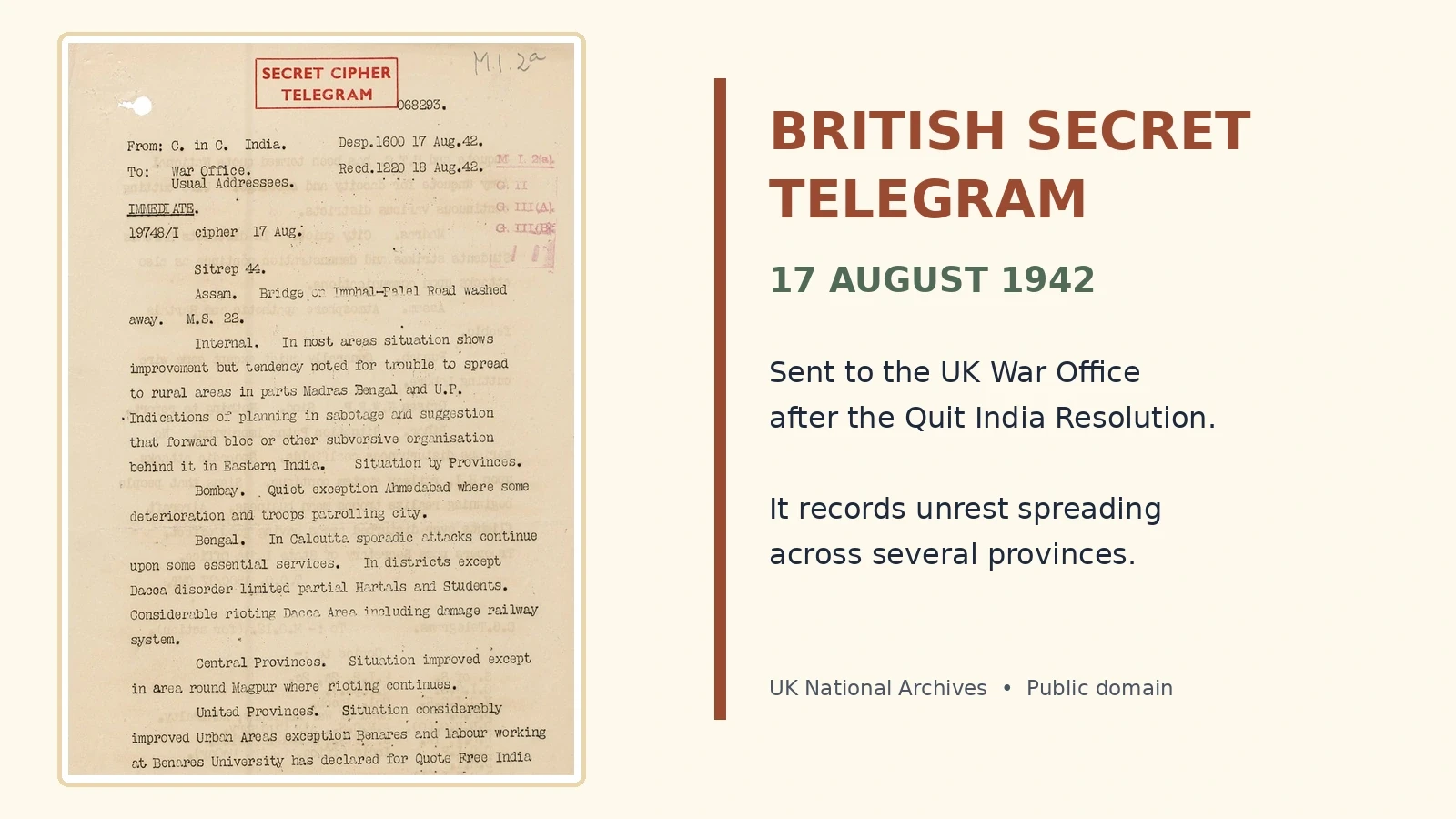
Viceroy Lord Linlithgow sent a telegram to Churchill on 31 August 1942. In it, he called the movement "by far the most serious rebellion since that of 1857", adding that its scale had so far been concealed from the world for reasons of military security.
Gandhi answered with a 21-day fast in February 1943. He was protesting the government's attempt to blame him for the violence. He survived it.
The government released him on 6 May 1944 on health grounds.
Significance of the Quit India Movement
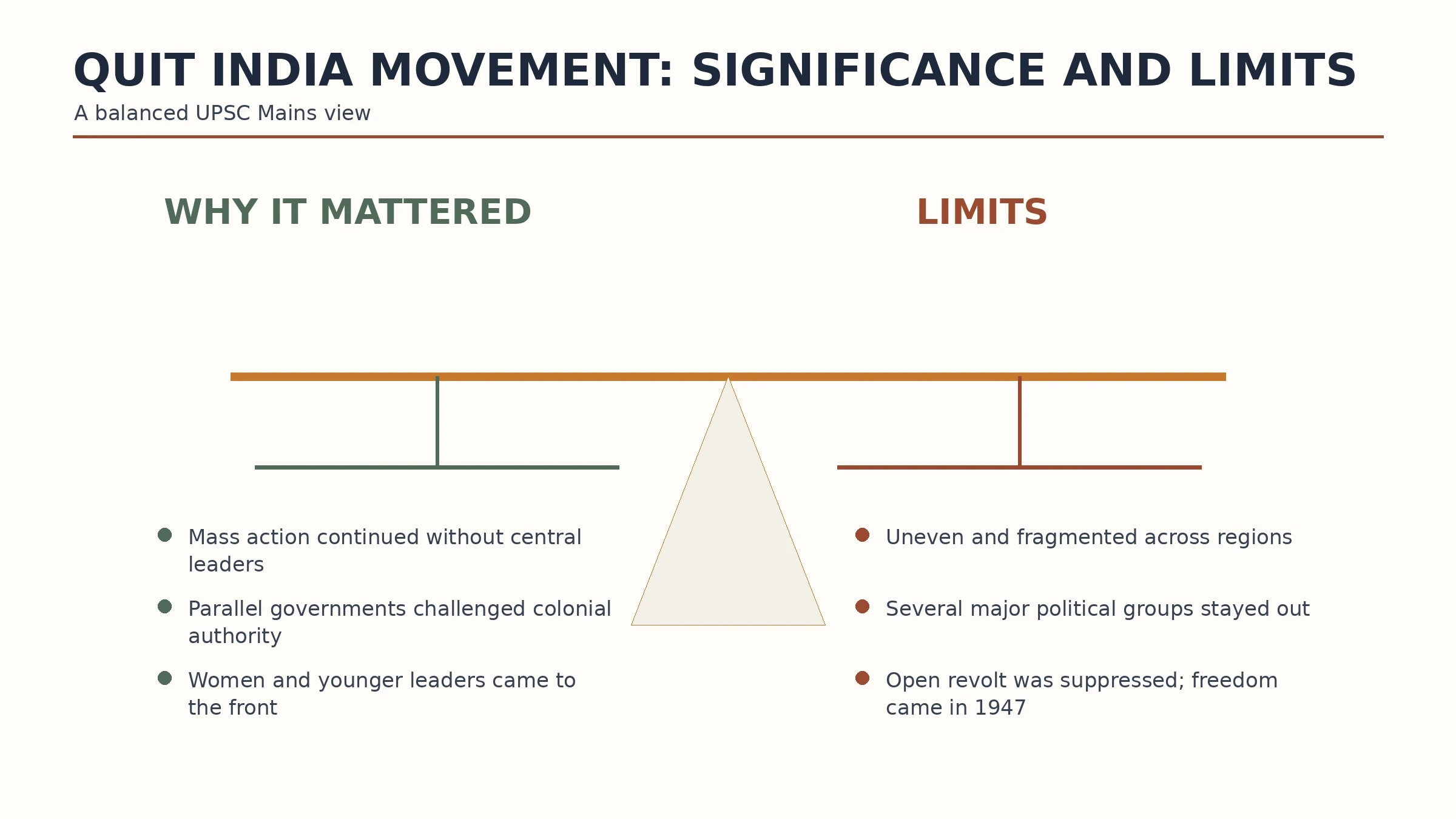
India did not gain freedom in 1942. The movement was largely suppressed within months. But the significance of the Quit India Movement lies in what became unavoidable afterwards.
Independence became a question of when, not whether. After 1942, the British could no longer argue that Indians accepted their rule. The debate shifted to the terms and timing of withdrawal.
The Raj could not govern without consent. Communications, police and administration failed across whole districts. A regime that needed aircraft to hold Bihar could not credibly claim it ruled by consent.
Mass participation hit its widest point. Peasants, students, workers and women took part on a scale beyond Non-Cooperation or Civil Disobedience. In many areas, they acted without any direction.
Women moved to the centre. Aruna Asaf Ali, Usha Mehta, Sucheta Kripalani, Matangini Hazra and Kanaklata Barua were not symbols. They were organisers and martyrs.
A new leadership generation came through, especially from the Congress Socialists. They shaped politics after 1947.
The mood it created carried forward. The INA trials of 1945, the Royal Indian Navy mutiny of February 1946, and the Cabinet Mission of 1946 all grew out of it.
The movement's limits
Honest analysis needs both sides. UPSC Mains rewards it.
No central direction existed. Every leader was in jail, so coordination collapsed and the movement fragmented by region.
It did not unite India. The League, the CPI and the Mahasabha stood outside it. Communal division hardened in the years that followed.
The British suppressed it. By 1944, it had been largely crushed. The British had ruled out independence before the war ended.
Gandhian principles came under strain. The violence in 1942 sat uneasily with non-violence. Gandhi himself refused to condemn it in the terms the government demanded.
How UPSC Asks About the Quit India Movement
This topic sits in GS Paper I under the freedom struggle, and it shows up in both stages.
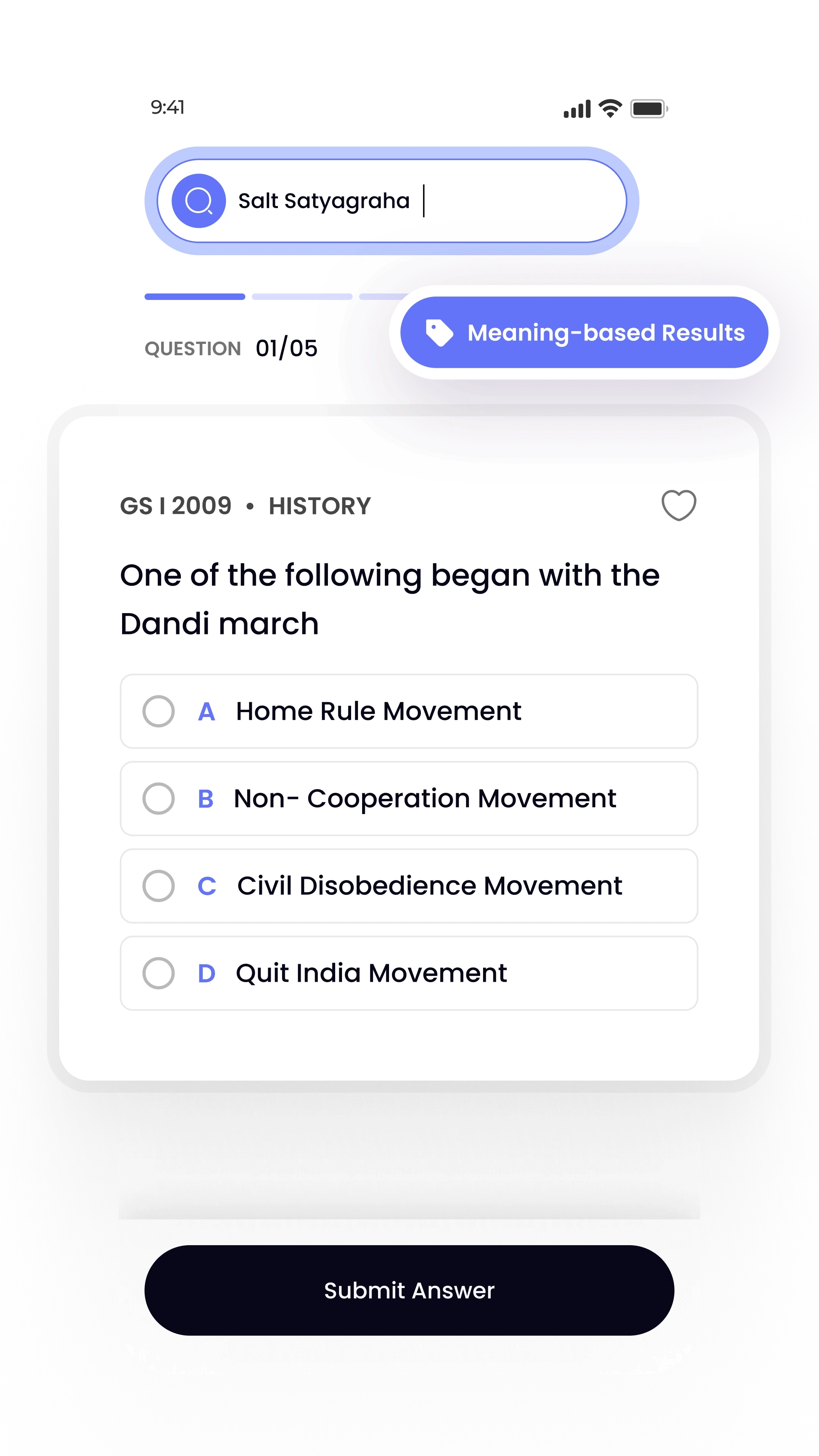
Prelims 2021: With reference to 8th August, 1942 in Indian history, which one of the following statements is correct? (a) The Quit India Resolution was adopted by the AICC. (b) The Viceroy's Executive Council was expanded to include more Indians. (c) The Congress ministries resigned in seven provinces. (d) Cripps proposed an Indian Union with full Dominion Status once the Second World War was over. Answer: (a). The other options belong to 1940, 1939 and March 1942. The distractors are all real events on the wrong date.
Prelims 2000: An assertion-reason question on Lord Linlithgow describing the August Movement as the most serious revolt since 1857, with the reason being the massive participation of rural masses. Both were true, and the reason explained the assertion.
Notice the pattern. UPSC tests dates and attributions. Who said what, what happened when, which place goes with which leader. Build a one-page table of 1939 to 1946 and revise it until the sequence is automatic. You can pull every modern history question by topic from our 30 years of previous year questions.
For Mains, the questions are analytical. Why did the movement take the form it did? Was it spontaneous? What did it contribute to independence? That demands the significance-and-limitations balance above. The structure is exactly what our guide to UPSC Mains answer writing practice covers.
The standard foundation is the NCERT Class 12 history text and Bipan Chandra's India's Struggle for Independence. Our full list of NCERT books for UPSC covers where to start. The rest of the freedom struggle is on the modern history hub.
Frequently asked question (FAQs)
Who started the Quit India Movement?
Who coined the slogan "Quit India"?
Why is the Quit India Movement called the August Kranti?
Which parties opposed the Quit India Movement?
What were the three parallel governments of 1942?
The Quit India Movement is the moment the freedom struggle stopped asking. Every earlier campaign had a negotiating position. This one had two words.
It failed in the narrow sense. The British stayed until 1947. But it succeeded where it counted: after 1942, nobody in London could pretend Indians consented to being ruled.
For the exam, three things carry most of the marks. The dates: 14 July at Wardha, 8 August at Bombay.
The attributions: Gandhi for "Do or Die", Meherally for "Quit India". And the balance of significance against limitation that every Mains answer on this topic needs.
Facts in this article are drawn from standard sources including Bipan Chandra's India's Struggle for Independence, the NCERT Class 12 history text and the Government of India's Press Information Bureau publication on the Quit India Movement.
Casualty and arrest figures are official British estimates unless stated otherwise, and are disputed. UPSC questions are quoted from the Civil Services Preliminary Examination papers of the years indicated.


Gajendra Singh Godara
Ex-UPSC Aspirant | Exam Preparation Expert
Gajendra Singh Godara is an IIT Bombay graduate and a UPSC aspirant with 4 attempts, including multiple Prelims and Mains appearances. He specializes in Polity, Modern History, International Relations, and Economy. At PadhAI, Gajendra leverages his firsthand exam experience to simplify complex concepts, creating high-efficiency study materials that help aspirants save time and stay focused.

No comments yet. Be the first to join the discussion!