The top 10 military powers in the world 2026 as per the Global Firepower Index are the United States, Russia, China, India, South Korea, France, Japan, UK, Türkiye and Italy. This UPSC guide breaks down each country's rank, Power Index score, defence budget, and India's position among global military powers.

Gajendra Singh Godara
Last updated
8
mins read
Add a comment

The Global Firepower Index 2026, released on 23 January 2026, ranks 145 countries on military strength.
United States retains the #1 spot (Power Index 0.0741), followed by Russia (0.0791) and China (0.0919).
India ranks 4th in the world military ranking 2026 (Power Index 0.1346).
France moved up to #6 and Japan to #7; the United Kingdom slipped to #8 in the top 10.
The US defence budget of $831.5 billion is larger than the next five countries combined.
The GFP Index uses 60+ indicators across manpower, equipment, finances, logistics and geography, but does not consider nuclear stockpiles.
A new 2026 indicator added by GFP is internet coverage as a measure of civil infrastructure.
The Global Firepower Index 2026 (GFP 2026), published on 23 January 2026, is the most widely cited yearly ranking of national militaries. It evaluates 145 countries on their conventional military strength and gives each one a composite score known as the Power Index (PwrIndx).
Three things to understand first:
A lower score is better. A perfect score of 0.0000 would mean a theoretically perfect military; no country reaches it.
The index is comparative, not absolute. It is designed to let a smaller, technologically advanced country compete fairly with a larger, less-developed one.
The GFP is run by an independent American outfit, Global Fire Power. It is not an official US government ranking, but it is treated as the industry benchmark.
For UPSC, the global firepower index 2026 is the number most interviewers, Prelims setters and current-affairs papers refer to when they ask about world military ranking 2026.
Join our WhatsApp Community
The table below lists the top 10 strongest militaries in the world as per the GFP 2026 Index, in order of their Power Index score (lower is stronger).
Rank 2026 | Country | Power Index (PwrIndx) | Rank 2025 | Change |
|---|---|---|---|---|
1 | United States | 0.0741 | 1 | Unchanged |
2 | Russia | 0.0791 | 2 | Unchanged |
3 | China | 0.0919 | 3 | Unchanged |
4 | India | 0.1346 | 4 | Unchanged |
5 | South Korea | 0.1642 | 5 | Unchanged |
6 | France | 0.1798 | 7 | ▲ 1 |
7 | Japan | 0.1876 | 8 | ▲ 1 |
8 | United Kingdom | 0.1881 | 6 | ▼ 2 |
9 | Türkiye (Turkey) | 0.1975 | 9 | Unchanged |
10 | Italy | 0.2210 | 10 | Unchanged |
The top 5 strongest armies in the world (US, Russia, China, India, South Korea) have held their positions since 2025. The real story in 2026 is the shuffle in the European middle order, where France and Japan have both climbed one place at the UK's expense.


The GFP Power Index uses more than 60 individual indicators and groups them into broad categories. Understanding the methodology helps you give a more credible UPSC Mains answer.
Main categories of indicators:

Category | What it includes |
|---|---|
Manpower | Total population, active personnel, reserves, paramilitary |
Equipment | Tanks, armoured vehicles, aircraft, warships, submarines, artillery |
Financial | Defence budget, external debt, foreign reserves, purchasing power |
Logistics | Airports, serviceable airports, major ports, labour force, roadways, railways, merchant marine |
Geography | Coastline, waterways, borders, land area, shared borders |
Natural resources | Oil production, consumption, proven reserves |
Technology (new in 2026) | Internet coverage as a share of population |
Important caveats:
GFP applies bonuses and penalties (modifiers) so that smaller, more technologically advanced nations are not overshadowed by larger ones.
The index focuses on weapon diversity, not just raw numbers.
The index does not count nuclear stockpiles, which is why nuclear-armed states like North Korea, Pakistan and Israel do not jump the ranking.
Being landlocked or dependent on imported fuel is a penalty; a long coastline or large domestic oil production is a bonus.
In short: the GFP ranking is a reasonable proxy for conventional military power, not a complete assessment of "most powerful country in the world".
Add as a preferred Source on Google
1. United States: The Most Powerful Military in the World
The United States is the most powerful military in the world for the 21st year running, with a Power Index score of 0.0741. Its dominance rests on unmatched defence spending ($831.5 billion in 2026, bigger than the next five countries combined), 11 nuclear-powered aircraft carriers, the largest air force on earth, and a global network of over 750 overseas bases. For UPSC, remember three names: the Pentagon, NATO, and the Indo-Pacific Command.
2. Russia: Enduring Second Place
Russia holds its #2 slot with a Power Index of 0.0791. Even under sanctions and a prolonged war in Ukraine, Russia retains a formidable nuclear arsenal, a large active force and reserves (around 3.57 million total personnel), and a defence budget of approximately $126 billion in 2026. Its strengths lie in air power, armour, long-range artillery and strategic deterrence.
3. China: The Rising Military Giant
China ranks third with a Power Index of 0.0919. The People's Liberation Army is the world's largest standing army, and the PLA Navy has become the largest navy by number of vessels. China's rapid modernisation, hypersonic missiles, J-20 stealth fighters, and the Belt and Road Initiative give it the deepest geopolitical reach among US rivals.
4. India: Indian Army Rank in World
The Indian Army rank in world as per the Global Firepower Index 2026 is 4th, with a Power Index of 0.1346. India has one of the largest active militaries (about 1.46 million personnel), ongoing modernisation under the Agniveer scheme, growing indigenous production (Tejas, Arjun Mk-1A, INS Vikrant), nuclear weapons under a No-First-Use policy, and the 5th-highest defence spending at around $86.1 billion. India's strategic reach is now firmly Indo-Pacific, not just South Asian.
5. South Korea: A Tech-Heavy Fifth
South Korea remains 5th with a Power Index of 0.1642. Faced with a hostile North Korea, Seoul maintains universal male conscription, a huge standing army, a modern air force with F-35s, and a thriving indigenous arms industry (K2 Black Panther tanks, FA-50 jets, KSS-III submarines).
6. France: Climbing to Sixth
France climbs one spot to 6th in 2026 with a Power Index of 0.1798. It is the only EU state with its own nuclear triad (sea, air, and historically land), permanent UNSC seat, nuclear-powered aircraft carrier Charles de Gaulle, and a growing defence export portfolio (Rafale, Scorpène).
7. Japan: Past the UK in 2026
Japan climbs to 7th with a Power Index of 0.1876. Despite the Pacifist Article 9 of its constitution, Japan has one of Asia's best-equipped militaries: Aegis-capable destroyers, F-35 fighters, two Izumo-class helicopter carriers being converted to F-35 operations, and a defence budget rising to 2 percent of GDP by 2027.
8. United Kingdom: Dropping to Eighth
The United Kingdom slips to 8th in 2026 with a Power Index of 0.1881, losing two places from its 2025 rank. Even so, the UK remains a nuclear power, operates two Queen Elizabeth-class aircraft carriers, hosts a permanent UNSC seat, and leads NATO's Joint Expeditionary Force.
9. Türkiye (Turkey): Regional Powerhouse
Türkiye stays 9th with a Power Index of 0.1975. It is NATO's second-largest army, with a rapidly expanding defence industry (Bayraktar TB2 drones, Altay tank, TCG Anadolu amphibious ship) and a growing global customer base for its drones and warships.
10. Italy: Rounding Off the Top 10
Italy completes the top 10 with a Power Index of 0.2210. It operates two aircraft carriers (Cavour and Trieste), is a NATO founding member, and plays a key role in Mediterranean security, especially around Libya and the Sahel.

Military ranking tells one story; defence spending tells another. The gap between US spending and the rest is the single biggest fact in global security today.
Rank by budget | Country | Approx. Defence Budget 2026 (USD) |
|---|---|---|
1 | United States | $831.5 billion |
2 | China | $266 billion |
3 | Russia | $126 billion |
4 | India | $86.1 billion |
5 | Saudi Arabia | $75 billion |
6 | United Kingdom | $74 billion |
7 | Germany | $72 billion |
8 | Japan | $55 billion |
9 | France | $55 billion |
10 | South Korea | $47 billion |
Two takeaways:
US defence budget is more than the next five countries combined ($831.5 bn vs. ~$752 bn). This single statistic drives most Mains questions on American hegemony.
India is the 4th or 5th largest military spender depending on how Saudi expenditure is counted, placing it comfortably in the global top-tier spenders club.
Manpower is a core input in GFP's methodology, but headline figures alone can mislead. The table below gives the approximate active personnel and total military personnel (active + reserves + paramilitary) for the top 10 countries.
Country | Active personnel (approx.) | Total military personnel (approx.) |
|---|---|---|
United States | 1.33 million | 2.13 million |
Russia | 1.32 million | 3.57 million |
China | 2.00 million | 3.05 million |
India | 1.46 million | 5.14 million |
South Korea | 0.56 million | 3.82 million |
France | 0.20 million | 0.47 million |
Japan | 0.26 million | 0.32 million |
United Kingdom | 0.18 million | 0.22 million |
Türkiye | 0.44 million | 0.89 million |
Italy | 0.16 million | 0.36 million |
Two things to note:
India has the largest total military personnel in the world when reserves and paramilitary are counted, driven by central armed police forces, the Territorial Army and large reserves.
China has the largest active-duty army at around 2 million soldiers in uniform.
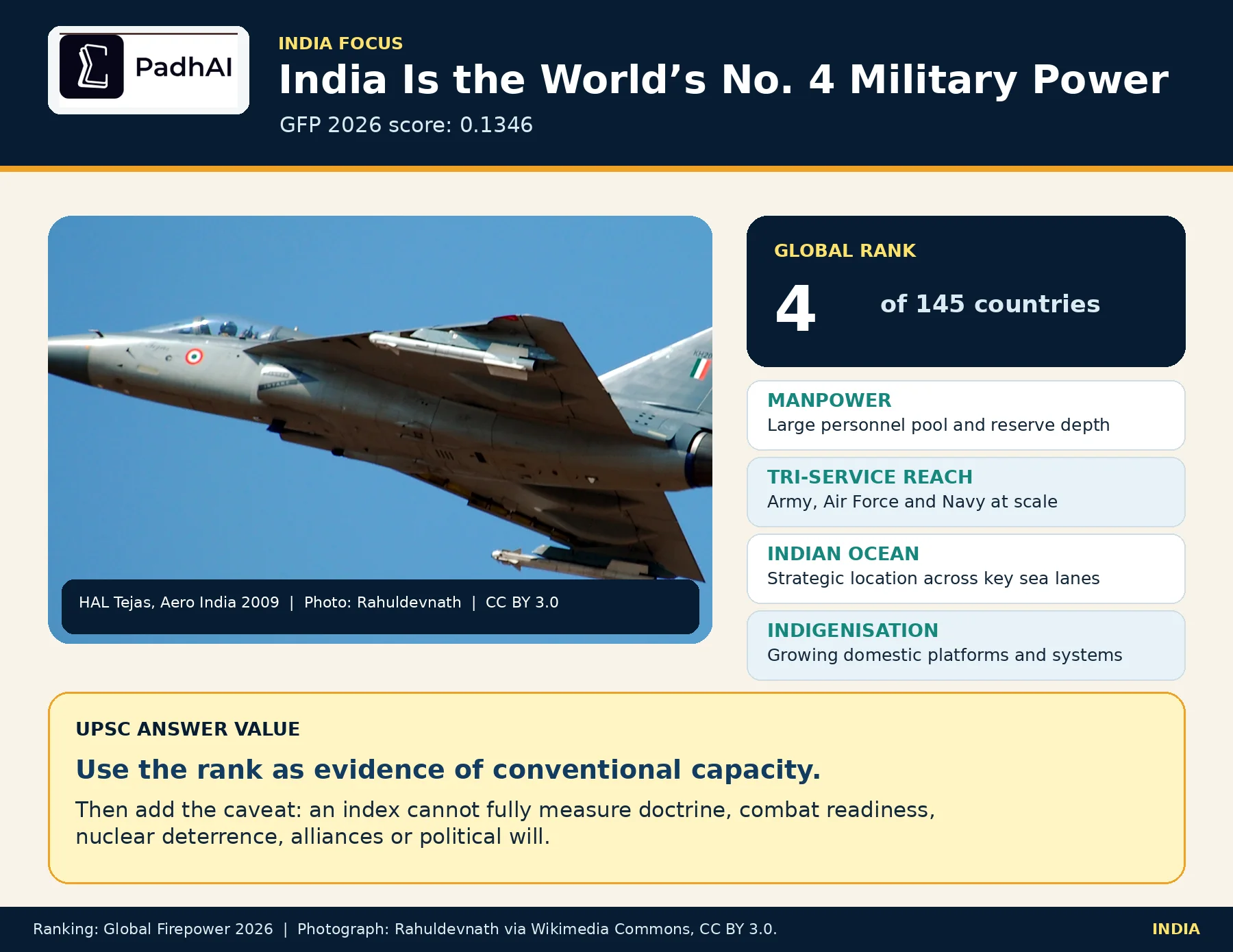
For UPSC aspirants, the Indian Army rank in world is one of the most frequently asked current-affairs facts. In the Global Firepower Index 2026, India is ranked 4th globally, behind the US, Russia and China, and ahead of South Korea.
Why India is 4th in the world military ranking 2026:
Massive manpower base. India has around 1.46 million active personnel, plus large reserves and paramilitary forces, pushing total personnel over 5 million (highest in the world when all categories are counted).
Nuclear deterrence. India is one of nine declared nuclear-weapon states, with an estimated 170+ warheads and a credible nuclear triad (Prithvi, Agni-V, K-15 submarine-launched missile).
Modernisation push. The Agnipath scheme (Agniveer), S-400 Triumf induction, Rafale fleet, INS Vikrant indigenous aircraft carrier and growing BrahMos exports have strengthened conventional capability.
Indigenous defence production. The Aatmanirbhar Bharat push has lifted the share of domestic procurement; the DRDO, HAL, DPSUs and private majors like Tata, Mahindra and L&T anchor a growing supply chain.
Defence budget. India's defence budget of around $86.1 billion places it 4th–5th in the world by spending.
Operational experience. India has fought in Kargil, Doklam, Galwan and multiple counter-insurgency theatres, giving it rare, recent combat experience among top military powers.
What holds India back from a top-three spot:
A share of defence spending still goes to pensions and salaries rather than modernisation.
Delays in procurement, acquisition cycles and R&D-to-induction timelines remain a concern.
The ratio of imports to indigenous production is improving but still relatively high.
Related read: For a wider look at India's security architecture, see the broader General Studies hub and the Current Affairs section on padhai.ai.

A common UPSC Prelims trap: the GFP Index does not count nuclear stockpiles. That is why countries like North Korea, Pakistan and Israel do not shoot up the ranking despite being nuclear-armed. For a complete picture of military power, you need the nuclear-weapon states list separately.
Nine nuclear-armed states (SIPRI Yearbook 2025 estimates):
Rank | Country | Estimated Warheads (approx.) |
|---|---|---|
1 | Russia | 5,580 |
2 | United States | 5,044 |
3 | China | 600 |
4 | France | 290 |
5 | United Kingdom | 225 |
6 | India | 180 |
7 | Pakistan | 170 |
8 | Israel | 90 (undeclared) |
9 | North Korea | 50 |
Russia and the United States together hold about 88 percent of the world's nuclear warheads. The Nuclear Non-Proliferation Treaty (NPT) recognises only five nuclear-weapon states (US, Russia, UK, France, China). India, Pakistan and Israel are not NPT signatories; North Korea withdrew in 2003.
For Mains, remember that a country's total military power = conventional capability (GFP) + nuclear deterrence + alliance network + strategic geography. GFP covers only the first of those four.
"The great Ashoka" was called powerful because of the empire he ruled, not just the size of his army. Today's measure is similar: the most powerful country in the world is not always the one with the strongest army.
Top military powers in the world (as per GFP 2026): US, Russia, China, India, South Korea…
Most powerful countries overall (as per the US News / Wharton 2026 rankings): US, China, Russia, UK, Germany, South Korea, France, Japan, Saudi Arabia, Israel.
Why the two lists differ:
Overall power also counts economy (GDP), political influence, alliances, cultural soft power, and technological leadership.
Military ranking focuses only on armed-forces capability.
Countries like Germany (12th military, 5th overall) and Saudi Arabia (outside top 10 military, inside top 10 overall) show this gap clearly.
India sits 4th in military, but typically 12th in overall global influence rankings for 2026, mainly because its per-capita economy and soft-power footprint are still catching up.
For UPSC Mains, this distinction is the difference between hard power and comprehensive national power (CNP).
The top 5 strongest armies in the world are unchanged from last year, but the mid-table saw real movement in the 2026 rankings.
Change | Country | 2025 → 2026 |
|---|---|---|
▲ Up 1 | France | 7 → 6 |
▲ Up 1 | Japan | 8 → 7 |
▼ Down 2 | United Kingdom | 6 → 8 |
▲ Up 2 | Germany | 14 → 12 |
Unchanged | US, Russia, China, India, South Korea, Türkiye, Italy | 1, 2, 3, 4, 5, 9, 10 |
Why these shifts happened:
France's rise reflects fresh defence investment under the 2024–2030 Loi de Programmation Militaire (LPM) and growing nuclear and aircraft-carrier capabilities.
Japan's rise is driven by the biggest Japanese defence budget hike since World War II, the move to 2 percent of GDP by 2027, and new offensive missile capabilities.
UK's drop reflects slower modernisation, a shrinking ground force and recruitment problems in the British Army.
Germany's rise reflects the €100 billion special defence fund announced after Russia's invasion of Ukraine, now feeding into procurement.
Stage | Where it fits | What to focus on |
|---|---|---|
Prelims | Current Affairs, International Relations | GFP 2026 top 10, India's rank, methodology, nuclear-weapon states, NPT recognised states |
Mains GS Paper II | Bilateral and global groupings, India and the world | India's rise as a military power, QUAD, BRICS, SCO, India-US-Russia-China balance |
Mains GS Paper III | Security | Defence modernisation, Agniveer, indigenous defence production, Aatmanirbhar Bharat |
Mains Essay | Themes on power, security, India's rise | Use India's 4th rank as evidence of India's growing hard power |
Interview | Current affairs | Short, confident answers on top 5 rankings, India's position, nuclear vs conventional power |
Related read: Keep tracking defence and security updates on the padhai.ai Current Affairs hub and build Mains answers using the UPSC Mains Answer Writing Practice page.
Frequently asked question (FAQs)
Which is the most powerful military in the world in 2026?
What is the Indian Army rank in world in 2026?
What are the top 10 strongest armies in the world in 2026?
Does the Global Firepower Index include nuclear weapons?
Why is the United Kingdom lower than France and Japan in 2026?

The top 10 military powers in the world 2026 list looks stable on the surface — the top five positions have not changed in two years — but a lot is happening underneath. Europe is remilitarising after Ukraine, Japan is quietly rewriting its post-war defence posture, and India has moved from being a large, defensive military into a genuinely top-four global force.
For UPSC answers, three habits will serve you well. First, always distinguish between the GFP conventional ranking and the overall most powerful country in the world list. Second, pair any military ranking with the defence budget and nuclear capability data; the three together give a complete picture. Third, when writing about India, do not stop at the rank, say why India is 4th: manpower, modernisation under Agniveer, indigenous production, nuclear triad, and operational experience.
Data verified against the Global Firepower Index 2026 (released 23 January 2026), SIPRI Yearbook 2025 estimates for nuclear warheads, NEXT IAS and the padhai.ai Current Affairs hub. All ranks reflect the GFP 2026 edition unless stated otherwise.
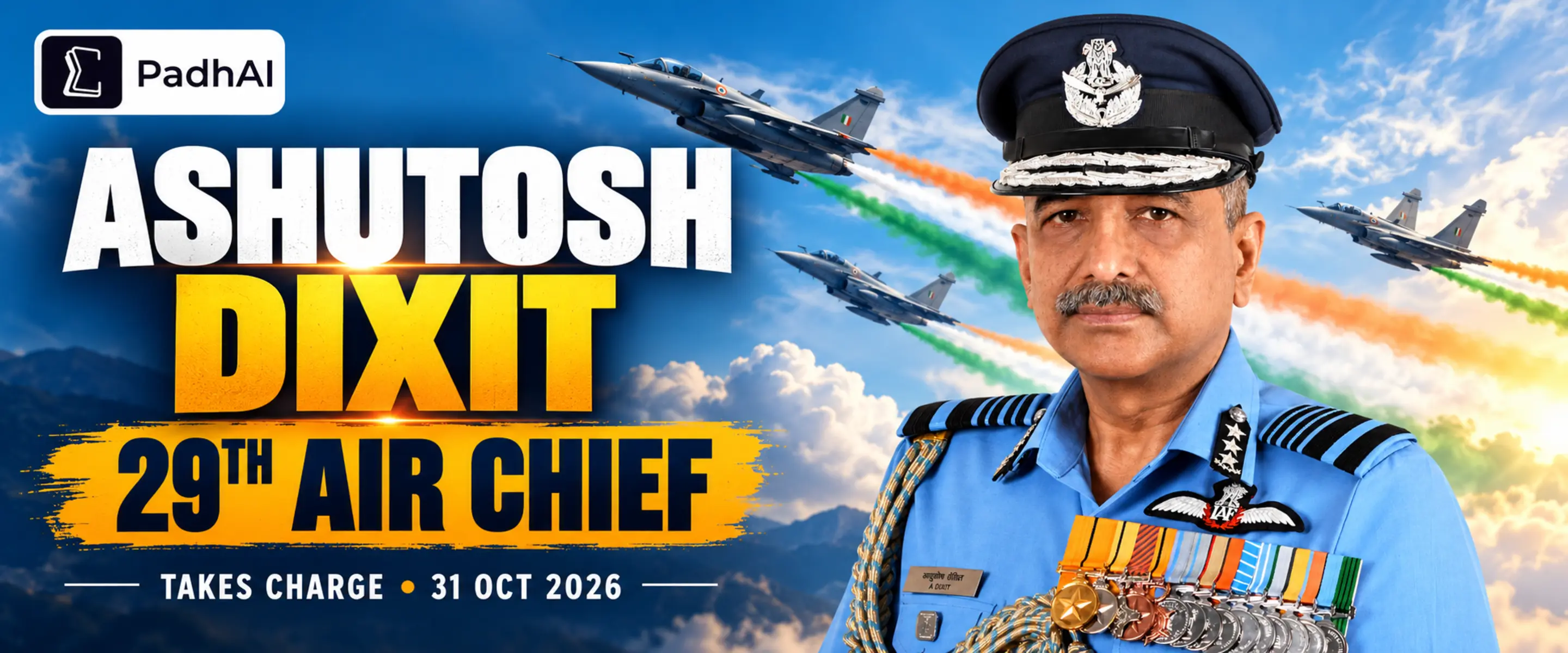


Gajendra Singh Godara
Ex-UPSC Aspirant | Exam Preparation Expert
Gajendra Singh Godara is an IIT Bombay graduate and a UPSC aspirant with 4 attempts, including multiple Prelims and Mains appearances. He specializes in Polity, Modern History, International Relations, and Economy. At PadhAI, Gajendra leverages his firsthand exam experience to simplify complex concepts, creating high-efficiency study materials that help aspirants save time and stay focused.

No comments yet. Be the first to join the discussion!