Electoral Roll Revision and ECINET: UPSC Notes 2026 PDF

Gajendra Singh Godara
Last updated
8
mins read
On 26 September 2026, the Election Commission made two announcements about the ongoing electoral roll revision. First, it ordered a review of ECINET, its digital platform.
Second, it removed the requirement for voters flagged during the Special Intensive Revision to appear before an officer in person.
Both decisions came after an Indian Express report raised questions about how the platform was being used.
A committee headed by a Senior Deputy Election Commissioner, with an IIT or IIIT expert, will review ECINET
Voters holding notices no longer need to appear before the ERO or AERO
BLOs will go to homes, collect documents, and upload them on ECINET
Hearings happen only in exceptional cases, preferably online
Form 6 returns to its original form once SIR ends
Deadlines moved: Delhi till 30 October 2026, Maharashtra till 12 October 2026
Join our WhatsApp Community
An electoral roll decides who gets to vote. Miss a name, and that person cannot cast a ballot no matter what documents they carry. That is why any large-scale electoral roll revision becomes politically sensitive.
The Commission ordered a Special Intensive Revision in Bihar on 24 June 2025. It was the first intensive revision in roughly two decades.
Phase II started on 4 November 2025 and covered about 51 crore electors. By 13 November 2025, over 42 crore enumeration forms had gone out, roughly 82.71 per cent of the target.
Opposition parties alleged wrongful deletions. The Supreme Court let the exercise continue with safeguards. By 2026, the issue reached Parliament as a removal motion against the Chief Election Commissioner.
Then in September 2026, a media report revealed that 97 voters in Goa had won their objections before officials, yet the software still left them off the final roll. That shifted attention to the platform itself.
An electoral roll is the official list of people eligible to vote in a constituency. Your name must be on it before you can vote.

Provision | What It Says |
Article 324(1) | Superintendence, direction and control of electoral rolls and elections vests in the Election Commission |
Article 325 | No person can be excluded from the roll on grounds of religion, race, caste or sex |
Article 326 | Elections on the basis of adult suffrage, voting age 18 years |
RP Act 1950, Section 21 | Provides for preparation and revision of rolls |
RP Act 1950, Sections 22 to 24 | Correction, inclusion of names, and appeals |
Registration of Electors Rules, 1960 | Prescribes the forms, including Form 6 |
Form 6 is the application for a new voter. Form 7 is for objecting to a name, and Form 8 for corrections or change of address.
Add as a preferred Source on Google
This is a standard Prelims area. Learn all three.
Type | How it works | When it is used |
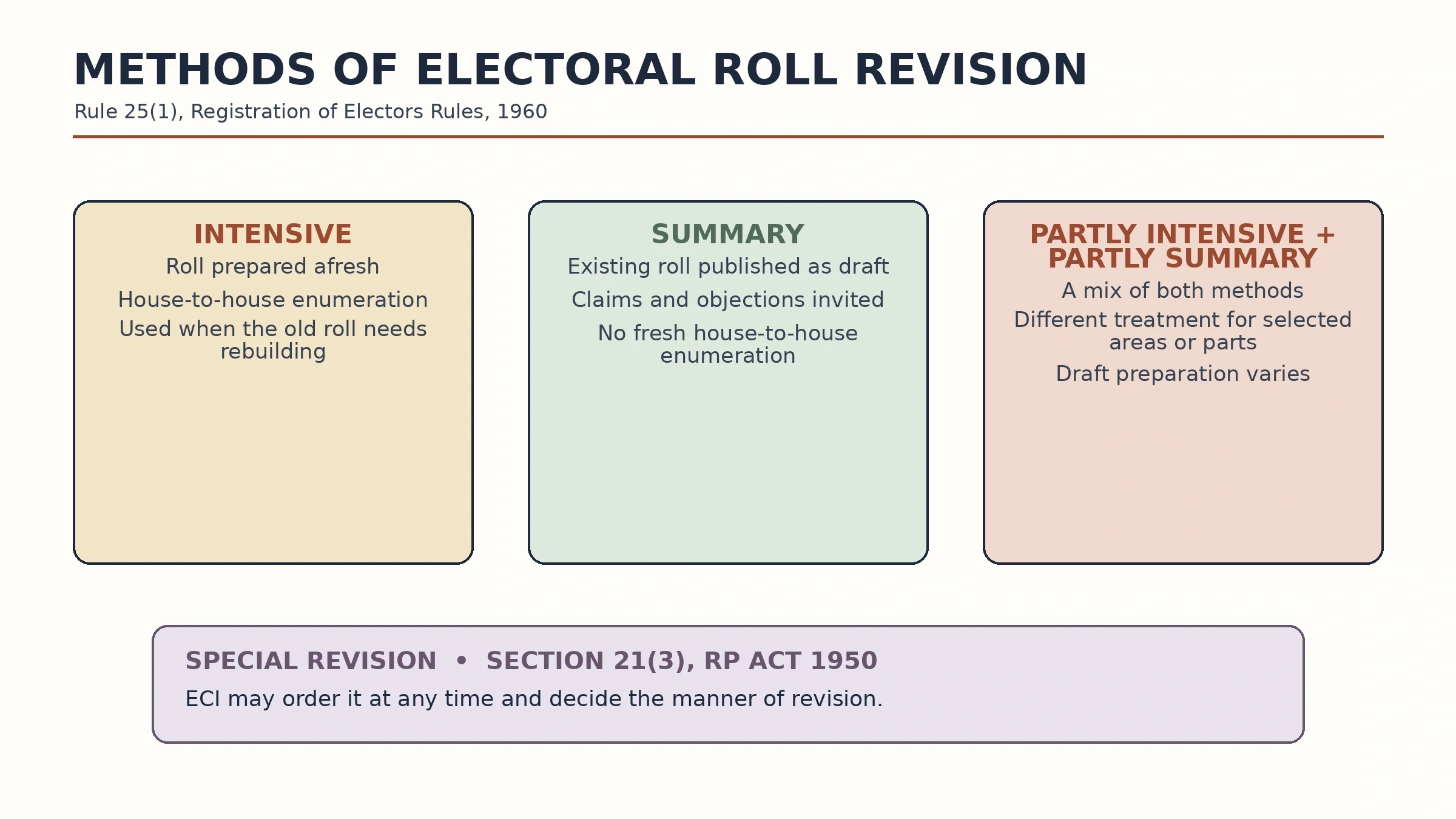
Intensive revision | Rolls are prepared afresh through house-to-house enumeration | When existing rolls are considered outdated or unreliable |
Summary revision | Existing roll is published as a draft, people file claims and objections. No door-to-door visits | Routine annual updating |
Special revision | Taken up in exceptional situations, using the summary or intensive method or both | Large-scale errors or special circumstances |
Section 21(3) of the Representation of the People Act, 1950 gives the Commission the power to order a special revision "in such a manner as it thinks fit".
Those words are the source of its discretion. They are also the reason the exercise is contested.
Past intensive revisions took place in 1952-56, 1961, 1983-84, 1995 and 2002-04.
The SIR of electoral rolls combines both methods. Booth Level Officers go house to house with enumeration forms, and electors file claims and objections against the draft roll.
Two categories received notices this round:
Unmapped electors: names absent from the previous intensive revision roll, where parents' or grandparents' details from that roll could not be given.
Logical discrepancies: cases flagged by the Commission's central software, where extra documents are sought.
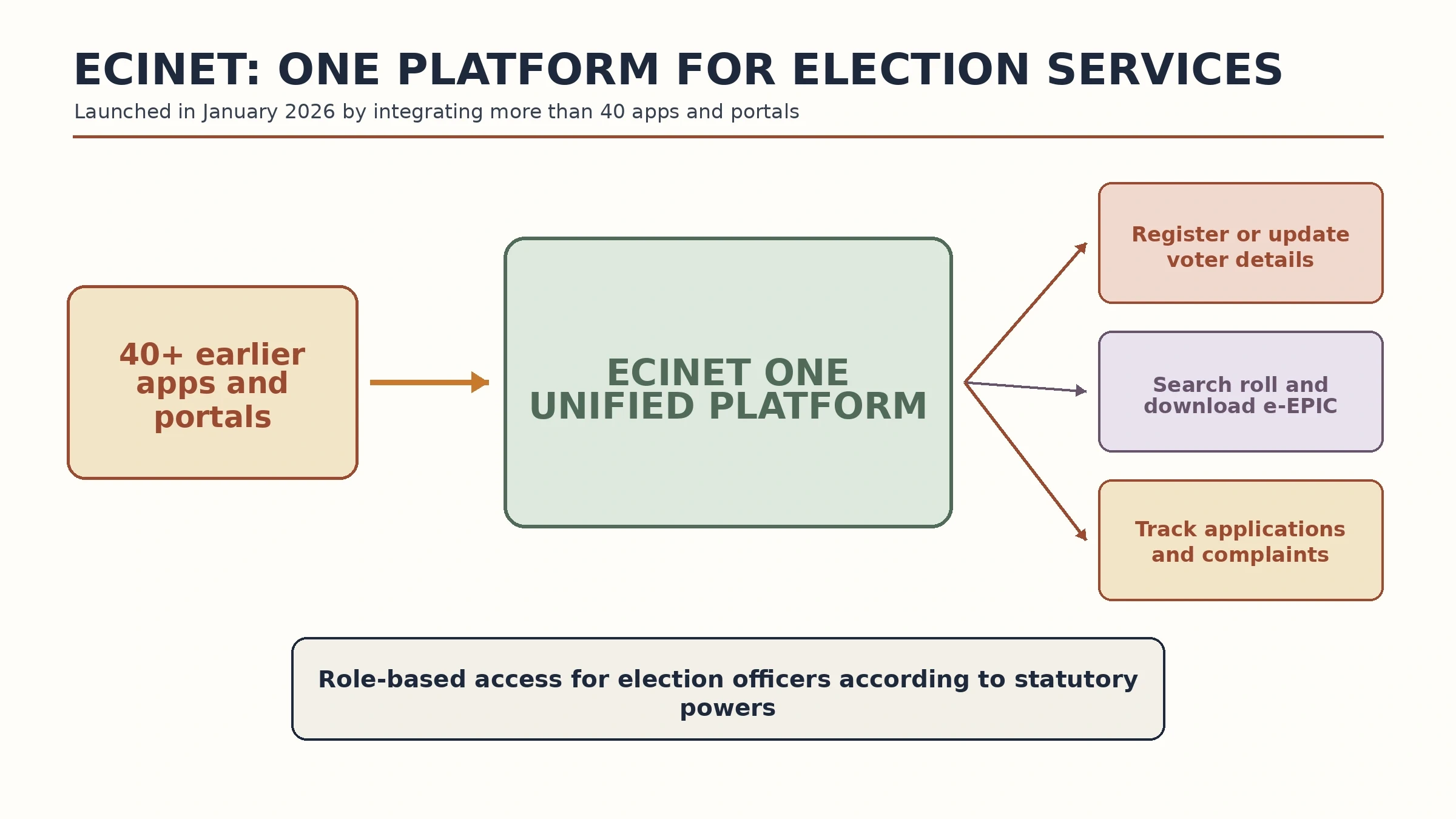
ECINET is the Election Commission's single digital platform. It brought more than 40 earlier apps and portals, such as the Voter Helpline app, cVIGIL and Saksham, into one system.
Feature | Detail |
Purpose | One platform for voter services, roll management and field reporting |
Access | Role-based, according to each officer's statutory powers |
Use in SIR | BLOs upload collected documents, EROs decide on them |
Voter-side features | Enrolment applications, grievance redressal, booking a call with the BLO |
Now under review | A committee will check whether it follows the Acts and Rules |
One platform cuts duplication and speeds up decisions. But if eligibility depends on software, a coding error can decide who votes.

Decision | Detail |
ECINET review | Committee under a Senior Deputy Election Commissioner with an IIT or IIIT expert, to check compliance with Acts and Rules and report back |
No personal hearing | Voters with unmapped or discrepancy notices need not go to the ERO or AERO office |
Home collection | BLOs will visit homes, collect documents and upload them on ECINET |
Exceptional hearings | Only if the ERO decides, preferably online, and a family member may be authorised |
Form 6 | The SIR declaration stays for the SIR period. After it, the original form under the 1960 Rules returns |
Special drive | For electors left out during SIR, including first-time voters, with help desks and camps for the homeless and for labourers |
IT approvals | New IT modules and portals to go to a Committee of Officers before Commission approval |
Internal working | Meeting agendas circulated in advance, minutes issued, and directions of Election Commissioners to be complied with |
The Commission also stated that the SIR order of 24 June 2025 was approved unanimously, and that the Supreme Court had upheld it.
Mohinder Singh Gill v Chief Election Commissioner (1978): where the law is silent, the Commission can act to ensure free and fair elections, subject to judicial review.
Lal Babu Hussein v Electoral Registration Officer (1995): a name already on the roll cannot be deleted without notice and a fair hearing.
The first gives the Commission room to design a revision. The second requires that no one loses a vote without being heard. Home collection of documents tries to satisfy both.
Revise more on the PadhAI polity section.
Criticism and the Other Side
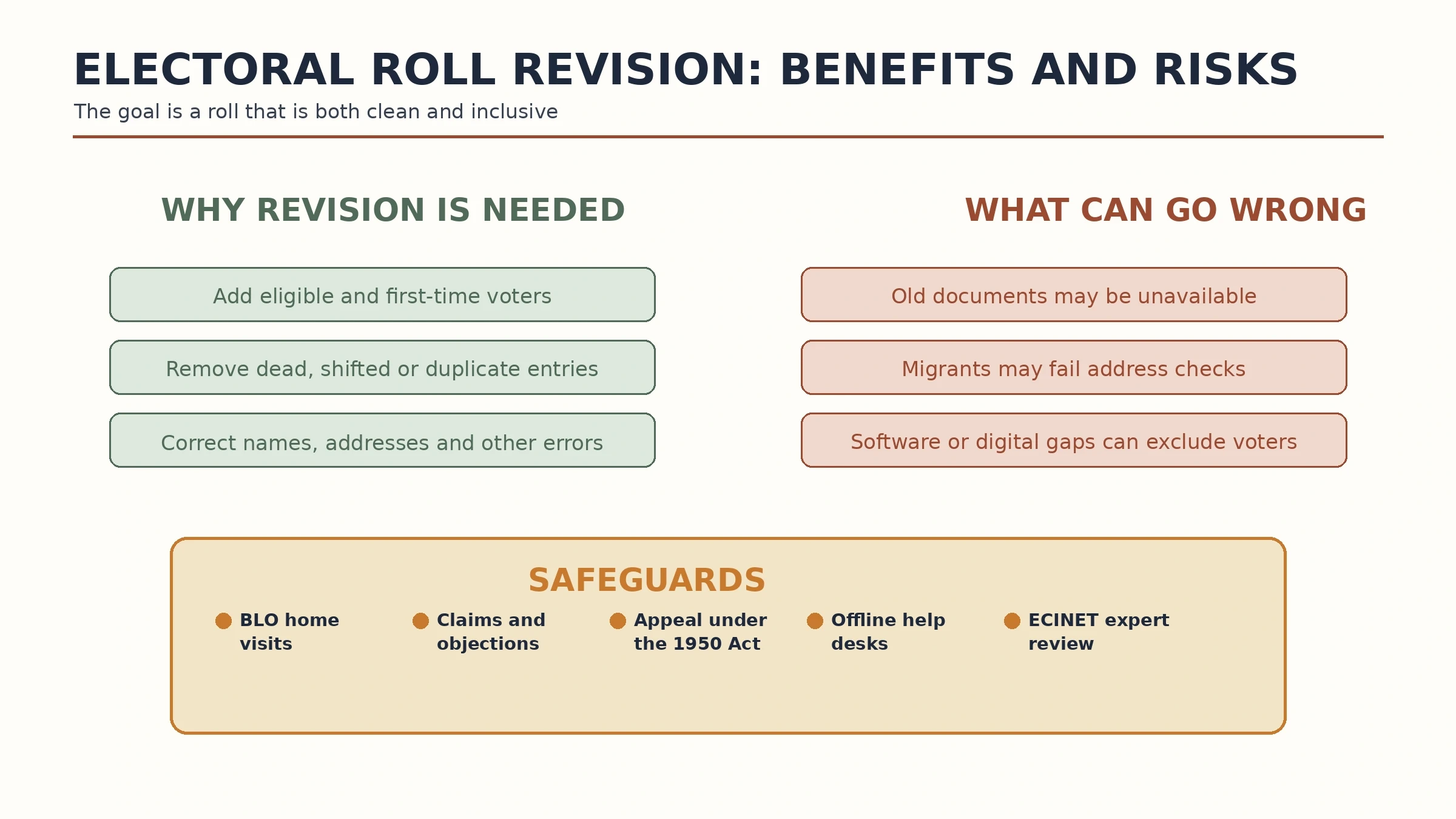
Documentation burden. People without birth or parental records struggle, even with Aadhaar or a ration card.
Digital access. Portal-based verification can leave out those without smartphones or internet, mainly in rural areas.
Migrants. With very large internal migration, address-based verification is hard to get right.
And the other side. Rolls do need cleaning. Duplicate entries and names of people who have died weaken the system.
The Commission argues that house-to-house verification is the only reliable fix, that claims and objections stay open, and that appeals lie to the District Magistrate and the Chief Electoral Officer under the 1950 Act.
Way Forward
Widen accepted documents so genuine voters are not excluded for want of old records. Publish deletion data booth-wise with reasons.
Audit the software regularly through an independent body, not only after a controversy. Support BLOs with staffing, training and local language material. Keep an offline route for every online process.
UPSC Relevance
Stage | Angle |
Prelims | Section 21(3) of the RP Act 1950, types of revision, Articles 324, 325, 326, Form 6, ECINET |
GS Paper 2 | Election Commission, electoral reforms, transparency and accountability |
GS Paper 3 | Use of technology in governance and its risks |
Interview | Should software decisions on voter eligibility be auditable? |
Frequently asked question (FAQs)
What is ECINET?
What is Special Intensive Revision of electoral rolls?
Who are unmapped electors?
What changed in the hearing process in September 2026?
Will Form 6 stay changed after the SIR?
Two goals pull against each other in the electoral roll revision debate. A clean roll keeps elections honest. An inclusive roll keeps them democratic.
The September 2026 decisions try to ease the burden on voters while keeping verification going.
Whether that works depends on what the ECINET committee finds and how the special drive runs on the ground. Track updates on our daily current affairs page.
Sources: Election Commission of India press note dated 26 September 2026; Representation of the People Act, 1950, Sections 21 to 24; Registration of Electors Rules, 1960; Articles 324, 325 and 326 of the Constitution.




Gajendra Singh Godara
Ex-UPSC Aspirant | Exam Preparation Expert
Gajendra Singh Godara is an IIT Bombay graduate and a UPSC aspirant with 4 attempts, including multiple Prelims and Mains appearances. He specializes in Polity, Modern History, International Relations, and Economy. At PadhAI, Gajendra leverages his firsthand exam experience to simplify complex concepts, creating high-efficiency study materials that help aspirants save time and stay focused.

No comments yet. Be the first to join the discussion!