Schedules of Indian Constitution: All 12 and Their Articles

Gajendra Singh Godara
Last updated
10
mins read

Corrected master table with all 12 Schedules, their subjects and precise Article references. |
12 Schedules today, up from 8 in the original Constitution
9th Schedule: added by the 1st Amendment, 1951, to shield land reform laws
10th Schedule: added by the 52nd Amendment, 1985, the anti-defection law
11th and 12th Schedules: added by the 73rd and 74th Amendments, 1992
25 Parts and roughly 470 Articles in the Constitution as it stands
Seventh Schedule entry counts differ across textbooks. The reason is the 101st Amendment

The original eight Schedules were followed by four additions through the 1st, 52nd, 73rd and 74th Amendments. |
There are 12 Schedules in the Indian Constitution today. The original Constitution had 8. If you are asking how many Schedule in Indian Constitution exist now, that is the number to remember, and the four Schedules of Indian Constitution added later are listed below.
The Schedules of Indian Constitution are lists attached at the end of the document. It holds the detail that would clutter the main text: the names of States, the salaries of constitutional officers, the languages the Union recognises, the exact wording of oaths. The Articles state the principle; the Schedules carry the particulars.
The four that were added:
Schedule | Added by | Year | Purpose |
Ninth | 1st Amendment | 1951 | Protect land reform laws from court challenge |
Tenth | 52nd Amendment | 1985 | Anti-defection law |
Eleventh | 73rd Amendment | 1992 | Powers of Panchayati Raj institutions |
Twelfth | 74th Amendment | 1992 | Powers of Municipalities |
A date correction worth making. You will read that the Constitution "commenced in 1949 with eight Schedules". It was adopted on 26 November 1949 and came into force on 26 January 1950. Both dates are correct for different events, and mixing them is a common error, including on pages that otherwise get the content right.
So if a question asks how many Schedules in the Indian Constitution, the answer is 12. If it asks how many the Constitution originally had, the answer is 8.
Join our WhatsApp Community

Schedule | Subject | Key Articles |
First | States and Union Territories, with their territories | Articles 1, 4 |
Second | Emoluments of the President, Governors, Speakers, judges and the CAG | Articles 59, 65, 75, 97, 125, 148, 158, 164, 186, 221 |
Third | Forms of oaths and affirmations for ministers, legislators, judges and the CAG | Articles 75(4), 99, 124(6), 148(2), 164(3), 188, 219 |
Fourth | Allocation of Rajya Sabha seats to States and UTs | Articles 4, 80 |
Fifth | Administration of Scheduled Areas and Scheduled Tribes | Article 244(1) |
Sixth | Administration of tribal areas in Assam, Meghalaya, Tripura and Mizoram | Articles 244(2), 275(1) |
Seventh | Union, State and Concurrent Lists | Article 246 |
Eighth | Official languages, now 22 | Articles 344(1), 351 |
Ninth | Laws protected from challenge on fundamental rights grounds | Article 31B |
Tenth | Anti-defection provisions | Articles 102(2), 191(2) |
Eleventh | 29 subjects for Panchayats | Article 243G |
Twelfth | 18 subjects for Municipalities | Article 243W |
That table answers the 12 Schedule of Indian Constitution query in one place, and it is the single most useful thing to memorise about the Schedules of Indian Constitution. The sections below cover the ones that carry the most exam weight.
Schedule 2 of the Indian Constitution fixes the emoluments, allowances and privileges of the highest constitutional offices. Of all the Schedules of Indian Constitution, it is the one that protects institutional independence most directly.
It covers the President, the Governors of States, the Speaker and Deputy Speaker of the Lok Sabha, the Chairman and Deputy Chairman of the Rajya Sabha, their counterparts in State legislatures, judges of the Supreme Court and High Courts, and the Comptroller and Auditor General.
Why put salaries in the Constitution at all? Because independence depends on it. If Parliament could cut a judge's salary at will, judicial independence would be theoretical. The Constitution therefore provides that the emoluments of judges and the CAG cannot be varied to their disadvantage during their term, except during a Financial Emergency under Article 360.
Note what the Second Schedule does not cover: the Prime Minister and other ministers. Their salaries are set by ordinary law, not by the Constitution. That distinction gets tested.
Add as a preferred Source on Google
Schedule 9 of the Indian Constitution is the most legally interesting of the twelve, and the most examined.
The origin. After 1950, courts began striking down zamindari abolition laws for violating the fundamental right to property. The 1st Amendment Act, 1951 inserted Article 31B and the Ninth Schedule together. Any law placed in the Ninth Schedule was immune from challenge on the ground that it violated fundamental rights.
The drift. The Schedule began with 13 entries, almost all land reform laws. It now holds over 280 entries, many unrelated to land. Governments learned that the Ninth Schedule was a way to put a law beyond judicial reach, and used it.
The correction. Two judgments matter:
Kesavananda Bharati v. State of Kerala (1973) established the basic structure doctrine: Parliament's amending power is not unlimited.
I. R. Coelho v. State of Tamil Nadu (2007) applied it directly. The Supreme Court held that any law placed in the Ninth Schedule on or after 24 April 1973, the date of the Kesavananda judgment, is open to judicial review if it damages the basic structure or abrogates fundamental rights.
Get the date right. It is 24 April 1973, not simply "after 1973". The cut-off is the date of the Kesavananda judgment, and that precision is exactly what a Prelims statement tests.
So the Ninth Schedule still exists and still offers protection, but the protection is no longer absolute for anything added after that date.
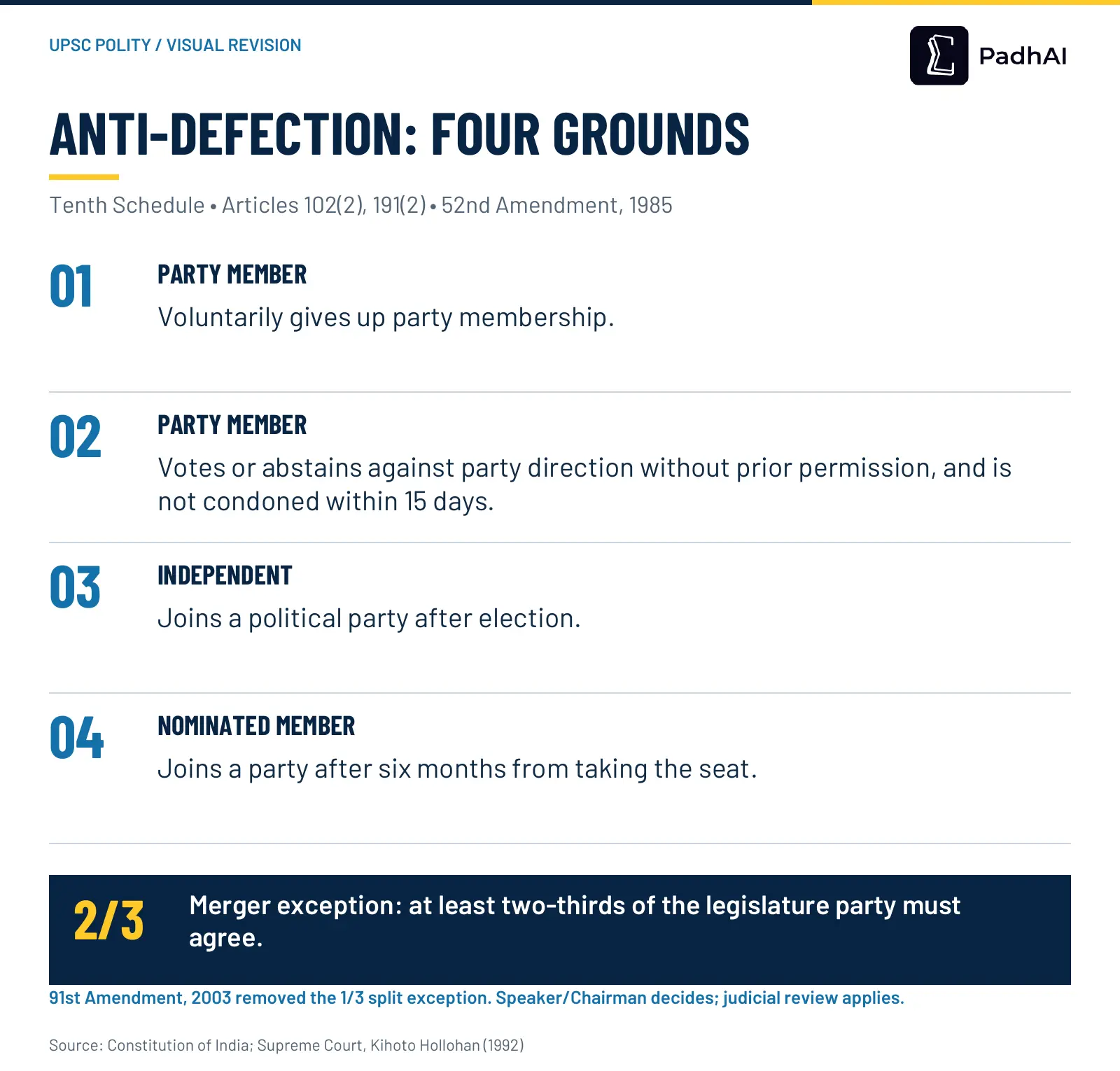
Four main grounds for anti-defection disqualification, the merger threshold and the removed split exception. |
The 10th Schedule of the Indian Constitution was added by the 52nd Amendment Act, 1985 to stop legislators switching parties after election. It is popularly called the anti-defection law.
Grounds for disqualification:
A member voluntarily gives up membership of their party
A member votes or abstains against the party whip without prior permission, and the party does not condone it within 15 days
An independent member joins a political party after election
A nominated member joins a party after six months of taking their seat
The exception. The original law exempted a split by one-third of a party's legislators. The 91st Amendment Act, 2003 deleted that, leaving only merger, which requires two-thirds of the members to agree. This is a high-frequency question: the one-third split defence no longer exists.
Who decides. The Speaker or Chairman of the House. That is also the most criticised feature of Schedule 10 of Indian Constitution, since the presiding officer usually belongs to a party.
Judicial review. In Kihoto Hollohan v. Zachillhu (1992), the Supreme Court upheld the Tenth Schedule but struck down the clause barring judicial review, holding that the Speaker's decision is subject to review. Courts have since repeatedly criticised indefinite delays in deciding defection petitions.
Our dedicated page on the anti-defection law covers the case law and the current debate in full.
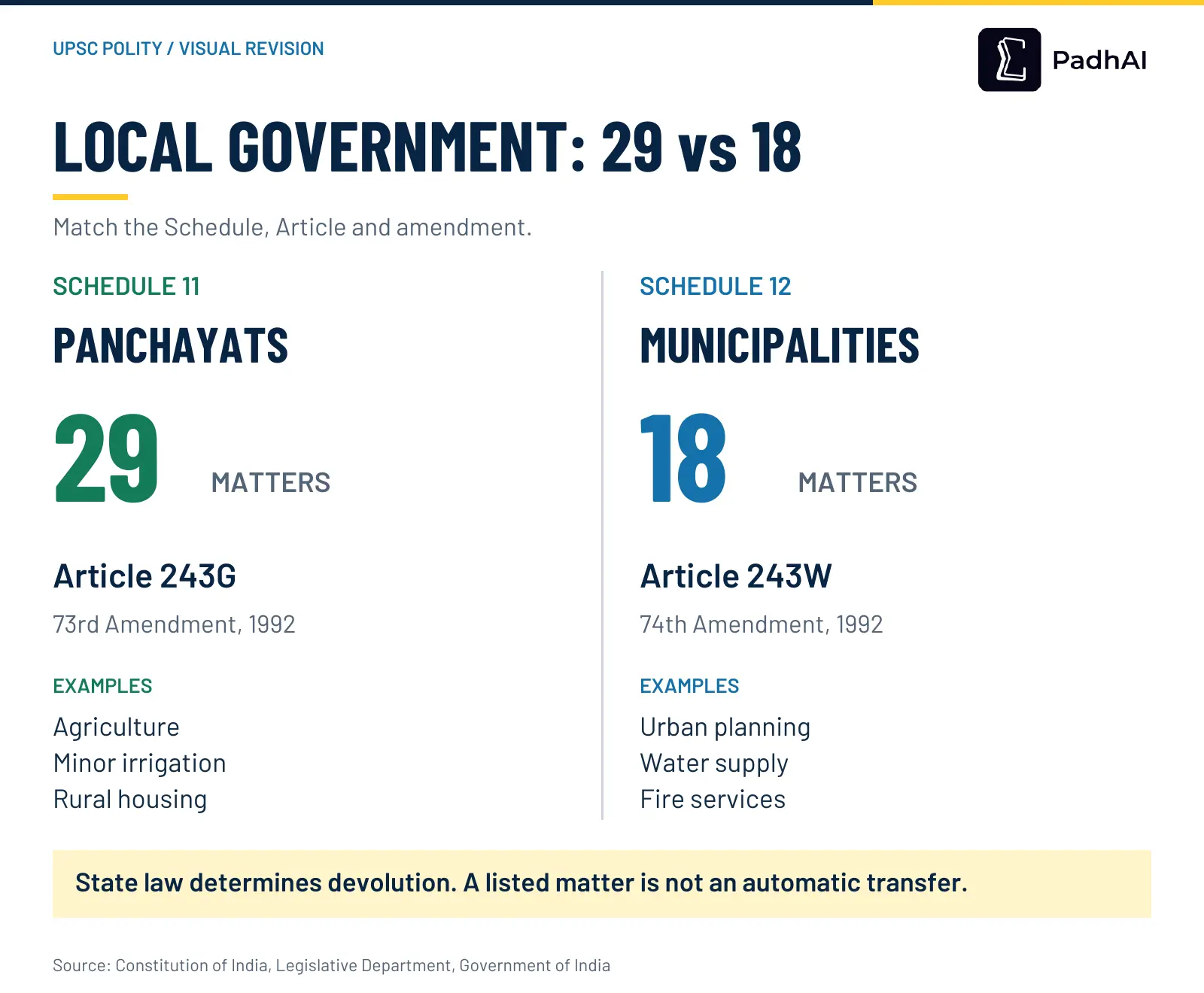
Panchayats have 29 listed matters under Article 243G; Municipalities have 18 under Article 243W. |
These two came together in 1992 and are usually examined as a pair.
Eleventh Schedule | Twelfth Schedule | |
Added by | 73rd Amendment, 1992 | 74th Amendment, 1992 |
Covers | Panchayati Raj institutions | Municipalities |
Subjects listed | 29 | 18 |
Linked Article | 243G | 243W |
Part added | Part IX | Part IXA |
The 12th Schedule of the Indian Constitution lists 18 municipal functions including urban planning, regulation of land use, water supply, public health, slum improvement, urban poverty alleviation and fire services.
The nuance that earns marks. Both Schedules are illustrative, not mandatory. Articles 243G and 243W say the State legislature may endow local bodies with these powers. Listing a subject does not transfer it. That is why devolution of funds, functions and functionaries remains uneven across States more than thirty years later, and it is the standard Mains criticism of the 73rd and 74th Amendments.
Three of the Schedules of Indian Constitution look purely administrative and still get asked.
First Schedule: States and Union Territories. It names every State and UT with its territorial description. It is the Schedule that changes most often, because every reorganisation rewrites it. Telangana's creation in 2014 and the reorganisation of Jammu and Kashmir in 2019 both amended it.
Third Schedule: Forms of oaths and affirmations. It carries the exact wording sworn by Union and State ministers, legislators, Supreme Court and High Court judges, the CAG, and candidates for election. Note who is absent: there is no oath prescribed here for the President. The President's oath is set out in Article 60 itself, not in the Third Schedule, which is a classic trap.
Fourth Schedule: Rajya Sabha seats. It allocates seats in the Council of States to each State and Union Territory, broadly by population. Like the First Schedule, it is rewritten whenever States are reorganised, and under Article 4 both can be changed by ordinary law.
These two are examined together because the contrast is the question.
Fifth Schedule | Sixth Schedule | |
Applies to | Scheduled Areas in States other than the four north-eastern ones | Tribal areas in Assam, Meghalaya, Tripura and Mizoram |
Article | 244(1) | 244(2) and 275(1) |
Body | Tribes Advisory Council, advisory only | Autonomous District and Regional Councils, with real powers |
Powers | Governor may modify how Union or State laws apply | Councils can make laws on land, forests, inheritance, marriage; run courts; levy taxes |
Degree of autonomy | Protective | Genuinely self-governing |
The practical difference is that a Sixth Schedule Council legislates and taxes, while a Fifth Schedule Tribes Advisory Council only advises. That is why Ladakh's demand for Sixth Schedule status has been a running political issue: it would mean law-making power, not just consultation.
Our dedicated pages on the polity notes hub and the standard polity books cover each in full.
Eighth Schedule: The 22 Languages
now has 22.
Amendment | Year | Languages added |
21st | 1967 | Sindhi |
71st | 1992 | Konkani, Manipuri, Nepali |
92nd | 2003 | Bodo, Dogri, Maithili, Santhali |
What inclusion actually does. Under Article 344(1), these languages are drawn on by the Official Languages Commission. Under Article 351, Hindi is to be developed by drawing on them. Practically, inclusion means a language can be used in UPSC and other public examinations, gets Sahitya Akademi recognition and attracts development funding.
A frequent misconception. Inclusion in the Eighth Schedule does not make a language an official language of the Union. Only Hindi in Devanagari script is that, under Article 343, with English continuing under the Official Languages Act, 1963.
The pending demands. Successive governments have reported dozens of requests for inclusion, among them Bhojpuri, Rajasthani, Tulu, Bhoti and Mizo. The Government has said there is no fixed criterion for inclusion, which is itself a Mains talking point about linguistic federalism.
The Seventh Schedule and the Entry-Count Confusion
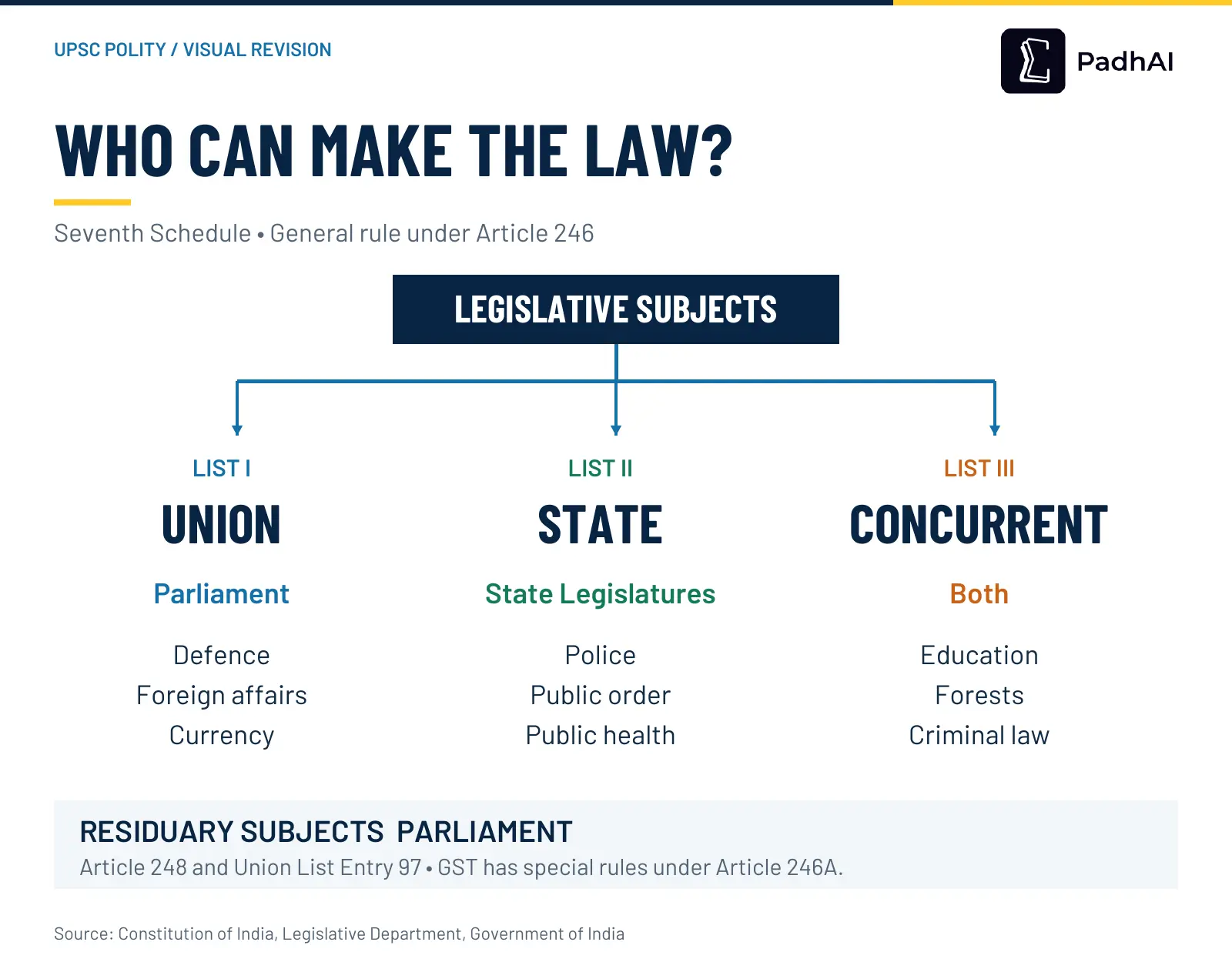
The three legislative lists organise subjects between Parliament and State Legislatures, with constitutional exceptions. |
Here is a genuine problem that trips up aspirants, and almost no page addresses it honestly.
How many entries are in each list? You will find two different sets of figures in print:
List | Original (1950) | Most textbooks say | Strictly, after the 101st Amendment |
Union List | 97 | 100 | 98 |
State List | 66 | 61 | 59 |
Concurrent List | 47 | 52 | 52 |
Why the difference. The 101st Amendment Act, 2016, which introduced GST, omitted entries 92 and 92C from the Union List and entries 52 and 55 from the State List. Books written before 2016, and many written since, still carry the pre-GST totals.
What to write in an exam. Most standard UPSC texts still give 100, 61 and 52, and answer keys have followed them. Use that, but know why 98 and 59 appear elsewhere, because a well-set question could turn on the 101st Amendment's effect. Understanding the reason is worth more than memorising either number.
The other figures to hold: the Union List entries run to number 97 with lettered additions such as 2A, 92A and 92B, which is why a count of "numbered entries" and a count of "actual entries" differ. The Concurrent List's last entry is numbered 47 even though it holds 52 items, for the same reason.
Our full breakdown of the standard polity books covers Article 246, residuary powers and Centre-State legislative relations.
Parts of Indian Constitution
The Parts of Indian Constitution are often confused with its Schedules, so it is worth being precise. Parts group the Articles by subject. The Schedules of Indian Constitution are annexures holding detail.
The Constitution today has 25 Parts and roughly 470 Articles. It began with 22 Parts and 395 Articles.
Change | What happened |
Part VII removed | Deleted by the 7th Amendment, 1956, when the Part B States category was abolished |
Part IVA added | Fundamental Duties, by the 42nd Amendment, 1976 |
Part IXA added | Municipalities, by the 74th Amendment, 1992 |
Part IXB added | Co-operative Societies, by the 97th Amendment, 2011 |
Part XIV A added | Tribunals, by the 42nd Amendment, 1976 |
Key Parts to know by number:
Part | Subject | Articles |
III | Fundamental Rights | 12 to 35 |
IV | Directive Principles | 36 to 51 |
IVA | Fundamental Duties | 51A |
V | The Union | 52 to 151 |
VI | The States | 152 to 237 |
XI | Centre-State Relations | 245 to 263 |
XVIII | Emergency Provisions | 352 to 360 |
XX | Amendment of the Constitution | 368 |
A point on Part IXB. The 97th Amendment gave co-operative societies constitutional status. In Union of India v. Rajendra N. Shah (2021), the Supreme Court struck down the portion applying to co-operatives within a State, holding that it needed ratification by half the State legislatures under Article 368 and had not received it. Part IXB survives only for multi-State co-operative societies. That is a recent and examinable development.
For article-by-article reference, see our guide to the amendment of the Indian Constitution.
Amendments That Changed the Schedules
Amendment | Year | Effect on the Schedules |
1st | 1951 | Added the Ninth Schedule and Article 31B |
7th | 1956 | Reorganised States; rewrote the First and Fourth Schedules |
21st | 1967 | Added Sindhi to the Eighth Schedule |
42nd | 1976 | Moved five subjects from State to Concurrent List in the Seventh Schedule |
52nd | 1985 | Added the Tenth Schedule |
71st | 1992 | Added Konkani, Manipuri and Nepali to the Eighth Schedule |
73rd | 1992 | Added the Eleventh Schedule |
74th | 1992 | Added the Twelfth Schedule |
91st | 2003 | Removed the one-third split exception from the Tenth Schedule |
92nd | 2003 | Added Bodo, Dogri, Maithili and Santhali, taking the Eighth Schedule to 22 |
101st | 2016 | Omitted GST-related entries from the Seventh Schedule |
Eleven amendments have touched the Schedules of Indian Constitution directly, and four of them created a new Schedule outright.
The five subjects moved by the 42nd Amendment, a stock question: Education, Forests, Weights and Measures, Protection of Wild Animals and Birds, and Administration of Justice (excluding the Supreme Court and High Courts).
On the 92nd Amendment date. The Act was passed in 2003 and came into force on 7 January 2004. Both years appear in print. The Act year, 2003, is the usual exam answer.
Which Schedules Can Be Changed Without Article 368?
A nuance most pages skip, and a good Mains point about constitutional flexibility. Not every change to the Schedules of Indian Constitution needs the full amendment procedure.
Schedule | How it is changed |
First and Fourth | By ordinary law under Article 4, when States are created or reorganised. Article 4 says such changes are not amendments for the purposes of Article 368 |
Fifth | Parliament may amend it by ordinary law under paragraph 7 of the Schedule itself |
Sixth | Parliament may amend it by ordinary law under paragraph 21 of the Schedule |
Seventh | Requires a special majority plus ratification by half the State legislatures, because it affects the federal structure |
Others | Special majority under Article 368 |
So creating a new State changes the First and Fourth Schedules by simple majority, while moving a single subject between the three lists requires the heaviest amendment procedure in the Constitution. That asymmetry is deliberate, and explaining it is a strong line in an answer on federalism.
How UPSC Tests the Schedules
The Schedules of Indian Constitution sit in GS Paper II, Indian polity, and are among the most reliably asked topics in Prelims.
What Prelims tests:
Schedule paired with subject, and Schedule paired with Article
Which amendment added which Schedule
The number of languages in the Eighth Schedule, and which were added when
The Coelho cut-off date for the Ninth Schedule
The 91st Amendment's deletion of the split provision
Which Schedules can be amended outside Article 368
What Mains asks: whether the Ninth Schedule should survive at all, whether the Tenth Schedule has strengthened or weakened legislators, and whether the Eleventh and Twelfth Schedules achieved genuine devolution.
The highest-yield revision habit here is a single table of Schedule, subject, article and amendment. Build it once and revise it monthly; it covers most of what gets asked.
Build answers using our guide to UPSC Mains answer writing practice, and pull past questions by topic from our previous year questions.
Frequently asked question (FAQs)
How many Schedules are there in the Indian Constitution?
What is the 9th Schedule of the Indian Constitution?
What does the 10th Schedule of the Indian Constitution contain?
What is the difference between Parts and Schedules?
Which Schedule deals with languages?
The Schedules of Indian Constitution look like appendices and function as load-bearing walls. The Seventh decides who can legislate on what.
The Ninth was built to put laws beyond the courts. The Tenth governs when a legislator can change sides. The Eleventh and Twelfth were meant to create a third tier of government.
For the exam, three things carry most of the marks. The mapping of Schedule to subject to Article. The amendment history, especially the four Schedules that were added.
And the live debates: the Ninth Schedule after Coelho, the Tenth Schedule after the 91st Amendment, and whether devolution under the Eleventh and Twelfth has actually happened.
Learn the table first. The arguments attach to it.
Provisions follow the text of the Constitution of India and standard references including M. Laxmikanth's Indian Polity*. Where sources differ on the number of entries in the Seventh Schedule, the article explains the reason rather than choosing silently. Case citations are to Kesavananda Bharati (1973), Kihoto Hollohan (1992), I. R. Coelho (2007) and Union of India v. Rajendra N. Shah (2021).*





Gajendra Singh Godara
Ex-UPSC Aspirant | Exam Preparation Expert
Gajendra Singh Godara is an IIT Bombay graduate and a UPSC aspirant with 4 attempts, including multiple Prelims and Mains appearances. He specializes in Polity, Modern History, International Relations, and Economy. At PadhAI, Gajendra leverages his firsthand exam experience to simplify complex concepts, creating high-efficiency study materials that help aspirants save time and stay focused.

No comments yet. Be the first to join the discussion!