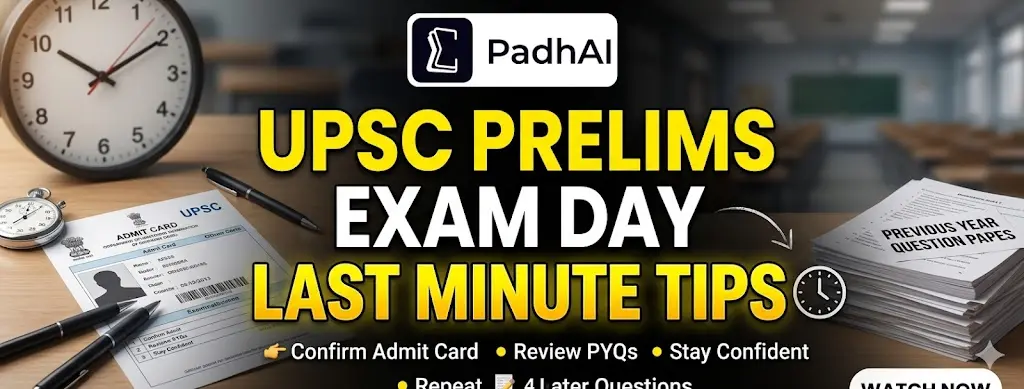
UPSC Prelims Exam Day 2026: Last-Minute Tips, Rules & Guide
The UPSC Prelims Exam Analysis 2026 covers GS Paper 1 and CSAT Paper 2 held on 24 May 2026. This page gives you the subject-wise question breakdown, difficulty rating, answer key status, and year-wise trends to sharpen your prep for UPSC 2027.

Last updated
mins read
KEY HIGHLIGHT
Shift in exam pattern: UPSC Prelims 2026 required multi-step elimination over rote memorization
Question type: 88% of questions were long statement-based.
Cognitive & Reading Load: Aspirants face severe time pressure with a 40% to 60% increase in reading load, necessitating a strict 75-second-per-question solving speed.
Change in Subject Weightage: Traditional trends failed as Environment dropped to just 10-12 questions, while History and Art & Culture unexpectedly spiked to 18-20 questions.
Higher difficulty level in polity: Testing precise granular facts, Polity featured 8 to 12 questions that mandate reading the bare Constitution text over standard reference books.
CSAT analysis: CSAT Reading Comprehension dominated with 30 to 32 questions, utilizing complex, academic passages expanded to 600-900 words.
Mains-Level Depth in Prelims: 3 full Ethics and Integrity case-study questions into the objective GS Paper 1.
Historically Low Cut-Offs: General category cut-off is expected to fall to a historical decade: range of 81 to 94 marks.
This UPSC Exam Analysis 2026 is the first detailed review of the Civil Services Preliminary Examination held on 24 May 2026.
This strategy includes analysis of GS Paper 1 and CSAT Paper 2, offering subject-wise breakdowns, difficulty ratings, and year-on-year question trends.
Whether you appeared in this exam or are planning for UPSC 2027, adopting this strategy by PadhAI experts will help you understand exactly where the UPSC exam pattern is heading.
The UPSC Civil Services Preliminary Examination is a two-paper objective-type screening test conducted by the Union Public Service Commission (UPSC).
It acts as the first filter in a three-stage process:
Prelims,
Mains,
Interview
Download UPSC Prelims Admit Card 2026
GS Paper 1 is the scoring paper, carrying 100 multiple-choice questions worth 200 marks.
CSAT (General Studies Paper 2) carries 80 questions worth 200 marks and is qualifying in nature, with the minimum passing mark set at 33% (approximately 66 marks).
Scores from CSAT are not counted in the Prelims merit list; only GS Paper 1 marks decide whether you clear the cut-off.
Every year, approximately 10-13 lakh candidates appear for UPSC Prelims, competing for roughly 1,000 vacancies in the Indian Administrative Service, Indian Police Service, Indian Foreign Service, and allied services.
The selection ratio makes UPSC Prelims one of the most competitive written exams in the world.
Particulars | Details |
Exam Name | UPSC Civil Services (Preliminary) Examination 2026 |
Conducting Body | Union Public Service Commission (UPSC) |
Exam Date | 24 May 2026 (Sunday) |
Paper 1 (General Studies) | 9:30 AM to 11:30 AM |
Paper 2 (CSAT) | 2:30 PM to 4:30 PM |
Reporting Time | At least 30-45 minutes before each shift |
Gate Closing | 9:00 AM (Paper 1), 2:00 PM (Paper 2) |
Admit Card Released | 15 May 2026 |
Mode | Offline (OMR-based) |
One-third of allotted marks | |
83 across India | |
Official Website | upsc.gov.in, upsconline.nic.in |
Join our WhatsApp Community
Compared to UPSC Exam 2025 which had average word count of 5500 words, UPSC 2026 had average word count
Detail | GS Paper 1 | CSAT (Paper 2) |
Total Questions | 100 | 80 |
Total Marks | 200 | 200 |
Negative Marking | 1/3 of marks deducted | 1/3 of marks deducted |
Qualifying Nature | No (merit-based) | Yes (33% minimum) |
Duration | 2 hours | 2 hours |
Medium | English and Hindi | English and Hindi |
Exam Date 2026 | 24 May 2026 | 24 May 2026 |
Source: UPSC Official Notification, 2026 —https://upsc.gov.in
UPSC Prelims Exam Pattern 2026: How the Paper Is Structured
The UPSC Prelims paper pattern has evolved meaningfully over the past five years. UPSC now prioritises three core competencies over simple factual recall.
The three areas UPSC tests most actively are:
Conceptual clarity: Can you explain why a policy exists, not just what it is?
Statement-based elimination: Can you identify which of three statements about a topic is correct when all sound plausible?
Current affairs integration: Can you connect a 2025 news event to a two-decade-old historical or constitutional provision?
This shift is visible in the question types. A growing share of GS Paper 1 questions use the format "Consider the following statements about X. Which of the above is/are correct?"
These questions cannot be answered by memorisation alone. They reward aspirants who read with understanding rather than those who read for volume.
UPSC also links static syllabus topics to recent government schemes, Supreme Court verdicts, international agreements, and scientific discoveries.
An aspirant who studied Polity from a standard textbook but ignored the last 18 months of news will find many polity questions inaccessible.
The real challenge in UPSC 2026 was switching between static and current, observing small details , option elimination, Keyword detection and mental fatigue.
Candidates had to grasp terms like
“Only”
“Not correct”
“Best explains”
“Can be inferred”
“Mainly”
One missed key term can drastically change the answer completely.
Only 18% of the questions were direct. 88 questions required layered processing and elimination.
Add as a preferred Source on Google
In UPSC 2026, 3 statement questions dominated the paper. There were 39 questions and 40% of the paper.
Candidates faced uncertainty due to misguided statements even though many studied 70-80% of the syllabus.
It led to-
Low confidence
More guesswork
Higher negative marking
Reduced overall accuracy
UPSC 2026 is being compared with the infamous UPSC 2023. Analysis by PadhAI experts reveals that both papers were difficult in very different ways.
In UPSC 2023, topics were unfamiliar, elimination was weak and candidates lacked conceptual clarity.
GS Paper 1 Analysis 2026: Subject-Wise Breakdown
The GS Paper 1 analysis for UPSC Prelims 2026 will reflect UPSC's established habit of distributing 100 questions across 10–12 subject areas.
CSAT Analysis 2026: Section-Wise Overview
CSAT (Civil Services Aptitude Test) is Paper 2 of UPSC Prelims. Its 80 questions cover three broad sections:
reading comprehension,
logical and analytical reasoning,
basic numerical ability.
The minimum qualifying mark is 33%, which means you need to correctly answer approximately 26–27 questions out of 80 (accounting for negative marking).
Most serious aspirants aim for 50–55 questions to stay comfortably above the cut-off.
Section | Approximate Questions | Key Skills Required |
Reading Comprehension | 28–35 | Speed reading, inference ability |
Logical and Analytical Reasoning | 25–30 | Pattern recognition, deductive logic |
Basic Numeracy and Data Interpretation | 15–20 | Arithmetic, graph reading |
Total | 80 |
CSAT comprehension passages have become longer over the years, testing reading speed as much as understanding. Passages now regularly cross 300–400 words each, with 3-4 questions attached.
An aspirant who reads one editorial or long-form article every day during preparation will find the comprehension section significantly more manageable.
Studying year-wise trends is one of the most reliable ways to prepare for UPSC Prelims. As per PadhAI experts analysis , the trend shows analytical papers reduce cut-offs while straightforward factual papers push cut-offs higher.
Four clear patterns emerge from this six-year data:
The economy never dips below 13 questions. In 2020, it peaked at 21. Any year below 15 is considered a low year for economy, yet it still outweighs most other subjects.
Environment and Ecology is consistently among the top two subjects, ranging from 13 to 19 questions annually.
Art and Culture is declining. It peaked at 10 in 2021 and fell to just 2 in 2025. Aspirants should not spend disproportionate time on this subject.
International Relations is gaining weight, rising from 2 questions in 2021 to 11 in 2022 and staying elevated at 8 in 2025. This mirrors UPSC's increased interest in India's global role.
Safe score provides buffer against
UPSC Answer Key disputes
Calculation mistakes
Unexpected cut-off variation
Table below provides safe score range:
How to Fill OMR Sheet in UPSC Prelims Exam
The OMR sheet is where you actually score marks. A blank OMR or a wrongly bubbled roll number can cost you the entire paper, no matter how well you knew the answers.
Here is the official UPSC OMR sheet filling drill.
Receive the OMR sheet and test booklet from the invigilator. Do not open the seal until told to.
Fill in personal details first. Roll number, test booklet series (A, B, C or D), centre code, candidate signature. Use only a black ballpoint pen.
Bubble the roll number columns carefully. Each digit has a separate column. Write the digit on top and darken the matching bubble below.
Match the test booklet series. This is the most common mistake. If you have Set A, darken bubble A. If your OMR shows the wrong series, the entire paper gets evaluated against the wrong key.
Do not start answering until the invigilator announces the start. Use the question booklet sticker on the OMR sheet only after the start signal.
Bubble every answer fully. Half-shaded, ticked, or circled answers are not read by the OMR scanner.
Stick to one answer per question. Two bubbles on a single question count as wrong. There is no option to overwrite.
Do not fold, tear or staple the OMR sheet. A creased OMR can jam the scanner.
Handover the OMR sheet to the invigilator before leaving. Do not carry it out, do not roll it up.
Use the last five minutes of every shift to recheck the bubbling, not to attempt new questions. A clean OMR is worth ten extra attempts.
UPSC Prelims Exam Day Do's and Don'ts
A clean side-by-side reference of the most important UPSC prelims exam day do's and don'ts.
Do's | Don'ts |
Reach the centre 45 minutes early | Do not arrive after gate closure under any reason |
Carry the printed admit card and original ID | Do not rely on a digital admit card on your phone |
Use only a black ballpoint pen | Do not use pencil, gel or blue ink on the OMR |
Fill the OMR roll number and booklet series first | Do not skip the booklet series, even by mistake |
Read each question fully before bubbling | Do not guess wildly; negative marking eats your score |
Manage time at 1 minute 12 seconds per question | Do not spend more than 90 seconds on a single question |
Stay seated during the paper | Do not look around or talk; it is treated as malpractice |
Drink small sips of water | Do not eat a heavy lunch between shifts |
Recheck OMR before submitting | Do not fold or staple the OMR sheet |
Hand over OMR sheet and booklet on time | Do not try to take the OMR sheet out of the hall |
Smart Attempt Strategy for UPSC Prelims 2026
A good attempt strategy can lift your score by 8 to 12 marks. Use the UPSC Marks Calculator & three-round method most toppers follow.
Round 1 (0 to 45 minutes): Sweep through all 100 questions. Mark the easy ones you are sure about and bubble them straight on the OMR. Skip the doubtful and tough ones. Aim for 40 to 50 confident attempts in this round.
Round 2 (45 to 90 minutes): Return to the doubtful questions. Apply elimination, statement analysis, and option-pair logic. Mark only those where you can reasonably eliminate two of the four options. Target another 15 to 25 attempts.
Round 3 (90 to 115 minutes): Take a deep breath. Look at the remaining tough questions. Pick only the ones where you can eliminate two of four options. Skip the rest cold.
Last 5 minutes: Stop attempting. Recheck the roll number, booklet series, and the bubbling on every answer.
The 2025 General cutoff was 92.66 out of 200. A clean attempt of 80 to 90 questions with 75 to 80 percent accuracy crosses that bar comfortably. Aim for quality of attempts, not quantity.
After the Exam: What to Do Between Paper 1 and CSAT
The break between 11:30 AM and 2:30 PM is the most underrated chunk of UPSC prelims exam day. Most aspirants spend it scrolling unofficial answer keys on Telegram and panicking.
Here is what high scorers do.
Step out of the centre at 11:30 AM. Get fresh air. Do not stand in groups discussing the paper.
Eat a light lunch. Rice, dal, curd and one vegetable. Skip biryani, oily food, and cold drinks.
Rest your eyes. A 20-minute nap in a quiet spot works wonders.
Stay off social media. Coaching channels post their answer keys within an hour. Looking at them now will tank your CSAT focus.
Mentally close GS Paper 1. Whatever happened, the paper is over. CSAT is qualifying. A confident CSAT attempt keeps your cycle alive.
Reach the centre by 1:30 PM. Same drill: face authentication, frisking, seat allocation.
CSAT is qualifying at 33 percent (66.67 out of 200 marks). Many GS scorers fall short here. Treat CSAT with the same seriousness as GS.
Frequently asked question (FAQs)
What is the gate closing time on UPSC Prelims exam day 2026?
What are the UPSC Prelims Exam Timings 2026 for both papers?
Which pen is allowed on the OMR sheet in UPSC Prelims?
What are the most important things to carry in UPSC exam centres?
What are the top exam day do's and don'ts for UPSC Prelims 2026?
UPSC Prelims is not won in the exam hall alone. It is won in the 24 hours before the exam, in the discipline of your morning routine, in the calm of your OMR bubbling, and in the smart triage of your three rounds. Strong preparation gives you the knowledge. The drill above gives you the score..
All the best for 24 May 2026. The country needs sharp minds in service. Walk in ready.





No comments yet. Be the first to join the discussion!