Artemis II: 4 Astronauts, 10 Days, One Historic Journey
NASA’s Artemis II has officially launched, sending four astronauts on a historic 10-day journey around the Moon as a final bridge to permanent lunar settlements

Gajendra Singh Godara
Last updated
5
mins read

Key highlights:
Mission led by: Reid Wiseman
Crew Milestones: Christina Koch (first woman) , Victor Glover (first person of colour), Jeremy Hansen (first non-American) to travel beyond Earth orbit
Trajectory: Free-return path → Moon’s gravity ensures safe return
Distance Record: ~4,700 miles beyond lunar far side (farthest human travel)
Mission Purpose: 10-day deep-space test of Orion spacecraft life support
Strategic Aim: Lunar south pole exploration (water ice as a crucial resource)
Re-entry Test: High-speed return testing heat shield (~5,000°F)
India Link: ISRO part of Artemis Accords
The Artemis mission is a part of the programme by NASA to establish long term human presence on the moon, preferably by 2030. This mission has sent 4 astronauts on a journey around the moon, historic for being the first astronaut mission to the moon in 50 years.
Unlike the Apollo missions in the past, Artemis II is the essential stress-test of the Space Launch System and deep space life support systems. It will provide critical insights for India’s own “Vision 2040” moon goals as well.
Join our WhatsApp Community
The Artemis II mission was launched by NASA from Launch Complex 39B at Kennedy Space Center in the state of Florida, USA on April 1, 2026 at 6:35 pm EDT.
The launch went successfully with minor issues in battery and range problems.
The 10 day long mission carries astronauts Reid Wiseman, Victor Glover, Christina Koch and Jeremy Hansen.
Commander Reid Wiseman:
The leader of the mission.
A former test pilot and NASA’s chief astronaut
Earlier spent about 165 days aboard the Space Station
Pilot Victor Glover:
The first person of colour on a lunar mission.
A US Navy captain
He has flown in space before as part of Crew-1 and has ISS experience.
Mission Specialist Christina Koch:
The first woman to head to the Moon.
An electrical engineer, she completed a 328-day mission in space and participated in the first all-women spacewalk in 2019.
Mission Specialist Jeremy Hansen:
The first non-U.S. citizen to leave Earth orbit
Representing Canada
A former fighter pilot from Canada
Artemis II is significant not just for its destination but the exceptional crew consisting of the first Black astronaut, the first woman and the first Canadian to be selected for a lunar mission.
Add as a preferred Source on Google
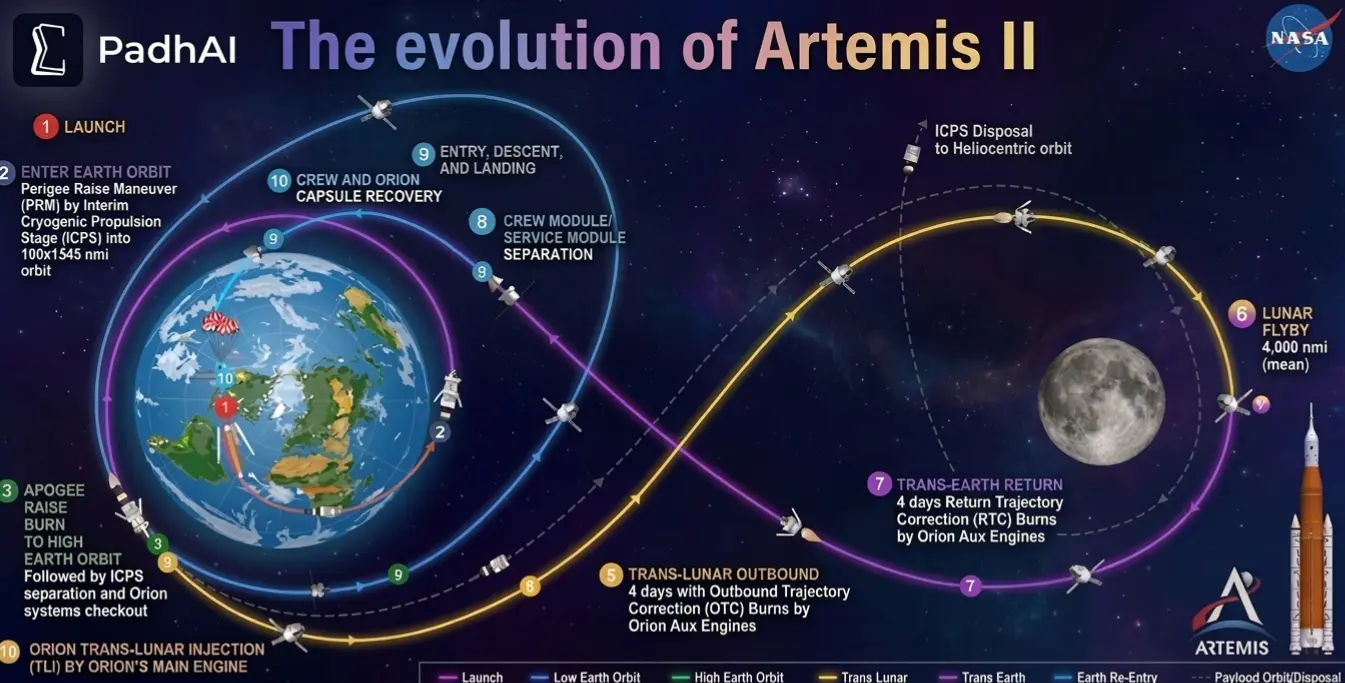
The journey of Artemis II isn't a straight line to the moon, it is a “figure-eight” through space. Below is the day-wise breakdown of the 685,000 mile round trip.
DAY 1-2: After successful lift-off, the crew will spend the first two days in High earth orbit testing Orion’s life-support, propulsion, navigation and communication systems. Once the checks are complete, Orion will perform a critical burn called the Trans-lunar injection- it will send the spacecraft out of Earth’s orbit towards the moon.
Day 3-4: En route to the moon, astronauts will monitor the spacecraft systems. The crew will pass the point where any human has ever travelled breaking the record of Apollo 13.
Day 5-6: As Orion swings around the far side of the moon, the crew will lose all radio contact with Earth. It will go on a “free-return trajectory” where gravity will naturally swing the spacecraft back to Earth without additional propulsion.
Day 7-9: The crew will continue their journey back home, and conduct several deep-space tests evaluating power systems, thermal controls and crew operations
Day 10: Orion will hit Earth’s atmosphere at 25,000 MPH (40,000 kph). The spacecraft's heat shield will be tested during the high-energy re-entry. As per schedule, the mission ends with a parachute descent into the Pacific Ocean on April 11, 2026, where U.S. Navy recovery teams are already waiting
Artemis II is not a landing mission but a crewed test flight that seeks to evaluate the Space Launch System (SLS) rocket and Orion spacecraft in deep space conditions.
The 10-day mission is essentially a full rehearsal for the Orion Life support systems with humans for the first time in deep space conditions.
While the Space Race in the Cold War era was about “firsts” (First satellite, first man), Space Race 2.0 focuses on resources and presence.
The Lunar South Pole: Both US and China are racing to Moon’s south pole as it is a “gold mine” of water ice stored in permanent shadowed craters.
NASA is aiming for a crew landing by 2028-2030 while China (CSNA) is aiming for 2030.
Role of India
India is not merely a spectator to this historic mission but plays a key role.
In 2023, India became a signatory of the Artemis Accords- the legal framework governing the exploration of Moon
While NASA orbits the Moon this week, India is preparing for its own historic 2026: the Gaganyaan G1 uncrewed test flight. Success of the mission will move ISRO toward its goal of an Indian Space Station (BAS) by 2035 and a Moon landing by 2040.
ISRO is also testing a simulated lunar space environment on earth as part of the HOPE mission.
The collaboration between ISRO and NASA is already visible through missions like NISAR Earth Observation.
The table shows the joint missions of ISRO and NASA:
Mission | Partners | Primary Objective | Timeline |
NISAR | NASA & ISRO | Earth Monitoring / Climate Change | Operational Now |
NASA, ISRO & Axiom | First Indian on the ISS | June 2026 | |
LUPEX | ISRO, JAXA & NASA | Lunar South Pole Water Drilling | 2028 Launch |
Frequently asked question (FAQs)
What is the Artemis II Mission?
Who are the four astronauts on the Artemis II mission?
Is the Artemis II crew landing on the Moon?
Is there an Indian astronaut on this mission?
Why is the Artemis II mission important?
The Artemis II mission is more than a fly-by, it is bringing the moon closer to humans and testing how technology can help them stay on the lunar surface for long periods. The ISRO-NASA partnership ensures that India will have a seat at the table as the new phase of lunar exploration begins.
If you want to track this historic journey, NASA provides a real-time tracker called "Artemis Real-time Orbit Render" (ACORE). You can see the Orion’s exact speed, distance from Earth, and even the "view" from the onboard cameras.






Research methodology
PadhAI's research methodology ensures every article is accurate, UPSC-ready, and beginner-friendly. We curate current affairs analysis based on UPSC exam relevance by cross-referencing The Hindu, Indian Express, and PIB. General Studies (GS) topics are drafted from NCERTs and standard books such as M. Laxmikanth, Spectrum, and GC Leong, then reviewed by subject matter experts to eliminate factual errors. Additionally, we update aspirants with verified government exam notifications alongside expert blogs suggesting the best resources, syllabus, and comprehensive Prelims and Mains strategies.


No comments yet. Be the first to join the discussion!